"A delightful book about the creation of Pixar from the inside . . . and like a good Pixar film, it'll put a smile on your face." —Andrew Ross Sorkin,
The New York Times
Winner, Axiom Business Book Award * Fortune
Favorite Books of the Year Top Pick * Amazon Best Book of the Year in Business & Leadership
After he was dismissed from Apple in the early 1990s, Steve Jobs turned his attention to a little-known graphics company he owned called Pixar. One day, out of the blue, Jobs called Lawrence Levy, a Harvard-trained lawyer and executive with whom he'd never spoken before. He hoped to persuade Levy to help him pull Pixar back from the brink of failure.
This is the extraordinary story of what happened next: how Jobs and Levy concocted and pulled off a highly improbable plan that transformed Pixar into the Hollywood powerhouse it is today. Levy offers a masterful firsthand account of how Pixar rose from humble beginnings, what it was like to work so closely with Jobs, and how Pixar's story offers profound lessons that can apply to our professional and personal lives.
To Pixar and Beyond reveals how a struggling computer animation company became one of the greatest entertainment studios of all time.
"[A] delightful book about finance, creative genius, workplace harmony, and luck." —
Fortune
"Part business book and part thriller—a tale that's every bit as compelling as the ones Pixar tells in its blockbuster movies." —Dan Lyons, bestselling author of
Disrupted
"A natural storyteller . . . an inside look at the business and a fresh, sympathetic view of Jobs." —
Success Magazine
eBook - ePub
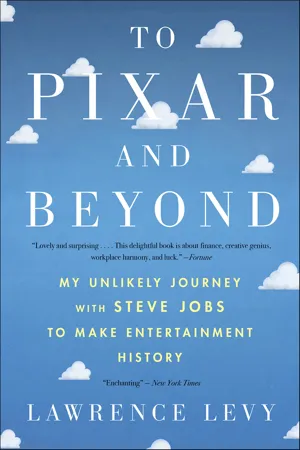
To Pixar and Beyond
My Unlikely Journey with Steve Jobs to Make Entertainment History
- 272 pages
- English
- ePUB (mobile friendly)
- Available on iOS & Android
eBook - ePub
About this book
Information
PART I
1
Why Would You Do That?
One afternoon in November 1994, the phone in my office rang. I was the chief financial officer and vice chairman of the board at Electronics for Imaging, a Silicon Valley company developing products for the burgeoning field of color desktop publishing. It was a clear and cool fall day in San Bruno, California, near the San Francisco airport. I picked up the phone, not knowing who it might be. The last thing I expected was to speak to a celebrity.
“Hi, is this Lawrence?”
“Yes, it’s me.”
“This is Steve Jobs,” the voice on the other end of the line said. “I saw your picture in a magazine a few years ago and thought we’d work together someday.”
Even in those days, when the downfall of Steve Jobs was a favorite topic around Silicon Valley eateries, a call from him was enough to stop me in my tracks. Maybe he wasn’t as hot as he had been before his unceremonious departure from Apple ten years earlier, but our industry had never had a more charismatic figure. I couldn’t help but feel a spurt of excitement at realizing not only that he knew who I was, but that he had actually called me.
“I have a company I’d like to tell you about,” he said.
NeXT, I immediately thought. He wants to talk about NeXT Computer. Jobs’s latest venture, supposedly his long-awaited second act, had been famous for its eye-catching cube-shaped workstations, but it was also rumored to be on shaky ground, especially after it was forced to close its hardware business not too long before. My mind raced: he wants to turn NeXT around; that could be an exciting challenge. But what he said next caught me off guard.
“The company is called Pixar.”
Not NeXT. Pixar. What in the world was Pixar?
“That sounds great,” I said, not wanting to reveal how little I knew about Pixar. “I’d love to hear more.”
We agreed to meet.
As I put the phone down, my first reaction was shock. A call from Steve Jobs out of the blue? That was startling. But the initial thrill faded rapidly; rudimentary research revealed that Pixar had a decidedly checkered history. Steve had acquired ownership of Pixar when George Lucas spun it off from Lucasfilm eight years earlier. He then apparently poured millions of dollars into the company in the hope of developing a high-end imaging computer and accompanying software. The result: not much. Pixar had long abandoned the quest to develop an imaging computer, and it was not clear to anyone I talked to what was sustaining Pixar now.
Moreover, Steve Jobs may have been Silicon Valley’s most visible celebrity, but that made it all the more glaring that he had not had a hit in a long time—a very long time. His last two products before being stripped of all responsibilities at Apple in 1985—the Lisa and the original Macintosh computers—had both been commercial disasters, and the NeXT Computer was regarded by many observers as the triumph of hubris over practicality. It had been heralded as a technological marvel, but it had been unable to compete with the likes of Sun Microsystems and Silicon Graphics that sold less expensive, more compatible machines. More and more, Jobs was looking like yesterday’s news. When I told friends and colleagues that I was meeting Steve Jobs about Pixar, the most common response was “Why would you want to do that?” Still, I was intrigued, and there would be no harm in a meeting. I followed up by calling Steve’s office to arrange a time.
Despite his reputation, I was excited to meet Steve in person, although I really didn’t know what to expect. Would I encounter the mercurial tyrant Silicon Valley loved to vilify, or the brilliant genius who led the personal computer revolution? Our meeting was in NeXT Computer’s ostentatious headquarters in Redwood City, California, where, upon arrival, I was ushered into Steve’s office. Rising from behind a commanding, book-strewn desk, wearing his trademark blue jeans, black turtleneck, and sneakers, Steve, a few years my senior, greeted me like he had been waiting to see me for years.
“Come in, come in,” he said excitedly. “I have so much to tell you.”
The conversation needed no warm-up. Steve jumped in, exuberantly telling me about Pixar—its history, its technology, and the production of its first full-length film.
“Only a few minutes of the film is finished,” he said, “but you have to see it. You’ve never seen anything like it.”
We hit it off immediately. For almost an hour I sat in a chair on the other side of his desk, listening carefully as Steve sketched out the role he hoped I would play. He explained how he wanted someone on the ground at Pixar while he was at NeXT, someone to run the business, to hone the strategy, to take it public. He described how Pixar had revolutionized the field of high-end computer graphics and was now focused on producing its first feature film.
Steve quizzed me about my background, my family, and my career. He seemed impressed that I’d studied law at Harvard; had been a partner at Wilson, Sonsini, Goodrich & Rosati, Silicon Valley’s largest law firm, which had taken Apple public many years earlier; and that I had created a new technology transactions department there, the first of its kind as far as I knew. He also liked that I had personal experience taking a company public. I felt he was testing my pedigree; it seemed important to him that I be a solid citizen. I was glad that he seemed to like what he heard.
The conversation proceeded effortlessly. But even while we were clearly hitting it off, a gnawing unease was growing within me. If Jobs had in mind taking Pixar public, he must have some serious notions about Pixar’s business and strategic plans. He never mentioned them, though. I thought about whether to ask if he had numbers or a business projection I could see, but he was driving the agenda, and I decided this wasn’t the time to interrupt. He was sizing me up to see if he wanted to meet again. When Steve eventually asked, “Can you visit Pixar soon? I’d love it if you could,” I felt pleased. I thought it would be fascinating to at least see what Pixar was all about.
By the time I was halfway home, though, my mind was back on the business issues; he should have mentioned them, and I should have pushed to hear about them. We had made a personal connection—better than I could have imagined—but how did I know Steve wasn’t putting up another “reality distortion field” for which he was notorious? That phrase had long been associated with Steve’s ability to make others believe almost anything, regardless of the business or market realities. Maybe he was weaving another fantasy, this time about Pixar. If I took this job and Pixar flamed out, as everyone I had spoken to seemed to think it would, the career I had so carefully built, along with my reputation, would take a huge blow.
Worse still, the more I looked, the more there seemed to be no end of individuals who felt burned by Jobs’s excesses. A year earlier, there had even been a book published, Steve Jobs and the NeXT Big Thing by Randall Stross, a scathing critique of Steve’s behavior and business practices at NeXT. I didn’t want to risk being a Steve Jobs fall guy. But I decided it was better to be patient. This wasn’t the time for decisions. The next step was in sight: a visit to Pixar.
Pixar was located in Point Richmond, California. I had never been to Point Richmond, never even heard of it. I had to look on a map to find where it was. Point Richmond was a tiny town between Berkeley and San Rafael. My heart sank as I mapped out how to get there. From Palo Alto, it was a ride up 101 north to San Francisco, then onto the Bay Bridge via 80 east, then 80 veered north and went past Berkeley, then onto 580 west to Cutting Boulevard where Pixar was located. I tried to tell myself that this was manageable, that it wouldn’t be too bad. Inside, however, I was full of doubt. These highways were among the most clogged in California. Driving to Pixar would not be fun.
I had always worked hard to be home for my family. I had two children—Jason, who was nine, and Sarah, who was six—and my wife, Hillary, was pregnant with our third. The demands of my career hadn’t made it easy to be home at the right times, but I had done my best to pull it off. I was part of my children’s lives, read to them at night, helped with homework, drove them to school. I knew how much discipline that took. I didn’t think I could take a job that might put this in jeopardy.
I was pretty dejected when I put down the map.
“I don’t know about this,” I said to Hillary one evening. “It’s too far away. I don’t see how we can pull it off and remain living here. And it makes no sense to move. It’s far too risky for that. Who knows how long this might last? If it flames out, I think we’d want to be here.”
Hillary and I had met as undergraduates at Indiana University. I started there at seventeen, a year after my family immigrated to Indianapolis from London, England, where I’d grown up. Hillary was petite, with blue eyes, wavy brown hair, and a pretty face with a cute, pointy chin. She was sweet-natured, grounded, and insightful. We had married while we were both in graduate school. We liked to say we grew up together because our twenties were a time of much change.
We had both attended graduate school in Boston, after which we worked in Florida for a little while, where my family then lived. After a couple of years there, we moved to Silicon Valley so I could try my hand at practicing law in the emerging world of high tech. With our one-year-old son in tow, we went west on our own. Hillary had a Master of Science degree in speech pathology and worked at Stanford Medical Center, where she specialized in rehabilitating stroke and head trauma patients who had language deficits. We talked through all our major decisions together.
“Don’t worry about Pixar’s location yet,” she suggested. “I wouldn’t dismiss the opportunity out of hand. Check it out. It’s not time for a decision yet.”
I arranged a meeting at Pixar and a few days later set out for my visit. As I approached San Francisco on Highway 101, I could see its impressive skyline appear before me: the rolling hills densely filled with homes, the broad cluster of shining office buildings in the financial district, the low clouds on the coast side that would burn off later in the day. It was a dramatic and stunning approach. As the highway split into two directions, one leading through the city toward the Golden Gate Bridge, the other heading onto the Bay Bridge toward Berkeley on the other side of the bay, I moved to the right lanes for the Bay Bridge.
The beauty of the city suddenly gave way to the reality of the clogged lanes merging onto the Bay Bridge. As I drove over the aging spans, I couldn’t help but think of the Loma Prieta earthquake that five years earlier, in 1989, had caused part of the bridge to collapse, killing one person among the almost sixty who died in that earthquake. The surreal images of the slice of road that had fallen down from the top part of the bridge became alarmingly fresh as I thought about crossing that bridge every day. Once across, I could see the traffic build up on the other side of the road as the cars coming into San Francisco stopped at the long line of tollbooths. The backup seemed to last for miles. This would be my drive home. My worst fears were confirmed. How could I take a job with a commute this horrendous?
It was small consolation that if I did this drive every day, I’d certainly have time to listen to the radio. Bill Clinton was president and the Democratic Party had just lost control of Congress in the midterm elections. The news was abuzz about a coming showdown between Congress and the president. There was also plenty of good music to hear. My car radio had been playing Whitney Houston, Boyz II Men, Mariah Carey, and Céline Dion. Elton John’s “Can You Feel the Love Tonight” from the past summer’s smash film The Lion King was also a hit. But no matter how much I was interested in the news, or enjoyed pop music, my plan was not to sit in the car listening to them for two or three hours a day.
Even worse, as out of the way as Point Richmond was, there was nothing to make up for it in terms of scenery. When arranging the interview, I had heard Pixar’s after-hours answering machine proudly proclaim that Pixar was “across the street from the refinery.” That was no understatement. Pixar was literally across the street from a Chevron oil refinery. I could see the tall smokestacks and mass of machinery and pipes.
Things did not appear much better as I pulled into Pixar’s parking lot, in which spaces were scant. Pixar was in a one-story, ordinary office building with no remarkable features. Its lobby was equally unremarkable, small, poorly lit, with a display case against one wall that showcased some of Pixar’s awards. It could not have been more of a contrast from the contemporary, sleek offices where Steve worked at NeXT. As I entered the main door, I thought to myself, “This is it? This is Pixar?”
My host for the day was Ed Catmull, cofounder of Pixar. Pixar’s other cofounder, Alvy Ray Smith, had left the company a few years earlier. Ed had been recruited by George Lucas in 1979 to start the computer division of Lucasfilm that would eventually be spun off as Pixar. As Ed’s assistant walked me back to his office, I noticed how dreary the place seemed: a worn carpet, plain walls, and poor lighting. Ed’s office was a good size, with a wall of windows on one side and a large bookcase on the other. I glanced at books on math, physics, animation, and computer graphics. Ed had a desk at the far end of the office, and a couch at the other. He invited me to sit on the couch, and he pulled up a chair to sit across from me.
Ed was a little shy of fifty, with a slight build and a thin beard. He had a quiet, even demeanor, authoritative and inquisitive at the same time. He asked me about my background and experience, told me a little of Pixar’s history, then the conversation turned to Pixar’s present situation.
“As you know,” Ed said, “we’re making a feature film due out in November. We’re also selling RenderMan software and making commercials. But we don’t really have a business plan for building the company. We could really use some help sorting that out.”
“How does Pixar fund its business now?” I asked.
Ed explained how it was very much just month to month. Disney paid for film production costs while sales of RenderMan software and animated commercials brought in some revenues. That wasn’t enough to cover Pixar’s expenses, though.
“How do you cover the shortfall?” I asked.
“Steve,” Ed explained. “Every month we go to Steve and tell him the amount of the shortfall, and he writes us a check.”
That caught me by surprise. I understood that Steve was funding Pixar, but I hadn’t expected it to be in the form of a personal check each month. Normally an investor puts in enough money to last six months, a year, or even more. Going to an investor every month for money was unusual, and probably not much fun, judging from my knowledge of investors in companies that were running out of cash.
Ed shifted just a bit in his chair and added, “It’s not an easy conversation to have with Steve.”
“Not an easy conversation” was an understatement. Ed explained that getting Steve to approve Pixar’s spending could be torturous. I got the sense that Ed had grown to dread it.
“Why is it so hard?” I asked.
“When Pixar was spun out from Lucasfilm, Steve wanted to invest in a hardware company,” Ed explained. “We were developing a high-end imaging computer. Animation was merely a way to showcase the technology. In 1991, we shut down Pixar’s hardware division.”
This was my first real glimpse into the details of Pixar’s history. My meeting with Steve had focused more on the future than the past.
“Steve never had his heart set on a company that was telling stories,” Ed went on. “He’s resisted it. It’s been a struggle to keep investing in story and animation.”
I had not realized that Pixar had morphed so drastically away from Steve’s initial vision. Pixar’s history was starting to look a lot more checkered than I had imagined.
“So, he doesn’t support what you’re doing?” I asked.
“He does now,” Ed said. “Steve was on board when we negotiated with Disney to make a feature film. He was a big help in making it happen. But he still gets frustrated at having to keep funding the rest of Pixar.”
“How much has he invested in the company?” I asked.
“Close to fifty million,” Ed said.
Fifty million! That was a huge number by Silicon Valley start-up standards. No wonder Steve griped when he had to put in more.
I enjoyed talking to Ed. He wasn’t pulling any punches with me on our first meeting, even though what he was saying wasn’t making me feel great about this opportunity. Pixar felt like a company that had meandered from here to there but never found its way. Why would I join a company that had been struggling for sixteen years and whose payroll was paid every month out of the personal checkbook of its owner? If I became...
Table of contents
- Title Page
- Contents
- Copyright
- Dedication
- Prologue
- PART I
- Why Would You Do That?
- Good Soldiers
- Planet Pixar
- Starving Artist
- My Big Break
- What’s an Entertainment Company?
- Few Options
- PART II
- Four Pillars
- IPO Dreaming
- On Board
- The Gatekeepers
- Speechless
- West Coast Swagger
- Hollywood Cred
- Two Numbers
- El Capitan
- PIXR
- PART III
- From the Heart
- Anatomy of a Deal
- Poker Time
- The Last 20 Percent
- A Little Credit
- Flickers
- Just Keep Swimming
- PART IV
- Finding My Deli
- A Hundred Years
- The Middle Way
- Epilogue
- Acknowledgments
- Index
- About the Author
- Connect with HMH
- Footnotes
Trusted by 375,005 students
Access to over 1.5 million titles for a fair monthly price.
Study more efficiently using our study tools.
Frequently asked questions
Yes, you can cancel anytime from the Subscription tab in your account settings on the Perlego website. Your subscription will stay active until the end of your current billing period. Learn how to cancel your subscription
No, books cannot be downloaded as external files, such as PDFs, for use outside of Perlego. However, you can download books within the Perlego app for offline reading on mobile or tablet. Learn how to download books offline
Perlego offers two plans: Essential and Complete
- Essential is ideal for learners and professionals who enjoy exploring a wide range of subjects. Access the Essential Library with 800,000+ trusted titles and best-sellers across business, personal growth, and the humanities. Includes unlimited reading time and Standard Read Aloud voice.
- Complete: Perfect for advanced learners and researchers needing full, unrestricted access. Unlock 1.5M+ books across hundreds of subjects, including academic and specialized titles. The Complete Plan also includes advanced features like Premium Read Aloud and Research Assistant.
We are an online textbook subscription service, where you can get access to an entire online library for less than the price of a single book per month. With over 1.5 million books across 990+ topics, we’ve got you covered! Learn about our mission
Look out for the read-aloud symbol on your next book to see if you can listen to it. The read-aloud tool reads text aloud for you, highlighting the text as it is being read. You can pause it, speed it up and slow it down. Learn more about Read Aloud
Yes! You can use the Perlego app on both iOS and Android devices to read anytime, anywhere — even offline. Perfect for commutes or when you’re on the go.
Please note we cannot support devices running on iOS 13 and Android 7 or earlier. Learn more about using the app
Please note we cannot support devices running on iOS 13 and Android 7 or earlier. Learn more about using the app
Yes, you can access To Pixar and Beyond by Lawrence Levy in PDF and/or ePUB format, as well as other popular books in Business & Film & Video. We have over 1.5 million books available in our catalogue for you to explore.