"A funny, horribly accurate portrait of a life in California in the Fifties."—Rolling Stone
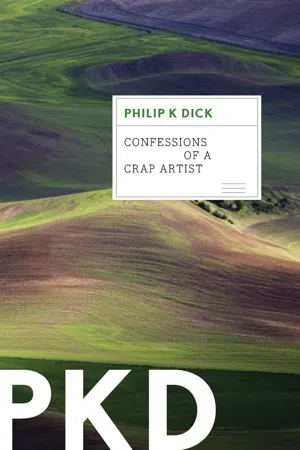
Jack Isidore doesn't see the world like most people. According to his brother-in-law Charlie, he’s a crap artist, obsessed with his own bizarre theories and ideas, which he fanatically records in his many notebooks. He is so grossly unequipped for real life that his sister and brother-in-law feel compelled to rescue him from it. But while Fay and Charlie Hume put on a happy face for the world, they prove to be just as sealed off from reality, in thrall to obsessions that are slightly more acceptable than Jack's but a great deal uglier. Their constant fighting and betrayals threaten their own marriage and the relationships of everyone around them. When they bring Jack into their home, he finds himself in the middle of a maelstrom of suburban angst from which he might not be able to escape.
Confessions of a Crap Artist is one of Philip K. Dick's most accomplished novels, and the only non–science fiction novel published in his lifetime.
- 256 pages
- English
- ePUB (mobile friendly)
- Available on iOS & Android
eBook - ePub
Confessions Of A Crap Artist
About this book
Trusted by 375,005 students
Access to over 1.5 million titles for a fair monthly price.
Study more efficiently using our study tools.
Information
1
I AM MADE OUT OF water. You wouldn’t know it, because I have it bound in. My friends are made out of water, too. All of them. The problem for us is that not only do we have to walk around without being absorbed by the ground but we also have to earn our livings.
Actually there’s even a greater problem. We don’t feel at home anywhere we go. Why is that?
The answer is World War Two.
World War Two began on December 7, 1941. In those days I was sixteen years old and going to Seville High. As soon as I heard the news on the radio I realized that I was going to be in it, that our president had his opportunity now to whip the Japs and the Germans, and that it would take all of us pulling shoulder to shoulder. The radio was one I built myself. I was always putting together superhet five-tube ac-dc receivers. My room was overflowing with earphones and coils and condensers, along with plenty of other technical equipment.
The radio announcement interrupted a bread commercial that went:
“Homer! Get Homestead bread instead!”
I used to hate that commercial, and I had just jumped up to turn to another frequency when all at once this woman’s voice was cut off. Naturally I noticed that; I didn’t have to think twice to be aware that something was up. Here I had my German colonies stamps—those that show the Kaiser’s yacht the Hohenzollern—spread out only a little way from the sunlight, and I had to get them mounted before anything happened to them. But I stood in the middle of my room doing absolutely nothing except respiring, and, of course, keeping other normal processes going. Maintaining my physical side while my mind was focused on the radio.
My sister and mother and father, naturally, had gone away for the afternoon, so there was nobody to tell. That made me livid with rage. After the news about the Jap planes dropping bombs on us, I ran around and around, trying to think who to call up. Finally I ran downstairs to the living room and phoned Hermann Hauck, who I went around with at Seville High and who sat next to me in Physics 2A. I told him the news, and he came right over on his bicycle. We sat around listening for further word, discussing the situation.
While discussing, we lit up a couple of Camels.
“This means Germany and Italy’ll get right in,” I told Hauck. “This means war with the Axis, not just the Japs. Of course, we’ll have to lick the Japs first, then turn our attention to Europe.”
“I’m sure glad to see our chance to clobber those Japs,” Hauck said. We both agreed with that. “I’m itching to get in,” he said. We both paced around my room, smoking and keeping our ears on the radio. “Those crummy little yellow-bellies,” Hermann said. “You know, they have no culture of their own. Their whole civilization, they stole it from the Chinese. You know, they’re actually descended more from apes; they’re not actually human beings. It’s not like fighting real humans.”
“That’s true,” I said.
Of course, this was back in 1941, and an unscientific statement like that didn’t get questioned. Today we know that the Chinese don’t have any culture either. They went over to the Reds like the mass of ants that they are. It’s a natural life for them. Anyhow it doesn’t really matter, because we were bound to have trouble with them sooner or later anyhow. We’ll have to lick them someday like we licked the Japs. And when the time comes we’ll do it.
It wasn’t long after December 7 that the military authorities put up the notices on the telephone poles, telling Japs that they had to be out of California by such and such a date. In Seville—which is about forty miles south of San Francisco—we had a number of Japs doing business; one ran a flower nursery, another had a grocery store—the usual smalltime businesses that they run, cutting pennies here and there, getting their ten kids to do all the work, and generally living on a bowl of rice a day. No white person can compete with them because they’re willing to work for nothing. Anyhow, now they had to get out whether they liked it or not. In my estimation it was for their own good anyhow, because a lot of us were stirred up about Japs sabotaging and spying. At Seville High a bunch of us chased a Jap kid and kicked him around a little, to show how we felt. His father was a dentist, as I recall.
The only Jap that I knew at all was a Jap who lived across the street from us, an insurance salesman. Like all of them, he had a big garden out on the sides and rear of his house, and in the evenings and on weekends he used to appear wearing khaki pants, a t-shirt, and tennis shoes, with an armload of garden hose and a sack of fertilizer, a rake and a shovel. He had a lot of Jap vegetables that I never recognized, some beans and squash and melons, plus the usual beets and carrots and pumpkins. I used to watch him scratching out the weeds around the pumpkins, and I’d always say:
“There’s Jack Pumpkinhead out in his garden, again. Searching for a new head.”
He did look like Jack Pumpkinhead, with his skinny neck and his round head; his hair was shaved, like the college students have theirs, now, and he always grinned. He had huge teeth, and his lips never covered them.
The idea of this Jap wandering around with a rotting head, in search of a fresh head, used to dominate me, back at that time before the Japs were moved out of California. He had such an unhealthy appearance—mostly because he was so thin and tall and stooped—that I conjectured as to what ailed him. It looked to me to be t.b. For a while I had the fear—it bothered me for weeks—that one day he’d be out in the garden, or walking down his path to get into his car, and his neck would snap and his head would bounce off his shoulders and roll down to his feet. I waited in fear for this to happen, but I always had to look out when I heard him. And whenever he was around I could hear him, because he continually hawked and spat. His wife spat too, and she was very small and pretty. She looked almost like a movie star. But her English, according to my mother, was so bad that there was no use of anybody trying to talk to her; all she did was giggle.
The notion that Mr. Watanaba looked like Jack Pumpkinhead could never have occurred to me if I hadn’t read the Oz books in my younger years; in fact I still had a few of them around my room as late as World War Two. I kept them with my science-fiction magazines, my old microscope and rock collection, and the model of the solar system that I had built in junior high school for science class. When the Oz books were first written, back around 1900, everybody took them to be completely fiction, as they did with Jules Verne’s books and H. G. Wells’. But now we’re beginning to see that although the particular characters, such as Ozma and the Wizard and Dorothy, were all creations of Baum’s mind, the notion of a civilization inside the world is not such a fantastic one. Recently, Richard Shaver has given a detailed description of a civilization inside the world, and other explorers are alerted for similar finds. It may be, too, that the lost continents of Mu and Atlantis will be found to be part of the ancient culture of which the interior lands played a major role.
Today, in the 1950s, everyone’s attention is turned upward, to the sky. Life on other worlds preoccupies people’s attention. And yet, any moment, the ground may open up beneath our feet, and strange and mysterious races may pour out into our very midst. It’s worth thinking about, and out in California, with the earthquakes, the situation is particularly pressing. Every time there’s a quake I ask myself: is this going to open up the crack in the ground that finally reveals the world inside? Will this be the one?
Sometimes at the lunch hour break, I’ve discussed this with the guys I work with, even with Mr. Poity, who owns the firm. My experience has been that if any of them are conscious of non-terrestrial races at all, they’re concerned only with UFOs, and the races we’re encountering, without realizing it, in the sky. That’s what I would call intolerance, even prejudice, but it takes a long time, even in this day and age, for scientific facts to become generally known. The mass of scientists themselves are slow to change, so it’s up to us, the scientifically-trained public, to be the advance guard. And yet I’ve found, even among us, there are so many that just don’t give a damn. My sister, for instance. During the last few years she and her husband have been living up in the north western part of Marin County, and all they seem to care about up there is Zen Buddhism. And so here’s an example, right in my own family, of a person who has turned from scientific curiosity to an Asiatic religion that threatens to submerge the questioning rational faculty as surely as Christianity.
Anyhow, Mr. Poity takes an interest, and I’ve loaned him a few of the Col. Churchward books on Mu.
My job with the One-Day Dealers’ Tire Service is an interesting one, and it makes some use of my skill with tools, although little use of my scientific training. I’m a tire regroover. What we do is pick up smoothies, that is, tires that are worn down so they have little or no tread left, and then I and the other regroovers take a hot point and groove right down to the casting, following the old tread pattern, so it looks as if there’s still rubber on the tire—whereas in actual fact there’s only the fabric of the casing left. And then we paint the regrooved tire with black rubbery paint, so it looks like a pretty darn good tire. Of course, if you have it on your car and you so much as back over a warm match, then boom! You have a flat. But usually a regrooved tire is good for a month or so. You can’t buy tires like I make, incidentally. We deal wholesale only, that is, with used car lots.
The job doesn’t pay much, but it’s sort of fun, figuring out the old tread pattern—sometimes you can scarcely see it. In fact, sometimes only an expert, a trained technician like myself, can see it and trace it. And you have to trace perfectly, because if you leave the old tread pattern, there’s a huge gouge mark that even an idiot can recognize as not having been made by the original machine. When I get done re-grooving a tire, it doesn’t look hand-done by any means. It looks exactly like the way it would look if a machine had done it, and, for a regroover, that’s the most satisfying feeling in the world.
2
SEVILLE, CALIFORNIA, HAS a good public library. But the best thing about living in Seville is that in only a twenty-minute drive you’re over into Santa Cruz where the beach is and the amusement park is. And it’s four lanes all the way.
To me, though, the library has been important in forming my education and convictions. On Fridays, which is my day off, I go down around ten in the morning and read Life and the cartoons in the Saturday Evening Post, and then if the librarians aren’t watching me, I get the photography magazines from the rack and read them over for the purpose of finding those special art poses that they have the girls doing. And if you look carefully in the front and back of the photography magazines, you find ads that nobody else notices, ads there for you. But you need to be familiar with the wording. Anyhow, what those ads get you, if you send in the dollar, is something different from what you see even in the best magazines, like Playboy or Esquire. You get photos of girls doing something else entirely, and in some ways they’re better, although usually the girls are older—sometimes even baggy old hags—and they’re never pretty, and, worst of all, they have big fat saggy breasts. But they are doing really unusual things, things that you’d never ordinarily expect to see girls do in pictures—not especially dirty things, because after all, these come through the Federal mails from Los Angeles and Glendale—but things such as one I remember in which one girl was lying down on the floor, wearing a black lace bra and black stockings and French heels, and this other girl was mopping her all over with a mop from a bucket of suds. That held my attention for months. And then there was another I remember, of a girl wearing the usual—as above—pushing another girl similarly attired down a ladder so that the victim-girl (if that’s what you call it; at least, that’s how I usually think of it) was all bent and lopsided, as if her arms and legs were broken—like a rag doll or something, as if she’s been run over.
And then always there’s the ones you get in which the stronger girl, the master, has the other tied up. Bondage pictures, they’re called. And better than that are the bondage drawings. They’re really competent artists who draw those . . . some are really worth seeing. Others, in fact most of them, are the run-of-the-mill junk, and really shouldn’t be allowed to go through the mails, they’re so crude.
For years I’ve had a strange feeling looking at these pictures, not a dirty feeling—nothing to do with sexuality or relations—but the same feeling you get when you’re high up on a mountain, breathing that pure air, the way it is over by Big Basin Park, where the redwoods are, and the mountain streams. We used to go hunting around in those redwoods, even though naturally it’s illegal to hunt in a state or Federal park. We’d get a couple of deer, now and then. The guns we used weren’t mine, though. I borrowed the one I used from Harvey St. James.
Usually when there’s anything worth doing, all three of us, myself and St. James and Bob Paddleford, do it together, using St. James’ ’57 Ford convertible with the double pipes and twin spots and dropped rear end. It’s quite a car, known all around Seville and Santa Cruz; it’s gold-colored, that baked on enamel, with purple trim that we did by hand. And we used molded fiberglass to get those sleek lines. It looks more like a rocket ship than a car; it has that look of outer space and velocities nearing the speed of light.
For a really big time, where we go is across the Sierras to Reno; we leave late Friday, when St. James gets off from his job selling suits at Hapsberg’s Menswear, shoot over to San Jose and pick up Paddleford—he works for Shell Oil, down in the blueprint department—and then we’re off to Reno. We don’t sleep Friday night at all; we get up there late and go right to work playing the slots or blackjack. Then around ten o’clock Saturday morning we take a snooze in the car, find a washroom to shave and change our shirts and ties, and then we’re off looking for women. You can always find that kind of women around Reno; it’s really a filthy town.
I actually don’t enjoy that part too much. It plays no role in my life, any more than any other physical activity. Even to look at me you’d recognize that my main energies are in the mind.
When I was in the sixth grade I started wearing glasses because I read so many funny books. Tip Top Comics and King Comics and Popular Comics . . . those were the first comic books to appear, back in the mid ’thirties, and then there were a whole lot more. I read them all, in grammar school, and traded them around with other kids. Later on, in junior high, I started reading Astonishing Stories, which was a pseudo-science magazine, and Amazing Stories, and Thrilling Wonder. In fact, I had an almost complete file of Thrilling Wonder, which was my favorite. It was from an ad in Thrilling that I got the lucky lodestone that I still carry around with me. That was back around 1939.
All my family have been thin, my mother excepted, and as soon as I put on those silver-framed glasses they always gave to boys in those days, I immediately looked scholarly, like a real bookworm. I had a high forehead anyhow. Then later, in high school, I had dandruff to quite an extent. And this made my hair seem lighter than it actually was. Once in a while I had a stammer that bothered me, although I found that if I suddenly bent down, as if brushing something from my leg, I could speak the word okay, so I got in the habit of doing that. I had, and still have, an indentation on my cheek, by my nose, left over from having had the chicken pox. In high school I felt nervous a great deal of the time, and I used to pick at it until it became infected. Also, I had other skin troubles, of the acne type, although in my case the spots got a purple texture that the dermatologist said was due to some low-grade infection throughout my body. As a matter of fact, although I’m thirty-four, I still break out in boils once in a while, not on my face but on my butt or armpits.
In high school I had some nice clothes, and that made it possible for me to step out and be popular. In particular I had one blue cashmere sweater that I wore for almost four years, until it got to smelling so bad the gym instructor made me throw it away. He had it in for me anyhow, because I never took a shower in gym.
It was from the American Weekly, not from any magazines, that I got my interest in science.
Possibly you remember the article they had, in the May 4th, 1935 issue, on the Sargasso Sea. At that time I was ten years old, and in the high fourth. So I was just barely old enough to read something besides funny books. There was a huge drawing, in six or seven colors, that covered two whole opened-up pages; it showed ships, stuck in the Sargasso Sea, that had been there for hundreds of years. It showed the skeletons of the sailors, covered with seaweed. The rotting sails and masts of the ships. And all different kinds of ships, even some ancient Greek and Roman ones, and some from the time of Columbus, and then the Norsemen’s ships. Jumbled in together. Never stirring. Stuck there forever, trapped by the Sargasso Sea.
The article told how ships got drawn in and trapped, and how no one ever got away. There were so many that they were side by side, for miles. Every kind of ship that existed, although later on when there were steamships, fewer ships got stuck, obviously because they didn’t depend on wind currents but had their own power.
The article affected me because in many ways it reminded me of an episode on Jack Armstrong, the All-American Boy, that had seemed very important to me, having to do with the Elephants’ Lost Graveyard. I remember that Jack had had a metal key that, when stuck, resonated strangely, and was the key to the graveyard. For a long time I knocked every bit of metal I came across against something to make it resonate, trying to produce that sound and find the Elephants’ Lost Graveyard on my own (a door was supposed to open in the rock somewhere). When I read the article on the Sargasso Sea I saw an important resemblance: the Elephants’ Lost Graveyard was sought for because of all the ivory, and in the Sargasso Sea there was millions of dollars worth of jewels and gold, the cargoes of the trapped ships, just waiting to be located and claimed. And the difference between the two was that the Elephants’ Lost Graveyard wasn’t a scientific fact but just a myth brought back by fever-crazed explorers and natives, whereas the Sargasso Sea was scientifically established.
On the floor of our living room, in the house we rented back in those days on Illinois Avenue, I had the article spread out, and when my sister came home with my mother and father I tried to interest her in it. But at that time she was only eight. We got into a terrible fight about it, and the upshot was that my father grabbed up the American Weekly and threw it into the paper bag of refuse under the sink. That upset me so badly that I had a fantasy about him, dealing with the Sargasso Sea. It was so disgusting that even now I can’t bear to think about it. That was one of the worst days in my life, and I always held it against Fay, my sister, that she was responsible for what happened; if she had read the article and listened to me talk about it, as I wanted her to, nothing would have gone wrong. It really got me down that something so important, and, in a sense, beautiful, should be degraded the way it was that day. It was as if a delicate dream was trampled on and destroyed.
Neither my father nor mother were interested in science. My father worked with another man, an Italian, as a carpenter and house-painter, and, for a number of years, he was with the Southern Pacific Railroad, in the maintenance department at the Gilroy Yards. He never read anything himself except the San Francisco Examiner and Reader’s Digest and the National Geographic. My mother subscribed to Liberty and then, when that went out of business, she read Good Housekeeping. Neither of them had any education scientific or otherwise. They always discouraged me and Fay from reading, and off and on during my childhood they raided my rooms and burned everything in the way of reading material they could get their hands on, even library books. During World War Two, when I was in the Service and overseas fighting on Okinawa, they went into my room at home, the room that had always belonged to me, gathered up all my science-fiction magazines and scrapbooks of girl pictures, and even my Oz books and Popular Science magazines, and burned them, just as they had done when I was a child. When I got back from defending them against the enemy I found that there was nothing to read in the whole house. And all my valuable reference files of unusual scientific facts were gone forever. I d...
Table of contents
- Title Page
- Table of Contents
- Copyright
- Dedication
- 1
- 2
- 3
- 4
- 5
- 6
- 7
- 8
- 9
- 10
- 11
- 12
- 13
- 14
- 15
- 16
- 17
- 18
- 19
- 20
- About the Author
Frequently asked questions
Yes, you can cancel anytime from the Subscription tab in your account settings on the Perlego website. Your subscription will stay active until the end of your current billing period. Learn how to cancel your subscription
No, books cannot be downloaded as external files, such as PDFs, for use outside of Perlego. However, you can download books within the Perlego app for offline reading on mobile or tablet. Learn how to download books offline
Perlego offers two plans: Essential and Complete
- Essential is ideal for learners and professionals who enjoy exploring a wide range of subjects. Access the Essential Library with 800,000+ trusted titles and best-sellers across business, personal growth, and the humanities. Includes unlimited reading time and Standard Read Aloud voice.
- Complete: Perfect for advanced learners and researchers needing full, unrestricted access. Unlock 1.5M+ books across hundreds of subjects, including academic and specialized titles. The Complete Plan also includes advanced features like Premium Read Aloud and Research Assistant.
We are an online textbook subscription service, where you can get access to an entire online library for less than the price of a single book per month. With over 1.5 million books across 990+ topics, we’ve got you covered! Learn about our mission
Look out for the read-aloud symbol on your next book to see if you can listen to it. The read-aloud tool reads text aloud for you, highlighting the text as it is being read. You can pause it, speed it up and slow it down. Learn more about Read Aloud
Yes! You can use the Perlego app on both iOS and Android devices to read anytime, anywhere — even offline. Perfect for commutes or when you’re on the go.
Please note we cannot support devices running on iOS 13 and Android 7 or earlier. Learn more about using the app
Please note we cannot support devices running on iOS 13 and Android 7 or earlier. Learn more about using the app
Yes, you can access Confessions Of A Crap Artist by Philip K. Dick in PDF and/or ePUB format, as well as other popular books in Literature & Classics. We have over 1.5 million books available in our catalogue for you to explore.