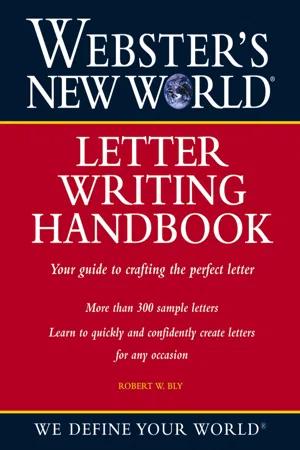
Expert tips and 300 sample letters make business and personal correspondence a snap.
When trying to close a sale, answer a complaint, or offer thanks, a well-crafted letter can make all the difference. Packed with practical advice and 300 easy-to-adapt sample letters, this all-purpose guide shows readers how to write letters that get results -at work and at home.
Covering the nuts-and-bolts of letter writing as well as the secrets of high-impact prose, the book delivers proven recipes for attention-grabbing introductions, persuasive arguments, memorable phrases, and closing clinchers. Best of all, it offers guidance on business and personal letters for every circumstance, from job hunting, selling, fundraising, and asking favors to giving a reprimand, responding to criticism, expressing sympathy, and declining gracefully. It's the only reference anyone will ever need to write the perfect letter, whatever the occasion.
- 600 pages
- English
- ePUB (mobile friendly)
- Available on iOS & Android
eBook - ePub
Webster's New World Letter Writing Handbook
About this book
Information
Subtopic
Business GeneralIndex
BusinessPART I
LETTER WRITING BASICS
Wherever you are today as a letter writer — good, bad, or indifferent — you can take your level of skill to the next level in a relatively short time.
The benefit of doing so is that you will write more effective letters: Letters that get your message across without the reader calling you for clarification. Letters that persuade your readers to accept your point of view, or take the actions you want them to take. Letters that get you the results — business and personal — you desire.
In this part, we cover some rules and tools for effective letter writing. They may seem like a lot of work right now — and maybe they will be, for now. But soon they will become a reflexive part of your letter-writing process. You won’t have to think about most of them; you will just use them to make your letters sharper, clearer, and more convincing than ever.
Prewriting Planning
You would not start building an addition onto your home until you had an architect make a drawing to show you what it would look like, would you? And a manager in charge of a division or product line would not start marketing the products without a marketing plan, would she?
In the same way, doing some preliminary preparation — rather than just turning on the PC and starting to type, can help you craft better letters. Of course writing a letter is not as big a job as planning a marketing campaign or building a family room. But it is important. As the saying goes, “Anything worth doing is worth doing well.”
Besides, the “planning” you do for a small writing job, like a letter, need not and should not be elaborate or time-consuming. A few minutes spent thinking and following the steps that follow can help you write a better letter, and may actually save time rather than take more time.
Here are some simple steps to take when planning a letter or other communication of any significance:
1. Do a SAP (subject, audience, and purpose) analysis as outlined in the sections that follow.
2. Gather the information you need and do whatever additional research is required to complete the letter.
3. Make a simple 1-2-3 outline of the points you need to cover, in the order you want to present them.
4. Now sit down, and start writing!
SAP: Subject, Audience, Purpose
SAP analysis is a process that quickly enables you to pin down the content and organization of your letter. The process requires you to ask and answer three questions:
- What is the subject (topic) of your letter?
- Who is your audience? (Who will be receiving your letter?)
- What is the purpose of your letter?
Subject
What is the subject (topic) of the letter? Make it as narrow and specific as possible. For instance, “marketing product X” is too broad for a letter; you’ll need a report or other longer document to cover it. But “approving copy for product X in our next catalog” is narrow and specific; there’s room in a letter to cover it.
Audience
Who is your reader? Well, you know who your reader is, but do you know what he or she thinks, likes, and worries about? Or what he or she wants, hopes, dreams, and desires? Most of us spend too much time thinking about what we want, and not enough time thinking about what the reader wants. Written communications are most effective when they are personal. Your writing should be built around the needs, interests, desires, and profit of the reader. The better you understand the other person, the more effectively you can communicate with him or her.
Crafting a letter that fits the reader is relatively easy when you are writing a personal letter to a friend or relative you know well. In the case of a business letter, it makes sense to ask yourself, “Who is my reader? What does he or she know about this subject? What is my relationship with the reader — subordinate, superior, colleague, or customer? How can I get the message across so that the reader will understand and agree?” When writing business letters, here are some things you want to know about your reader:
- Job title. Mechanics are interested in your compressor’s reliability and serviceability, while the purchasing agent is more concerned with cost. A person’s job colors his perspective of your product, service, or idea. Are you writing for plant engineers? Office managers? CEOs? Shop foremen? Make the tone and content of your writing compatible with the professional interests of your readers.
- Education. Is your reader a PhD or a high-school dropout? Is he a chemical engineer? A doctor? A carpenter? A senior citizen? Write simply enough so that the least technical and educated of your readers can understand you completely. When in doubt, err on the side of simplicity. You will never have a recipient of your letter complain to you that it was too easy to read.
- Industry. When chemical producers buy a reverse-osmosis water-purification system for a chemical plant, they want to know every technical detail down to the last pipe, pump, fan, and filter. Marine buyers, on the other hand, have only two basic questions: What does it cost? How reliable is it? The weight and size are also important, since the system must be carried onto and bolted onto the floor of a boat.
- Level of interest. A prospect who has responded to your ad is more likely to be receptive to a salesman’s call than someone who the salesman calls on “cold turkey.” Is your reader interested or disinterested? Friendly or hostile? Receptive or resistant? Understanding the reader’s state of mind helps you tailor your message to meet his needs.
Often, however, when writing business letters and longer documents — articles, papers, manuals, reports, and brochures — you are writing for many readers, not an individual. Even though you may not know the names of your readers, you still need to develop a picture of who they are — their job titles, education, industry, and interests.
Purpose
What is the purpose of your letter? You might be tempted to say, “to transmit information.” Sometimes merely transmitting information is the letter’s sole purpose, but often it is more than that. Is there a request you want the reader to comply with, or a favor you are hoping they will grant? Keep your goal in mind as you write, so that you may persuade the reader to agree with your point of view.
Gather Information
In order to write an effective letter and save time in doing so, you need to have all your information at hand, such as copies of previous correspondence on the topic, customer records, service orders, and so on. If you don’t have all the information you need, do the necessary research. For instance, if you are answering a technical question for a customer, and you do not know the answer, ask someone in engineering to explain it to you. Or if you are writing a letter to your insurance company explaining why you think they were wrong in refusing to pay for your treatment, it really helps to have all the facts in front of you — dates and costs of your exams, test results, doctors seen, and a copy of your policy, so you can reference the part that supports your argument.
The 3-Step Writing Process
Often when people write, they’re afraid to make mistakes, and so they edit themselves word by word, inhibiting the natural flow of ideas and sentences. But professional writers know that writing is a process consisting of numerous drafts, rewrites, deletions, and revisions.
Rarely does a writer produce a perfect manuscript on the first try. The task ideally should be divided into three steps: writing, rewriting, and polishing.
1. Writing. Most professional writers go through a minimum of three drafts. The first is this initial “go with the flow” draft where the words come tumbling out.
When you sit down to write, let the words flow freely. Don’t worry about style, syntax, punctuation, or typos — just write. You can always go back and fix it later. By “letting it all out,” yo...
Table of contents
- Cover
- Contents
- Title
- Copyright
- Acknowledgments
- Dedication
- Preface
- Introduction
- Part I: Letter Writing Basics
- Part II: Personal Correspondence
- Part III: Career and Employment Letters
- Part IV: General Business Correspondence
- Part V: Internal Communication
- Part VI: Customer Service Correspondence
- Part VII: Sales and Marketing Letters
- Part VIII: Credit, Collection, and Billing
- Part IX: Vendor Communications
- Part X: E-Mail and Fax Correspondence
- Appendix A: Formats
- Appendix B: Useful Letter Writing Aids
- Appendix C: Mailing and Shipping
- Glossary
- Index
Trusted by 375,005 students
Access to over 1.5 million titles for a fair monthly price.
Study more efficiently using our study tools.
Frequently asked questions
Yes, you can cancel anytime from the Subscription tab in your account settings on the Perlego website. Your subscription will stay active until the end of your current billing period. Learn how to cancel your subscription
No, books cannot be downloaded as external files, such as PDFs, for use outside of Perlego. However, you can download books within the Perlego app for offline reading on mobile or tablet. Learn how to download books offline
Perlego offers two plans: Essential and Complete
- Essential is ideal for learners and professionals who enjoy exploring a wide range of subjects. Access the Essential Library with 800,000+ trusted titles and best-sellers across business, personal growth, and the humanities. Includes unlimited reading time and Standard Read Aloud voice.
- Complete: Perfect for advanced learners and researchers needing full, unrestricted access. Unlock 1.5M+ books across hundreds of subjects, including academic and specialized titles. The Complete Plan also includes advanced features like Premium Read Aloud and Research Assistant.
We are an online textbook subscription service, where you can get access to an entire online library for less than the price of a single book per month. With over 1.5 million books across 990+ topics, we’ve got you covered! Learn about our mission
Look out for the read-aloud symbol on your next book to see if you can listen to it. The read-aloud tool reads text aloud for you, highlighting the text as it is being read. You can pause it, speed it up and slow it down. Learn more about Read Aloud
Yes! You can use the Perlego app on both iOS and Android devices to read anytime, anywhere — even offline. Perfect for commutes or when you’re on the go.
Please note we cannot support devices running on iOS 13 and Android 7 or earlier. Learn more about using the app
Please note we cannot support devices running on iOS 13 and Android 7 or earlier. Learn more about using the app
Yes, you can access Webster's New World Letter Writing Handbook by Robert Bly in PDF and/or ePUB format, as well as other popular books in Business & Business General. We have over 1.5 million books available in our catalogue for you to explore.