![]()
Part One
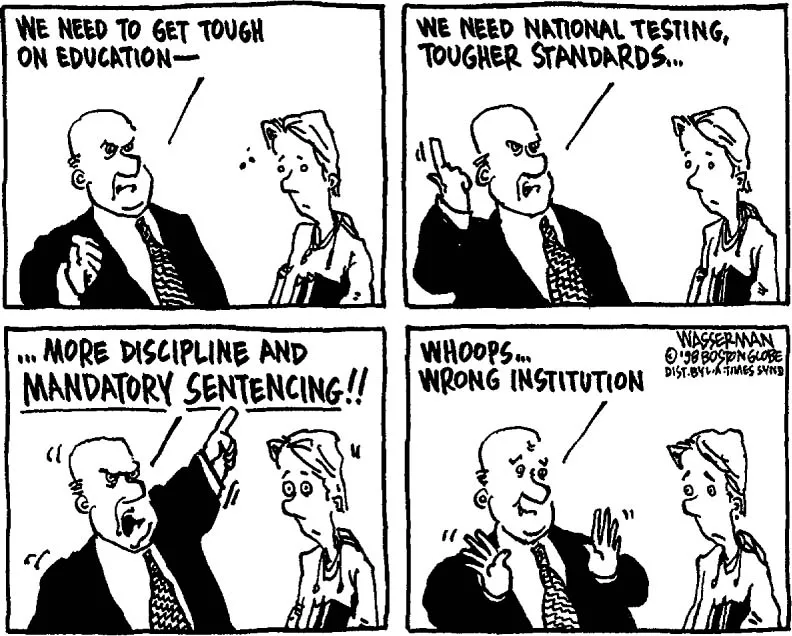
TOUGHER STANDARDS Versus BETTER EDUCATION
Teaching requires the consent of students, and discontent will not be chased away by the exercise of power.
—John Nicholls, 1993
Copyright © 1998 by Dan Wasserman
Distributed by Los Angeles Times Syndicate
Used by permission
![]()
2
Getting Motivation Wrong
The Costs of Overemphasizing Achievement
IF WE WANT to talk about schools in a way that matters, we have to talk about the people in schools. In fact, we have to make a habit of seeing things from the perspective of that student sitting right over there. You see her? She’s playing with her hair and wondering why the clock stops moving during math class. Meaningful educational reform requires us to understand her point of view: Can she connect at any level with what she just read? Does she have any reason for wanting to connect with it? What’s her goal when she opens a book? If she puts any effort into her writing, is it because she gets a kick out of finding the right words, because she wants to please her mom, or because she’s afraid of looking lame?
I don’t want to mention any names, but some social scientists specializing in education may as well be crunching numbers about E. coli or the electromagnetic spectrum. Even those who conduct research on motivation sometimes forget to ask students “what sorts of subject matter and what associated teaching methods make sense to them.” Likewise, some teachers are “more interested in what they’re teaching than in what students are learning,” more focused on the subject matter than on the kids.
These distinctions are not idle or incidental. They are not platitudes about the Importance of Children lifted from a soothing after-dinner speech. For anyone who cares about education, these are the issues that matter the most. They have the power to turn our beliefs and practices inside out, as we’re about to see. Does it matter whether your child studied last night? Yes; but what may matter even more is why he did so (or didn’t). Does it make any difference whether your child did well on a test? Sure; but what will be even more important over the long haul is why she thinks she did well—that is, how she accounts for her success. It is the student’s point of view—specifically, a psychologically informed understanding of that point of view—that determines whether real learning will happen and keep happening. As any number of studies have found, a child’s “thoughts and emotions while performing an action are more important in determining subsequent engagement than the actual outcome of that action.”
The failure to understand this is the first distinguishing feature of those who march behind the banner of Tougher Standards. I refer especially to the people who sit on Mount Olympus, where no children live, and insist that students be made to learn. They like to talk about motivating kids, as though motivation could be imposed from the outside. They are fixated on observable, testable behaviors (such as correctly pronouncing the words on a page) while ignoring the people who are doing the behaving (and whether they care about, or understand, those words). They may even set up a dichotomy whereby we are supposed to choose between being committed to Excellence, on the one hand, and just being worried about how students “feel” about what they’re doing, on the other.
The fact is, unless we attend to how students feel about what they’re doing, it’s less likely that they will become excellent learners. All those demands to raise standards aren’t just disrespectful of kids; ultimately, they’re unlikely to succeed even on their own terms. This chapter explains why.
What Versus How Well
When he was the mayor of New York City, beginning in the late 1970s, Ed Koch was famous for wandering through the streets and asking passersby, “How’m I doin’?” This affectation he evidently regarded as endearing—as opposed to, say, neurotic. Getting students to ask this same question umpteen times a day seems to be a major purpose of our educational system. Indeed, the dominant version of contemporary educational reform consists of leaning on students, teachers, administrators, and parents until they focus ever more intently on results.
What could possibly be wrong with results? To answer this question, we first have to recognize that for people to think about how well they’re doing is not at all the same as thinking about what they’re doing. These represent two very different mind-sets for parents, students, and educators. Imagine two parents, for example, both of whose children mention that they wrote an essay in school that day. One parent wants to know how good the essay was and asks what the teacher said about it. The other parent asks about the essay itself and the process of writing it: Why did you choose that topic? Did your opinion about the subject change while you were writing? How did you decide what to include in the opening paragraph?
Or imagine a student who comes home from school announcing that “she had a great day because she got an A, did better than her best friend, or . . . won the spelling bee.” These accomplishments reflect a very different set of goals than those held by a student who says “she had a great day because she finally mastered long division, read a wonderful story about India, or tried to solve a really difficult problem.” One of these children regards learning as a means (to a grade or a victory or just to being able to say she was successful). The other regards learning as an end.
Teachers and administrators, too, may promote one mind-set more than the other. Consider a school that constantly emphasizes the importance of performance! results! achievement! success! A child who has absorbed that message may find it difficult to get swept away with the process of creating a poem, trying to build a working telescope, or figuring out why fighting always seems to be breaking out in the Balkans. He may be so concerned about the results that he’s not all that concerned about the activity that produces those results.
As students move from elementary to middle or junior high school, there is an especially marked, and often irreversible, shift from trying to figure things out to trying to be high achievers—although it isn’t unusual to find even young children being led to think less about making sense of what they’re doing and more about how successful they’ve been at doing it. The two goals aren’t mutually exclusive, of course, but in practice they feel different and lead to different kinds of behaviors. Without even knowing how well a student actually did at a task or how smart she is supposed to be, we can tell a lot just from knowing whether she is more concerned about layers of learning or levels of achievement.
Like most people, I think it matters how effectively students are learning. It’s appropriate to sit down with them every so often to figure out how successful they (and their teachers) have been. But when we get carried away with results, we wind up, paradoxically, with results that are less than ideal. Surprising as it may seem, the evidence suggests that our long-term goals for children and schools are less likely to be realized when teachers, parents, and the students themselves become preoccupied with standards and achievement.
The Costs of Overemphasizing Achievement
Let’s be clear about exactly what is wrong with encouraging students to put “how well they’re doing” ahead of “what they’re doing.” An impressive and growing body of research suggests that this emphasis (1) undermines students’ interest in learning, (2) makes failure seem overwhelming, (3) leads students to avoid challenging themselves, (4) reduces the quality of learning, and (5) invites students to think about how smart they are instead of how hard they tried. Any one of these five consequences should be cause for concern; together, they make it abundantly clear that the conventional wisdom about schooling has to be rethought.
Interest. When students are constantly encouraged to think about how well they’re performing, the first likely casualty is their attitude toward learning. They may come to view the tasks themselves—the stories and science projects and math problems—as stuff they’re supposed to do better at, not stuff they’re excited about exploring. Or, as Carol Dweck, one of the leading researchers in this field, once put it, “Performance goals may well create the very conditions that have been found to undermine intrinsic interest.”
We can immediately see that the kind of student who is “learning-oriented”—the student whose goal is to understand and who is thinking about what she is doing—is likely to enjoy school. But the flip side is that her classmate, who is mostly concerned with being a top performer, is probably a lot less eager. Research and experience teach us that when “performance-oriented instructional strategies” are used, such as emphasizing the importance of good grades and high test scores, students tend to value reading less.
That doesn’t mean they won’t read. Indeed, some performance-driven or competitive students may persevere at a task when they’ve been told they have to do well. But a genuine interest in the task—or excitement about the whole idea of learning—often begins to evaporate as soon as achievement becomes the main point. Assuming it’s important to us that our children become lifelong learners, we have good reason to be concerned if too much attention to boosting achievement during school can make the whole idea of learning seem like a chore.
Reaction to Failure. No one succeeds all the time, and no one can learn very effectively without making mistakes and bumping up against limits. It’s extremely important, therefore, to encourage a healthy and resilient attitude toward failure. As a rule, that is exactly what students tend to have if their main goal is to learn: when they do something incorrectly, they figure out what went wrong and how to fix it. Their mood is generally positive and their attitude is optimistic.
Not so for the kids who are mostly concerned about how well they’re doing, who believe (often because they have been told explicitly) that the point is to succeed—or even to do better than everyone else. They seem to be fine as long as they’re succeeding, but as soon as they hit a bump they may regard themselves as failures and act as though they’re helpless to do anything about it. They are “always vulnerable to becoming overwhelmed by a failure experience,” so that a momentary stumble can seem to cancel out all their past successes. When the point isn’t to figure things out but to prove how good you are, it’s often hard to cope with being told you’re not so good.
Consider the student who falls apart when he gets a 92 instead of his usual 100. We’ve all seen such kids. We may even have such a kid or have been such a kid. The problem is that no matter how familiar we are with such a reaction, we invariably analyze what’s going on incorrectly. Consistent with our whole society’s tendency to ignore the bigger picture, we usually see it as a problem with the individual and conclude that such students are just too hard on themselves. But the distinction between “what I’m doing” and “how well I’m doing” can let us see what is going on here through a new lens. Instead of blaming the student’s anxiety or depression on his psychological makeup, we begin to realize that a systemic demand for high achievement may have led him to become debilitated when he fails—even if the failure is only relative. The important point isn’t what level of performance qualifies as failure (a 92 vs. a 40, say); it’s the perceived pressure not to fail. That can have a particularly harmful impact on high-achieving and high-ability students.
Thus, reassuring such a student that “a 92 is still very good” or that we’re sure he’ll “do better next time” doesn’t just miss the point—it makes things worse by underscoring yet again that success is all that counts. We may intend to be supportive and helpful, but in fact we’ve managed to drive home the message that the point of school isn’t to explore ideas, it’s to do well. Similarly, it really doesn’t help to give students easier tasks so they can “experience success” and feel more confident, or to provide them ...