A New York Times Notable Book, winner of the Jerwood Award from the Royal Society of Literature, a New York Times Book Review Editors' Choice, and named a Book of the Year by the Telegraph, Spectator, Observer, and BBC History Magazine, this bold new history of the rise of Christianity shows how its radical followers helped to annihilate Greek and Roman civilizations.
The Darkening Age is the largely unknown story of how a militant religion deliberately attacked and suppressed the teachings of the Classical world, ushering in centuries of unquestioning adherence to "one true faith."
Despite the long-held notion that the early Christians were meek and mild, going to their martyrs' deaths singing hymns of love and praise, the truth, as Catherine Nixey reveals, is very different. Far from being meek and mild, they were violent, ruthless, and fundamentally intolerant. Unlike the polytheistic world, in which the addition of one new religion made no fundamental difference to the old ones, this new ideology stated not only that it was the way, the truth, and the light but that, by extension, every single other way was wrong and had to be destroyed. From the first century to the sixth, those who didn't fall into step with its beliefs were pursued in every possible way: social, legal, financial, and physical. Their altars were upturned and their temples demolished, their statues hacked to pieces, and their priests killed. It was an annihilation.
Authoritative, vividly written, and utterly compelling, this is a remarkable debut from a brilliant young historian.
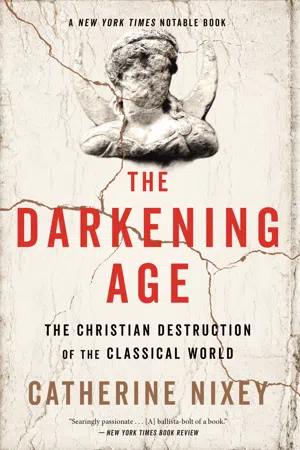
- 368 pages
- English
- ePUB (mobile friendly)
- Available on iOS & Android
eBook - ePub
About this book
Information
Notes
List of Abbreviations
ACM The Acts of the Christian Martyrs
AGT John Chrysostom, Against the Games and Theatres
Anth. Pal. Palladas, Anthologia Palatina
AP Apophthegmata Patrum, The Sayings of the Desert Fathers: The Alphabetical Collection
C. Just. Codex Justinianus
C. Th. Codex Theodosianus
CC Origen, Contra Celsum
EH Sozomen, The Ecclesiastical History
HC Eusebius, The History of the Church from Christ to Constantine
LC Eusebius, Life of Constantine
OAP Galen, On Anatomical Procedures
ONT Lucretius, On the Nature of Things
PH Damascius, Philosophical History
PROLOGUE: A BEGINNING
1. Coptic pilgrims’ chant, quoted in Kristensen (2013), 85.
[back]
INTRODUCTION: AN ENDING
1. Athanassiadi (1993), 4; Marinus, Life of Proclus, 26.
[back]
2. PH, 124.
[back]
3. PH, 117C; Olympiodorus, Commentary on the First Alcibiades, quoted in Cameron (1969), 15.
[back]
4. C. Th., 16.4.4.2, dated 16 June 388.
[back]
5. AGT.
[back]
6. PH, 119.
[back]
7. PH, 42.
[back]
8. Palladas, 10.90 and 10.82.
[back]
9. The precise criteria for a triumph varied; the stipulation of thousands dead was, for a time, one of them. Deciding when a triumph had been won was usually more an art than a science. See Beard (2007).
[back]
10. Greenblatt (2012), 43–44.
[back]
11. For paganism as insanity, sickness, etc., see C. Th., 16.10.1–21 and C. Just., 1.11.10.
[back]
12. Augustine, Sermon 24.6, quoted in MacMullen (1984), 95.
[back]
13. AGT.
[back]
14. Augustine, Sermon 279.4, quoted in Shaw (2011), 682.
[back]
15. Eusebius, The History of the Church from Christ to Constantine, 10.9.7.
[back]
16. Johnson, 15 April 1778, quoted in MacMullen (1997), 169 n. 37, to whom this paragraph is indebted.
[back]
1. THE INVISIBLE ARMY
1. Chitty (1966) calls it a pigsty, though this may not be strictly accurate: the Greek refers to him moving “just outside his house”—presumably to some sort of simple structure there. Nonetheless, the idea of a pigsty confers well the idea of simplicity—even squalor—that would no doubt have been appropriate.
[back]
2. Clement, The Instructor, 3.5.
[back]
3. Matthew 19:21.
[back]
4. Augustine, Confessions, 8.7–8.
[back]
5. Life of Antony, 5.
[back]
6. Life of Antony, 5–6.
[back]
7. Life of Antony, 24.
[back]
8. Cyprian, Bishop of Carthage, On the Mortality, 14.
[back]
9. Dodds (1965), 133–34.
[back]
10. Palladas, Palatine Anthology, 10.72, quoted in Dodds (1965), 11.
[back]
2. THE BATTLEGROUND OF DEMONS
1. Augustine, Confessions, 8.7.
[back]
2. Mark 5:9.
[back]...
Table of contents
- Title Page
- Contents
- Copyright
- Dedication
- List of Illustrations
- Map
- Prologue: A Beginning
- Introduction: An Ending
- The Invisible Army
- The Battleground of Demons
- Wisdom Is Foolishness
- “On the Small Number of Martyrs”
- Photos I
- These Deranged Men
- The Most Magnificent Building in the World
- To Despise the Temples
- How to Destroy a Demon
- The Reckless Ones
- To Drink from the Cup of Devils
- To Cleanse the Error of Demons
- Carpe Diem
- They That Forsake the Way of God
- Photos II
- To Obliterate the Tyranny of Joy
- “Merciful Savagery”
- “A Time of Tyranny and Crisis”
- Acknowledgments
- Notes
- Bibliography
- Index
- About the Author
- Connect with HMH
- Footnotes
Trusted by 375,005 students
Access to over 1.5 million titles for a fair monthly price.
Study more efficiently using our study tools.
Frequently asked questions
Yes, you can cancel anytime from the Subscription tab in your account settings on the Perlego website. Your subscription will stay active until the end of your current billing period. Learn how to cancel your subscription
No, books cannot be downloaded as external files, such as PDFs, for use outside of Perlego. However, you can download books within the Perlego app for offline reading on mobile or tablet. Learn how to download books offline
Perlego offers two plans: Essential and Complete
- Essential is ideal for learners and professionals who enjoy exploring a wide range of subjects. Access the Essential Library with 800,000+ trusted titles and best-sellers across business, personal growth, and the humanities. Includes unlimited reading time and Standard Read Aloud voice.
- Complete: Perfect for advanced learners and researchers needing full, unrestricted access. Unlock 1.5M+ books across hundreds of subjects, including academic and specialized titles. The Complete Plan also includes advanced features like Premium Read Aloud and Research Assistant.
We are an online textbook subscription service, where you can get access to an entire online library for less than the price of a single book per month. With over 1.5 million books across 990+ topics, we’ve got you covered! Learn about our mission
Look out for the read-aloud symbol on your next book to see if you can listen to it. The read-aloud tool reads text aloud for you, highlighting the text as it is being read. You can pause it, speed it up and slow it down. Learn more about Read Aloud
Yes! You can use the Perlego app on both iOS and Android devices to read anytime, anywhere — even offline. Perfect for commutes or when you’re on the go.
Please note we cannot support devices running on iOS 13 and Android 7 or earlier. Learn more about using the app
Please note we cannot support devices running on iOS 13 and Android 7 or earlier. Learn more about using the app
Yes, you can access The Darkening Age by Catherine Nixey in PDF and/or ePUB format, as well as other popular books in History & European Medieval History. We have over 1.5 million books available in our catalogue for you to explore.