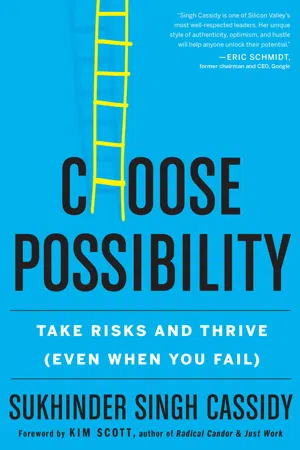
Wall Street Journal bestseller | An indispensable guide to decision-making and risk-taking for anyone who finds themselves afraid of making a wrong choice in their career. This fresh, new approach comes from one of the most highly regarded and well-respected female tech executives in Silicon Valley, who made many wrong choices in her career, but learned how to turn those down moments into successes.
Life is made up of a series of choices. What do you do if one of those choices turns out poorly, especially if it was carefully considered? How do you trust your instinctive decision-making skills and make the next right choice? How do you continue to take risks when, suddenly, your risks are not working out?
Sukhinder Singh Cassidy is one of the most highly regarded and well-respected female tech executives in Silicon Valley, but she’ll be the first to admit that her path to success has been far from linear. She started three companies that have done exceedingly well, including theBoardlist (an organization designed to promote and place women onto corporate boards), and she just served as president of StubHub, which sold earlier this year for $4 billion.
But she’s also encountered plenty of poor choices, misfires, unexpected headwinds, and all other types of pitfalls that she had to learn how to confront, analyze, navigate, and incorporate into her new path forward. From her own experience, she knows that personal success does not come from making one singular “correct” or “big” decision. Rather, long-range success comes from tackling numerous choices that are aimed to optimize future possibilities.
Singh Cassidy’s “seven myths of success,” as well as her advice on how to make FOMO into your friend, multiply your “bets” in life, and understand why you shouldn’t be blinded by “passion bias,” all provide an entirely new way to approach risk-taking and achieve lasting success.
- 272 pages
- English
- ePUB (mobile friendly)
- Available on iOS & Android
eBook - ePub
About this book
Information
PART I
Get Going
Nothing will ever be attempted if all possible objections must be first overcome.
— SAMUEL JOHNSON
1 | Ditch the Hero’s Journey
Have you reached an inflection point in your life or career only to feel terrible pressure to make a choice? My older sister Nicky can identify. In 2010, she was running her own optometry practice in a suburban mall. Caring and giving by nature, she loved to serve patients and took immense pride in her office and small staff, whom she treated like family. For a decade, her business prospered, but more recently it had struggled due to macro conditions. Foot traffic to the mall was declining, local competition had intensified, and more customers were opting to purchase glasses online year after year.
With no break in her fixed costs, Nicky’s practice was generating less profit each year, and she strained to save money for the future. Meanwhile, her lease required that she keep her office open until the mall closed at nine p.m. each night. Her husband was an executive with an international company who spent much of his time traveling, and between sports and school their two sons had busy schedules. Most nights, my sister came home around ten p.m., fixed dinner for her two hungry boys, chased them to finish their homework, and fell into bed around one or two a.m. The next day, she got up and did it all again.
Concerned about her well-being, I pressed Nicky to consider her options, which included shutting down or selling her practice, going to work for someone else, combining her practice with another doctor’s, or keeping her practice but finding a new location. As exhausted and stressed as she was, Nicky couldn’t bring herself to make a move. All she knew was running her own practice in its current form and in that mall location. She had built a large base of patients, sunk capital in inventory and equipment, and assembled a team of people who looked to her for their livelihood. “I took a super big risk in buying and building out this practice,” she said. “Sure, I could make a change, but going to work for someone else might be an even bigger mistake. I’d be giving up everything I’ve built.” It was too scary to think about doing something different.
Nicky felt burdened by the sense that everything rode on the choice before her—that it was make or break. Without realizing it, she had given herself over to the Myth of the Single Choice (Figure 1). So many of us fall into this trap. We struggle to chart a new path because of the seeming weightiness of a single decision before us. Risk-taking, we think, boils down to one big move, and we fear that choosing poorly will prove ruinous. Our anxiety heightens when we’re already grappling with a challenging situation, but it’s also pretty bad even when we feel stable and successful—we don’t want to relinquish the great position we’ve managed to secure. And so, we wring our hands and suffer sleepless nights, racking our brains about what to do. We decide to stay put even as our current situation deteriorates, or we pressure ourselves to make a perfect choice to avoid ruin. Risk-taking becomes much harder than it has to be when we subscribe to the Myth of the Single Choice.
THE HERO’S JOURNEY IN OUR HEADS
Why do we so often monumentalize risk in this way? We often perceive successful people as heroes who take massive risks and vanquish enemies on an epic journey to greatness. Transposing that thinking onto our own lives, we assume we must take a massive risk to achieve outsize success. In turn, we fear the downside more than we otherwise might. The bigger the potential success, we think, the bigger our fall if our choices go awry.

Figure 1
Stories we encounter throughout our lives reinforce this thinking. Scholars have discerned narratives of heroic quests in ancient myths and folk tales, observing that they continue to influence the narratives we spin today in novels, television, and movies. “Throughout the inhabited world,” writes Joseph Campbell in his classic book The Hero with a Thousand Faces, “in all times and under every circumstance, the myths of man have flourished; and they have been the living inspiration of whatever else may have appeared out of the activities of the human body and mind.” Campbell interprets the hero’s journey as an epic passage toward self-discovery and transformation, one that entails a brush with danger as the hero discovers their true self. “A hero ventures forth from the world of common day into a region of supernatural wonder: fabulous forces are there encountered and a decisive victory is won: the hero comes back from this mysterious adventure with the power to bestow boons on his fellow man.” On a macro level, the entire quest constitutes a monumental challenge or danger the hero accepts in hopes of achieving greatness.
Look closely, however, and you’ll find that the hero’s journey doesn’t amount to just one big risk. In fact, according to Campbell, heroes take any number of risks big and small along the way. They embark on their journeys, leave the ordinary world, enter a special one unknown to them, put faith in mentors, undergo a series of trials to test their skills, and much else. But in our daily retellings of the hero’s journey, we often fail to recognize or process this level of detail. We continue to perceive the journey as encompassing a single, outsize risk.
Humans find the prospect of uncertainty fundamentally terrifying. “Uncertainty acts like rocket fuel for worry,” one observer writes, referencing numerous scientific studies on the subject. “It causes people to see threats everywhere they look, and at the same time it makes them more likely to react emotionally in response to those threats.” Psychologists posit that fear of the unknown might be our most basic fear, or as one scholar puts it, “one fear to rule them all.” Some suspect that uncertainty ruffles us because it confronts us with the need to navigate more complexity in our decision-making.
Any risk carries uncertainty, but if you believe everything rides on a single big choice, the prospect of uncertainty magnifies your unease. Nicky felt deeply uncertain about her future—she had no way of knowing if any risk she might take would work out, and as she saw it, her future depended on her decision.
A final psychological factor that intensifies the effects of the Myth of the Single Choice concerns our perception of loss. As the behavioral economist Daniel Kahneman and the cognitive psychologist Amos Tversky famously argued, our fear of losing what we already have feels more compelling to us than the boost we might feel from notching a potential but uncertain gain. If you already regard risk-taking as a single, high-stakes bet, the potential downside seems massive. Add in your aversion to loss, and the downside might seem so overwhelming as to render the risk impossible to take in your mind.
MANY CHOICES MAKE A CAREER
As crippling as the Myth of the Single Choice might be, you can actually dispel it quite easily. The next time you watch a movie with a clear hero’s journey plotline, take a moment to chart the risks a hero takes along the way. You’ll find there are many—large and small, successful and not. Likewise, if you scrutinize the careers of successful people, you discover that success usually unfolds progressively as a result of many risks of different sizes. You also find that a person’s overall success usually arises out of multiple failures as well as wins along the way. Successful people tend to iterate their way to cumulative success through failures and achievement in equal measure.
To reach a dream is to string together a long series of choices, large and small, well advised or not. I can count at least twenty-three choices I made over a career spanning almost three decades. Figure 2 boils these down to the ten most important choices that have led me to my present circumstances. As you’ll see, some of these choices worked out, some didn’t, but my overall career flourished. Over time, I managed to achieve many more of my dreams than I would have with more limited risk-taking.
If you find yourself terrified of a seemingly big risk, conduct a similar analysis of your own life or career to date. You’ll likely find that your success to date didn’t come from a single big risk, but from many of them, with a much larger number of smaller risks nestled in.

Figure 2
As you register the complexity of your career path or those of people whom you know or admire, notice that any different number of permutations might have unlocked your or their present level of success. We tend to idealize clear, fixed “tracks” to success. If you want to become a successful corporate attorney, you must get into a top law school, then obtain a summer position at a major New York City law firm, then land a permanent job at one of these firms, then work your way up to partner. If you want to be CEO of a big company, you obtain some initial business experience, then earn your MBA, land a job at a big company, and just keep climbing. Although such traditional “recipes” might comfort us, they also frighten us, because everything seems to ride on one or a few “big” choices you make: where you go to law school, or the job you land upon graduating, or whether or not you accept the riskier new role your current company is offering you.
A generation or two ago, these so-called key choices might have been critically important. But the good news is that, today, tracks to success don’t matter nearly as much as they used to. Millennials and Gen Zers are crafting individualized, nontraditional career paths by working “side hustles” or jumping between industries. In one study of female business leaders, an overwhelming majority—86 percent—regarded nontraditional moves as important to their success. If you’re stressed about taking a particular step on the way to your goal, don’t worry so much about it. I might have become a CEO and tech leader via my twenty-three decisions, or by an entirely different sequence.
Some CEOs rise up by following the well-worn track of “work experience, fancy MBA, killer job offer, work your way up.” But this is less and less common. Anjali Sud, called by one observer a “master of the non-linear career,” experienced a number of successes and failures en route to becoming CEO of Vimeo, despite an academic pedigree that includes degrees from Harvard Business School and Wharton. As she recounts, “I did everything from investment banking to being a toy buyer to marketing diapers online to coming to Vimeo to do marketing and finding myself in my dream job now as the CEO.” Along the way, she leveraged opportunities to create new ones. When Amazon hired her as an intern in business development, for instance, she parlayed that into an opportunity in merchandising, which in turn led to a marketing position. She counsels that people have “faith that you can affect your career path at any point,” understanding that “opportunities come from places you could never imagine. I wish I had known that. I think I would have been more chill.”
Research bears out the wisdom of a more free-flowing approach to crafting a career. As the authors of a decade-long study of CEOs note, leaders who reach the top job more quickly than others “don’t accelerate to the top by acquiring the perfect pedigree. They do it by making bold career moves over the course of their career that catapult them to the top.” These moves include taking a smaller job in order to gain new skills or experience, taking on a job for which they felt unprepared, or signing up to tackle a big, uninviting business problem. Other research, including a large LinkedIn study of hundreds of thousands of people who worked in management consulting, found that people with diverse job experiences advance more quickly than those who toil away in a single specialty or business function. As an article in the New York Times put it, “The quickest path is a winding one” when it comes to those seeking to become CEOs.
For me, the journey of risk-taking to career success unfolded across different chapters (Figure 3), each defined by its own broad ambitions. In every chapter, I made a series of choices to help me move toward the ambition in question, generating in turn a series of outcomes. As time passed, each new chapter also built upon the previous ones in ways that appear logical and preplanned to others now, but that were not nearly so clear as events unfolded.

Figure 3
GROW OR GO
As long as a career risk you take results in some sort of positive impact (more on that later), it moves you forward, enhancing your skills and opening up several more potential opportunities than you could access previously. Even when a given choice results in failure, it still likely illuminates new paths to get you where you want to go. In fact, the riskiest career choice of all might be the one that seems “safest”: not moving at all. The German poet Goethe put it well when he said, “The dangers of life are infinite, and among them is safety.”
If your present situation is already deteriorating, staying put only allows it to worsen. Life might also create situations in which we have little choice but to take risks, even if we didn’t seek them out. On the other hand, if you’re coming off a success yet envisioning an even greater goal, staying put carries ever-increasing opportunity costs. As you linger in place, you fail to develop new skills and capabilities as quickly as your peers, making it increasingly harder to compete going forward. As I’ve found many times over, taking a chance, even if it fails to pan out, usually allows you to learn more quickly than remaining in a more comfortable situation that no longer challenges you.
When interviewing job candidates, I often ask them to name their biggest career regret. Curiously, most candidates point not to their failures, but to the business they didn’t start, the job opportunity they didn’t grasp, the service they hesitated to launch, the employee they failed to let go, and so on. There’s an important lesson to be learned from this.
Even on the organizational level, research shows that over the long term companies that remain relatively static are far more prone to failure than companies that make multiple choices, successful or not. In researching their book Strategy Beyond the Hockey Stick, the McKinsey partners Chris Bradley, Martin Hirt, and Sven Smit studied companies ...
Table of contents
- Title Page
- Contents
- Copyright
- Dedication
- Epigraph
- Foreword
- Introduction
- Part I: Get Going
- Chapter 1: Ditch the Hero’s Journey
- Chapter 2: Pump Your Risk-Taking Muscles
- Chapter 3: The Power of Pipelining in Parallel
- Chapter 4: Why Proximity Beats Planning
- Chapter 5: FOMO > FOF = Action
- Part II: Get Smarter
- Chapter 6: Put Who Before What When Taking a Risk
- Chapter 7: It’s Not All About You
- Chapter 8: Well, Some of It Is (How to Bet on Ourselves)
- Chapter 9: Bigger Leaps
- Part III: Get Rewarded
- Chapter 10: The Myth of Risk and Reward
- Chapter 11: To Succeed, Forget Success
- Chapter 12: Impact Fails
- Chapter 13: The Sines of Growth
- Chapter 14: Possibility and Powerflow
- Acknowledgments
- Notes
- Index
- About the Author
- Connect on Social Media
Trusted by 375,005 students
Access to over 1.5 million titles for a fair monthly price.
Study more efficiently using our study tools.
Frequently asked questions
Yes, you can cancel anytime from the Subscription tab in your account settings on the Perlego website. Your subscription will stay active until the end of your current billing period. Learn how to cancel your subscription
No, books cannot be downloaded as external files, such as PDFs, for use outside of Perlego. However, you can download books within the Perlego app for offline reading on mobile or tablet. Learn how to download books offline
Perlego offers two plans: Essential and Complete
- Essential is ideal for learners and professionals who enjoy exploring a wide range of subjects. Access the Essential Library with 800,000+ trusted titles and best-sellers across business, personal growth, and the humanities. Includes unlimited reading time and Standard Read Aloud voice.
- Complete: Perfect for advanced learners and researchers needing full, unrestricted access. Unlock 1.5M+ books across hundreds of subjects, including academic and specialized titles. The Complete Plan also includes advanced features like Premium Read Aloud and Research Assistant.
We are an online textbook subscription service, where you can get access to an entire online library for less than the price of a single book per month. With over 1.5 million books across 990+ topics, we’ve got you covered! Learn about our mission
Look out for the read-aloud symbol on your next book to see if you can listen to it. The read-aloud tool reads text aloud for you, highlighting the text as it is being read. You can pause it, speed it up and slow it down. Learn more about Read Aloud
Yes! You can use the Perlego app on both iOS and Android devices to read anytime, anywhere — even offline. Perfect for commutes or when you’re on the go.
Please note we cannot support devices running on iOS 13 and Android 7 or earlier. Learn more about using the app
Please note we cannot support devices running on iOS 13 and Android 7 or earlier. Learn more about using the app
Yes, you can access Choose Possibility by Sukhinder Singh Cassidy in PDF and/or ePUB format, as well as other popular books in Business & Business Development. We have over 1.5 million books available in our catalogue for you to explore.