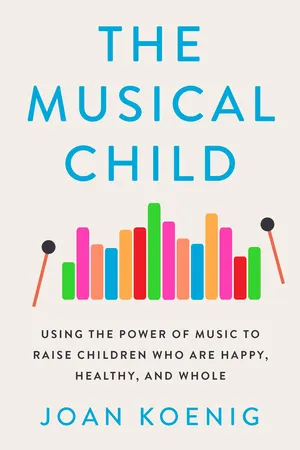
A pioneering music educator reveals how music can supercharge early childhood development—and how parents and educators can harness its power.
Since opening her famed Parisian conservatory over three decades ago, Joan Koenig has led a global movement to improve children’s lives and minds with the transformative power of music. With a curriculum and philosophy drawn from cutting-edge science, L’Ecole Koenig has educated and empowered even its youngest students, from baby Max, whose coordination and communication grow as he wiggles and coos along to targeted songs and dance, to five-year-old Constance, who nourishes her empathy, creativity, and memory while practicing music from other cultures. In The Musical Child, Koenig shares stories from her classrooms, along with tips about how to use the latest research during the critical years when children are most sensitive to musical exposure—and most receptive to its benefits.
A gift for parents, caregivers, musicians, and educators, The Musical Child reveals the multiple ways music can help children thrive—and how, in the twenty-first century, its practice is more vital than ever.
It’s a crisp October morning in Paris, and at L’École Koenig, excitement is in the air: the fourth Baby Musicking class of the school year is about to begin. Parents and teachers alike are eagerly anticipating another chance to experience the immediate and joyful reactions of these tiny infants, who range in age from three to twelve months.
Our school has three separate locations, all within a five-hundred-meter area of Paris’s 15th arrondissement. The Baby Musicking room, which is located next door to our main conservatory and kindergarten campus, is a brightly colored living room–sized space, with thick blue carpeting for comfortable rolling around—for both the babies and the adults. There is one piano for our pianist, and one piano stripped of its decorative outer shell: a sort of naked version of the instrument, which we denuded by unhooking the wooden cover above the keyboard that hid the piano hammers, and by removing the cover below the keyboard that hid the lowest and longest strings. This left the keys, strings, and hammers exposed for children to explore, which they do tirelessly. A big conga drum is lying on the floor for baby exploration, along with a small harp and several xylophones.
It takes a few minutes for everyone to exchange greetings, remove their shoes and coats. Soon, parents and caretakers are seated on the floor in a “magic circle,” grinning and waiting for the music to begin. After only a few classes, we also sense the babies’ eager anticipation; seated on the adults’ laps, they become silent and still, clearly waiting. As soon as their teacher Marion counts down from five, and the music begins, the babies start waving their arms, swaying back and forth and vocalizing, which is to say, loudly and happily squawking.
After the “Bonjour/Good Morning” song, Marion launches into a game of rhythmic call-and-response that includes clapping and stomping. The youngest babies try their best to respond: we see them rocking, but their little hands and feet are not yet cooperating.
Next we begin our unique method of calling roll. Each baby has a musical name—a short fragment of music composed to reflect the child’s personality and to match the number of syllables in their name. The parents and caretakers join in, greeting each child by singing their musical name, enthusiastically moving in time with the music. An air of unity and joy fills the room.
When eight-month-old Maximilian hears his musical name, a fragment of a salsa rhythm, he is initially silent and motionless, as if making sure that this is indeed his music. And then he’s off, swaying with delight, waving his arms and loudly vocalizing. We sing his name several times as he revels in the group’s attention.
Baby’s Musical Name
Would you like to make a melody out of your baby’s name? I suggest that you try the following exercise. You might just be thrilled by the results.
Take the number of syllables in baby’s name and make a melody. Let’s take the name Gabrielle. You can sing the three syllables moving up, just like Do-Re-Mi,
or descending, Mi-Re-Do.
You don’t have to start on a specific pitch; just start somewhere that feels comfortable for your voice. No need to feel self-conscious about this. Think of your favorite folk, rock, or R&B songs: the singers don’t just sing the notes, they inhabit them. You can also use the beginning of a song you know and just repeat her name to fit the melody. For example, “Amazing Grace” becomes:
Or “Jingle Bells,” with its easy-to-retain short-short-long rhythm, is an easy fit for three-syllable names:
Take your baby in your arms and lift or bend according to the rising or falling melodic movement of your song. Now play around: speed up, slow down; use a high voice or a deep, throaty voice. If you have chosen “Jingle Bells,” dance to the rhythm with corresponding movements: short-short-long, short-short-long.
Pay attention to which aspects your baby likes best—and stick with what works.
Within a few weeks, you will notice that this song—your baby’s very own musical name—will bring on a smile, and also calm your baby when she is distressed. Why? Because this is her song. This is a little tiny masterpiece that you have created for her. She recognizes your loving intention, as well as the shape of the melody and the feel of the rhythm. The song is your personal duet: an act of love and connection that she will participate in long before she can actually sing along or move with you.
One morning, not much later in the school year, Max’s mother placed the tambourine she had been using on the floor near Max’s foot. As our pianist improvised an especially rock-and-roll piece of music, Max inadvertently hit the tambourine with his foot. Seeming both surprised and pleased to have made the sound, he did what every baby does when experiencing something new: he tried it again. Then he grabbed the tambourine with both hands and began shaking it back and forth. When I moved closer to him with my drum and began to play along with him, Max grew still.
He was staring intently at me, and I could almost see the cogs turning in his little head. He tested me several times, shaking the tambourine once, twice, three times. I would answer with the same number of beats on my drum. Our pianist was following along closely, playing in time with both of us, adding a harmonic layer of resonant chords. Suddenly this spontaneous little exchange was beginning to sound like something more.
We can scarcely imagine what this might feel like to an eight-month-old child, to hear his tentative tambourine-tapping morph into a symphonic work that he appears to be conducting. Max had stopped smiling and now was concentrating his gaze on me, barely moving. Then he began vocalizing, oohing and aahing excitedly. I answered his vocalizations, but he was taking the lead, the conductor directing our nonverbal conversation.
Finally, Max put the small tambourine in his mouth, which was such classic eight-month-old behavior that everyone in the classroom had to laugh. Max signaled that our conversation was over by dropping the tambourine and reaching up to his mother, who proudly smothered him with kisses as the room erupted in applause.
The following week, as we sat down for class again, it was evident that Max not only remembered the game but also wanted to relive the experience. He smiled at me and began tapping his tambourine and vocalizing as soon as his mother settled onto the carpet with him. Once again, this time with certainty, Maximilian was showing us that he was ready to engage in what I call “the first duet.”
LOOK WHO’S TALKING . . .
The musical child’s journey begins in the first year of life. So much is happening in baby’s brain and body during this first year, and research has shown that music is a powerful means of communication at this stage of life. Stimulating a child’s innate musicality sets the stage for healthy cognitive, emotional, and physical development, and above all, self-confidence.
To be sure, there have been far too many claims made about music making your child smarter. Even if this could be proven, moreover, it isn’t the primary reason to expose the youngest children to music. Your baby needs a music-infused exchange—the first duet—to reassure herself that she is not alone and, therefore, not in danger. Every sound, every gesture that elicits a response from you confirms in her mind that she exists, that she is safe, and that you are there for her. Even the most basic musical exchanges develop baby’s sense of security—the cornerstone of self-confidence, which in turn sets the stage for learning and happiness.
Your baby’s brain development mirrors the way the human brain evolved over the millennia—from the bottom up. At the base of the brain, sitting on top of the spinal cord, is a set of structures known collectively as the limbic system, home to our emotional, sensory, and memory centers. Inside the limbic system is the amygdala, one of the key centers for emotional processing Next to the amygdala is the hippocampus, one of our memory processing centers. These two have a veritable communication hotline in place. Both the hippocampus and the amygdala play a crucial role in processing emotional aspects of memories. Music processing strongly engages this highly emotional and reactive part of the brain.
At the front of the brain sits the prefrontal cortex, the seat of analysis, judgment, and executive function, the set of cognitive processes, from short-term memory to the sorting of information, that underlie self-awareness, emotional regulation, planning, and problem solving. The only difficulty for baby, and for you, is that this part of the brain is not even close to fully developed at birth. As an adult, you can manage fear or sadness or confusion with reason and through the benefit of experience. This is your executive function stepping in, lending a rational helping hand. Baby simply does not have this equipment; she is raw sensation and emotion. Her prefrontal cortex, where rationality lives, won’t develop fully until late adolescence or early adulthood.
Research dating from as far back as 1980 determined that a fetus’s sense of hearing is already functioning in the third trimester in utero. Newborns prefer their mother’s voice at birth, clearly demonstrating that they recognize this voice from before birth. With fully functioning hearing and a ripe and ready limbic system, baby is biologically prepared to experience music from day one. The effect can be powerful, providing the comfort and reassurance that underlie her emotional stability and well-being. Music affects babies intensely because it engages proportionally more parts of their brain at this stage of their development. Every warm moment of connection is processed in the limbic system, and even if these experiences can’t be recalled, they become a part of who we are. Think of the firm foundation of well-being that we can provide by singing and engaging with our babies.
Human beings are naturally sensitive and responsive to melody and rhythm. Almost without exception, babies—all humans, in fact—have a spontaneous physical and emotional reaction to music. You probably have a favorite song, and most likely find yourself tapping your toes in time or becoming emotional upon hearing a memorable piece of music from your past. This is clear and simple proof that you are sensitive to music, that you are musical, even if you never think of yourself that way. And that’s all you need to engage with your baby in this elemental musical way.
What are your favorite pieces of music? Whatever the answer, now is the time to share them with your baby. I met a new father recently who had a child late in life. Daniel grew up during the musically prolific 1970s. He told me how he had been dutifully putting on special baby music for his daughter, and hating every minute of it. I asked him what music he loved, and he immediately started gushing about the Stones, the Beatles, ABBA, and Dolly Parton. I laughed and told him to throw away the baby albums, put on Dolly, pick up Patsy, and dance! This shared joy is like a superfood for the mind, the body, and the heart—and not just for baby!
You do not need professional training to make music with your child. Even if you think you sing off-key, or believe you have two left feet, your baby wants to sing and dance with you. This first duet will bring your child happiness and contribute to her healthy development. I will suggest simple techniques, and the science underlying them, so that you can share musical experiences with your child from the moment she’s born. The potential pleasures and benefits to both you and your child are boundless.
What can we learn from Maximilian’s duet about an eight-month-old infant’s need to communicate? When I joined in with Max, we were engaging in a musical conversation. For an eight-month-old baby, a conversation needs no words, but it does require your full attention. In this case, Max was initiating our interaction and taking the lead. This is an example of the moment when a baby realizes that he can provoke a response from another human being through his voice or actions. Max was learning that he could, in a sense, ask me a question and that I would respond.
Max and I were creating a narrative together. There were no words, but there was meaning. This is an important part of the first duet—the essential dialogue that every baby seeks. And it is enhanced by music. In fact, decades of research suggest that babies prefer music to speech.
Your First Duet
You may doubt your musical ability, but you cannot doubt your ability to speak. The first duet does not have to include musical instruments. All you need are your voice, your imagination, and your body. This simple exercise will get you started.
Sit down and place your baby face-up on your thighs, with her head on your knees, her feet touching your stomach. You can sing or whisper just about anything—even made-up nonsense words—as long as you are not afraid to modulate your voice. Take her feet or hands (or, ideally, one of each) and gently move them in sync to your words or your song. We know that babies prefer song to speech, so this is the moment to let go of any fear of singing. Keep constant eye contact with your baby. Pretend you are a mime, and use every facial expression you can. Don’t be afraid to be silly; open your mouth and stick out your tongue. Your baby will probably do the same!
You look so lovely in your beautiful blue pajamas!
Daddy loves his baby ohhhhhhh so much!
Let’s make some pancakes, pancakes, pancakes . . .
Remember that repetition is necessary for baby because it develops her ability to predict what will come next—and when it does, she is happily reassured. This is one of the principal ways that babies learn. Listen very closely to your baby’s tiny sounds and try to answer with something that keeps the conversation going. Repeat the sounds that baby makes, and perhaps add on, much like you might in an adult conversation: “Oh, really? I had no idea!”
Be sure to also pay attention to your baby’s facial expressions and movements. You can imitate them, and then try adding something new, like a raised eyebrow. Try moving your mouth in a funny way and accompanying the movement with a “pop” sound. Your baby will surely begin to imitate these facial expressions, which is a crucial part of her development. (Imitation is one of the first steps on baby’s path to absorbing the c...
Table of contents
Title Page
Contents
Copyright
Dedication
Epigraph
Author’s Note
Introduction
1. Year One: The First Duet
2. Year Two: Babe on the Run
3. Year Three: Body and Soul
4. Year Four: Days of Miracle and Wonder
5. Year Five: Rationality and Unicorns
6. Year Six: The Age of Enlightenment
Conclusion
Acknowledgments
Appendix: Musical Scores
Notes
Index
About the Author
Connect on Social Media
Footnotes
Trusted by 375,005 students
Access to over 1.5 million titles for a fair monthly price.
Study more efficiently using our study tools.
Frequently asked questions
Yes, you can cancel anytime from the Subscription tab in your account settings on the Perlego website. Your subscription will stay active until the end of your current billing period. Learn how to cancel your subscription
No, books cannot be downloaded as external files, such as PDFs, for use outside of Perlego. However, you can download books within the Perlego app for offline reading on mobile or tablet. Learn how to download books offline
Perlego offers two plans: Essential and Complete
Essential is ideal for learners and professionals who enjoy exploring a wide range of subjects. Access the Essential Library with 800,000+ trusted titles and best-sellers across business, personal growth, and the humanities. Includes unlimited reading time and Standard Read Aloud voice.
Complete: Perfect for advanced learners and researchers needing full, unrestricted access. Unlock 1.5M+ books across hundreds of subjects, including academic and specialized titles. The Complete Plan also includes advanced features like Premium Read Aloud and Research Assistant.
Both plans are available with monthly, semester, or annual billing cycles.
We are an online textbook subscription service, where you can get access to an entire online library for less than the price of a single book per month. With over 1.5 million books across 990+ topics, we’ve got you covered! Learn about our mission
Look out for the read-aloud symbol on your next book to see if you can listen to it. The read-aloud tool reads text aloud for you, highlighting the text as it is being read. You can pause it, speed it up and slow it down. Learn more about Read Aloud
Yes! You can use the Perlego app on both iOS and Android devices to read anytime, anywhere — even offline. Perfect for commutes or when you’re on the go. Please note we cannot support devices running on iOS 13 and Android 7 or earlier. Learn more about using the app
Yes, you can access The Musical Child by Joan Koenig in PDF and/or ePUB format, as well as other popular books in Psychology & Early Childhood Education. We have over 1.5 million books available in our catalogue for you to explore.