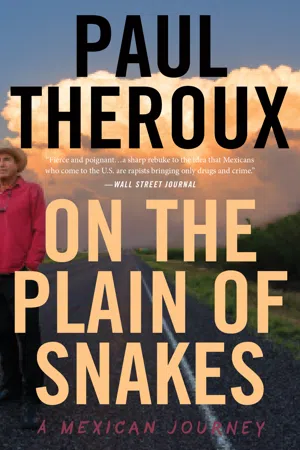
The legendary travel writer drives the entire length of the US–Mexico border, then takes the back roads of Chiapas and Oaxaca, to uncover the rich, layered world behind the everyday headlines. Paul Theroux has spent his life crisscrossing the globe in search of the histories and peoples that give life to the places they call home. Now, as immigration debates boil around the world, Theroux has set out to explore a country key to understanding our current discourse: Mexico. Just south of the Arizona border, in the desert region of Sonora, he finds a place brimming with vitality, yet visibly marked by both the US Border Patrol to the north and mounting discord from within. With the same humanizing sensibility that he employed in Deep South, Theroux stops to talk with residents, visits Zapotec mill workers in the highlands, and attends a Zapatista party meeting, communing with people of all stripes who remain south of the border even as family members brave the journey north. From the writer praised for his “curiosity and affection for humanity in all its forms” (The New York Times Book Review), On the Plain of Snakes is an exploration of a region in conflict.
- 464 pages
- English
- ePUB (mobile friendly)
- Available on iOS & Android
eBook - ePub
About this book
Information
Topic
Personal DevelopmentSubtopic
Global PoliticsPart Three
Oaxaca, the Inframundo
To Puebla
Leaving the city, thinking of my students and the surprise of the handsome gift left in my car, I was glum with nostalgic melancholy. It was the effect of my detour to the border, my side trip to the coast, the end of the writing workshop. I wasn’t busy anymore. The cure for idleness was to hit the road. I was not sad to leave Mexico City—my heart sings whenever I leave a big city and see the thinning suburbs and first green hills beyond them—but I was sad to leave the students, no longer students, but friends.
My destination was Puebla, and there was a direct route, southeast from where I’d been shaken down. But this would have taken me through Nezahualcóyotl—sinister “Ciudad Neza”—the densest district of Mexico City, and not only the most populous but the most violent, a place of cops much crookeder than the one who had just extorted me on a leafy boulevard in Roma Sur. Neza was notorious for its slums, its seedy underworld, gangs, drugs, and murder—in particular femicides, the rape and killing of women—where I would also be impeded by the slow traffic through its barrios. By taking a detour, I would be in the countryside quicker, and far from the police.
I was soon in Texcoco and driving clockwise around the slopes of Monte Tlaloc, “the ghost mountain,” with a temple to Tlaloc the storm god, the god of rain and fertility, on its summit at 13,600 feet—one of the highest archeological sites in the world, higher than Machu Picchu. Tlaloc is part of a trio of close-together volcanoes, with the 17,000-footers Iztaccíhuatl (the Woman in White) and Popocatépetl (Smoking Mountain). Popocatépetl was still smoking, still erupting, and the grandeur of this trio of steep, symmetrical flanks and peaks was apparent even cloaked in the brown grainy cloudbanks drifting from Mexico City.
A bit farther south I was traveling on the old Camino Real, which linked the great capital to Puebla—the Royal Road in name, but humble in reality, a thoroughfare of farms and cultivated land and small villages, passing through Calpulalpan (celebrated for its annual fair, during which, so the town’s tourist office boasted, “people feast on local specialties—maguey worms, pulque, and owls”). This region of plowed fields provided the food for the big city. Keeping to this straight road, I connected to the autopista, paying a toll and sailing to Puebla.
At a service area near the town of San Martín Texmelucan de Labastida I stopped for gas. By now, as a road tripper, I had become accustomed to the routine of a Mexican pit stop, a model of efficiency and in many respects superior to its equivalent in the US. Because Mexico has abandoned its passenger trains, and depends on eighteen-wheelers to move its freight north to the border and beyond, and on its fleets of long-distance buses, its main highways are well maintained. The off-ramp always leads to the dusty antique past—to the man plowing a stony field with a burro, to the woman with a bundle on her head, to the boy herding goats, to the ranchitos, the carne asada stands, the five-hundred-year-old churches, and a tienda, selling beer and snacks, with a skinny cat asleep on the tamales.
On the main road, the gas pumps at the service area are manned by attendants in uniforms. You drive in, say “Lleno, por favor” or “Llenarlo,” and the fellow fills the tank, washes your windows, earns a tip, and offers his elaborate thanks: “At your service, sir.”
There will always be an OXXO convenience store at the service area, many of them the size of a small supermarket: beer, wine, T-shirts, hats, chips, automotive accessories, fireworks, balloons, lucky charms, first aid supplies, fruit, canned food, plastic toys, magazines, and newspapers. There will probably be a taco stand next door, or a chicken franchise like El Pollo Loco, staffed by pretty girls in paper hats. The restrooms will be guarded by a woman wrapped in a rebozo and wearing an apron. She will greet you and remind you that you will need to insert a 5-peso coin in the turnstile, and she might discreetly hand you four squares of stiff abrasive paper, expecting a tip. An enterprising man might be seated at a table near the gas pumps, selling watermelons or clay pots. In some of the larger service areas between the big cities there might be a brown motel of fake adobe, and some of the smaller ones feature a decent restaurant selling local food.
After the gasoline ritual, I parked and bought two tacos, a cup of coffee, and a copy of El Universal, and sat in the sunshine, reading the paper and blessing my luck. I’d be in Puebla within an hour, and in three or four days—I was in no hurry—in Oaxaca. But no sunny moment in Mexico is without a cloud. On an inside page of the paper, under a photo that looked like a gruesome car crash, I read a news item about how, just the day before, a car—the vandalized and sticky one in the picture—was found in Veracruz with five human heads tied to the hood, the decapitated corpses stacked inside the car. Graffiti scratched into the car’s paint, a narcomensaje, indicated that it was the work of a cartel, the Jalisco New Generation.
“Sending a message” was the usual explanation, an unambiguous message in this case, stating that this cartel was not to be trifled with. In 2017 there had been 2,200 criminal homicides in Veracruz state, most of them cartel related.
From here to Puebla, every flat area of the fertile landscape was a cultivated field—hardly a tree in sight—smallholdings of green vegetables, onions or cabbages, lettuce or tomatoes. In the north, I had been used to seeing cactus and bleak stretches of desert, roads of washboard gravel, but here in southerly Puebla state the land was fertile, the fields were green, and people were hoeing, their backs bent, clawing at the soil, the iconic postures of peasants.
Passing Cholula, I thought of stopping for the night, but the traffic began to pile up around me, and pretty soon I was shouldered off the motorway by honking cars and, in a maze of narrow streets, going in the wrong direction. I knew I was lost—or at least far from the center of the city—because the streets were slanted and asymmetrical. The oldest parts of a Mexican city, surveyed and laid out by the Spanish, were always arranged in a tight grid of right angles.
I pulled off the road, consulted the map on my phone, and got my bearings. But I was still in a single crawl of traffic on back streets, nowhere near the center of Puebla, passing a residential area of walled-in bungalows, cringing dogs, and tire repair shops.
Such is the revelation of the road trip. Someone says, “We spent a week in Puebla,” and the name seems magical: colonial churches, houses roofed with red tiles, the Zócalo lined with cafés and arcades, mole poblano drizzled on chicken, brassy music, perhaps folkloric dancing—twirling skirts, stamping feet, shoeshine stalls and balloon sellers, the locals strolling, some of the women outfitted in the Frida Kahlo style, with the colorful Puebla dress, the china poblana outfit of an embroidered blouse and full skirt, perhaps a tiara of pompoms and a shawl and an apron thick with floral stitching. All that is accurate, but there is more.
Here is the reality. Puebla is not the compact colonial city it once was. No Mexican city with a romantic name fits that description. Never mind that it is more than five hundred years old. Puebla is a sprawling metropolis of more than four million people, with a Walmart and shopping malls and factories—one of the biggest textile factories in Mexico. It has a Volkswagen plant, another making Hyundais, and eleven industrial parks. Also the industry for which Puebla is most famous, the making of Talavera ceramics—nine such workshops.
There is not a big city in Mexico—no matter how charming its plaza, how atmospheric its cathedral, how wonderful its food, or how illustrious its schools—that is not in some way fundamentally grim, with a big-box store, a Sam’s Club, and an industrial area, a periphery of urban ugliness that makes your heart sink. Because this is in Mundo Mexico, on the plain of snakes, its citizens are overlooked by the government, its workers exploited and underpaid, its teachers belittled, nearly all its city dwellers living in small spaces. But the people are making the best of it, because it was my experience that Mexicans might be mockers and teasers, but they are not idle complainers.
When an oppressed group in Mexico airs a grievance, it doesn’t mumble. It takes to the streets with resolve, holds a demonstration in the main plaza, camps out in front of a ministry in a defiant vigil, burns a bus, blocks a motorway, or, in the case of the Zapatistas in Chiapas, arrives on horseback out of the jungle and declares an insurrection, taking over an entire state and eventually running it so well that the government (out of shame or indifference or confusion) turns its back on the rebels, pretends they don’t exist, and allows them to create a better way of life.
I made my way through the Puebla suburbs, into the numbered streets and the square blocks, following the signs pointing to centro histórico. Passing an older but solid hotel, its brick facade decorated with Talaveras, on a corner next to a church—the Hotel San José—I parked and ran inside. Yes, they had plenty of rooms, $50 a night, walking distance to the Zócalo and the museums. And that became my home for four nights.
After a long drive and a long walk, I strolled around the Zócalo, where a klezmer group was playing. Klezmer? Yes, violins, guitars, a drum, a trumpet, a trombone. Two players were bearded, in black vests and black fedoras. None were Jewish, they told me later; they simply loved the sound. They had seen videos of klezmer music on the internet and decided to learn how to play its strangulated and sobbing tremolos, its flatulent oompahs, its Bulgarian syncopations, and its Polish mazurkas, bewitching the many Mexicans who crowded the arcade to hear it. One child was provoked to a stumbling dance at the feet of the fiddler, who was sawing his heart out with his eyes shut.
Looking for the famous seventeenth-century paintings in the cathedral on the Zócalo the next day, I was distracted by a scene that reached back to the Spanish conquest: a tall, white-robed bishop in a sparkly white miter, carrying a gold shepherd’s crook, a white giant walking among a congregation of much smaller, much darker people. The bishop was attended by a priest in purple vestments, bearing a bucket. Wielding a dripping silver aspergillum—the knobbed, hand-held sprinkling instrument—the bishop spattered holy water on the upturned faces of the faithful, bringing pious smiles of gratitude to those ritually moistened.
The paintings were soot-darkened and severe, the Altar of the Kings (of Spain) was overpainted and garish, containing the sculpted images of the kings, patrons of the church residing in niches. But two items stood out. One was a glass coffin with a life-size model of the naked Christ inside, lying supine, his tortured eyes turned toward heaven and covered in blood and deeply scored with spectacular lacerations. This was not old, but it was gory enough to be alarming.
And at a side altar, a painting depicting Father Miguel Pro, his arms extended as though crucified, being shot by a firing squad. This image, too, was fairly sooty, but I remembered the name of Father Pro from Graham Greene. He was fondly recalled by Greene in 1938 as the priest who had returned from studying in Europe to serve the faithful in 1926, when the anticlerical laws were being strictly enforced. Celebrating Mass in secret, in defiance of the government, Father Pro was arrested in 1927 on a trumped-up charge of attempting to assassinate a general (Obregón, who was later killed by a militant Catholic for his anticlericalism). Far from quelling the Cristero Rebellion, the execution of Father Pro—as shown in the painting—gave the Cristeros a martyr. And the atmosphere of persecution provided Graham Greene with a plot: godless politicians, brutish soldiers, God-fearing peasants, churches under siege, and priests ministering the sacraments in covert rituals.
What Greene did not mention was that the churches reopened in 1929, except in the two reluctant states where he was traveling, and that the Cristero rebels were militant, crudely armed, but passionate Catholics, willing to commit murder for their faith—a formidable army howling “Viva Cristo Rey!” and gunning for infidels. Though the states of Tabasco and Chiapas were suffering the vandalism of their churches, Mexico was being governed by Lázaro Cárdenas, a man mildly disparaged by Greene, whom most Mexicans believe to have been their most enlightened president. Cárdenas was a pacifier: as he repealed the antichurch laws, he was trying to mollify the Cristeros in some states, and the persecutors of the Catholics in other states, while at the same time fending off foreign petrocrats and nationalizing the oil companies.
Puebla was an interlude in my road trip south, a four-day touristic pit stop. I fueled my walks with Puebla’s wonderful food: mole poblano—goopy, spiced chocolate sauce over chicken; memelas—corn cakes topped with cheese and tomato; molotes—stuffed pastry; chalupas topped with salsa and shredded meat. Hearty meals, stuffed buns, sticky sauces, and street food.
A museumgoer when I have nothing better to do, I avoid writing much about collections, because a visitor should enter a museum innocent of what’s to come, be allowed to make discoveries, and not be nagged into seeing specific works. I had been humbled by the museums in Mexico City, especially by the treasures in the National Museum of Anthropology—the giant Olmec heads, the skull with staring bejeweled eyes and overlaid with a mosaic of turquoise, Moctezuma’s feathered headdress, and glittering mortuary masks, items harvested from ruins and tombs all over Mexico.
There were no treasures in Puebla’s Museo Amparo to equal those. The Amparo’s small collection was housed in two old stone buildings on a side street. But I found something remarkable there, a Mexican artist obsessed with the grotesqueries of modern Mexico. Among the colonial paintings and ancient stone carvings was an artist I’d never heard of and who seemed to me a true original. This was Yoshua Okón, who described himself as a performance artist. Young (born in 1970) and widely traveled, he made videos as well as installations and sculptures. One of the sculptures in the Museo Amparo was a shimmering object of chrome and cast bronze, a thing of singular beauty that looked like a throne. And in a manner of speaking it was one, as its label stated: El Excusado / The Toilet. It was a superior hopper, as arresting as an Edward Hopper, of lovely proportions, made in the shape of the Museo Soumaya, “an emblem of Carlos Slim’s telecommunication empire” and intended to mock both Slim’s museum (the Soumaya, in Mexico City) and Slim’s wealth, succeeding at both with devastating Mexican mockery.
Looping around that room was Okón’s installation titled HCl, a symmetrical series of acrylic pipes, each pipe about six inches in diameter and running up and down the walls of two rooms, attractive as a well-made industrial masterpiece depicting the austere geometry of plumbing. This too, at first glance, was a wonderful thing, for the way the bold pipes surrounded the room. The pipes vividly churned with brownish-gray liquid, and the whole business was operated by a gulping, pumping contraption, as impressively made as Carlos Slim’s scale-model art museum that was also a “functioning, luxury” toilet.
“HCl is the formula for hydrochloric acid,” the label began, and explained that this acid is an aid to human digestion. Then the unexpected detail: the see-through pipes were filled with human vomit, “donated by anonymous patients from a bulimic clinic.” You admire the artistry and form, and then, told what ...
Table of contents
- Title Page
- Contents
- Copyright
- Epigraph
- Prologue
- Borderlands
- Mexico Mundo
- Oaxaca, the Inframundo
- The Road to Nueva Maravilla
- The Way Back
- Photos
- Read More from Paul Theroux
- About the Author
- Connect with HMH
- Footnotes
Trusted by 375,005 students
Access to over 1.5 million titles for a fair monthly price.
Study more efficiently using our study tools.
Frequently asked questions
Yes, you can cancel anytime from the Subscription tab in your account settings on the Perlego website. Your subscription will stay active until the end of your current billing period. Learn how to cancel your subscription
No, books cannot be downloaded as external files, such as PDFs, for use outside of Perlego. However, you can download books within the Perlego app for offline reading on mobile or tablet. Learn how to download books offline
Perlego offers two plans: Essential and Complete
- Essential is ideal for learners and professionals who enjoy exploring a wide range of subjects. Access the Essential Library with 800,000+ trusted titles and best-sellers across business, personal growth, and the humanities. Includes unlimited reading time and Standard Read Aloud voice.
- Complete: Perfect for advanced learners and researchers needing full, unrestricted access. Unlock 1.5M+ books across hundreds of subjects, including academic and specialized titles. The Complete Plan also includes advanced features like Premium Read Aloud and Research Assistant.
We are an online textbook subscription service, where you can get access to an entire online library for less than the price of a single book per month. With over 1.5 million books across 990+ topics, we’ve got you covered! Learn about our mission
Look out for the read-aloud symbol on your next book to see if you can listen to it. The read-aloud tool reads text aloud for you, highlighting the text as it is being read. You can pause it, speed it up and slow it down. Learn more about Read Aloud
Yes! You can use the Perlego app on both iOS and Android devices to read anytime, anywhere — even offline. Perfect for commutes or when you’re on the go.
Please note we cannot support devices running on iOS 13 and Android 7 or earlier. Learn more about using the app
Please note we cannot support devices running on iOS 13 and Android 7 or earlier. Learn more about using the app
Yes, you can access On The Plain Of Snakes by Paul Theroux in PDF and/or ePUB format, as well as other popular books in Personal Development & Global Politics. We have over 1.5 million books available in our catalogue for you to explore.