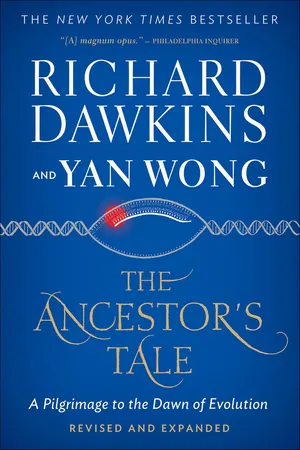
The renowned biologist and thinker Richard Dawkins presents his most expansive work in this revised edition that offers a comprehensive look at evolution.
Loosely based on the form of Chaucer's
Canterbury Tales, Dawkins's tale takes us modern humans back through four billion years of life on our planet. As the pilgrimage progresses, we join with other organisms at the forty "rendezvous points" where we find a common ancestor. The band of pilgrims swells into a vast crowd as we join first with other primates, then with other mammals, and so on back to the first primordial organism.
Dawkins's brilliant, inventive approach allows us to view the connections between ourselves and all other life in a bracingly novel way. It also lets him shed bright new light on the most compelling aspects of evolutionary history and theory: sexual selection, speciation, convergent evolution, extinction, genetics, plate tectonics, geographical dispersal, and more.
The Ancestor's Tale is at once a far-reaching survey of the latest, best thinking on biology and a fascinating history of life on Earth. Here Dawkins shows us how remarkable we are, how astonishing our history, and how intimate our relationship with the rest of the living world.
- 800 pages
- English
- ePUB (mobile friendly)
- Available on iOS & Android
eBook - ePub
About this book
Information
Topic
Ciencias biológicasSubtopic
EvoluciónRendezvous 1
CHIMPANZEES
Between 5 and 7 million years ago, somewhere in Africa, we human pilgrims enjoy a momentous encounter. It is Rendezvous 1, our first meeting with pilgrims from another species. Two other species to be precise, for the band that joins us here consists of two living representatives: common chimpanzees and pygmy chimpanzees, or bonobos. By the time we meet them, these pilgrims have already joined forces: their rendezvous with each other took place perhaps 2 million years ago, far more recently than their rendezvous with us. The common ancestor we share with them, Concestor 1, is our 250,000-greats-grandparent—an approximate guess this, of course, like the comparable estimates that I shall be making for other concestors.
As we approach Rendezvous 1, then, the chimpanzee pilgrims are approaching the same point from another direction. Unfortunately we know very little about that other direction. Although Africa has yielded up some thousands of hominid fossils or fragments of fossils, the only fossils which can definitely be regarded as along the chimpanzee line of descent from Concestor 1 are a few recent teeth from Kenya. This may be because chimpanzees are forest animals, and the leaf litter of forest floors is not friendly to fossils. Whatever the reason, it means that the chimpanzee pilgrims are effectively searching blind. Their equivalent contemporaries of the Turkana Boy, of 1470, of Mrs Ples, Lucy, Little Foot, Dear Boy and the rest of ‘our’ fossils—have never been found.
Nevertheless, in our fantasy the chimpanzee pilgrims meet us in some Miocene forest clearing, and their dark brown eyes, like our less predictable ones, are fixed upon Concestor 1: their ancestor as well as ours. In trying to imagine the shared ancestor, an obvious question to ask is, is it more like modern chimpanzees or modern humans, is it intermediate, or completely different from either?
Notwithstanding the pleasing speculation that ended the previous section—which I would by no means rule out—the prudent answer is that Concestor 1 was more like a chimpanzee, if only because chimpanzees are more like the rest of the apes than humans are. Humans are the odd ones out among apes, both living and fossil. Which is only to say that more visible change has occurred along the human line of descent from the common ancestor, than along the lines leading to the chimpanzees. We must not assume, as many laymen do, that our ancestors were chimpanzees, or like them in all respects. The very phrase ‘missing link’ is suggestive of this misunderstanding. You still hear people saying things like, ‘Well, if we are descended from chimpanzees, why are there still chimpanzees around?’

Chimpanzees join. There are over 2 million species on earth. To show them all on a single evolutionary tree, we use the fractal representation pioneered by James Rosindell [364]. This zoomed-in region of the tree shows the branch containing ourselves and our closest relatives, the two species of chimpanzee. The dark line from humans back up the branch marks our journey into the past. Note that the length and width of the branches and the size of the circles for each species have no specific meaning: they are simply chosen to fit into the available space.
Dates on this tree, in millions of years ago (Ma), are indicated by contour lines. These show that the concestor of common chimpanzees and bonobos is thought to have lived slightly less than 2 million years ago. Concestor 1, the most recent common ancestor of humans and chimpanzees, probably lived around 6 million years ago. This is Rendezvous 1, marked by a numbered circle with a date.
Branches in the tree appear solid, but are better imagined as an enormous genealogical network, as in the schematic illustration at Rendezvous 0. Within this pedigree, most genes unite somewhat further back in time than the rendezvous. This results in some genes showing relationships at odds with those shown here, for example tying humans more closely to common chimpanzees than to bonobos. This is the topic of the Bonobo’s Tale.
So, when we and the chimpanzee/bonobo pilgrims meet at the rendezvous point, the likelihood is that the shared ancestor that we greet in that Miocene clearing was hairy like a chimpanzee, and had a chimpanzee-sized brain. Reluctantly to set aside the speculations which concluded the previous chapter, it probably moved around using its hands, as well as its feet, although maybe not exactly as chimpanzees do today. It probably spent some time up trees, but also lots of time on the ground, maybe squat feeding as Jonathan Kingdon would say. All available evidence suggests that it lived in Africa, and only in Africa. It probably used and made tools, following local traditions as modern chimpanzees still do. It probably was omnivorous, sometimes hunting, but with a preference for fruit.
Bonobos have been seen to kill duikers, but hunting is more frequently documented for common chimpanzees, including highly co-ordinated group pursuits of colobus monkeys. But meat is only a supplement to fruit, which is the main diet of both species. Jane Goodall, who first discovered hunting and intergroup warfare in chimpanzees, was also the first to report their now famous habit of termite fishing, using tools of their own construction. Bonobos have not been seen to do this, but that may be because they have been studied less. Common chimpanzees in different parts of Africa develop local traditions of tool use. Where Jane Goodall’s animals on the east side of the range fish for termites, other groups to the west have developed local traditions of cracking nuts using stone or wood hammers and anvils. Some skill is required. You have to hit hard enough to break the kernel but not so hard as to pulp the nut itself.
Although often spoken of as a new and exciting discovery, by the way, nut cracking was mentioned by Darwin in Chapter 3 of The Descent of Man (1871):
It has often been said that no animal uses any tool; but the chimpanzee in a state of nature cracks a native fruit, somewhat like a walnut, with a stone.
The evidence cited by Darwin (a report by a missionary in Liberia in the 1843 issue of the Boston Journal of Natural History) is brief and non-specific. It simply states that ‘the Troglodytes niger, or Black Orang of Africa’ is fond of a species of unidentified nut, which ‘they crack with stones precisely in the manner of human beings’.
The especially interesting thing about nut cracking, termite fishing and other such chimpanzee habits is that local groups have local customs, handed down locally. This is true culture. Local cultures extend to social habits and manners. For example, one local group in the Mahale Mountains in Tanzania has a particular style of social grooming known as the grooming hand clasp. The same gesture has been seen in another population in the Kibale forest in Uganda. But it has never been seen in Jane Goodall’s intensively studied population at Gombe Stream. Interestingly, this gesture also spontaneously arose and spread among a captive group of chimpanzees.
If both species of modern chimpanzee used tools in the wild as we do, this would encourage us to think that Concestor 1 probably did too. I think it probably did—even though bonobos have not been seen using tools in the wild, they are adept tool-users in captivity. The fact that common chimpanzees use different tools in different areas, following local traditions, suggests to me that lack of such a tradition in a particular area should not be taken as negative evidence. After all, Jane Goodall’s Gombe Stream chimpanzees haven’t been seen to crack nuts. Presumably they would, if the West African nut-cracking tradition were introduced to them. I suspect that the same might be true of bonobos. Maybe they just haven’t been studied enough in the wild. In any case, I think the indications are strong enough that Concestor 1 made and used tools. This idea is strengthened by the fact that tool use also occurs in wild orang utans, local populations again differing in ways that suggest local traditions. And tool use is widespread among mammals and birds, as Jane Goodall herself (among others) has documented.
The present-day representatives of the chimpanzee lineage are both forest apes, whereas we are savannah apes, more like baboons except, of course, that baboons are not apes at all but monkeys. Bonobos today are confined to the forests south of the great curve of the River Congo and north of its tributary the Kasai. Common chimpanzees inhabit a wider belt of the continent, north of the Congo, westward to the coast, and extending as far as the Rift Valley in the east.
As we shall see in the Cichlid’s Tale, current Darwinian orthodoxy suggests that usually, in order for an ancestral species to split into two daughter species, there is an initial, accidental separation between them, often geographical. Without the geographical barrier, sexual mixing of the two gene pools keeps them together. It is plausible that the great Congo river provided the barrier to gene flow which assisted the evolutionary divergence of the two chimpanzee species from each other, a few million years ago.
Geography also divides each of the other great ape lineages into two species: the western and eastern gorillas, and the Bornean and Sumatran orang utans. This might lead us to suspect that some sort of geographical separation was responsible for dividing the population that was to become humans from that which was to become chimpanzees. One candidate is the emergence of the Great Rift Valley and the east-west climatic differences that it generated. Recent discoveries have rendered this idea unfashionable. Half-a-million-year-old chimpanzee teeth from Kenya show that chimps are not purely a West African species, as once thought. Neither are early hominids solely East African any more: the ‘Toumai’ skull comes from Chad, thousands of miles to the west of the Rift Valley, as does the younger and more poorly known Australopithecus bahrelghazali.
Whether or not it was the Great Rift Valley, or another feature of geography, some ancestral population of apes must have split in two, leaving as evidence humans on one side and the chimpanzees (including bonobos) on the other. The traces of this split are strewn across our genomes, and the details will occupy our next two tales.
PROLOGUE TO THE CHIMPANZEE’S TALE
Chimpanzees fascinate us because they bear comparison to ourselves. The Chimpanzee’s Tale compares human and chimpanzee genomes, which can help us to date Rendezvous 1. Before that, it is worth tackling a couple of oft-asked questions that crop up when carrying out such comparisons.
The most common question sounds simple: by what percentage does the chimp genome differ from that of humans? It turns out to be rather tricky to answer, largely because of problems of definition. A reasonable analogy might be made with two different edits of a book. Edits involve deleting sentences and changing words, but can also encompass all sorts of other copy-and-paste changes such as moving paragraphs or even whole chapters around. That makes it hard to put an exact value on the degree of difference between the two end products. Similarly, large chunks of DNA move around the genome during evolution. For example, there is incontrovertible evidence that our chromosome 2 was formed by pasting together two great ape chromosomes, which explains why humans have 23 pairs of chromosomes and the rest of the great apes have 24. It is not a clear choice whether we should count this as a very large mutation, or (given that the genes themselves have been kept) as a rather minor one.
Smaller sections of DNA can be duplicated or excised too, and it has been estimated that these ‘indels’ (insertion/deletion differences) number about 5 million, covering an estimated 3 per cent of the genome. But it would be misleading to equate this to a 3 per cent difference between our genomes, because in one sense a duplicated section is not different at all. Would a duplicated page in this book count as a difference of (say) 400 words from the original? Or would it just be a single ‘difference’? To set aside that semantic issue, we can match fragments of DNA from humans and chimps, then focus on small, single-letter differences. Compared to indels, there are far more of these ‘single nucleotide changes’, around 35 million, but they cover a smaller fraction of the genome: just over 1 per cent. In this very limited sense, we might say that chimps and humans are roughly 98–99 per cent similar. Bear in mind, however, that this not only omits indels, but also regions which are so different that human and chimp sequences can’t be matched, common in certain gene-poor regions, in particular the Y chromosome.
Another common question is where these genetic differences lie. Again, this turns out to require qualification, because about half of our DNA is parasitic ‘junk’, and much of the rest is probably unused. Conventional ‘genes’ that code for proteins only account for between 1 and 2 per cent of human (and chimp) DNA. Perhaps another 8 per cent is useful in other ways (some is used for turning genes on or off, other sequences have an as yet unknown function). In other words, only about 10 per cent of our DNA consists of actively useful sequences. These regions experience rather little change over evolutionary time. It is the remaining 90 per cent of the genome where we differ most from chimpanzees, since this is where any mutation can happen without much effect—where the accumulated changes are invisible to natural selection.
A more incisive question is where the significant genetic differences between humans and chimps lie: those that are responsible for our contrasting forms and behaviour. A knotty problem. It involves working out what our various DNA sequences actually do: a major (if not the major) task for biologists of the future. Preliminary studies indicate that many important differences affect not so much the protein-coding genes, but the DNA sequences that switch these genes on and off. This intriguing topic is the focus of the Mouse’s Tale. Here in the Chimpanzee’s Tale, we are not interested in the few significant mutations, but in the many that have no effect, and are free to accumulate over time. It is these that can be used to date our current rendezvous.
THE CHIMPANZEE’S TALE
The word ‘mutation’ conjures up images of grotesquely distorted creatures, perhaps generated by unscrupulous experimenters, or springing up as a consequence of some radioactive catastrophe. The truth is somewhat different. We are all mutants. The DNA passed on to us from our parents contains novel changes—mutations—which were not present in the DNA that they inherited from their parents. Fortunately so, for mutations provide the raw material, sculpted over millennia by natural selection, used to build the bodies of all the pilgrims on our journey. How many new mutations do we each inherit? That is the topic of the Chimpanzee’s Tale, of particular interest because this ‘mutation rate’ is used to calibrate the timescale of human evolution.
There are many types of mutation, and there are many different mutation rates. In this tale we are only concerned with single letter mutations, which are mostly due to mistakes made when copying DNA. How many DNA letters can be copied, on average, before an uncorrected typo slips in? We don’t know for sure, but biochemical observations suggest a range of once every 1 billion to once every 100 billion letters copied. The problem is that this error rate varies, and it is tricky to measure such a tiny number with any accuracy. To do so requires examining huge numbers of copying events.
We have a few options. One possibility is to look at a small section of DNA over many millions of copying events. Indirectly, that is what we are doing when we compare a gene between a human and a chimpanzee. Another possibility is to focus on one gene in many millions of individuals, as in a particular study that counted all the novel instances of haemophilia mutations in the USA. Finally, with modern DNA sequencing technology, we can directly count the number of mutations we pass on to our offspring, by sequencing the 6 billion DNA letters in a child and comparing those to both its parents. This direct method is currently threatening to double many previously established dates in human evolution. To understand why requires some background detail.
Before the molecular era, fossil discoveries suggested that the ancestors of chimps and humans split apart more than 15 million years ago. In a now famous paper from 1967, Vincent Sarich and Allan Wilson from Berkeley threw down a major challenge to these dates, claiming that molecular similarities argued for closer to 5 million years. In lieu of being able to read DNA directly, or even using protein sequences encoded by genes, Sarich and Wilson took an indirect measure: the strength of antibody reactions against a particular protein, in their case a blood protein called albumin. Any animal with an immune system would serve: they used rabbits. It’s an ingenious technique. Rabbits are injected with albumin from (say) a human, and their antibodies collected. These anti-human versions react strongly against human albumin of course, but also more weakly against chimpanzee, gorilla and monkey albumin. The strength of reaction is used to measure the similarity between albumin proteins of different species.
Sarich and Wilson’s rabbits revealed that humans, chimpanzees and gorillas were far more similar at the molecular level than expected, their differences accounting for only about a sixth of that between apes and Old World monkeys. As it happened, the split from Old World monkeys could be dated with the hard evidence of fossils. It took place around 30 million years ago, so Sarich and Wilson were able to use this to calibrate their estimate of the split between human and chimpanzee albumins: they put it at 5 million years ago. This is a classic example of using the ‘molecular clock’, something we will meet in earnest in the Epilogue to the Velvet Worm’s Tale. As we shall discuss there, the molecular clock can have problems when the species in question are very different creatures, with radically different rates of molecular evolution. And there can be issues with problematic fossil ‘calibration’ points. Neither problem should apply strongly in the case of the apes and monkeys, however. And indeed the Sarich and Wilson estimate became widely accepted. As geneticists developed more sophisticated techniques for reading and analysing DNA sequences, similar studies tended to agree, more or less, with the original estimates. Until recently, the average date of divergence of chimpanzee and human genes was placed at 6 or perhaps 7 million years ago.
If we take these divergence dates at face value, we can use them to calculate the yearly...
Table of contents
- Title Page
- Contents
- Copyright
- Dedication
- Preface to the Second Edition
- Acknowledgements
- The Conceit of Hindsight
- The General Prologue
- 0 All Humankind
- 1 Chimpanzees
- 2 Gorillas
- 3 Orang Utans
- 4 Gibbons
- 5 Old World Monkeys
- 6 New World Monkeys
- 7 Tarsiers
- 8 Lemurs, Bushbabies and Their Kin
- 9 & 10 Colugos and Tree Shrews
- 11 Rodents and Rabbitkind
- 12 Laurasiatheres
- 13 Xenarthrans and Afrotheres
- 14 Marsupials
- Photos
- 15 Monotremes
- 16 Sauropsids
- 17 Amphibians
- 18 Lungfish
- 19 Coelacanths
- 20 Ray-Finned Fish
- 21 Sharks and Their Kin
- 22 Lampreys and Hagfish
- 23 Sea Squirts
- 24 Lancelets
- 25 Ambulacrarians
- 26 Protostomes
- 27 Acoelomorph Flatworms
- 28 Cnidarians
- 29 Ctenophores
- 30 Placozoans
- 31 Sponges
- 32 Choanoflagellates
- 33 Filastereans
- 34 Drips
- 35 Fungi
- 36 Uncertain
- 37 Amoebozoans
- 38 Light Harvesters and Their Kin
- 39 Archaea
- 40 Eubacteria
- Canterbury
- Further Reading
- Notes to the Phylogenies and Reconstructions
- Bibliography
- Illustration Credits
- Index
- About the Authors
Trusted by 375,005 students
Access to over 1.5 million titles for a fair monthly price.
Study more efficiently using our study tools.
Frequently asked questions
Yes, you can cancel anytime from the Subscription tab in your account settings on the Perlego website. Your subscription will stay active until the end of your current billing period. Learn how to cancel your subscription
No, books cannot be downloaded as external files, such as PDFs, for use outside of Perlego. However, you can download books within the Perlego app for offline reading on mobile or tablet. Learn how to download books offline
Perlego offers two plans: Essential and Complete
- Essential is ideal for learners and professionals who enjoy exploring a wide range of subjects. Access the Essential Library with 800,000+ trusted titles and best-sellers across business, personal growth, and the humanities. Includes unlimited reading time and Standard Read Aloud voice.
- Complete: Perfect for advanced learners and researchers needing full, unrestricted access. Unlock 1.5M+ books across hundreds of subjects, including academic and specialized titles. The Complete Plan also includes advanced features like Premium Read Aloud and Research Assistant.
We are an online textbook subscription service, where you can get access to an entire online library for less than the price of a single book per month. With over 1.5 million books across 990+ topics, we’ve got you covered! Learn about our mission
Look out for the read-aloud symbol on your next book to see if you can listen to it. The read-aloud tool reads text aloud for you, highlighting the text as it is being read. You can pause it, speed it up and slow it down. Learn more about Read Aloud
Yes! You can use the Perlego app on both iOS and Android devices to read anytime, anywhere — even offline. Perfect for commutes or when you’re on the go.
Please note we cannot support devices running on iOS 13 and Android 7 or earlier. Learn more about using the app
Please note we cannot support devices running on iOS 13 and Android 7 or earlier. Learn more about using the app
Yes, you can access The Ancestor's Tale by Richard Dawkins,Yan Wong in PDF and/or ePUB format, as well as other popular books in Ciencias biológicas & Evolución. We have over 1.5 million books available in our catalogue for you to explore.