"A Roots for a new generation, rich in storytelling and steeped in history."
—Kirkus Reviews, starred review
"A compelling saga that gives a voice to those that history tried to erase . . . Poignant and eye-opening, this is a must-read."
—Booklist
In
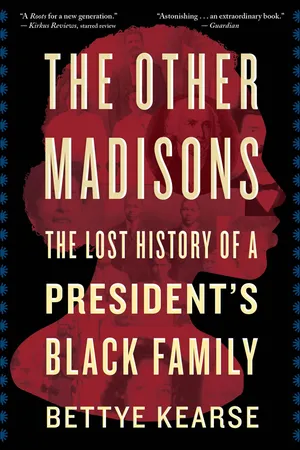
The Other Madisons, Bettye Kearse—a descendant of an enslaved cook and, according to oral tradition, President James Madison—shares her family story and explores the issues of legacy, race, and the powerful consequences of telling the whole truth.
For thousands of years, West African
griots (men) and
griottes (women) have recited the stories of their people. Without this tradition Bettye Kearse would not have known that she is a descendant of President James Madison and his slave, and half-sister, Coreen. In 1990, Bettye became the eighth-generation
griotte for her family. Their credo—"
Always remember—you're a Madison. You come from African slaves and a president"—was intended to be a source of pride, but for her, it echoed with abuses of slavery, including rape and incest.
Confronting those abuses, Bettye embarked on a journey of discovery—of her ancestors, the nation, and herself. She learned that wherever African slaves walked, recorded history silenced their voices and buried their footsteps: beside a slave-holding fortress in Ghana; below a federal building in New York City; and under a brick walkway at James Madison's Virginia plantation. When Bettye tried to confirm the information her ancestors had passed down, she encountered obstacles at every turn.
Part personal quest, part testimony, part historical correction,
The Other Madisons is the saga of an extraordinary American family told by a
griotte in search of the whole story.
- 288 pages
- English
- ePUB (mobile friendly)
- Available on iOS & Android
eBook - ePub
About this book
Information
11
“Visiting”
I never heard my mother use the word sex. For her generation, people born in the early 1900s, sex outside of marriage was a sin. In the 1950s and ’60s, when I was growing up, there were topics no one talked about in public. Television, film, newspapers, and radio followed a code of morality too. It was a world without social media and the internet; unlike today, images and language steeped in sex were not ubiquitous, and privacy was not obsolete.
For my mother and other black women who had escaped the Jim Crow South, and for those who had not, there was also the multigenerational memory of the predatory white male. African-American mothers faced the quandary of how to maintain modesty and decency while warning their daughters about unwanted sex.
Mom often told me stories about our ancestors while she sat at her sewing machine. I recall one I heard when I was eleven.
“What was Coreen’s father’s name?” I asked as I stood waiting for my next round of fittings.
“He was James Madison Sr. His son, the one who became president, was James Madison Jr.” I can still see Mom, hunched over the machine, seeming a little nervous as she continued to sew.
“How did Mandy and the president’s father meet each other?”
Mom explained that Madison Sr. owned colored people. They were his property—his slaves. They had to follow his every order, take care of his every need, and fulfill his every desire. Mandy was one of Madison’s slaves. He was her master. The slaves called him Massa.
“Whenever he felt like it,” Mom said, “Massa could walk into any cabin where slaves lived and visit whichever woman he wanted.”
“Visit?” I asked.
“Yes. Massa went from cabin to cabin. That’s the way it was back then.”
“Like gentlemen visited you before you met Daddy?” I said.
“What I’m talking about is very different,” she said, her eyes on her sewing, her foot pressing harder on the pedal, the needle a flashing blur.
“What’s different?” I asked, struggling to understand what Mom was trying to say.
“What happened to Mandy.”
“What happened to her?” I persisted.
“Mandy attracted the master’s attention because she could pick cotton fast.”
“Did Mandy get a reward for being a good worker?”
“No. Massa punished her.”
“Why?”
Mom looked up at me. “She was his slave.”
“How did he punish her?”
Mom hesitated and looked down again. “I’ll tell you later. Not now. You’re too young.”
“I’m almost twelve,” I complained.
“I know.” She stopped sewing. “When I was your age, I was curious, just like you.”
Gramps was a vivid storyteller, Mom said, but whenever she asked him about Mandy and the massa, he would change the subject. One day, Mom decided to ask her aunt Laura, Gramps’s oldest, and rather grumpy, sister. They were alone in the kitchen. Aunt Laura was facing the stove, frying chicken in a big iron skillet.
“Aunt Laura,” my mother said, “what did President Madison’s father do to Mandy?”
Aunt Laura whirled around, the chicken sizzling, the grease popping behind her. She was a big woman; now she looked even bigger. “Ruby,” she said, glaring and waving a long fork, “don’t bother me with that kind of question. I don’t remember none of that old stuff. Besides, you’re too young. Forget about it.”
As I stood beside her sewing machine, Mom looked me in the eye and said, “My aunt was right. Eleven is too young.”
For help with teaching my brother and me about sex and other important day-to-day concerns, Mom turned to Jack and Jill of America, a national organization founded in 1938 to inform, encourage, and inspire black youths. Our parents enrolled the two of us in the Oakland chapter. Meetings took place in members’ homes, safe places to approach uncomfortable issues. Though Jack and Jillers had serious discussions, we also had fun. We bowled, played tennis, and went horseback riding. The moms took us to lectures, museums, operas, ballets, and concerts. The dads showed up at the picnics.
The first time I heard the word sex was at a meeting in 1956. I was thirteen. The early-teens group had gathered in the Waltons’ house, an expanse of stuffy rooms overfilled with ornate furniture encased in thick plastic slipcovers. My mom’s close friend Edwina Walton, a tan-colored woman with tightly curled graying hair, wore an ill-fitting mauve dress, black flats, and a strand of pearls. Her favorite topics were “proper behavior” and “good morals.” It was often difficult to figure out what she was trying to tell us. She was an articulate, haughty woman, but that day, standing in the center of her harshly lit living room, her voice was shaky and halting.
“Who knows how babies are made?” she asked out of the blue. My mother had not told me what the topic of the meeting would be.
We all looked at each other. Leon, a rambunctious, athletic boy wearing a blue blazer, his shirttail hanging out, threw up his hand.
“You go all the way,” he announced.
Surprised, Mrs. Walton asked, “What does that mean?”
“It means you do it.” Leon grinned.
There were a few snickers.
She persisted. “Who does what?”
“A boy and a girl have sex,” he answered.
Mrs. Walton turned red, stiffened, and stepped toward him. “That’s an ugly thought, young man.” Leon slouched in his chair. “A man and a woman get married, and then what they do together is called ‘making love.’” She continued, placing her hands over her heart. “And it’s a beautiful union of their hearts and souls.”
That’s weird, I thought, the backs of my bare arms sticking to the hard plastic of the sofa.
Some of my fellow Jack and Jillers looked amused, others confused, like me. Not one of us said a word. I didn’t believe Leon knew what he was talking about, so I thought Mrs. Walton was going to answer the question herself. But she turned away from Leon, clapped her hands, and said to the group, “Mildred Thompson will hold the next meeting, and you will have a debating contest about the pros and cons of the freedom of speech.”
Linda, who was a little older than the rest of us, said, “We should choose teams by sex.” She giggled, and a few others joined her.
I held my breath as Mrs. Walton twisted her necklace and glared at Linda. “The children on my right, team A, will discuss the pros; those on my left, team B, will discuss the cons,” Mrs. Walton said. “You may use any research materials you like—library books, encyclopedias, magazines, newspapers, and so forth. Each group will choose a captain, and he or she will come up with an outline of the key points of the team’s argument. That’s what you will talk about next time.”
The meeting was over, and the only thing we had learned about sex was that grown-ups didn’t know how to tell us about it. As we gathered our things, Mrs. Walton looked relieved.
Over the years, the Jack and Jillers met at different homes and discussed many topics, but never again did we talk about sex. From time to time, my mother would try to talk to my brother and me about it, but her message was elusive and often odd. I remember her saying, “After Mommy and Daddy got married, we slept together, then, nine months later, Bettye, you popped out, and seven years after that, Biff, you popped out too.”
For my fifteenth birthday, Mom and I redecorated my room. I chose pink paint for the walls, and she designed the curtains, bed covering, and skirt around the vanity, all in white organdy with wide ruffles along the edges. As a finishing touch, Mom bought a white rug with pink roses.
One evening, Mom tapped on my door.
I felt grown up sitting at the kidney-shaped dressing table with its three-way mirror and reflecting tabletop, arranging bottles of cologne and trying out different shades of lipstick. “Come in,” I said.
Mom opened the door as I was applying Persian Melon to my lips. She wore a pale blue shirtwaist dress and a floral-print apron.
“That lipstick is perfect for a Sunday-afternoon lady,” she said, standing beside the dressing table. “It’s not gaudy like Saturday-night gals wear. Those Jezebels smear on a ton of makeup, squeeze into low-cut, skintight dresses, then go to nightclubs and try to attract men.”
I waited for Mom to tell me what happened next.
“Dinner’s about ready,” Mom said, turning toward the door. She paused. “I was a Sunday-afternoon lady. When a gentleman came to visit me, he brought flowers, and we sat in the living room with my parents. If he did not greet my parents properly, he was not allowed to come again.”
Mom and Dad expected my brother and me to make them proud and advance the gains that they, and the generations before them, had made. Dad was a founding board member of the First AME Church in Oakland. Every Sunday, I attended service wearing a freshly ironed dress, a hat, white gloves, polished shoes, and sheer stockings. Once home, I could remove the hat and gloves, but I stayed dressed up all day. And I always sat with my ankles crossed.
As Mom sewed and recounted stories from our family saga, I, without realizing it, memorized the many small details. Mom’s narration was usually animated, but when she talked about Mandy becoming pregnant, she didn’t look up from her sewing; her voice was flat, her explanation stunted. She said, “Mandy was not a Jezebel, but she wasn’t married when the massa made her have a baby.” I knew something was missing. The stories not told were as much a part of my family history as the stories told again and again.
When I was almost eighteen, Mom helped me prepare for the senior prom. After I’d gone from shop to shop and tried on dozens of dresses, I discovered a pale blue organdy gown in my mom’s closet. I pulled it out and admired the flower appliqués on the bodice and above the hem.
“Why don’t you wear this anymore?” I asked.
“It’s getting a bit too small.”
“Can I wear it to the prom?”
“Of course, but I’ll have to take it in to make it fit that figure of yours.”
I stood beside her sewing machine, pleased that I was going to wear such a pretty dress. I’d noticed that the dresses she made for me lately, as I was getting ready to go to college, were often cinched at the waist and snug across the breasts and hips. To catch the “right” kind of man someday, I now understood, I was supposed to be a look-but-don’t-touch kind of girl.
Without preamble, Mom said while she made the alterations, “Nobody ever explained ‘visiting’ to me. Aunt Laura and most other folks in the family did not want to remember the past, and for Daddy, even thinking about some issues was not consistent with being a good Christian. Certain matters were not to be discussed, especially between father and daughter. Finally, when I was around your age, I figured out for myself what happened to Mandy.”
“What happened?” It had been years since she had promised me an explanation. By this point, I thought I knew the answer, but I was eager to hear the details.
“When Mandy was fifteen or sixteen,” Mom said, choosing her words carefully, “Madison Sr. took his pleasure with her. As a result, she gave birth to his daughter Coreen. Then, when Coreen became a young woman, his son did exactly the same thing to her. Coreen might have been a little older.”
The sewing machine whirred faster. I knew what Mom was not telling me, and that knowledge was unsettling to both of us. She and I were women too.
When Mom came to deliver the box, some twenty-nine years after the prom, she was still uncomfortable talking about what had happened to Mandy and Coreen. By then, I was married and had my own teenage daughter. I felt awkward talking to Nicole about sex and sexual abuse, but I was clear, and my daughter was tolerant.
My mother, my daughter, and I were far safer than our enslaved ancestors had been, but I knew that for five generations, some of our forebears had been slaves and others had been slaveholders. It was hard to accept that some of our ancestors were victims and that the perpetrators of the crimes against them were family too. Every member of my African-American family, the Other Madisons, I painfully understood, was a product of unwanted sex and incest.
One day during my mother’s visit, we sat together in the living room, the translucent curtains muting the gold of the afternoon sun. My mom spoke, and her hands, resting on her lap, looked pale against the bright fabric of her pantsuit. I envisioned Madison Sr.’s pale hands against Mandy’s nearly black skin. White hands touching dark skin are part of my family’s history.
“In 1797,” Mom said, “Madison Jr. left his political life in Philadelphia and returned to Montpelier. He had represented Virginia at the Continental Congress from 1780 to 1786, played a major role in the writing and ratification of the U.S. Constitution from 1787 to 1789, drafted the Bill of Rights and helped get it ratified in 1791, and served in the U.S. House of Representatives from 1789 to 1797.
But Madison wasn’t satisfied. He felt he had nothing that was truly his. As the oldest son, he was first in line to inherit his father’s assets—the money, the plantation, the business enterprises, and the slaves. He had married the vivacious widow Dolley Payne Todd three years earlier, but when the couple arrived in Virginia, she was the future president’s only ‘possession.’ He wanted more than that. He wanted children. When he married Dolley, she already had a child from her previous marriage. ...
Table of contents
- Title Page
- Contents
- Copyright
- Dedication
- Madison Family Tree
- Prologue
- Mandy
- The New Griotte
- The Box
- Mandy
- Family Stories
- Footsteps
- Living History
- Destination Jim Crow
- The Dentist
- Mandy
- Beads
- The Castle
- The Museum
- “Visiting”
- Mandy
- Sanctuaries
- Mandy
- In Search of the President’s Son
- Elizabeth
- Free!
- Gramps
- New York Memorial
- The Plantation’s Tale
- Mandy
- History, Heritage, Memory
- Mandy
- Acknowledgments
- Image Credits
- Resources
- Reading Group Guide
- Q&A with Bettye Kearse
- About the Author
- Connect with HMH
- Footnotes
Trusted by 375,005 students
Access to over 1.5 million titles for a fair monthly price.
Study more efficiently using our study tools.
Frequently asked questions
Yes, you can cancel anytime from the Subscription tab in your account settings on the Perlego website. Your subscription will stay active until the end of your current billing period. Learn how to cancel your subscription
No, books cannot be downloaded as external files, such as PDFs, for use outside of Perlego. However, you can download books within the Perlego app for offline reading on mobile or tablet. Learn how to download books offline
Perlego offers two plans: Essential and Complete
- Essential is ideal for learners and professionals who enjoy exploring a wide range of subjects. Access the Essential Library with 800,000+ trusted titles and best-sellers across business, personal growth, and the humanities. Includes unlimited reading time and Standard Read Aloud voice.
- Complete: Perfect for advanced learners and researchers needing full, unrestricted access. Unlock 1.5M+ books across hundreds of subjects, including academic and specialized titles. The Complete Plan also includes advanced features like Premium Read Aloud and Research Assistant.
We are an online textbook subscription service, where you can get access to an entire online library for less than the price of a single book per month. With over 1.5 million books across 990+ topics, we’ve got you covered! Learn about our mission
Look out for the read-aloud symbol on your next book to see if you can listen to it. The read-aloud tool reads text aloud for you, highlighting the text as it is being read. You can pause it, speed it up and slow it down. Learn more about Read Aloud
Yes! You can use the Perlego app on both iOS and Android devices to read anytime, anywhere — even offline. Perfect for commutes or when you’re on the go.
Please note we cannot support devices running on iOS 13 and Android 7 or earlier. Learn more about using the app
Please note we cannot support devices running on iOS 13 and Android 7 or earlier. Learn more about using the app
Yes, you can access The Other Madisons by Bettye Kearse in PDF and/or ePUB format, as well as other popular books in Social Sciences & Social Science Biographies. We have over 1.5 million books available in our catalogue for you to explore.