"This is a great book about life at remote bases in Canada's far north as seen by a young English boy who went there by himself to see the world and got more than he could have bargained for. Beautifully written." --Sir Ranulph Fiennes
"As spare, gleaming, and exhilarating as the Arctic wastes and the gentle, stoic Eskimos who had mastery of this realm . . . The book evokes the frozen seas, whale hunts, snow plains and storms that intimidated those rash enough to brave this world, and the traditions, myths, and hunting skills that contoured a bygone way of life . . . His translucent prose is a sparkling and moving record." -- Times (London)
At sixteen, Edward Beauclerk Maurice impulsively signed up with the Hudson's Bay Company -- the Company of Gentleman Adventurers -- and was sent to an isolated trading post in the Canadian Arctic, where there was no telephone or radio and only one ship arrived each year. But the Inuit people who traded there taught him how to track polar bears, build igloos, and survive expeditions in ferocious winter storms. He learned their language and became so immersed in their culture and way of life that children thought he was Inuit himself. When an epidemic struck, Maurice treated the sick using a simple first aid kit, and after a number of the hunters died, he had to start hunting himself, often with women, who soon began to compete for his affections. The young man who in England had never been alone with a woman other than his mother and sisters had come of age in the Arctic.
In The Last Gentleman Adventurer Edward Beauclerk Maurice transports the reader to a time and a way of life now lost forever.
After serving in the New Zealand navy during World War II, Edward Beauclerk Maurice became a bookseller in an English village and rarely traveled again. He died in 2003 as this, his only book, was being readied for publication.
"If you like reality, The Last Gentleman Adventurer will be your cup of tea: a delicious quaff of it. Savor it!" -- Edward Hoagland
"Maurice's memoir supplies a fascinating elegy to a vanishing world." -- Telegraph
"One of those rare writers who will be remembered for turning out one great memoir/travel book . . . He relates these events in a beautiful prose that is quaintly elegant in tone but never archly so . . . Not only a gentleman but a wonderful writer who limited his output to one book, and perhaps that is why it reads so beautifully." -- Sunday Tribune (Dublin)
"Maybe he was exceptional, but the charm of his book lies in its modesty; he makes no claims for himself. His concern was to make a record of some amazing adventures and a vanishing way of life; these are woven into an eye-opening narrative that is suffused with kindliness and an attitude to growing up more restrained but more humane than that prevailing today. A gentleman adventurer indeed." -- Times Educational Supplement
"A deceptively simple account of how he grew to manhood, shaped on one hand by the brutal elements of the Arctic, on the other by the compassionate communities of Inuit who understood them . . . This is a beautifully unadorned, homespun tale with a lack of self-consciousness rare in travel literature . . . I was charmed." -- Benedict Allen, Independent on Sunday
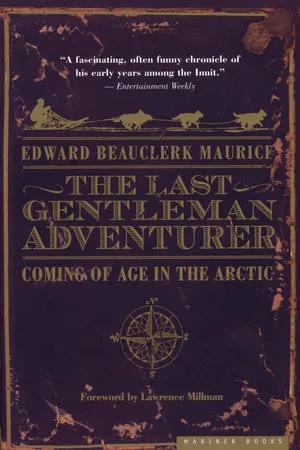
eBook - ePub
The Last Gentleman Adventurer
Coming of Age in the Arctic
- 416 pages
- English
- ePUB (mobile friendly)
- Available on iOS & Android
eBook - ePub
About this book
Information
Topic
StoriaSubtopic
Biografie in ambito storicoII
THE LABRADOR COAST runs in a north-westerly direction, pointing at the top like an outstretched finger across Hudson Straights toward Resolution Island and Baffin Island. The Torngak Range, mountains of the devil, high and menacing, jut out into the straight above Ungava Bay. Straggling still further beyond the mainland, the islands Killineck and the Buttons jostle each other, desolate and barren as if the Almighty, coming to the end of a coastline with a few black and unproductive rocks left over, flung them in one despairing handful into that grey and uninviting sea.
The other end of the coast is less daunting, but still hostile to anyone used to the gentle countryside of southern England. It begins just above the Gulf of St Lawrence and curves round into the Straits of Belle Isle, the strip of water which separates Labrador from the island of Newfoundland. Here, before we had even really entered the northern seas, the elements served up a warning of what we might expect in the higher latitudes.
During the afternoon of the fourth day out from Montreal, the heavy clouds massed threateningly from the north. Slowly they grouped and crept across the darkening sky toward us, then suddenly, just before nightfall, launched their attack. The wind roared down at us, flinging gouts of rain like pieces of metal into the faces of those foolish enough to stray out on deck to see what was happening.
At the height of each gust, the old ship seemed to waver and stop, shuddering helplessly on the crest of the mounting waves, unable to force a passage through the strength of the storm. Then, as the gust slackened, the vessel slid down into the deep beyond, shaking itself free of the holding wind.
Those of us quartered in the after part of the ship were effectively marooned, since to reach the dining saloon and forward parts we had to cross over the barrels with a near certainty of being flung into the sea. The other apprentices did not seem to mind about this, because the pitching and tossing of the ship had removed their interest in food, but I felt deprived at having to content myself with a bar of chocolate for the evening meal.
Any feeling of superiority was quite dispelled during the night, however, for my bunk, which had not been fastened properly to the wall, gave way with the strain of the ship’s movement, flinging me down on to the deck with the mattress and spring on top of me. First aid had to be administered to a gash on my head, necessitating a rather unsightly, bloodstained bandage. My friends thought it much funnier and more undignified that I had fallen out of my bunk (as they soon persuaded themselves) than that they had suffered a bout of seasickness.
Within twenty-four hours the storm calmed almost as quickly as it had risen. We had turned the corner from Belle Isle and were now steaming along the Labrador coast, heading for our first port of call, a settlement called Cartwright.
The harbour was just inside the entrance to a fairly wide bay with an island slanted across the mouth in such a way as to make it almost landlocked. We thought at first that the captain had stopped the ship and dropped anchor to wait until the visibility improved, for all round the vessel there was a low mist stretching to the horizon. Then we noticed straight ahead of us, apparently suspended from the sky, the familiar flag of the Hudson’s Bay Company. Shortly afterwards the fog dispersed sufficiently for us to see that the captain had placed the ship directly in front of the post buildings.
The scenery was not inspiring: a long deep stretch of flat land which looked like marshland or swamp, as if there ought to have been a river delta just ahead of us. We could see no river though, just the flats with some low hills in the distance and, further still, blending almost into the clouds along the horizon but breaking through here and there as a peak or crag, the higher hills of the interior. Just below the buildings, at a jetty pushed out into the bay for about fifty yards or so, a nondescript group of people appeared to be waiting for the Ungava to start unloading.
Dotted across the flats were numerous shack-like erections, with larger single-storey buildings here and there, such as a school and a hospital. The whole outlook was as grey and dull as the day itself, but we soon found that we were not there just as tourists. The group we had seen waiting at the end of the jetty was to come aboard and work in the holds, while we were to go ashore to handle the supplies as they came off the lighters.
Our job was to carry the goods down the full length of the jetty and then across to the store, which was situated beyond the dwelling house. It was hard work and a very long way to those not used to carrying heavy weights, which seemed to be most of us. Under my first sack of flour I nearly sank to my knees, but managed to hold up, much to the disappointment, I am sure, of the first mate, who was standing near by with a grin all over his face waiting for one of us to make a fool of himself. Adding considerably to our discomfort was the fact that the place was infested with vicious mosquitoes, which descended upon us in veritable clouds to sample the blood of the newcomers, so that our first day’s work on the Labrador coast was misery endured rather than a brave step forward.
The apprentice at Cartwright had come out from Scotland two years previously and he warned us not to expect any home comforts. On the evening of his arrival, he had asked the manager where his bedroom was. He had been taken down to the store, shown a mattress squeezed in behind the counter and told that that was his bedroom. He warned us too that a greenhorn in the Arctic was fair game for everyone, especially the old-timers. During his first winter, he had slightly frozen his big toe and had in due course lost the nail. An apparently knowledgeable colleague at the post told him that he must strap the black nail back on to his toe for at least three months, after which time it would have grown back on again. According to our friend he had done this at very great discomfort and not until several weeks later did he discover that his leg had been pulled. I think most of us thought ourselves too clever to be caught out like that, but it was not easy to resist the insistent advice of experienced people, however bizarre it seemed.
The unloading took about twenty-four hours, working quite late into the night and resuming again at daybreak. The mosquitoes attacked relentlessly, but our loads seemed to get less heavy as our muscles became more and more used to the strain, although we were all glad when the last case had been safely deposited in the store. The Ungava did not sail at once, so we had an opportunity to look round our first Hudson’s Bay Company post.
We visited some of the shacks dotted about on the flats. It was rather like stepping back in time, for these homes could well have belonged to a much earlier era. The first thing that met the eye were the outsize texts hanging near the entrance and at other strategic points inside. ‘THE WAGES OF SIN ARE DEATH’, ‘GOD IS LOVE’, ‘JUDGE NOT THAT YE BE NOT JUDGED’ and other sombre messages set the tone. The occupants sat in their homes, prim and formal, surrounded by their possessions as though they were relics of the Victorian peasantry somehow strayed into the twentieth century. They appeared to be of European descent, with perhaps some intermingling of Indian blood and possibly Innuit as well. They understood some English, but could not be drawn into anything but the most conventional conversation.
During the morning of our departure from Cartwright, the man in charge of our group summoned me to his cabin and told me that I was to become the apprentice at a post called Fort Chimo, a small but long-established settlement situated at the head of Ungava Bay. He advised me to seek the advice of a passenger who had just joined us to travel along the coast and who had spent several years at Chimo. Ian Smith was to go to a nearby post, so he joined me in seeking out this man, Bill Ford by name.
We found Bill asleep in his cabin and at first he did not seem to be too pleased at having his rest interrupted, but he mellowed when he discovered we had brought a couple of bottles of beer with us. He sat drinking the beer and dangling his legs over the bunk.
‘Years ago,’ he said, ‘Chimo was almost a small township. The post staff was much larger than it is nowadays. They had people to make barrels, carpenters, interpreters. There were opposition trading companies, a school, a hospital and government officials.’
‘How did the company people get on with the opposition?’ asked Ian.
‘They didn’t have very much to do with each other,’ replied Bill, ‘they didn’t fraternize. If anything went wrong for one of them, the other was always very bucked about it. I remember once that during a gale a boat belonging to the French company Revillon Frères broke away from her moorings. It was a big boat too, about five tons, and the company chaps gathered along the river bank to cheer as she drifted past. The thing went right out to sea and it was several days before they got her back again, with a hole stove in her bow just above the waterline where she had hit a rock.
‘There aren’t many opposition posts left now though. There hasn’t been enough trade for more than one company for the past few years at Chimo and rumour has it that Revillon Frères will be pulling out before long.’
I asked him about the natives in Ungava Bay.
‘The Eskimos live around the shores,’ Bill replied, ‘and the Indians have their camps inland. They’re quite friendly and don’t really come into contact with each other very much. There’s never been any trouble as far as I know. Round the bay, where the Eskimos live, the land is very flat—sometimes I used to wish that the hills were a little higher. The wind comes down from the interior and whistles round the houses during the winter. We had some fair old blizzards. In a real blizzard, you have no idea where you are, the wind can keep changing and you can’t see a thing. One of the Chimo missionaries got caught once coming back from a visit to his flock. He and his Eskimo driver dug themselves into the snow, after struggling as far as they could. They were miserable in what was little better than a hole in the ground for two days. On the third day they were amazed to hear the sound of church bells coming from near by and they struggled out of their holes to find that they had camped almost alongside the missionary’s own house. The bells they had heard was his assistant ringing for the morning service.’
We soon found that Bill Ford, who had spent most of the previous winter alone, inland from Cartwright, needed little persuasion to launch off into his stories of the Labrador coast and Ungava Bay. Sometimes it was quite difficult to stop him, but both Ian and I felt that he never did try to make fools of us, a pastime to which many old-time northerners were willing to devote a considerable amount of time.
We made several stops during our voyage along the Labrador coast. At Makkovik, my star did not at first seem to be in the ascendant. Wearing a new beret, purchased under the French influence of the Montreal shops, I felt quite jaunty as I reached the bottom of the gangway and prepared to climb into the first boat ashore. Unfortunately, at that precise moment the fastening, or whatever it was that held the bottom step in place, broke. The step tilted up into a vertical position, allowing me to slide, quite gracefully they told me, into the water. My efforts to grasp something as I went down simply resulted in me pulling the step back down into position over my head. I was able to tell my friends later that although the water looked calm and inviting enough for a swim, it was really too cold to be enjoyable.
Later on during the afternoon, I rejoined the working party on shore and they kept up their ribaldry at my expense for the rest of the day. We finished the work before teatime and a pleasant surprise awaited us, for the post manager told us that his wife wanted us to go and have a meal with them instead of going back to the ship. His wife, a jolly, cheerful person, did not seem to mind how many of us came. She had cooked a huge dishful of cod steaks in batter and on the table was what looked like an old-time washbasin full of crisp chips. She just stood back and let us help ourselves, laughing with delight at our obvious appreciation. When the fish had all gone, the lady produced an outsize apple pie, then cake and bread and jam for any unfilled corner. She seemed much concerned about my plunge into the sea. Had I dried myself properly? What about my clothes? What was the Hudson’s Bay Company thinking of, bringing children up into the Arctic? I rejected the suggestion that I was a child at sixteen, but she shook her head and said that it was a hard life and a very lonely one.
After we had cleared up the mess and done the washing up, we gathered round an old piano that had been retrieved from a wreck along the coast. The manager played familiar tunes and we sang and laughed and played silly games until it was time to go back to the ship. When we tried to thank them for everything, they said that they hadn’t had such a happy evening for a long time and hoped that one day we might all come back.
Early the next morning we sailed from Makkovik to steam along the central part of the coastline. The scenery improved greatly. There were dozens of islands large and small, where the sea wound in and out in twisting passageways, curious-shaped cliffs and rocks, worn down by time and sea and weather. Birds of all coastal types abounded, from the hungry, cawing gull to the lively little arctic tern.
By the time we reached Hebron, a few days further down the coast, the land was even more impressive, as it rose high and rugged toward the desolate mountains. The weather was fine and sunny and a morning spent on deck was as good as anything an expensive cruise ship could offer.
I found Bill in a cozy spot one morning, behind some boxes, quite sheltered from the slight breeze. He smiled when he saw me.
‘So you tracked me down, eh?’ he said, but showed no reluctance to talk.
‘You wouldn’t think that a fine new ship was lying just beneath the water over there, would you? Not that she would be new now of course.’ He pointed over to the coast and continued.
‘The Bay Rupert. I don’t suppose you ever heard of her. The company had her built after the war. She was a fine ship, much larger than the Nascopie and everything brand spanking new. They put in special accommodation for bringing tourists up here. It was more like travelling on an Atlantic liner than coming up north.’
‘Did you ever sail in her?’ asked Ian.
‘I did indeed,’ said Bill. ‘I got off just before she went down. It seems that there’s a rock along the coast, somewhere hereabouts, which sticks up under the sea but doesn’t break water and there was no buoy there to mark the spot. We were coming along the inside passage in beautiful weather, just like today, with a pilot who was responsible for the navigation. The story was that one evening this man made out the course that they were to follow and the captain said that if he did as the pilot wanted, they would run smack into a rock about breakfast time next morning. Some people said that they had a great row about it, but that the course stayed as it was. The next morning, I was just getting out of my bunk when there was a terrific bump and, sure enough, the skipper was right. I’d never been shipwrecked before and it wasn’t anything like what I had thought it would be. We just got into the boats and they took us ashore, rather as if we were going for a day out, but the ship sank quite quickly and as the water isn’t very deep, it became a kind of treasure trove for all and sundry. Most of the homes along there have to thank the Bay Rupert for some item or another.’
‘What did they do to the pilot?’ I asked.
‘I don’t think that they actually did anything to anybody. There was a great deal of argument as to what had really happened and nobody seemed to know the whole story.’
‘It’s a good thing that it doesn’t happen very often up here,’ Ian said.
‘Oh, round about that time there was a jinx on the company,’ said Bill. ‘Another of the bay boats was lost, the Bay Chimo, but she didn’t sink, not at first anyway. She was trapped by the ice and it seems that she got frozen in during the winter, after they had abandoned her. Later on, she was sighted drifting about in the pack ice, like a sort of ghost ship, somewhere up in the Beaufort Sea, and for all I know she may still be held together by the ice of the Western Arctic!’
Almost as soon as we left Hebron the weather changed and during the night a thick fog closed about us. The captain groped his way at half speed, with frequent blasts of the fog horn, in case any of the wheat boats on their way to or from Churchill were in the vicinity.
We awoke in the morning to find the fog cleared and heard the rattle of the anchor chain going down, signifying our arrival at a post. When Ian and I went out on deck to see where we were, we did not at first believe that we had arrived anywhere. All we could see of the land was what resembled one humped black rock. Bill Ford put us right.
‘Port Burwell,’ he said, ‘and I hope that I never land here for my sins.’
We could see what he meant. This was one of the islands where the Labrador coast straggled off into the arctic seas. Bleak and inhospitable even on a summer’s day, one could well imagine that in the dark grey of the stormy winter the elements would combine to make life as unpleasant as possible.
For once there was little activity, and the dullness of the morning was only enlivened by the arrival of a boatload of Eskimos from the shore. They pulled alongside and one or two of their number came straight aboard the Ungava. The crew made them welcome, then the rest came pouring up the gangway, gabbling away to each other and beaming all over their brown faces. A few of the women wore red or green tartan shawls wrapped around their shoulders, but mainly they were clothed in parkas with deep hoods in which to carry their babies. Underneath they had on ordinary summer dresses made of coloured prints of various designs. Many of them looked as though they had got straight out of bed to come to the ship, and a few as though they had worn their clothes all night. The men all wore parkas with coloured braid round the edges; some had bright knitted head coverings, while one or two sported naval caps with gold straps. The chief man of the boat handled his craft very efficiently.
The stewards produced a large kettle of tea and a box of biscuits and another of the crew brought up a carton of mugs. In a moment the Eskimos were squatting all over the deck downing their tea. Some of the women had brought their babies in their parkas, and every now and then one of them would suddenly run to the side of the ship, to hold baby out over the sea to relieve itself.
They were a happy, cheerful lot and looked to me to fit somewhere between the American Indians and Chinese. When the tea was all drunk, they surged back down the gangway to their boat and chugged off, disappearing round a point of land a few moments later.
Ralph Parsons, the district manager for the whole of the Eastern Arctic, who had himself established most of the posts in the district, arrived in his own Peterhead boat about midday and the ship came to life. Ian and I were sent ashore with the first scowload and were surprised to find that the harbour was just on the other side of the point round which the Eskimos had passed. The little cove was only about a hundred yards in depth, but the opening was quite narrow, so there was good shelter from the open sea.
There was not a lot of cargo to handle as the Nascopie had already unloaded the main supplies, but the goods had to be carried up a long winding walkway as the store had been built on a rise some way back from the shoreline. By now we were becoming quite experienced stevedores and did not provide the ship’s pe...
Table of contents
- Title Page
- Contents
- Frontispiece
- Copyright
- Dedication
- Foreword
- Epigraph
- The Boy
- I
- II
- III
- IV
- V
- VI
- Issumatak
- VII
- VIII
- IX
- X
- XI
- XII
- XIII
- XIV
- XV
- Epilogue
- About the Author
- Connect with HMH
Trusted by 375,005 students
Access to over 1.5 million titles for a fair monthly price.
Study more efficiently using our study tools.
Frequently asked questions
Yes, you can cancel anytime from the Subscription tab in your account settings on the Perlego website. Your subscription will stay active until the end of your current billing period. Learn how to cancel your subscription
No, books cannot be downloaded as external files, such as PDFs, for use outside of Perlego. However, you can download books within the Perlego app for offline reading on mobile or tablet. Learn how to download books offline
Perlego offers two plans: Essential and Complete
- Essential is ideal for learners and professionals who enjoy exploring a wide range of subjects. Access the Essential Library with 800,000+ trusted titles and best-sellers across business, personal growth, and the humanities. Includes unlimited reading time and Standard Read Aloud voice.
- Complete: Perfect for advanced learners and researchers needing full, unrestricted access. Unlock 1.5M+ books across hundreds of subjects, including academic and specialized titles. The Complete Plan also includes advanced features like Premium Read Aloud and Research Assistant.
We are an online textbook subscription service, where you can get access to an entire online library for less than the price of a single book per month. With over 1.5 million books across 990+ topics, we’ve got you covered! Learn about our mission
Look out for the read-aloud symbol on your next book to see if you can listen to it. The read-aloud tool reads text aloud for you, highlighting the text as it is being read. You can pause it, speed it up and slow it down. Learn more about Read Aloud
Yes! You can use the Perlego app on both iOS and Android devices to read anytime, anywhere — even offline. Perfect for commutes or when you’re on the go.
Please note we cannot support devices running on iOS 13 and Android 7 or earlier. Learn more about using the app
Please note we cannot support devices running on iOS 13 and Android 7 or earlier. Learn more about using the app
Yes, you can access The Last Gentleman Adventurer by Edward Beauclerk Maurice,Lawrence Millman in PDF and/or ePUB format, as well as other popular books in Storia & Biografie in ambito storico. We have over 1.5 million books available in our catalogue for you to explore.