The definitive biography of FDR's leadership during WWII, presented here in a single volume—"splendid . . . the memoir Roosevelt didn't get to write" (
New York Times Book Review).
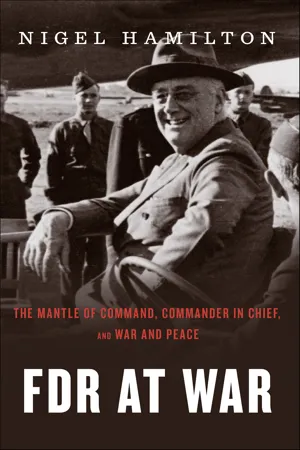
This groundbreaking, three-volume study of President Roosevelt's role as Commander in Chief tells the story of World War II from his perspective. Using hitherto unpublished documents and interviews, Hamilton rewrites the famous account of Allied strategy given by Winston Churchill in his memoirs.
Hamilton reveals, close-up and in dramatic detail, Roosevelt's mastery of strategy, his vision, and how he overcame resistance from Churchill and his own generals to set the course for victory.
Mantle of Command, Commander in Chief, and
War and Peace have been celebrated as "masterly" (
The Wall Street Journal).
"A first-class, lens-changing work." —James N. Mattis, former US secretary of defense
- 1,632 pages
- English
- ePUB (mobile friendly)
- Available on iOS & Android
eBook - ePub
About this book
Information
Part One
Placentia Bay
1
Before the Storm
THE “PLAN OF ESCAPE,” as Roosevelt called it, was simple. It was also deceitful—the sort of adventure that the President, confined to the White House by the burden of his responsibilities as well as his wheelchair, loved. He would pretend to go on a fishing trip on his 165-foot presidential yacht, the USS Potomac, similar to the vacation he had taken earlier in the spring. In reality he would secretly transfer from the “floating White House” to an American battleship or cruiser lying off the New England coast, then race up to Canadian waters to meet with the embattled British prime minister, Mr. Winston Churchill: the man who for more than a year had been leading his country in a lonely struggle against the Third Reich, following the fall of France and most of Europe.
FDR had suggested such a meeting several times since January 1941, when his emissary, Harry Hopkins, first put the idea to Churchill on a visit to London. The purpose was, according to Roosevelt’s own account (which he dictated for the historical record and a magazine article—one that, sadly, he never completed), “to talk over the problem of the defeat of Germany.”1
The proposed date “mentioned at that time,” the President stated in his narrative, was to be “March or April” of that spring. However, the tortuous passage of the vast Lend-Lease bill through Congress and other important legislation made it impossible for him to leave Washington before the early summer, “and by that time the war in Greece—and later the war in Crete—prevented Churchill,” Roosevelt explained. “The trip was mentioned again in May and June,” the President narrated—but talk of such a meeting was overshadowed by a more momentous event than Hitler’s predations in the Mediterranean. For on June 22, 1941, the German invasion of Russia began—Hitler launching several million mobilized German troops in a do-or-die effort to smash the Soviet Union before turning back to the problematic invasion of England.2
And—the U.S. secretary of war, Colonel Henry Stimson, feared—eventual war with the United States.3
Three weeks later a date for the Anglo-American summit “was finally decided”; it would take place, the President and Prime Minister concurred, in a mutually agreed upon location between August 8 and 10, 1941.4 The initial site chosen was the British island of Bermuda. Canada, though, considered by the President to be safer, met with final approval by both leaders.
An official U.S. presidential visit to the capital city of Ottawa was mooted as cover for the meeting, with a secret side trip to the coast allowing Roosevelt to meet Churchill on his arrival. A problem was foreseen, however, in other British Dominion premiers asking to join the powwow. Such a gathering would have raised all sorts of political questions back in Washington, where a suspicious, isolationist Congress would have had to be informed—and involved.
It had thus been decided that only the President and Mr. Churchill would meet, aboard their anchored battleships—preferably in a protected sixty-mile-wide gulf off the Newfoundland coast called Placentia Bay, named for a French naval station that had existed there before the British conquest. Though the waters were Canadian, the naval station at Argentia had been ceded to the United States for ninety-nine years as a quid pro quo in the previous year’s “destroyers for bases” deal to help Britain fight the Nazis. Following its acquisition it had been expanded to provide U.S. Army Air Force protection, and was already handling U.S. Navy minesweepers. Shore-based communications could also be provided, if required. From the President’s perspective, however, it would above all be an American venue—putting the Prime Minister at a disadvantage, in the same way that visitors to Louis XIV were made to climb a thousand steps at Versailles before meeting the French monarch.
“Escape,” for the President, meant, of course, from something, namely the American press: mainstay of the nation’s vigilant democracy, but also a millstone in terms of executive privacy and confidentiality—and security. If word of the prospective meeting leaked, it would endanger not only the President’s life but the Prime Minister’s as well, drawing German U-boats in the North Atlantic to the area.
More threatening to Roosevelt’s presidential authority in a time of continuing isolationism, though, would be the fierce debate aroused across America about the purpose of such a meeting. The majority of the American public (as expressed in opinion polls, which Roosevelt watched carefully)5 remained resolutely opposed to being drawn into the war raging in Europe. At the height of the previous year’s election campaign, the President had given his “most solemn assurance” that there was “no secret treaty, no secret obligation, no secret commitment, no secret understanding in any shape or form, direct or indirect, with any other Government, to involve this nation in any war or for any other purpose.”6 In the summer of 1941 there were still isolationists aplenty—encouraged by Hitler’s turn to the east—watching to see that the President kept his word. Only Congress could declare war—or alter the terms of the November 1939 Neutrality Act.7 For the President to end or breach American neutrality without congressional backing would risk his impeachment.
It was for personal reasons as well that the President was anxious to keep away the press and other voyeurs. He wanted the meeting to be intimate: an opportunity to finally get to know in person the British prime minister, with whom he had begun secretly corresponding in 1939, when Hitler invaded Poland and Churchill was made First Lord of the Admiralty. Once Churchill had become prime minister in May 1940, the President had continued to bypass his own U.S. ambassador to London, the nefarious appeaser and isolationist Joseph P. Kennedy, and the communications between Roosevelt and Churchill had become more and more grave, as the President first agreed to provide American mothballed warships to the British, then brokered through Congress the vast Lend-Lease deal to provide munitions, aircraft, and weapons on credit. Instead of being grateful, however, the Prime Minister kept asking for more—indeed, to the President’s irritation, Churchill had recently told Roosevelt’s emissary in London, Harry Hopkins, that he would be bringing all his military chiefs with him to the Placentia Bay summit. The President therefore had no option but, on Hopkins’s advice, to take with him his own service chiefs: stern General George Marshall, chief of staff of the U.S. Army; bluff but more junior Major General Henry “Hap” Arnold, chief of the U.S. Army Air Forces (the Army Air Corps and GHQ Air Force, which was still a division of the U.S. Army);8 and Admiral Harold R. “Betty” Stark, quiet, bespectacled chief of naval operations. As commander of the Atlantic Fleet, responsible for the small presidential contingent’s safe naval passage to Newfoundland, the irascible and somewhat anti-British Admiral Ernest “Ernie” King would be a party to the summit, too.
On a very hot August 3, 1941, Roosevelt left Washington by train. That evening he embarked on the presidential yacht (which had a crew of fifty-four) at New London’s submarine base, in Connecticut—unaccompanied by the three Associated Press journalists who typically followed Roosevelt in a separate vessel on other such “fishing trips.”
The USS Potomac motored north, anchoring that night off Martha’s Vineyard, across the water from Cape Cod. At dawn the next morning Roosevelt secretly sped away by launch from the two-deck, 376-ton motor yacht, leaving a group of U.S. Secret Service stand-ins to impersonate him and his private guests when it continued its stately way up the Cape Cod Canal. From the shore the white vessel would be (and was) seen and waved to by peacetime summer holidaymakers. In truth the U.S. commander in chief was by then aboard the flagship of Admiral King’s Atlantic Fleet, the USS Augusta: a ninety-two-hundred-ton, six-hundred-feet-long Northampton Class heavy cruiser, manned by more than a thousand sailors and armed with nine eight-inch guns, eight five-inch guns, and six torpedo tubes, lurking off Martha’s Vineyard.
Admiral Stark and General Marshall were already onboard when the President arrived. A handful of other members of the presidential party, including General Arnold, had embarked on an accompanying heavy cruiser, the New Orleans–class USS Tuscaloosa. Escorted by four new American destroyers, the VIPs then sailed north toward a summit that, the officers finally became aware, promised to make history.
Speeding at times at thirty-two knots, the American presidential party raced through patchy fog to reach the Newfoundland rendezvous ahead of time. Roosevelt had not even told his secretary of war, Colonel Stimson, about the conference, nor his secretary of the navy, Mr. Frank Knox—nor even his secretary of state, Mr. Cordell Hull, who was on medical leave. The President had not even told his secretary, Grace Tully! He had only informed General Marshall and Admiral Stark three days before departure—with orders that General Arnold, the air force commander, be invited to attend but not informed of the purpose or destination of the voyage before embarking on the USS Tuscaloosa. There was to be no fraternization, or planning, before the meeting: nothing that could later be denounced as preparatory to a secret agreement or alliance.
By contrast, Prime Minister Winston Churchill had great plans for just such an affiliation.
Buoyed by excitement and hope, Winston Spencer Churchill—son, after all, of an American mother—had ordered his chiefs of staff to draw up a “Future Strategy Paper,” setting out how Britain could win the war if the United States became an ally. He had also proudly sent secret signals to the prime ministers of all the Dominions of the British Empire to let them know of the impending conference—stating that, although none of them had been invited, he “hoped that from the meeting some momentous agreement might be reached.”9 Setting off “with a retinue which Cardinal Wolsey might have envied” (as his private secretary sarcastically noted in his diary),10 the Prime Minister had even written in excitement to Queen Elizabeth, consort of the monarch, to tell her of his great expectations.
“I must say, I do not think our friend would have asked me to go so far, for what must be a meeting of world notice, unless he had in mind some further forward step,” Churchill confided, explaining why he was leaving his country at such a critical time.11 He had ordered grouse and rare turtle soup as among the provisions he would take, as well as a full military band. He would travel aboard his latest radar-equipped forty-three-thousand-ton battleship, HMS Prince of Wales. As he had presumptuously signaled to the President from Scapa Flow, Scotland, on August 4, 1941: “We are just off. It is twenty-seven years ago today that Huns began their last war. We must make a good job of it this time. Twice ought to be good enough.”12
Churchill’s hope that the President was about to declare war on Nazi Germany, or was going to promise to solicit the backing of the U.S. Congress for such a declaration, or was perhaps willing to engineer a casus belli (as Churchill himself had been accused of doing in 1915, over munitions he had ordered to be taken aboard the ill-fated neutral American liner, the SS Lusitania), was understandable, but completely erroneous. Roosevelt had no intention whatsoever of entering hostilities in Europe to save the British Empire—especially its colonial empire. Instead, he wished merely to get the measure of the British arch-imperialist—and see if he might bend him to a different purpose.
Poor Churchill, who rested up on the voyage and barely interacted with his own chiefs of staff, had no idea what was coming. Nor, ironically, did the U.S. chiefs of staff, who were not told the object of the meeting, or their roles, beyond that of advising the President.
Roosevelt genuinely respected his chiefs of staff as spokesmen of the armed services they directed, but the truth was, he had as yet little or no faith in their military, let alone their political, judgment. Almost everything they and their war departments had forecast or recommended to him as commander in chief since May 1941 had turned out wrong.13 The “preparations” that the War Department had reported for a German drive through Spain and Northwest Africa to Dakar, prior to an anticipated assault on South America,14 had proven but a ruse. Instead, the Führer had invaded the Soviet Union, on June 22, with more than three million troops, thirty-six hundred tanks, and six hundred thousand vehicles, supported by twenty-five hundred aircraft.
Far from conquering Russia in a matter of weeks, however, as forecast both by the secretary of war, the U.S. War Department,15 and the U.S. military attaché in Moscow,16 the vast 180-division German Wehrmacht and Luftwaffe forces sent into battle looked by early August as if they were meeting stiff resistance in the Soviet Union.17 Moreover, far from abandoning their hold on the Middle East—as American military observers were still advising the British to do, but the President was not18—the British were holding General Erwin Rommel at bay in North Africa. British forces, in fact, had successfully driven into Iraq and Syria to deter Vichy French assistance to Hitler. As a result, neither Turkey nor Portugal, nor Spain, had moved a finger to help Hitler.19 Even Marshal Pétain’s egregious puppet government in Vichy had refused to alter the terms of its 1940 surrender to Hitler and permit French military cooperation with the Nazis. Hitler, the President was convinced, was not going to have things his own way.
It was not only the predictions of the U.S. War Department that were wrong, the President felt. The advice given by the U.S. Navy Department had seemed to him, as a former assistant secretary of the navy, to be strategically unsound—as well as psychologically naïve. The chief of naval operations and his director of plans favored a one-ocean navy operating solely in the Atlantic, with U.S. forces in the Philippines and Pacific Islands left to defend themselves against potential Japanese attack.20 By contrast, the President had been determined to bluff both Hitler and the Japanese emperor, Hirohito, by keeping one U.S. fleet in the Pacific to deter Japan—still embroiled in a vicious land war on the Chinese mainland—from new conquests, while using the other U.S. fleet in the Atlantic to assert its naval authority over the waters of the Western Hemisphere. Hitler, the President was certain, had his hands full in Russia, and would not dare declare war on the Unit...
Table of contents
- Title Page
- Contents
- Copyright
- The Mantle of Command
- Copyright
- Dedication
- Maps
- Prologue
- Part One: Placentia Bay
- Before the Storm
- Part Two: Pearl Harbor
- The U.S. Is Attacked!
- Hitler’s Gamble
- Part Three: Churchill in the White House
- The Victory Plan
- Supreme Command
- The President’s Map Room
- Photos I
- Part Four: Trouble with MacArthur
- The Fighting General
- Part Five: End of an Empire
- Singapore
- The Mockery of the World
- The Battleground for Civilization
- Part Six: India
- No Hand on the Wheel
- Lessons from the Pacific
- Churchill Threatens to Resign
- The Worst Case of Jitters
- Part Seven: Midway
- Doolittle’s Raid
- The Battle of Midway
- Photos II
- Part Eight: Tobruk
- Churchill’s Second Coming
- The Fall of Tobruk
- No Second Dunquerque
- Avoiding Utter Catastrophe
- Part Nine: Japan First
- Citizen Warriors
- A Staggering Crisis
- A Rough Day
- Part Ten: The Mutiny
- Stimson’s Bet
- A Definite Decision
- A Failed Mutiny
- Part Eleven: Reaction in Moscow
- Stalin’s Prayer
- Part Twelve: An Industrial Miracle
- A Trip Across America
- The President’s Loyal Lieutenant
- Part Thirteen: The Tragedy of Dieppe
- A Canadian Bloodbath
- Part Fourteen: The Torch Is Lit
- Something in West Africa
- Alamein
- First Light
- The Greatest Sensation
- Armistice Day
- Acknowledgments
- Photo Credits
- Notes
- Index
- Commander in Chief
- Copyright
- Dedication
- Maps
- Prologue
- Part One: A Secret Journey
- A Crazy Idea
- Aboard the Magic Carpet
- Part Two: Total War
- The United Nations
- What Next?
- Stalin’s Nyet
- Addressing Congress
- A Fool’s Paradise
- Facing the Joint Chiefs of Staff
- Part Three: Casablanca
- The House of Happiness
- Hot Water
- A Wonderful Picture
- In the President’s Boudoir
- Part Four: Unconditional Surrender
- Stimson Is Aghast
- De Gaulle
- An Acerbic Interview
- The Unconditional Surrender Meeting
- Part Five: Kasserine
- Kasserine
- Arch-Admirals and Arch-Generals
- Photos I
- Between Two Forces of Evil
- Health Issues
- Part Six: Get Yamamoto!
- Inspection Tour Two
- Get Yamamoto!
- “He’s Dead?”
- Part Seven: Beware Greeks Bearing Gifts
- Saga of the Nibelungs
- A Scene from The Arabian Nights
- The God Neptune
- A Battle Royal
- No Major Operations Until 1945 or 1946
- Part Eight: The Riot Act
- The Davies Mission
- A Dozen Dieppes in a Day
- The Future of the World at Stake
- The President Loses Patience
- Part Nine: The First Crack in the Axis
- Sicily—and Kursk
- The Führer Flies to Italy
- Countercrisis
- A Fishing Expedition in Ontario
- The President’s Judgment
- Part Ten: Conundrum
- Stalin Lies
- War on Two Western Fronts
- The Führer Is Very Optimistic
- Photos II
- A Cardinal Moment
- Churchill Is Stunned
- Part Eleven: Quebec 1943
- The German Will to Fight
- Near-Homicidal Negotiations
- A Longing in the Air
- The President Is Upset—with the Russians
- Part Twelve: The Endgame
- Close to Disaster
- A Darwinian Struggle
- A Talk with Archbishop Spellman
- The Empires of the Future
- A Tragicomedy of Errors
- Meeting Reality
- A Message to Congress
- Achieving Wonders
- Acknowledgments
- Photo Credits
- Notes
- Index
- War and Peace
- Copyright
- Maps
- Prologue
- Book One
- Part One: Going to See Stalin
- A Trip to the Mediterranean
- The Meeting Is On
- Maximum Secrecy
- Setting Sail
- Sheer Madness
- Churchill’s Improper Act
- Torpedo!
- A Pretty Serious Set-to
- Marshall: Commander in Chief Against Germany
- A Witches’ Brew
- Fullest Guidance
- On Board the Iowa
- In the Footsteps of Scipio and Hannibal
- Two Pieces in a Chess Game
- Part Two: Stonewall Roosevelt
- Airy Visions
- The American Sphinx
- Churchill’s “Indictment”
- Showdown
- Part Three: Triumph in Tehran
- A Vision of the Postwar World
- In the Russian Compound
- The Grand Debate
- A Real Scare
- Impasse
- Pricking Churchill’s Bubble
- War and Peace
- Part Four: Who Will Command Overlord?
- A Commander for Overlord
- A Momentous Decision
- A Bad Telegram
- Perfidious Albion Redux
- In the Field with Eisenhower
- A Flap at Malta
- Homeward Bound!
- The Odyssey Is Over
- Part Five: In Sickness and in Health
- Churchill’s Resurrection
- In the Pink at Hyde Park
- Sick
- Anzio
- The President’s Unpleasant Attitude
- Crimes Against Humanity
- Photos I
- Late Love
- In the Last Stages of Consumption
- Part Six: D-day
- “This Attack Will Decide the War”
- Simplicity of Purpose
- The Hobcaw Barony
- A Dual-Purpose Plan
- D-day
- The Deciding Dice of War
- Architect of Victory
- To Be, or Not to Be
- Book Two
- Part Seven: The July Plot
- A Soldier of Mankind
- Missouri Compromise
- The July Plot
- Part Eight: Hawaii
- War in the Pacific
- Deus ex Machina
- Slow Torture
- In the Examination Room
- A Terrible Mistake
- Part Nine: Quebec
- A Redundant Conference
- The Complete Setting for a Novel
- Photos II
- Two Sick Men
- Churchill’s Imperial Wars
- A Stab in the Armpit
- The Morgenthau Plan
- Beyond the Dreams of Avarice
- The President Is Gaga
- Part Ten: Yalta
- Outward Bound
- Light of the President’s Fading Life
- Aboard the USS Quincy
- Hardly in This World
- “A Pretty Extraordinary Achievement”
- One Ultimate Goal
- In the Land of the Czars
- The Atom Bomb
- Riviera of Hades
- Russian Military Cooperation
- Making History
- A Silent President
- Kennan’s Warning
- A World Security Organization
- Poland
- Pulsus Alternans
- The Prime Minister Goes Ballistic
- The Yalta Communiqué
- The End of Hitler’s Dreams
- Part Eleven: Warm Springs
- King Odysseus
- In the Well of Congress
- Appeasers Become Warmongers
- Mackenzie King’s Last Visit
- Operation Sunrise
- No More Barbarossas!
- The End
- Acknowledgments
- Photo Credits
- Notes
- Index
- About the Author
- Connect with HMH
Trusted by 375,005 students
Access to over 1.5 million titles for a fair monthly price.
Study more efficiently using our study tools.
Frequently asked questions
Yes, you can cancel anytime from the Subscription tab in your account settings on the Perlego website. Your subscription will stay active until the end of your current billing period. Learn how to cancel your subscription
No, books cannot be downloaded as external files, such as PDFs, for use outside of Perlego. However, you can download books within the Perlego app for offline reading on mobile or tablet. Learn how to download books offline
Perlego offers two plans: Essential and Complete
- Essential is ideal for learners and professionals who enjoy exploring a wide range of subjects. Access the Essential Library with 800,000+ trusted titles and best-sellers across business, personal growth, and the humanities. Includes unlimited reading time and Standard Read Aloud voice.
- Complete: Perfect for advanced learners and researchers needing full, unrestricted access. Unlock 1.5M+ books across hundreds of subjects, including academic and specialized titles. The Complete Plan also includes advanced features like Premium Read Aloud and Research Assistant.
We are an online textbook subscription service, where you can get access to an entire online library for less than the price of a single book per month. With over 1.5 million books across 990+ topics, we’ve got you covered! Learn about our mission
Look out for the read-aloud symbol on your next book to see if you can listen to it. The read-aloud tool reads text aloud for you, highlighting the text as it is being read. You can pause it, speed it up and slow it down. Learn more about Read Aloud
Yes! You can use the Perlego app on both iOS and Android devices to read anytime, anywhere — even offline. Perfect for commutes or when you’re on the go.
Please note we cannot support devices running on iOS 13 and Android 7 or earlier. Learn more about using the app
Please note we cannot support devices running on iOS 13 and Android 7 or earlier. Learn more about using the app
Yes, you can access FDR At War by Nigel Hamilton in PDF and/or ePUB format, as well as other popular books in Politics & International Relations & Historical Biographies. We have over 1.5 million books available in our catalogue for you to explore.