A prize–winning historian looks at FDR in the years from the Great War to the Great Depression: "Full of personalities and anecdotes and humor and drama." —
The New York Times
The Crisis of the Old Order, 1919-1933, volume one of Pulitzer Prize- and National Book Award-winning historian and biographer Arthur M. Schlesinger, Jr.'s Age of Roosevelt series, is the first of three books that interpret the political, economic, social, and intellectual history of the early twentieth century in terms of Franklin D. Roosevelt, the spokesman and symbol of the period.
Portraying the United States from the Great War to the Great Depression,
The Crisis of the Old Order covers the Jazz Age and the rise and fall of the cult of business. For a season, prosperity seemed permanent, but the illusion came to an end when Wall Street crashed in October 1929. Public trust in the wisdom of business leadership crashed too. With a dramatist's eye for vivid detail and a scholar's respect for accuracy, Schlesinger brings to life the era that gave rise to FDR and his New Deal and changed the public face of the United States forever.
"While a lot of ink has been spilled profiling FDR, Schlesinger's three-volume work remains among the best efforts." —
Library Journal
"Probably no more thoughtful or surgical or compassionate study of the period in the United States has ever been written." —
The New Yorker
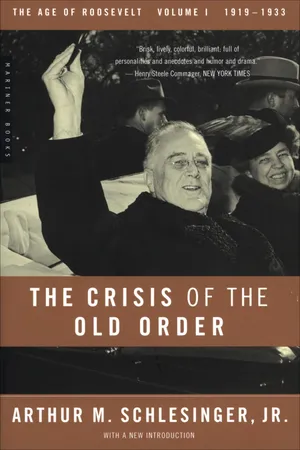
eBook - ePub
The Crisis of the Old Order 1919–1933
The Age of Roosevelt, 1919–1933
- 576 pages
- English
- ePUB (mobile friendly)
- Available on iOS & Android
eBook - ePub
About this book
Information
Notes
IN ORDER to avoid a hopelessly large number of notes, I have followed the practice of collecting the references necessary to a particular passage in a single note. The full citation of each title is to be found on the first mention in each chapter, with the exception of the following works, which receive abbreviated citation throughout:
Franklin D. Roosevelt, Public Papers and Addresses, S. I. Rosenman, comp. (New York, 1938–50), cited as F.D.R., Public Papers, with the year covered by the volume in parenthesis.
Franklin D. Roosevelt, His Personal Letters: Early Years, Elliott Roosevelt, ed. (New York, 1947); His Personal Letters: 1905–1928, Elliott Roosevelt, ed. (New York, 1948); His Personal Letters: 1928–1945, Elliott Roosevelt, ed. (2 vols., New York, 1950), cited as F.D.R., Personal Letters, I, II, III, IV.
Herbert Hoover, State Papers and Other Public Writings, W. S. Myers, ed., 2 vols. (New York, 1934), cited as Hoover, State Papers, I, II.
Herbert Hoover, Memoirs . . . Years of Adventure, 1874–1920 (New York, 1951): Memoirs . . . The Cabinet and the Presidency, 1920–1933 (New York, 1952); Memoirs . . . The Great Depression, 1922–1941 (New York, 1952), cited as Hoover, Memoirs, I, II, III.
Bureau of the Census, Historical Statistics of the United States, 1789–1945 (Washington, 1949), cited as Historical Statistics.
Franklin D. Roosevelt Collector, cited as F.D.R. Coll.
Of the manuscript collections cited, the following are at the Roosevelt Library at Hyde Park, New York: Franklin D. Roosevelt Papers; Louis M. Howe Papers; Mary W. Dewson Papers; Harry L. Hopkins Papers; Roosevelt Foundation Papers; Henry Morgenthau, Jr., Diary; Herbert Claiborne Pell Papers. The Henry L. Stimson Diary is at the Sterling Library, Yale University. I consulted the Norman H. Davis Papers at the Council on Foreign Relations in New York City; they are now in the Library of Congress. The Adolf A. Berle, Jr., Papers, and the Rexford G. Tugwell Papers are in the personal possession of Mr. Berle and Mr. Tugwell. I am grateful to Anna Roosevelt Halsted for permission to consult certain family material cited as Roosevelt Family Papers. The Oral History Project is at Columbia University.
Chapter 1
1. T. G. Joslin, Hoover Off the Record (New York, 1934), 366, 180.
[back]
2. The account of the inauguration is based on a number of eyewitness accounts, particularly those of Edwin C. Hill in his vivid broadcast of March 6 (transcript in the Roosevelt Papers), Anne O’Hare McCormick (“The Nation Renews Its Faith,” New York Times Magazine, March 19, 1933), Edmund Wilson (“Inaugural Parade,” New Republic, March 22, 1933), and Time, March 13, 1933; also E. W. Starling, Starling of the White House (New York, 1946), 305–6; Henry L. Stimson, Diary, March 4, 1933.
[back]
3. Herbert Hoover, Memoirs, III, 344.
[back]
4. E. J. Flynn, You’re the Boss (New York, 1947), 125; Grace Tully, F. D. R., My Boss (New York, 1949), 64; I. H. Hoover, Forty-Two Years in the White House (Boston, 1934), 227.
[back]
5. Tully, F. D. R., 67–68.
[back]
6. For citations and further details see Chs. 19–22.
[back]
7. Senate Agriculture and Forestry Committee, Agricultural Adjustment Relief Plan: Hearings, 72 Cong., 2 Sess. (1933), 15; Senate Manufactures Committee, Federal Aid for Unemployment Relief: Hearings, 72 Cong., 2 Sess. (1933), 455; Senate Judiciary Committee, Thirty-Hour Work Week: Hearings, 72 Cong., 2 Sess. (1933), 21–22.
[back]
8. Time, Jan. 9, 16, 1933.
[back]
9. Elmer Davis, “The Collapse of Politics,” Harper’s, Sept. 1932; Cornelius Vanderbilt, Jr., “Do the American Bourbons Realize Their Fate?” Liberty, July 2, 1932; H. F. Pringle, “A Year Ago Today,” Red Book, April 1934.
[back]
10. Senate Finance Committee, Investigation of Economic Problems: Hearings, 72 Cong., 2 Sess. (1933), 1060, 758, 5, 8; Time, March 6, 1933.
[back]
11. White to Walter Lippmann, April 19, 1932, in W. A. White, Selected Letters . . . 1899–1943, Walter Johnson, ed. (New York, 1947), 324; Reinhold Niebuhr “After Capitalism—What?” World Tomorrow, March 1, 1933; Hamilton Fish, Jr., to F.D.R., Feb. 24, 1933, Roosevelt Papers.
[back]
12. Hughes to F.D.R., Feb. 28, 1933, Roosevelt Papers.
[back]
13. For text (without the opening sentence), F.D.R., Public Papers (1933); see also Roosevelt’s own memorandum on the speech’s composition, March 25, 1933, Roosevelt Papers; and S. I. Rosenman, Working with Roosevelt (New York, 1952), 89 ff.
Chapter 2
1. Parliamentary Debates, House of Commons, Nov. 11, 1918, quoted in R. H. Ferrell, Peace in Their Time (New Haven, 1952). 3.
[back]
2. S. J. Woolf, “Bullitt Looks at the European Scene,” New York Times Magazine, Sept. 6, 1936; Jack Alexander, “He Rose from the Rich,” Saturday Evening Post, March 11, 18, 1939; Janet Flanner’s sketch in An American in Paris (New York, 1940); Ernesta Drinker Bullitt, An Uncensored Diary from the Central Empires (New York, 1917), 4.
[back]
3. Address to Congress, Jan. 8, 1918, Woodrow Wilson, Messages and Papers, Albert Shaw, ed. (New York, 1924), I, 466, 469.
[back]
4. Lincoln Steffens, Autobiography (New York, 1931), 791–92, 799; W. C. Bullitt, The Bullitt Mission to Russia (New York, 1919), 54.
[back]
5. Berle to Upton Sinclair, Dec. 27, 1939, Berle Papers. I should perhaps add that neither Professor Morison nor Governor Herter remembers the episode in quite the same way.
[back]
6. Papers Relating to the Foreign Relations of the United States: The Paris Peace Conference (Washington, 1942–47), XI, 570–74.
[back]
7. I follow here the account given by Mr. Hoover in America’s First Crusade (New York, 1942), 50–51; in his Memoirs (I, 462) he says he met both Smuts and Keynes on his morning walk.
[back]
8. H. C. F. Bell, Woodrow Wilson and the People (New York, 1945), 342–44; Wilson, Messages, II, 810.
[back]
9. J. M. Keynes, Economic Consequences of the Peace (New York, 1920), 297.
[back]
Chapter 3
1. “The Great Decision,” New Republic, April 7, 1917.
[back]
2. Edward Stanwood, History of the Presidency (Boston, 1898), 509–13; Richard Hofstadter, The Age of Reform (New York, 1955), Ch. 2.
[back]
3. Robert M. La Follette, La Follette’s Autobiography (Madison, Wise., 1913), 478, 479.
[back]
4. Theodore Roosevelt, An Autobiography (New York, 1913), 67; ...
Table of contents
- Title Page
- Contents
- Copyright
- Dedication
- Foreword to the Mariner Edition
- Foreword
- Epigraph
- Prologue: 1933
- The Golden Day
- Darkness at Noon
- The New Nationalism
- The New Freedom
- Nationalizing the New Freedom
- Euphoria and Collapse
- The Politics of Prosperity
- Main Street in the White House
- The Ethos of Normalcy
- The Economics of Republicanism
- The Age of Business
- Prophet of the New Era
- Outside Looking In
- The Politics of Frustration
- Protest on the Countryside
- The Stirrings of Labor
- The Struggle for Public Power
- The Campaign of 1928
- The Philosophy of Liberalism
- The Revolt of the Intellectuals
- The Valley of Darkness
- Crash
- The New Era at Bay
- The Contagion of Fear
- Business at the Great Divide
- The Agenda of Reform
- Farewell to Reform
- Climax in Washington
- The Crisis of 1932
- The Politics of Depression
- The Democrats Prepare
- Decision in Chicago
- The Happy Warrior
- Childhood on the Hudson
- Testing in Washington
- Trial by Fire
- Responsibility in Albany
- The Darkling Plain
- Campaign for America
- A Nation Waits
- Confusion in the Void
- Notes
- Index
- About the Author
- Connect with HMH
Trusted by 375,005 students
Access to over 1.5 million titles for a fair monthly price.
Study more efficiently using our study tools.
Frequently asked questions
Yes, you can cancel anytime from the Subscription tab in your account settings on the Perlego website. Your subscription will stay active until the end of your current billing period. Learn how to cancel your subscription
No, books cannot be downloaded as external files, such as PDFs, for use outside of Perlego. However, you can download books within the Perlego app for offline reading on mobile or tablet. Learn how to download books offline
We are an online textbook subscription service, where you can get access to an entire online library for less than the price of a single book per month. With over 1.5 million books across 990+ topics, we’ve got you covered! Learn about our mission
Look out for the read-aloud symbol on your next book to see if you can listen to it. The read-aloud tool reads text aloud for you, highlighting the text as it is being read. You can pause it, speed it up and slow it down. Learn more about Read Aloud
Yes! You can use the Perlego app on both iOS and Android devices to read anytime, anywhere — even offline. Perfect for commutes or when you’re on the go.
Please note we cannot support devices running on iOS 13 and Android 7 or earlier. Learn more about using the app
Please note we cannot support devices running on iOS 13 and Android 7 or earlier. Learn more about using the app
Yes, you can access The Crisis of the Old Order 1919–1933 by Arthur M. Schlesinger in PDF and/or ePUB format, as well as other popular books in History & Historical Biographies. We have over 1.5 million books available in our catalogue for you to explore.