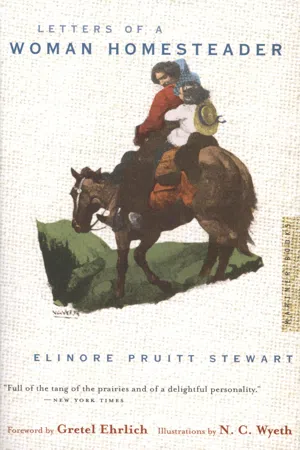
"Peopled with the kinds of characters most novelists only dream of" (Christian Science Monitor), this classic account of American frontier living captures the rambunctious spirit of a pioneer who set out in 1909 to prove that a woman could ranch.
A series of letters make for a fascinating narrative and descriptive journal of Mrs. Stewart's life, moving from the city to a Wyoming homestead, marrying and still having the determination to homestead on her own. Stewart's captivating missives bring to full life the beauty, isolation, and joys of working the prairie.
Trusted by 375,005 students
Access to over 1.5 million titles for a fair monthly price.
I have wanted to write you for a long time, but have been so busy. I have had some visitors and have been on a visit; I think you would like to hear about it all, so I will tell you.
I don’t think you would have admired my appearance the morning this adventure began: I was in the midst of fall house-cleaning which included some papering. I am no expert at the very best, and papering a wall has difficulties peculiar to itself. I was up on a barrel trying to get a long, sloppy strip of paper to stick to the ceiling instead of to me, when in my visitors trooped, and so surprised me that I stepped off the barrel and into a candy-bucket of paste. At the same time the paper came off the ceiling and fell over mine and Mrs. Louderer’s head. It was right aggravating, I can tell you, but my visitors were Mrs. O’Shaughnessy and Mrs. Louderer, and no one could stay discouraged with that pair around.
After we had scraped as much paste as we could off ourselves they explained that they had come to take me somewhere. That sounded good to me, but I could not see how I could get off. However, Mrs. Louderer said she had come to keep house and to take care of the children while I should go with Mrs. O’Shaughnessy to E——. We should have two days’ travel by sled and a few hours on a train, then another journey by sled. I wanted to go powerfully, but the paste-smeared room seemed to forbid.
As Mrs. Louderer would stay with the children, Mr. Stewart thought the trip would be good for me. Mrs. O’Shaughnessy knew I wanted to visit Bishop D——, a shining light among the Latter-Day Saints, so she promised we should stay overnight at his house. That settled it; so in the cold, blue light of the early morning, Mr. Beeler, a new neighbor, had driven my friends over in Mrs. Louderer’s big sled, to which was hitched a pair of her great horses and his own team. He is a widower and was going out to the road for supplies, so it seemed a splendid time to make my long-planned visit to the Bishop. Deep snow came earlier this year than usual, and the sledding and weather both promised to be good. It was with many happy anticipations that I snuggled down among the blankets and bearskins that morning.
Mr. Beeler is pleasant company, and Mrs. O’Shaughnessy is so jolly and bright, and I could leave home without a single misgiving with Mrs. Louderer in charge.
MRS. LOUDERER AND MRS. O’SHAUGHNESSY
The evening sky was blazing crimson and gold, and the mountains behind us were growing purple when we entered the little settlement where the Bishop lives. We drove briskly through the scattered, straggling little village, past the store and the meeting-house, and drew up before the dwelling of the Bishop. The houses of the village were for the most part small cabins of two or three rooms, but the Bishop’s was more pretentious. It was a frame building and boasted paint and shutters. A tithing-office stood near, and back of the house we could see a large granary and long stacks of hay. A bunch of cattle was destroying one stack, and Mrs. O’Shaughnessy remarked that the tallow from those cattle should be used when the olive oil gave out at their anointings, because it was the Bishop’s cattle eating consecrated hay.
We knocked on the door, but got no answer. Mr. Beeler went around to the back, but no one answered, so we concluded we would have to try elsewhere for shelter. Mrs. O’Shaughnessy comforted me by remarking, “Well, there ain’t a penny’s worth of difference in a Mormon bishop and any other Mormon, and D—— is not the only polygamist by a long shot.”
We had just turned out of the gate when a lanky, tow-headed boy about fourteen years of age rode up. We explained our presence there, and the boy explained to us that the Bishop and Aunt Debbie were away. The next best house up the road was his “Maw’s,” he said; so, as Mr. Beeler expected to stay with a friend of his, Mrs. O’Shaughnessy and I determined to see if “Maw” could accommodate us for the night.
Mr. Beeler offered to help the boy get the cattle out, but he said, “No, Paw said it would not matter if they got into the hay, but that he had to knock off some poles on another part of the stockyard so that some horses could get in to eat.”
“But,” I asked, “isn’t that consecrated hay?—is n’t it tithing?”
“Yes,” he said, “but that won’t hurt a bit, only that old John Ladd always pays his tithe with foxtail hay and it almost ruins Paw’s horses’ mouths.”
I asked him if his father’s stock was supposed to get the hay.
“No, I guess not,” he said, “but they are always getting in accidental like.”
We left him to fix the fence so the horses could get in “accidental like,” and drove the short distance to “the next best house.”
We were met at the door by a pleasant-faced little woman who hurried us to the fire. We told her our plight. “Why, certainly you must stay with me,” she said. “I am glad the Bishop and Deb are away. They keep all the company, and I so seldom have any one come; you see Debbie has no children and can do so much better for any one stopping there than I can, but I like company, too, and I am glad of a chance to keep you. You two can have Maudie’s bed. Maud is my oldest girl and she has gone to Ogden to visit, so we have plenty of room.”
By now it was quite dark. She lighted a lamp and bustled about, preparing supper. We sat by the stove and, as Mrs. O’Shaughnessy said, “noticed.”
Two little boys were getting in wood for the night. They appeared to be about eight years old; they were twins and were the youngest of the family. Two girls, about ten and twelve years old, were assisting our hostess; then the boy Orson, whom we met at the gate, and Maud, the daughter who was away, made up the family. They seemed a happy, contented family, if one judged by appearance alone. After supper the children gathered around the table to prepare next day’s lessons. They were bright little folks, but they mingled a great deal of talk with their studies and some of what they talked was family history.
“Mamma,” said Kittie, the largest of the little girls, “if Aunt Deb does buy a new coat and you get her old one, then can I have yours?”
“I don’t know,” her mother replied; “I should have to make it over if you did take it. Maybe we can have a new one.”
“No, we can’t have a new one, I know, for Aunt Deb said so, but she is going to give me her brown dress and you her gray one; she said so the day I helped her iron. We’ll have those to make over.”
For the first time I noticed the discontented lines on our hostess’s face, and it suddenly occurred to me that we were in the house of the Bishop’s second wife. Before I knew I was coming on this journey I thought of a dozen questions I wanted to ask the Bishop, but I could never ask that careworn little woman anything concerning their peculiar belief. However, I was spared the trouble, for soon the children retired and the conversation drifted around to Mormonism and polygamy; and our hostess seemed to want to talk, so I just listened, for Mrs. O’Shaughnessy rather likes to “argufy”; but she had no argument that night, only her questions started our hostess’s story.
She had been married to the Bishop not long before the manifesto, and he had been married several years then to Debbie. But Debbie had no children, and all the money the Bishop had to start with had been his first wife’s; so when it became necessary for him to discard a wife it was a pretty hard question for him because a little child was coming to the second wife and he had nothing to provide for her with except what his first wife’s money paid for. The first wife said she would consent to him starting the second, if she filed on land and paid her back a small sum every year until it was all paid back. So he took the poor “second,” after formally renouncing her, and helped her to file on the land she now lives on. He built her a small cabin, and so she started her career as a “second.” I suppose the “first” thought she would be rid of the second, who had never really been welcome, although the Bishop could never have married a “second” without her consent.
“I would never consent,” said Mrs. O’Shaughnessy.
“Oh, yes, you would if you had been raised a Mormon,” said our hostess. “You see, we were all of us children of polygamous parents. We have been used to plural marriages all our lives. We believe that such experience fits us for our after-life, as we are only preparing for life beyond while here.”
“Do you expect to go to heaven, and do you think the man who married you and then discarded you will go to heaven too?” asked Mrs. O’Shaughnessy.
“Of course I do,” she replied.
“Then,” said Mrs. O’Shaughnessy, “I am afraid if it had been mysilf I’d have been after raising a little hell here intirely.”
Our hostess was not offended, and there followed a long recital of earlier-day hard times that you would scarcely believe amy one could live through. It seems the first wife in such families is boss, and while they do not live in the same homes, still she can very materially affect the other’s comfort.
Mrs. O’Shaughnessy asked her if she had married again.
She said, “No.”
“Then,” said Mrs. O’Shaughnessy, “whose children are these?”
“My own,” she replied.
Mrs. O’Shaughnessy was relentless. “Who is their father?” she asked.
I was right sorry for the poor little woman as she stammered, “I—I don’t know.”
Then she went on, “Of course I do know, and I don’t believe you are spying to try to stir up trouble for my husband. Bishop D—— is their father, as he is still my husband, although he had to cast me off to save himself and me. I love him and I see no wrong in him. All the Gentiles have against him is he is a little too smart for them. ’T was their foolish law that made him wrong the children and me, and not his wishes.”
“But,” Mrs. O’Shaughnessy said, “it places your children in such a plight; they can’t inherit, they can’t even claim his name, they have no status legally.”
“Oh, but the Bishop will see to that,” the little woman answered.
Mrs. O’Shaughnessy asked her if she had still to work as hard as she used to.
“No, I don’t believe I do,” she said,“for since Mr. D—— has been Bishop, things come easier. He built this house with his own money, so Deb has nothing to do with it.”
I asked her if she thought she was as happy as “second” as she would be if she was the only wife.
“Oh, I don’t know,” she said, “perhaps not. Deb and me don’t always agree. She is jealous of the children and because I am younger, and I get to feeling bad when I think she is perfectly safe as a wife and has no cares. She has everything she wants, and I have to take what I can get, and my children have to wait upon her. But it will all come right somewhere, sometime,” she ended cheerfully, as she wiped her eyes with her apron.
I felt so sorry for her and so ashamed to have seen into her sorrow that I was really glad next morning when I heard Mr. Beeler’s cheerful voice calling, “All aboard!”
We had just finished breakfast, and few would ever guess that Mrs. D—— knew a trial; she was so cheerful and so cordial as she bade us good-bye and urged us to stop with her every time we passed through.
About noon that day we reached the railroad. The snow had delayed the train farther north, so for once we were glad to have to wait for a train, as it gave us time to get a bite to eat and to wash up a bit. It was not long, however, till we were comfortably seated in the train. I think a train ride might not be so enjoyable to most, but to us it was a delight; I even enjoyed looking at the Negro porter, although I suspect he expected to be called Mister. I found very soon after coming West that I must not say “Uncle” or “Aunty” as I used to at home.
It was not long until they called the name of the town at which we wanted to stop. Mrs. O’Shaughnessy had a few acquaintances there, but we went to a hotel. We were both tired, so as soon as we had supper we went to bed. The house we stopped at was wanner and more comfortable than the average hotel in the West, but the partitions were very thin, so when a couple of “punchers,” otherwise cowboys, took the room next to ours, we could hear every word they said.
It appears that one was English and the other a tenderfoot. The tenderfoot was in love with a girl who had filed on a homestead near the ranch on which he was employed, but who was then a waitress in the hotel we were at. She had not seemed kind to the tenderfoot and he was telling his friend about it. The Englishman was trying to instruct him as to how to proceed.
“You need to be very circumspect, Johnny, where females are concerned, but you must n’t be too danged timid either.”
“I don’t know what the devil to say to her; I can barely nod my head when she asks me will I take tea or coffee; and to-night she mixed it because I nodded yes when she said, ‘tea or coffee,’ and it was the dangdest mess I ever tried to get outside of.”
“Well,” the friend counseled, “you just get her into a corner some’eres and say to ’er, ‘Dearest ’Attie, I hoffer you my ’and hand my ’eart.’”
“But I can’t,” wailed Johnny. “I could never get her into a corner anyway.”
“If you can’t, you’re not hold enough to marry then. What the ’ell would you do with a woman in the ’ouse if you could n’t corner ’er? I tell ’e, women ’ave to ’ave a master, and no man better tackle that job until ’e can be sure ’e can make ’er walk the chalk-line.”
“But I don’t want her to walk any line; I just want her to speak to me.”
“Dang me if I don’t believe you are locoed. Why, she’s got ’e throwed hand ’og-tied now. What d’e want to make it any worse for?”
They talked for a long time and the Englishman continued to have trouble with his A’s; but at last Johnny was encouraged to “corner ’er” next morning before they left for their ranch.
We expected to be astir early anyway, and our curiosity impelled us to see the outcome of the friend’s counsel, so we were almost the first in the dining-room next morning. A rather pretty girl was busy arranging the tables, and soon a boyish-looking fellow, wearing great bat-wing chaps, came in and stood warming himself at the stove.
I knew at once it was Johnny, and I saw ’“Attie” blush. The very indifference with which she treated him argued well for his cause, but of course he did n’t know that. So when she passed by him and her skirt caught on his big spurs they both stooped at once to unfasten it; their heads hit together with such a bump that the ice was broken, although he seemed to think it was her skull. I am sure there ought to be a t...
Table of contents
Title Page
Contents
Frontispiece
Copyright
Publishers’ Note
Illustrations
Foreword
The Arrival at Burnt Fork
Filing a Claim
A Busy, Happy Summer
A Charming Adventure and Zebulon Pike
Sedalia and Regalia
A Thanksgiving-Day Wedding
Zebulon Pike Visits His Old Home
A Happy Christmas
A Confession
The Story of Cora Belle
Zebbie’s Story
A Contented Couple
Proving Up
The New House
The “Stocking-Leg” Dinner
The Horse-Thieves
At Gavotte’s Camp
The Homesteader’s Marriage and a Little Funeral
The Adventure of the Christmas Tree
The Joys of Homesteading
A Letter of Jerrine’s
O’Shaughnessy
How it Happened
A Little Romance
Among the Mormons
Success
About the Author
Frequently asked questions
Yes, you can cancel anytime from the Subscription tab in your account settings on the Perlego website. Your subscription will stay active until the end of your current billing period. Learn how to cancel your subscription
No, books cannot be downloaded as external files, such as PDFs, for use outside of Perlego. However, you can download books within the Perlego app for offline reading on mobile or tablet. Learn how to download books offline
Perlego offers two plans: Essential and Complete
Essential is ideal for learners and professionals who enjoy exploring a wide range of subjects. Access the Essential Library with 800,000+ trusted titles and best-sellers across business, personal growth, and the humanities. Includes unlimited reading time and Standard Read Aloud voice.
Complete: Perfect for advanced learners and researchers needing full, unrestricted access. Unlock 1.5M+ books across hundreds of subjects, including academic and specialized titles. The Complete Plan also includes advanced features like Premium Read Aloud and Research Assistant.
Both plans are available with monthly, semester, or annual billing cycles.
We are an online textbook subscription service, where you can get access to an entire online library for less than the price of a single book per month. With over 1.5 million books across 990+ topics, we’ve got you covered! Learn about our mission
Look out for the read-aloud symbol on your next book to see if you can listen to it. The read-aloud tool reads text aloud for you, highlighting the text as it is being read. You can pause it, speed it up and slow it down. Learn more about Read Aloud
Yes! You can use the Perlego app on both iOS and Android devices to read anytime, anywhere — even offline. Perfect for commutes or when you’re on the go. Please note we cannot support devices running on iOS 13 and Android 7 or earlier. Learn more about using the app
Yes, you can access Letters Of A Woman Homesteader by Elinore Pruitt Stewart in PDF and/or ePUB format, as well as other popular books in History & Historical Biographies. We have over 1.5 million books available in our catalogue for you to explore.
![[Image]](https://book-extracts.perlego.com/3185849/images/LettersOfAWomanHomesteader_290_1-plgo-compressed.webp)