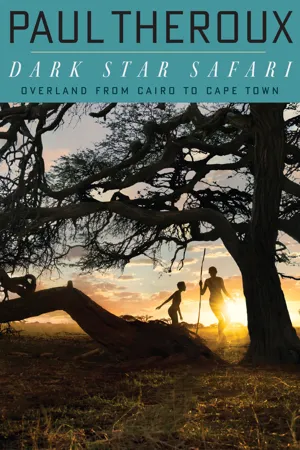
The legendary travel writer's thrilling and dangerous account of his journey across Africa
A rattletrap bus, dugout canoe, cattle truck, armed convoy, ferry, and train. In the course of his epic and enlightening journey, wittily observant and endearingly irascible Paul Theroux endures danger, delay, and dismaying circumstances. Gauging the state of affairs, he talks to Africans, aid workers, missionaries, and tourists. What results is an insightful meditation on the history, politics, and beauty of Africa and its people.
- 496 pages
- English
- ePUB (mobile friendly)
- Available on iOS & Android
eBook - ePub
About this book
Information
Topic
Personal DevelopmentSubtopic
Historical Biographies 7
The Longest Road in Africa
BACK IN ADDIS, I tried to plot a trip by road to the Kenyan border and beyond. Not difficult to plot—there was only one road—but in these uncertain times no reliable information. The farther you got from an African capital, the worse the roads. Everyone knew that, but harder information was unobtainable, and the more you inquired the vaguer people became. In such circumstances the cliché “terra incognita” was something real and descriptive. The border was distant; distant places were unknown; the unknown was dangerous.
Border towns in African countries were awful places, known for riffraff and refugees and people sleeping rough, famous for smugglers and backhanders, notorious for bribery and delay, nitpicking officialdom, squeezing policemen, pestering moneychangers, the greatest risks, and the crummiest hotels. There was either a new national language on the other side of the border or the same tribal language straddling it—and a nasty border dispute because the dotted line ran through a divided people. Roadside customs and immigration barriers were horrible bottlenecks, usually at one end of a bridge on the bank of a muddy river. People told me, Don’t go.
Some buses went to the southern towns of Dila and Mega, and occasional vehicles to the frontier town of Moyale, but Moyale was the edge of the known world for Ethiopians. None of them ever went to Kenya—why would they? The north of Kenya was waterless desert and rutted roads and quarrelsome tribes, a border dispute among the gun-toting Borena people, and worst of all, the troops of roaming, heavily armed Somalis known as shifta. Just dropping the word “shifta” into a proposed itinerary was enough to make traveling Africans go in the opposite direction.
On what was now the longest road in Africa, some of it purely theoretical, from Cairo to Cape Town, there had once been a plan for a great transcontinental railway. Apart from his dream of diamonds and conquest, Cecil Rhodes’s imperial vision for Africa was of a railway line that would run from South Africa to Egypt, taking in Nairobi and Addis Ababa, Khartoum and Nubia. “Your hinterland is there” is the inscription under his bronze figure, pointing north on a pedestal in Cape Town. Sections of the northerly running railway line were built in Rhodes’s lifetime (a short lifetime: he died at the age of forty-nine). Later, track was laid to the Copper Belt in Northern Rhodesia (now Zambia) as far as the Congo border. The Germans built a railway across their colony of German East Africa (later British Tanganyika, later still independent Tanzania). The Tanzanians, under the leadership of the muddled Maoist Julius Nyerere, soon had a line south from Dar es Salaam into Zambia, entirely the work of Mao-sponsored Chinese railway men, chanting the Great Helmsman’s Thoughts as they hammered spikes and fastened rails. This was 1967, at the beginning of the Great Proletarian Cultural Revolution, which Tanzania too embraced in a superficial and self-destructive way.
By zigging and zagging and taking a ferry across Lake Victoria, it was possible for a solo traveler like me, with a bag and a map, to go by rail from Cape Town to Nairobi. But north of Nairobi the tarred road gives way to mud, the buses stop running at Isiolo, and after that it is just a rocky road, hyenas, and colorful Rendille tribesmen, wearing armlets and loincloths, carrying spears and sabers, and forever fussing over their elaborate hairdos. As soon as the road surface turned bad the bandits appeared, shifta carrying AK-47s, classic highwaymen. The road from Nairobi to the border was reputed to be the emptiest in Africa. That was where I was headed.
No one had any information about that road in Addis, and there wasn’t much available about southern Ethiopia either. People would say they had been to a certain town in the south and then, when I questioned them further, they would go blank. Even the Kenyans went blank. Visa requirements had changed. I would need one. I went to the Kenyan embassy and was told by a sulky Kikuyu woman at a desk that I would have to wait three or four days for the visa.
“Why can’t I have it today or tomorrow?”
In a scolding tone she said, “Mr. Ochieng, the visa officer, must not be distubbed.”
“And why is that?”
“He is busy wucking.”
“But I am busy too,” I said mildly, “and I want to visit your wonderful country.”
“You will have to wait.” She picked up a telephone and flicked her fingers at me in a bugger-off gesture.
But I did not leave. I buttonholed diplomats and inquired about the road. Of the three officers at the embassy I spoke to, none had gone by land from Addis to Nairobi across the common border.
A Kenyan man in a three-piece suit seemed insulted that I should suggest it. “We fly,” he said.
One Kenyan woman confided that she disliked Ethiopians. “They are proud,” she said. She meant racist. To annoy other Africans, Ethiopians sometimes said, “We are not Africans.”
…
With time to spare in Addis, I looked around. No tourists in the country meant that the antiques shops were full of merchandise, both treasures and fakes, in the form of old Amharic Bibles made by scribes and monks (with hand-painted plates), silver crosses that looked like giant latchkeys, paintings on cloth stolen from churches, icons, chaplets, Korans, amber beads, Venetian beads, ivory bangles and armlets, spoons of horn and iron, and wooden and leather artifacts from every tribe in the country: elaborate stools, milk jugs, spears, shields, Konso funeral posts depicting the lately departed with a carved penis protruding from the forehead, Mursi lip plugs, penis sheaths, and cache-sexes—little metal aprons that Nuer women wore at their waist for modesty’s sake.
An Asiatic man screaming at an Ethiopian woman in a curio shop one day caught my attention. The woman apparently owned the shop, or at least worked there.
“You give me for four hundred birr!” The man was moon-faced, and his tone of voice was harsh and bullying. He wore a white shirt and tie and looked fairly respectable, which made his anger all the more disconcerting.
“No. Six hundred birr. Last price.” The woman turned away.
Shaking with rage, the Asiatic man said, “No! Four hundred! I come back! You give me!”
I listened with interest, for one of the curiosities of travel is hearing two nonnative speakers of English venting at each other in English. The dispute went back and forth for a little while longer, the man growing shriller and a pinkness blooming in his cheeks as he became enraged and incoherent. Finally, wordless, he left in a minivan with some other grim-faced Asiatics.
Four hundred Ethiopian birr was $47, six hundred birr was $72.
The shop was empty. I said to the woman, “I’ll give you six hundred. That seems reasonable.”
“It is a good price. Best price. I sell him some before for five hundred, but it low quality. This maximum quality.”
“What is?”
“Ivory.” She looked closely at me. “You give me six hundred?”
“New ivory or old?”
“New! Tusks! Big ones!”
Any trade in ivory was illegal, and so I pursued the subject. Ivory from poached elephants was available in large quantities, so I had heard. I had seen chunks of it in shops, but I never saw whole tusks and didn’t know the market price. Indeed, though I had been told the trade flourished in Harar and elsewhere, I had no idea I could simply walk into a little store in Addis Ababa and say, How about some elephant tusks, please?
“How many tusks do you have?” I asked.
“How many you want?”
“Let’s say quite a few.”
“I have much. Fifty, sixty. Each tusk ten kilo, average. When you buy?”
Imagining a half ton of ivory stacked on the ground, something that would satisfy the greed of Mister Kurtz, I said, “Would these be Ethiopian elephants?”
“Ethiopian.” Ityopian, she said, the usual pronunciation of the Greek word meaning “the Burned Ones.”
The Ethiopian elephant, Loxodonta africana orleansi, is a severely endangered species—so endangered that an elephant sanctuary had been established in Babille, near Harar, to protect the creatures. Keeping the elephants in this special area made it easier for poachers, and this place (as well as Kenya) was the source of the ivory.
“So, when you come back? You come today?”
I havered and said, “I have a little problem. I’m sending the ivory to the USA, and that’s illegal.”
“No problem. You got friends?”
“What kind of friends?”
“Embassy friends. Diplomat people. They buy it,” she said. “That man you see shouting? He someone in Korean embassy.”
“So embassy people buy ivory?”
“Yah. Chinese. Japanese. They buy it.”
“I see. They put it in the diplomatic bag and ship it home?”
“Yah. No one look.”
“The American embassy might not want to ship a thousand pounds of elephant tusks in the diplomatic bag.”
“Yes, you ask them, you ask them,” the woman said, now getting a bit impatient with my questions.
Just to satisfy myself I looked around Addis and asked for elephant ivory at two other shops. The only quibble was: How much do you want? Four years before, the price had been two hundred birr ($23) a kilo. Now elephant tusks were harder to find and in great demand, so the price had risen. And a day would come, not far off perhaps, when there would be no more elephants, although no shortage of devious diplomats, stuffing diplomatic pouches with contraband.
…
“No, I don’t think we can help you send any elephant tusks back to the States,” the information officer at the U.S. embassy in Addis said. He chuckled glumly and made a note to alert cites—the Convention on International Trade in Endangered Species. He was Karl Nelson, who had served in the Peace Corps in the early to mid-sixties in the Philippines; at that time I had been a Peace Corps volunteer in Malawi.
“How was Malawi?” Karl asked me.
“It was heaven.”
“I loved the Philippines, too,” Karl said. He had been a teacher, married a Filipina, taught on the Pacific island of Yap for eleven years, wandered the world a bit, and then joined the Foreign Service. He was exactly my age, and our lives had been somewhat parallel. He said, “I joined late. I didn’t make anything of my life.” But he was wrong: he had a happy family, he loved his wife, he had raised five sturdy, successful children.
“You say you’ve just come from the Sudan?” Karl said. “And I know you’ve written about India and Singapore.”
“I lived in Singapore for three dreadful years.”
“You’ll appreciate this, then,” he said. “A Sudanese, an Indian, and a Singaporean were asked, ‘In your opinion, what is the nutritional value of beef?’ The Sudanese said, ‘What is nutritional value?’ The Indian said, ‘What is beef?’ And the Singaporean said, ‘What is an opinion?’”
I laughed and realized I was in the company of a man whose manner of discourse was jokes and anecdotes. When his turn came in a political discussion with a bunch of bores, he would say, “Bush walks into a delicatessen and says, ‘I’ll have a sandwich.’ Fella says, ‘What do you want on that?’ Bush says . . .” And Karl would make his point. They were jokes with a point, but gentle and usually deflationary, intended to demonstrate the absurdity of the proposition being debated.
“You’re going to Nairobi by road?” he said, and laughed his wheezy laugh. “Well, of course you are. Flying there would be too simple for you. It’ll take a week or more. You’ll have a terrible time. You’ll have some great stuff for your book.”
“My idea is to get to the border. African borders are full of revelations. Have you been to the Ethiopian border at Moyale?”
“No. So please write your book, and then I can read about it.” He added, “Did you know, in any group of half a dozen Ethiopians, five of them will have been in prison?”
“Is this a joke?”
“This is an invitation,” Karl said. “I want to introduce you to some people.”
We had lunch at his house on a back street of Addis, a bungalow behind a high wall, with a flower garden and birdhouses and a dovecote. Five Ethiopians and two Filipina doctors, who were also Catholic nuns. The nuns were in Addis for a few days, friends of Karl’s wife, who was in the Philippines. The Ethiopians lived in a remote part of the country where there was a large Muslim population, and their mission was providing medical treatment to Muslim women, an altruistic and thankless task that, judging from their uncomplaining dispositions, they performed cheerfully.
One of the Ethiopians was a woman who had worked at the embassy for many years. She said, in a tone of resignation, “Women have no status here. They are pushed aside and beaten.”
The four men were all writers, editors, and journalists. Each of them had been in prison. One had been jailed under three successive regimes, a total of twelve years. “I was even in the emperor’s prison—the palace jail.” It was something of an accomplishment to have annoyed both Haile Selassie and the Derg, the monarchists and the Marxists. Another man had been in prison for most of the Derg years. The two other men told the same story. None of these men had ever been formally charged or brought to trial, just tossed in jail and left to rot.
Ethiopians are vague on Western—that is, Gregorian—calendar dates because their own calendar is seven years behind the Western one (and, likewise, the Jewish one is 3,760 years ahead, and the Muslim one 581 years behind). Whenever I asked an Ethiopian the date of something that had happened in the past, he would begin to count on his fingers. To the best of his calculations, Nebiy Makonnen, an ex-prisoner of about fifty, had languished in the Central Prison from 1977 until 1987.
“It was politics. I was on the wrong side.” Nebiy laughed at the very idea of an indictment or a trial. He had simply been picked up one day and thrown in the slammer, where—he was a man who was used to reading and writing—there were no books, nothing to write with, nothing to write on.
“I would go crazy in jail,” I said.
“You would learn patience,” he said.
“That’s true!” the other ex-prisoners said.
“One day, after I had been there about a year, a man was brought in by the guards,” Nebiy said. “He had been searched, but somehow they had missed the book he was carrying. It was Gone With the Wind. We were so happy! We were all educated men. We took turns reading it—of course, we had to share it. There were three hundred fifty men in my section, and so we were allowed to have the book for one hour at a time. That was the best part of the day in Central Prison—reading Gone With the Wind.
“I decided to translate it. I had no paper, so for paper I smoothed out the foil from cigarette packs and used the back side of it, where there was paper to write on. A pen was smuggled in. I wrote very small. And I was entertainment officer, so every night I read some of my translation to the other prisoners.
“But still I had to share the book—I could only have it for one hour. The translation took two years. I wrote it on three thousand sheets of cigarette foil. One by one, I folded these up and put them back into cigarette packs, and when the prisoners were released they took them out of priso...
Table of contents
- Title Page
- Contents
- Copyright
- Dedication
- Maps
- Lighting Out
- The Mother of the World
- Up and Down the Nile
- The Dervishes of Omdurman
- The Osama Road to Nubia
- The Djibouti Line to Harar
- The Longest Road in Africa
- Figawi Safari on the Bandit Road
- Rift Valley Days
- Old Friends in Bat Valley
- The MV Umoja Across Lake Victoria
- The Bush Train to Dar es Salaam
- The Kilimanjaro Express to Mbeya
- Through the Outposts of the Plateau
- The Back Road to Soche Hill School
- River Safari to the Coast
- Invading Drummond’s Farm
- The Bush Border Bus to South Africa
- The Hominids of Johannesburg
- The Wild Things at Mala Mala
- Faith, Hope, and Charity on the Limpopo Line
- The Trans-Karoo Express to Cape Town
- Blue Train Blues
- Postscript
- Coming Soon from Paul Theroux
- Read More from Paul Theroux
- About the Author
Trusted by 375,005 students
Access to over 1.5 million titles for a fair monthly price.
Study more efficiently using our study tools.
Frequently asked questions
Yes, you can cancel anytime from the Subscription tab in your account settings on the Perlego website. Your subscription will stay active until the end of your current billing period. Learn how to cancel your subscription
No, books cannot be downloaded as external files, such as PDFs, for use outside of Perlego. However, you can download books within the Perlego app for offline reading on mobile or tablet. Learn how to download books offline
Perlego offers two plans: Essential and Complete
- Essential is ideal for learners and professionals who enjoy exploring a wide range of subjects. Access the Essential Library with 800,000+ trusted titles and best-sellers across business, personal growth, and the humanities. Includes unlimited reading time and Standard Read Aloud voice.
- Complete: Perfect for advanced learners and researchers needing full, unrestricted access. Unlock 1.5M+ books across hundreds of subjects, including academic and specialized titles. The Complete Plan also includes advanced features like Premium Read Aloud and Research Assistant.
We are an online textbook subscription service, where you can get access to an entire online library for less than the price of a single book per month. With over 1.5 million books across 990+ topics, we’ve got you covered! Learn about our mission
Look out for the read-aloud symbol on your next book to see if you can listen to it. The read-aloud tool reads text aloud for you, highlighting the text as it is being read. You can pause it, speed it up and slow it down. Learn more about Read Aloud
Yes! You can use the Perlego app on both iOS and Android devices to read anytime, anywhere — even offline. Perfect for commutes or when you’re on the go.
Please note we cannot support devices running on iOS 13 and Android 7 or earlier. Learn more about using the app
Please note we cannot support devices running on iOS 13 and Android 7 or earlier. Learn more about using the app
Yes, you can access Dark Star Safari by Paul Theroux in PDF and/or ePUB format, as well as other popular books in Personal Development & Historical Biographies. We have over 1.5 million books available in our catalogue for you to explore.