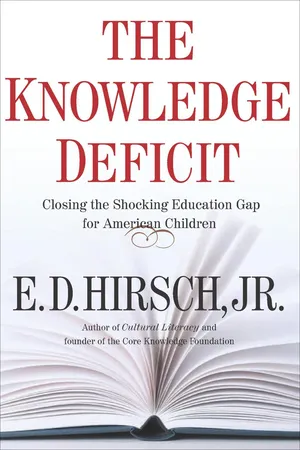
The Knowledge Deficit illuminates the real issue in education today -- without an effective curriculum, American students are losing the global education race. In this persuasive book, the esteemed education critic, activist, and best-selling author E.D. Hirsch, Jr., shows that although schools are teaching the mechanics of reading, they fail to convey the knowledge needed for the more complex and essential skill of reading comprehension. Hirsch corrects popular misconceptions about hot issues in education, such as standardized testing, and takes to task educators' claims that they are powerless to overcome class differences. Ultimately, this essential book gives parents and teachers specific tools for enhancing children's abilities to fully understand what they read.
eBook - ePub
The Knowledge Deficit
Closing the Shocking Education Gap for American Children
- 192 pages
- English
- ePUB (mobile friendly)
- Available on iOS & Android
eBook - ePub
About this book
Information
Topic
EducationSubtopic
Early Childhood Education1. Why Do We Have a Knowledge Deficit?
The Achievement Crisis
THE PUBLIC SEES that something is badly amiss in the education of our young people. Employers now often need to rely on immigrants from Asia and Eastern Europe to do the math that our own high school graduates cannot do. We score low among developed nations in international comparisons of science, math, and reading. This news is in fact more alarming than most people realize, since our students perform relatively worse on international comparisons the longer they stay in our schools. In fourth grade, American students score ninth in reading among thirty-five countries, which is respectable. By tenth grade they score fifteenth in reading among twenty-seven countries, which is not promising at all for their (and our) economic future.1 In the global age, a person’s and a nation’s economic success depend on high reading and/or math ability. We have learned from the phenomenon of outsourcing that those who have these abilities can find a place in the global economy no matter where they happen to live, while those who lack them can be marginalized even if they live in the middle of the United States.
That this crisis in American competence should have been a topic during a recent presidential campaign, even in the midst of terror threats, is a striking sign of its present importance to the American people—of our growing sense that we, like other peoples these days, must live by our wits. The reason that reading ability is the heart of the matter is that reading ability correlates with learning and communication ability. Reading proficiency isn’t in and of itself the magic key to competence. It’s what reading enables us to learn and to do that is critical. In the information age, the key to economic and political achievement is the ability to gain new knowledge rapidly through reading and listening.
The public’s estimate of the great importance of reading skill is strongly supported by the research evidence. Students’ scores in reading comprehension are consistently associated with their subsequent school grades and their later economic success. Under our current educational methods, a child’s reading in second grade reliably predicts that child’s academic performance in eleventh grade, quite irrespective of his or her native talent and diligence.2 Long-range studies show that if children become skilled readers, the United States offers them a fair chance in life—probably more so than any other nation.3 But that is a big if. Becoming a skilled reader—a skilled user of language—is not fast or easy. If it were, our schools would be enabling all our students to reach this goal, when in fact they are bringing fewer than half of them to reading proficiency.
Verbal SAT scores in the United States took a nosedive in the 1960s, and since then they have remained flat. Despite intense efforts by the schools, reading scores nationwide have remained low. An equally worrisome outcome of current school methods and the knowledge deficit they cause is the continuation of the large reading gap between demographic groups. While the origins of the discrepancy lie outside school, in the language that toddlers hear, our current educational methods have not been able to narrow that early gap, but instead have allowed it to widen as students move through the grades. Over the past decades, we have made little progress in bringing all social groups to a reasonable proficiency in reading comprehension. The average reading scores of Hispanics have hovered some twenty-five points below that of whites, while scores of blacks are nearly thirty points below that of whites. These large gaps tell only part of the story: whites cannot read well either. More than half of them—some 59 percent—fail to read at a proficient level. For Hispanics, it is a depressing 85 percent, and for blacks it is a tragic 88 percent.4
Tragic is not too strong a word. Reading ability correlates with almost everything that a democratic education aims to provide, including the ability to be an informed citizen who can actively participate in the self-government of a democracy. What gives the reading gap between demographic groups a special poignancy is the dramatic failure of our schools to live up to the basic ideal of a democratic education, which, as Thomas Jefferson conceived it, is the ideal of offering all children the opportunity to succeed, regardless of who their parents happen to be. Reading proficiency is at the very heart of the democratic educational enterprise, and is rightly called the “new civil rights frontier.”5
The Curse of Romantic Ideas
The reason for this state of affairs—tragic for millions of students as well as for the nation—is that an army of American educators and reading experts are fundamentally wrong in their ideas about education and especially about reading comprehension. Their well-intentioned yet mistaken views are the significant reason (more than other constantly blamed factors, even poverty) that many of our children are not attaining reading proficiency, thus crippling their later schooling. An understanding of how these mistaken ideas arose may help us to overcome them.
When I began college teaching in the 1950s, my academic specialty was the history of ideas. I also specialized in the theory of textual interpretation, which, reduced to its essence, is the theory of reading. So I became well versed in the scientific literature on language comprehension and in American and British intellectual history of the nineteenth century. This double research interest prepared my mind for disturbing insights about American schooling. I saw that John Maynard Keynes’s remark about the power of ideas over vested interests which I have used as an epigraph was profoundly right. Root ideas are much more important in practical affairs than we usually realize, especially when they are so much taken for granted that they are hidden from our view.
As I taught intellectual history, with a focus on writers like William Blake and William Wordsworth, my immersion in nineteenth-century romanticism gave me another insight into what had gone wrong in our schools. Our nation was born in the Enlightenment but bred in the Romantic period. Today we most often use the term romantic to refer to romantic love. But romanticism as a broad intellectual movement that has greatly influenced American thought has much less to do with romantic love than with a complacent faith in the benefits of nature. Such faith was the aspect of nineteenth-century ideas that powerfully influenced our young nation in its beginnings, and it still dominates our thinking about education and many other things.
Consider the idea that school learning, including reading, is or should be natural. The word natural has been a term of honor in our country ever since our forebears elevated “nature” and “natural” to a status that had earlier been occupied by divine law. Following the Colonial period, during the heady days of the early 1800s, the most influential thinkers in New England were no longer writers like Jonathan Edwards, who had exhorted us to follow the commandments of God’s law, but writers like Emerson and Thoreau, who admonished us to develop ourselves according to nature. That was a hugely important shift in our mental orientation. Vernon Parrington titled the second volume of his massive intellectual history of the United States The Romantic Revolution in America, 1800–1860, and his use of the term revolution accurately estimates the fundamental change that took place in the American attitude to nature and to education.6
The fundamental idea of romanticism is that there isn’t any boundary between the natural and the divine. Jonathan Edwards emphatically did not see nature and the natural as being either reliable or divine. In his famous 1741 sermon called “Sinners in the Hands of an Angry God,” he cautions us against the sinful “natural man” and contrasts an imperfect “nature” with divine “grace,” which is a special supernatural dispensation that sinful “natural man” must seek if he is to be saved.7 In the nineteenth century, by contrast, American Romantics like Emerson, Whitman, and even our great educational reformer Horace Mann thought that if you followed nature, in life and in education, you really were following the divine. There were no natural sinners. Sin was a product of civilization. “Nature never did betray the heart that loved her,” as Wordsworth wrote. To be natural was automatically to be good, whether in life or in learning.
Horace Mann is justly praised as the father of public education in the United States, and he rightly saw the need of our schools to bring all children, including recent immigrants, into the main stream of American life. But romantic ideas, especially the idea that nature is best, influenced his belief that the best way to teach early reading—sounding out words from the printed page—is by a “natural,” whole-word approach.8 The most important American thinkers of the nineteenth and early twentieth centuries, those who formed our current ways of approaching education and many other matters, believed that the natural cannot lead us astray. Today, when we invoke the word natural in this way, we continue to illustrate the powerful influence of romanticism on our thought.
Of course, historians don’t always call these ideas romanticism. They have given them special American names. They call Emerson and Thoreau “Transcendentalists.” They call John Dewey, the father of present-day American education, a “pragmatist” or a “progressive.” But progressivism in education is just another name for romanticism. Within Dewey’s writings about education beats the heart of a romantic, as indicated by his continual use of the terms development and growth with regard to the schooling of children—terms that came as naturally to him as they still do to us. In fact, they come to us so unbidden that we do not even notice the fact that conceiving of education as “growth” on the analogy of a bush or tree is in many cases highly questionable, and is made to seem plausible only because children do indeed develop naturally, both physically and mentally, during the early years of schooling.9 Being trained in the history of ideas, I had become familiar with the way in which unnoticed metaphors like “growth” and “development” unconsciously govern our thought—and continue to do so, even when scientific evidence clearly shows that reading and doing math are not natural developments at all.
My academic specialties thus freed me to think in new ways about what had gone wrong in our schools and to write my 1987 book, Cultural Literacy, which became a surprise bestseller. It was an enormously controversial book. Many classroom teachers and parents praised it as accurately describing the way in which knowledge-oriented teaching had vanished from the early grades. But coming at the height of fierce debates over multiculturalism and gender politics, it was damned with great hostility by cultural reformers and education professors as a reactionary tract aimed at preserving the intellectual domination of white Anglo-Saxon males, and as a means of boring children with mindless drills and stuffing them with “mere facts.”
Its main argument, that reading comprehension—literacy itself—depends on specific background knowledge, was overlooked in the cultural taking of sides. The atmosphere seems different today. The intensity of identity politics has diminished. Existing instructional practices have not been working. National mandatory testing, which prods schools to achieve “adequate yearly progress” in reading, has highlighted the bankruptcy of prevailing ideas. The public increasingly understands that the knowledge deficit is a profound failure of social justice. Less understood is the fact that this failure is the consequence of good intentions in the service of inadequate ideas.
Should Schooling Be Natural?
The word nature has its root in the Latin word natus—birth, what organisms are born with. By the same token, the word development means an unfolding in time of what at birth we potentially contain. Yet the romantic concept of education as a natural unfolding—by far the most influential idea in the history of American education—has small basis in reality when it comes to reading, writing, and arithmetic. On current scientific evidence, the notion that the job of the schools is to foster the natural development of the child is only a half-truth.10
Let’s ponder “development” for a moment. When a fertilized egg turns into an embryo, that development is indeed something that unfolds naturally. Similarly, in the first two years of life, when a child learns to walk and talk, those are natural developments that are universal in all cultures. Since the child acquires these extremely difficult skills often without conscious adult instruction, we might mistakenly extend trust in natural unfolding to the next stage of life, when a child enters school. And indeed, that is what educators do when they delay teaching the mechanics of reading until a child reaches a state that is deemed to be a developmental stage of “reading readiness.” Before that time, children are not to be interfered with by premature and artificial teaching of letter-sound correspondences, because these are “developmentally inappropriate.”
Extreme advocates of this viewpoint insist that children will learn to read as readily as they learned to talk. Similarly, the romantic complacency of American educational thought holds that children, given time, will develop a readiness to understand place value in arithmetic. The idea that children might naturally develop a readiness for either place value or the phonic code overlooks the glaring fact that we as a species might never have invented these things at all. Place value in base-ten arithmetic was a very unnatural invention of civilization that reached Europe even later than the alphabet did —not until around the fifteenth century.11 Alphabetic writing was a brilliant, momentous invention, and it was equally unnatural. Scholars are still debating whether or not alphabetic writing was invented only once in human history.12
If early childhood experts, liberated from the romantic traditions of American schools, had considered the matter from a historical or anthropological angle, they might have taken stock of the fact that reading is developmentally inappropriate at all ages of human life. There is little in the human organism that prepares us naturally for alphabetic reading and writing (decoding and encoding), which have been very late and rare attainments of civilization. The inherent unnaturalness of learning to read is part of the reason that it is at first so difficult and, for many, so painful. Shakespeare memorably captured the perennial unnaturalness of schooling in his picture of the “whining schoolboy” “creeping unwillingly to school.”
What About “Mere Facts”?
A naturalistic approach to teaching phonics, under the idea that children are somehow wired to master the alphabetic code, is not, however, the most deleterious influence of romantic ideas in hindering the effective teaching of reading. The word reading has two senses, often confusingly lumped together. The first means the process of turning printed marks into sounds and these sounds into words. But the second sense means the very different process of understanding those words. Learning how to read in the first sense—decoding through phonics—does not guarantee learning how to read in the second sense—comprehending the meaning of what is read. To become a good comprehender, a child needs a great deal of knowledge. A romantically inspired, long delay in teaching phonics, until children are supposedly developmentally ready, as regrettable as it is, is not nearly as permanently harmful to our students economically and socially as the other aspect of the romantic tradition in education—its knowledge-withholding, anti-intellectual aspect.
Disparagement of factual knowledge as found in books has been a strong current in American thought since the time of Emerson. Henry Ford’s famous dictum “History is bunk” is a succinct example. Since the nineteenth century, such anti-intellectualism has been as American as apple pie, as the great historian Richard Hofstadter has pointed out, and it came straight out of the Romantic movement into our schools.13
In our pre-romantic days, books were seen as the key to education. In a 1785 letter to his nephew, Peter Carr, aged fifteen, Jefferson recommended that he read books (in the original languages and in this order) by the following authors: Herodotus, Thucydides, Xenophon, Anabasis, Arian, Quintus Curtius, Diodorus Siculus, and Justin. On morality, Jefferson recommended books by Epictetus, Plato, Cicero, Antoninus, Seneca, and Xenophon’s Memorabilia, and in poetry Virgil, Terence, Horace, Anacreon, Theocritus, Homer, Euripides, Sophocles, Milton, Shakespeare, Ossian, Pope, and Swift.14 Jefferson’s plan of book learning was modest compared to the proper Puritan education of the seventeenth century as advocated by John Milton.15
The Romantics rejected such advice. They opposed the reading of books as unnatural, as arising from the artificial habits and constraints of civilization. Wordsworth wrote:
One impulse from a vernal wood
Can teach us more of man
Of moral evil and of good
Than all the sages can.
Emerson claimed that the farm was a better teacher than the school: “We are shut up in schools and college recitation rooms for ten or fifteen years & come out at last with a bellyful of words & do not know a thing . . . The farm, the farm is the right school . . . The farm is a piece of the world, the School house is not.”16 John Dewey’s Lab School, which he started in Chicago in 1896, was based on the conviction that children would learn what they needed by engaging in practical activities such as cooking.
Today our schools and colleges of education, the inheritors of these ideas, are still the nerve centers of an anti-intellectual tradition. One of their most effective rhetorical tics is to identify the acquisition of broad knowledge with “rote learning” of “mere facts”—in subtle disparagement of “merely verbal” presentation in books and through the coherent explanations of teachers. Just like Rousseau, Wordsworth, and Dewey, our schools of education hold that unless school knowledge is connected to “real life” in a “hands-on” way, it is unnatural and dead; it is “rote” and “meaningless.” ...
Table of contents
- Title Page
- Contents
- Copyright
- Epigraph
- Preface
- 1. Why Do We Have a Knowledge Deficit?
- 2. Sounding Out: Just the Beginning of Reading
- 3. Knowledge of Language
- 4. Knowledge of Things
- 5. Using School Time Productively
- 6. Using Tests Productively
- 7. Achieving Commonality and Fairness
- Appendix: The Critical Importance of an Adequate Theory of Reading
- Notes
- Acknowledgments
- Index
- About the Author
- Connect with HMH
Trusted by 375,005 students
Access to over 1.5 million titles for a fair monthly price.
Study more efficiently using our study tools.
Frequently asked questions
Yes, you can cancel anytime from the Subscription tab in your account settings on the Perlego website. Your subscription will stay active until the end of your current billing period. Learn how to cancel your subscription
No, books cannot be downloaded as external files, such as PDFs, for use outside of Perlego. However, you can download books within the Perlego app for offline reading on mobile or tablet. Learn how to download books offline
Perlego offers two plans: Essential and Complete
- Essential is ideal for learners and professionals who enjoy exploring a wide range of subjects. Access the Essential Library with 800,000+ trusted titles and best-sellers across business, personal growth, and the humanities. Includes unlimited reading time and Standard Read Aloud voice.
- Complete: Perfect for advanced learners and researchers needing full, unrestricted access. Unlock 1.5M+ books across hundreds of subjects, including academic and specialized titles. The Complete Plan also includes advanced features like Premium Read Aloud and Research Assistant.
We are an online textbook subscription service, where you can get access to an entire online library for less than the price of a single book per month. With over 1.5 million books across 990+ topics, we’ve got you covered! Learn about our mission
Look out for the read-aloud symbol on your next book to see if you can listen to it. The read-aloud tool reads text aloud for you, highlighting the text as it is being read. You can pause it, speed it up and slow it down. Learn more about Read Aloud
Yes! You can use the Perlego app on both iOS and Android devices to read anytime, anywhere — even offline. Perfect for commutes or when you’re on the go.
Please note we cannot support devices running on iOS 13 and Android 7 or earlier. Learn more about using the app
Please note we cannot support devices running on iOS 13 and Android 7 or earlier. Learn more about using the app
Yes, you can access The Knowledge Deficit by E. D. Hirsch in PDF and/or ePUB format, as well as other popular books in Education & Early Childhood Education. We have over 1.5 million books available in our catalogue for you to explore.