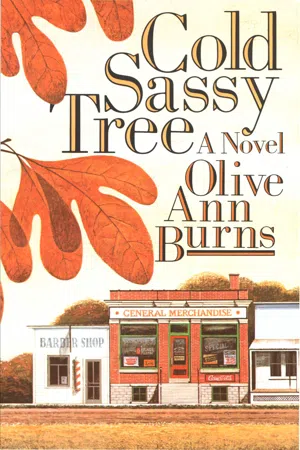
The one thing you can depend on in Cold Sassy, Georgia, is that word gets around—fast. When Grandpa E. Rucker Blakeslee announces one July morning in 1906 that he’s aiming to marry the young and freckledy milliner, Miss Love Simpson—a bare three weeks after Granny Blakeslee has gone to her reward—the news is served up all over town with that afternoon’s dinner. And young Will Tweedy suddenly finds himself eyewitness to a major small-town scandal. Boggled by the sheer audacity of it all, and not a little jealous of his grandpa’s new wife, Will nevertheless approves of this May-December match and follows its progress with just a smidgen of youthful prurience. As the newlyweds’ chaperone, conspirator, and confidant, Will is privy to his one-armed, renegade grandfather’s second adolescence; meanwhile, in a classic coming of age story, he does some growing up of his own. He gets run over by a train and lives to tell about it; he kisses his first girl, and survives that too. Olive Ann Burns has given us a timeless classic—a funny, resplendent novel about a romance that rocks an entire town, about a boy’s passage through the momentous but elusive year when childhood melts into adolescence, and about just how people lived and died in a small Southern town at the turn of the century. Inhabited by characters who are wise and loony, unimpeachably pious and deliciously irreverent, Cold Sassy, Georgia, is the perfect setting for the debut of a storyteller of rare brio, exuberance, and style.
- 400 pages
- English
- ePUB (mobile friendly)
- Available on iOS & Android
eBook - ePub
Cold Sassy Tree
About this book
Information
1
THREE WEEKS after Granny Blakeslee died, Grandpa came to our house for his early morning snort of whiskey, as usual, and said to me, “Will Tweedy? Go find yore mama, then run up to yore Aunt Loma’s and tell her I said git on down here. I got something to say. And I ain’t a-go’n say it but once’t.”
“Yessir.”
“Make haste, son. I got to git on to the store.”
Mama made me wait till she pinned the black mourning band for Granny on my shirt sleeve. Then I was off. Any time Grandpa had something to say, it was something you couldn’t wait to hear.
That was eight years ago on a Thursday morning, when Grandpa Blakeslee was fifty-nine and I was fourteen. The date was July 5, 1906. I know because Grandpa put it down in the family Bible, and also Toddy Hughes wrote up for the Atlanta paper what happened to me on the train trestle that day and I still have the clipping. Besides that, I remember it was right after our July the Fourth celebration—the first one held in Cold Sassy, Georgia, since the War Between the States.
July 5, 1906, was three months after the big earthquake in San Francisco and about two months after a stranger drove through Cold Sassy in a Pope-Waverley electric automobile that got stalled trying to cross the railroad tracks. I pushed it up the incline and the man let me ride as far as the Athens highway.
July 5, 1906, was a year after my great-grandmother on the
Tweedy side died for the second and last time out in Banks County. It was six months after my best friend, Bluford Jackson, got firecrackers for Christmas and burned his hand on one and died of lockjaw ten days later. And like I said, it was only three weeks after Granny Blakeslee went to the grave.
During those three weeks, Grandpa Blakeslee had sort of drawn back inside his own skin. Acted like I didn’t mean any more to him than a stick of stovewood. On the morning of July 5th, he stalked through the house and into our company room without even speaking to me.
Granny never would let him keep his corn whiskey at home. He kept it in the company room at our house, which was between the depot and downtown, and came by for a snort every morning on his way to work. I and my little redheaded sister, Mary Toy, always followed him down the hall, and he usually gave us each a stick of penny candy before shutting the company room door in our faces. While our spit swam over hoarhound or peppermint, we’d hear the floorboards creak in the closet, then a silence, then a big “H-rumph!” and a big satisfied “Ah-h-h-h!” He would come out smiling, ready for the day, and pat Mary Toy’s head as he went past her.
But this particular morning was different. For one thing, Mary Toy had gone home with Cudn Temp the day before. And Grandpa, instead of coming out feeling good, looked like somebody itching for a fight. That’s when he said, “Will Tweedy?” (He always called me both names except when he called me son.) Said, “Will Tweedy? Go find yore mama, then run up to yore Aunt Loma’s and tell her I said git on down here.”
Lots of people in Cold Sassy had a telephone, including us. Grandpa didn’t. He had one at the store so he could phone orders to the wholesale house in Athens, but he was too stingy to pay for one at home. Aunt Loma didn’t have a phone, either. She and Uncle Camp were too poor. That’s why I had to go tell her.
I ran all the way, my brown and white bird dog, T.R., bounding ahead. As usual when we got to Aunt Loma’s, the dog plopped down on the dirt sidewalk in front of her house to wait. He couldn’t go up in the dern yard because of the dern cats, of which there were eighteen or twenty at least. They would scratch his eyes out if he went any closer.
I found Aunt Loma sitting at the kitchen table, her long curly red hair still loose and tousled, the dirty breakfast dishes pushed back to clear a space. With one cat in her lap and another licking an oatmeal bowl on the table, she sat drinking coffee and reading a book of theater plays.
Mama never knew how often Aunt Loma put pleasure before duty like that. Mama liked to stay in front of her work. But then Loma was young—just twenty—and sloven.
When I told her what Grandpa said, she slammed her book down so hard, the cat leaped off the table. “Why don’t you just tell him I’m busy.” But even as she spoke she stood up, gulped some coffee, set down the cup still half full, and rushed upstairs to change into a black dress on account of her mother having just died and all. When she came down, carrying fat, sleepy Campbell Junior, her mass of red hair was combed, pinned up, and draped with what she called “my genteel black veil.”
Campbell Junior pulled at the veil all the way to our house, and Aunt Loma fussed all the way. When we got there, she handed the baby over to our cook, Queenie, and hurried in where Grandpa was pacing the front hall, his high-top black shoes squeaking as he walked.
I couldn’t help noticing how in only three weeks as a widower he already looked like one. His dark bushy hair and long gray beard were tangled. The heavy, droopy mustache had some dried food stuck on it. His black hat, pants, and vest were dusty and the homemade white shirt rusty with tobacco juice. Granny always prided herself on keeping his wild hair and beard trimmed, his shirts clean, his pants brushed and “nice.” Now that she was gone, he couldn’t do for himself very well, having only the one hand, but he wouldn’t let Mama or Aunt Loma do for him.
“Mornin’, Pa,” Aunt Loma grumped.
“Is that y’all, Will?” Mama called from the dining room, where she was closing windows and pulling down shades to keep out the morning sun. We waited in the front hall till she hurried in, her hair still in a thick plait down one side of her neck. I always thought she looked pretty with it like that—almost like a young girl. Mama was a plain person, like Granny, and didn’t dress fancy the way Aunt Loma did every time she stuck her nose out of the house. Even at home Aunt Loma was fancy. She
wouldn’t of been caught dead in an apron made out of a flour sack, whereas Mama had on one that still read Try Skylark Self-Rising Flour right across the chest. The words hadn’t washed out yet, which I was sure Aunt Loma noticed as she said crossly, “Mornin’, Sister.”
Taking off the apron as if we had real company, Mama said to me, “Son, you go gather the eggs, hear? With Mary Toy gone, you got to gather the eggs.”
“Yes’m.” My feet dragged me toward the back hall.
“Let them aiggs wait, Mary Willis,” Grandpa ordered. “I want Will Tweedy to hear what I come to say. He’ll know soon enough anyways.” Then he stomped toward the open front door and put his hand on the knob as if all he planned to say was good-bye—or maybe more like he was fixing to put a match to a string of firecrackers and then run before they went off.
My mother asked, nervous-like, “You want us to all go sit in the parlor, sir?”
He shook his head. “Naw, Mary Willis, it won’t take long enough to set down for.” He took off his black hat and laid it on the table, pulled at his mustache, scratched through the white streak in his beard, and turned those deep blue eyes on Mama and Aunt Loma, his grown children, standing together puzzled and uneasy. When he began his announcement, you could tell he had practiced it. “Now, daughters, you know I was true to yore mother. Miss Mattie Lou was a fine wife. A good cook. A real good woman. Beloved by all in this here town, and by me, as y’all know.”
Hearing Grandpa go on about Granny made my throat ache. Mama and Aunt Loma went to sobbing out loud, their arms around each other.
“Now quit yore blubberin’, Mary Willis. Hesh up, Loma. I ain’t finished.” Then his voice softened. “Since yore ma’s passin’ I been a-studyin’ on our life together. Thirty-six year we had, and they was good years. I want y’all to know I ain’t never go’n forget her.”
“Course you w-won’t, Pa,” said my mother, sobbing.
“But she’s gone, just like this here hand a-mine.” He held up his left arm, the shirt sleeve knotted as usual just below the elbow. Grandpa’s blue eyes were suddenly glassy with unspilled tears. He
struggled to get aholt of himself, then went on. “Like I said, she’s gone now. So I been studyin’ on what to do. How to make out. Well, I done decided, and when I say what I come to say I want y’all to know they ain’t no disrespect to her intended.” Grandpa opened the door wider. He was about to light his firecrackers.
“Now what I come to say,” he blurted out, “is I’m aimin’ to marry Miss Love Simpson.”
Mama’s and Aunt Loma’s mouths dropped open and their faces went white. They both cried out, “Pa, you cain’t!”
“I done ast her and she’s done said yes. And Loma, they ain’t a bloomin’ thang you can do bout it.”
Aunt Loma’s face got as red as if she’d been on the river all day, but it was Mama who finally spoke. In a timid voice she said, “Sir, Love Simpson’s young enough to be your daughter! She’s not more’n thirty-three or -four years old!”
“Thet ain’t got a thang to do with it.”
Mama put both hands up to her mouth. With a sort of whimper, she said, “Pa, don’t you care what folks are go’n say?”
“I care bout you carin’ what they’ll say, Mary Willis. But I care a heap more bout not bein’ no burden on y’all. So hesh up.”
Aunt Loma was bout to burst. “Think, Pa!” she ordered, tears streaming down her face. “Just think. Ma hasn’t been d-dead but three w-w-weeks!”
“Well, good gosh a’mighty!” he thundered. “She’s dead as she’ll ever be, ain’t she? Well, ain’t she?”
2
I THOUGHT Mama was going to faint. She stumbled toward her daddy, arms outstretched, but Grandpa glared at her and she stepped back.
“I’m lonesome.” He said it kind of quiet. Then he hugged each weeping daughter and walked out the door, hitching up his trousers with the stub of his left arm.
On the veranda, Grandpa turned back and spoke his defense. “I ain’t go’n be no burden on y’all. Not ever. Which means I got to hire me a colored woman or git married, one, and tell you the truth, hit’s jest cheaper to have a wife. So I’m a-go’n marry Miss Love. And I ain’t got but one more thang to say. All y’all be nice to her. You hear?” He said all y’all, but it was Aunt Loma he glared at when he said it.
With that, my grandfather stalked tall down the steps. We watched as he strode past Mama’s pots of pink begonias and Papa’s life-size iron stag and walked through the iron gate. Banging it shut, he passed the tall pink crepe myrtles that lined the dirt sidewalk in front of our house, crossed the dirt street called South Main, went over the railroad tracks onto North Main, and headed for the store.
Soon as Grandpa got out of sight it was as if somebody had wound Mama and Aunt Loma up and let go the spring. Mama wailed that she could never show her face in Cold Sassy again, she was so embarrassed. Aunt Loma was just plain mad. “Remember Ma’s funeral headline, Sister?” She spat out the words.
Mama nodded into her handkerchief. “Y-yes, of course I do. It said, ‘Grieving Husband Left to Walk Through Life Alone.’”
“I can just see the engagement notice: ‘Grieving Widower Finds Woman to Walk With.’”
“You know Bubba wouldn’t do that!” Mama cried. Bubba Reynolds was editor of the Cold Sassy Weekly.
“He will if he thinks of it,” said Loma. “Sister, that woman ought to be ashamed. And I’m go’n go tell her so.”
Mama was alarmed. “Now, Loma, once you get started, you don’t know when to hush.” Then she added, “But it might do some good to tell her how stingy Pa is, and how hard he is to cook for. That might make her think twice.”
There was a silence, except for Aunt Loma pounding her right fist into her left hand, bam, bam, bam, glaring at me as she did it. Finally she said my daddy might could talk Grandpa out of it.
Mama didn’t think so. “Hoyt don’t even dare ast Pa to raise his pay. Get your Camp onto him.” She was being sarcastic. I’d heard her say that Grandpa thought Uncle Camp was still in knee britches. Aunt Loma didn’t answer. She knew—they both knew—that nobody could stand up to their daddy.
Then Loma shook both fists in the direction of the store. “Dog bite your hide, Love Simpson!” she screamed. “And dog bite yours, Pa!”
“Loma, hush. The neighbors will—”
“How could he do it, and her a Yankee!”
Mama was always fair, even when flustrated to distraction. “Now, Loma, everybody calls Miss Love a Yankee and she does kind of talk like one. But Maryland is not a Northern state.” Then, as another thought struck her, Mama collapsed onto the leather davenport there in the front hall. “Loma,” she wailed, “Pa didn’t have on his black armband!”
“Well, should he, Sister? When he’s engaged?” Aunt Loma like to choked on the word engaged.
“But they cain’t marry for a year or more. I don’t see why Pa couldn’t wear an armband for Ma.”
“While Love Simpson wears an engagement ring for Pa?”
“Surely he won’t give her a ring! He just said he wanted us to know, not the whole world!” Mama jumped up and stuck her nose right in her young sister’s face. “Now you listen to me.” Loma backed off a little. “I want you to keep your mouth shut. It may all blow over, and nobody’ll ever know. Maybe—maybe Pa just thought she said yes.”
“Grandpa ain’t hard of hearin’,” said I, but they didn’t seem to notice.
I was amazed at Mama. She was usually just the mildest sort of person. Ordinarily if anybody was saying hush up around here, it was Aunt Loma, despite she was fourteen years younger than my mother. No doubt Aunt Loma marveled, too, because she didn’t say anything sassy back. Just jerked off her genteel black veil and threw it hard as she could towards the front door.
“Sister, I was fixin’ to ast Pa for Ma’s piano,” she burst out. Tears of flustration wet her red face. “And I want the mirror that Cudn Pearl painted Saint Cecilia on. Just think, while I was waitin’ a decent time to ast for a piano and a mirror, come to find out he was astin’ for a wife!” Screaming the words out, she stomped her foot.
I knew Mama wanted the piano so Mary Toy could take music lessons. Mama always liked the Saint Cecilia mirror, too. Everybody in Cold Sassy except us had Saint Cecilia painted on something. And though Mama wasn’t the kind to ask for things, I’d heard her tell Queenie she was go’n see if her Pa would let her swap our mismatched parlor furniture for Granny’s nice parlor suit. She knew he wouldn’t care one way or the other.
“I just cain’t understand it,” Mama fumed, getting up to pace the hall just the way Grandpa had. “I thought Love Simpson would marry Son Black. I know his mother don’t approve, but he’s not gettin’ any younger, and they been courtin’ a year or more.”
“And Love deserves him,” said Aunt Loma. She used to be sweet on Son Black herself, so I reckon she knew what she was talking about when she added, “Son’s right nice-lookin’ and smart, but his mouth sure isn’t any prayer book. And he’s meaner’n a snake.”
“Yeah,” I chimed in. “I heard he had him a pet snake one time that bit him and the next day the snake died.”
They ignored that. Mama said, “Love is too used to town life and dressin’ fashionable. Maybe she don’t care to stay out there on the farm with Son’s mama and raise chi’ren. Maybe she thinks she’s too good to marry a farmer.”
“Shoot,” retorted Aunt Loma, “what about that rancher out in Texas she was engaged to before she came here? A rancher has lots of land and money but he’s a farmer just the same. Lord, I wish to heaven she’d married him. If only he hadn’—”
“Sh-h!” Mama nodded toward me.
I knew Loma was fixing to say “If only he hadn’t got Miss Love’s best friend in trouble and had ...
Table of contents
- Title Page
- Contents
- Copyright
- Dedication
- Acknowledgments
- 1
- 2
- 3
- 4
- 5
- 6
- 7
- 8
- 9
- 10
- 11
- 12
- 13
- 14
- 15
- 16
- 17
- 18
- 19
- 20
- 21
- 22
- 23
- 24
- 25
- 26
- 27
- 28
- 29
- 30
- 31
- 32
- 33
- 34
- 35
- 36
- 37
- 38
- 39
- 40
- 41
- 42
- 43
- 44
- 45
- 46
- 47
- 48
- 49
- 50
- About the Author
- Connect with HMH
Trusted by 375,005 students
Access to over 1.5 million titles for a fair monthly price.
Study more efficiently using our study tools.
Frequently asked questions
Yes, you can cancel anytime from the Subscription tab in your account settings on the Perlego website. Your subscription will stay active until the end of your current billing period. Learn how to cancel your subscription
No, books cannot be downloaded as external files, such as PDFs, for use outside of Perlego. However, you can download books within the Perlego app for offline reading on mobile or tablet. Learn how to download books offline
Perlego offers two plans: Essential and Complete
- Essential is ideal for learners and professionals who enjoy exploring a wide range of subjects. Access the Essential Library with 800,000+ trusted titles and best-sellers across business, personal growth, and the humanities. Includes unlimited reading time and Standard Read Aloud voice.
- Complete: Perfect for advanced learners and researchers needing full, unrestricted access. Unlock 1.5M+ books across hundreds of subjects, including academic and specialized titles. The Complete Plan also includes advanced features like Premium Read Aloud and Research Assistant.
We are an online textbook subscription service, where you can get access to an entire online library for less than the price of a single book per month. With over 1.5 million books across 990+ topics, we’ve got you covered! Learn about our mission
Look out for the read-aloud symbol on your next book to see if you can listen to it. The read-aloud tool reads text aloud for you, highlighting the text as it is being read. You can pause it, speed it up and slow it down. Learn more about Read Aloud
Yes! You can use the Perlego app on both iOS and Android devices to read anytime, anywhere — even offline. Perfect for commutes or when you’re on the go.
Please note we cannot support devices running on iOS 13 and Android 7 or earlier. Learn more about using the app
Please note we cannot support devices running on iOS 13 and Android 7 or earlier. Learn more about using the app
Yes, you can access Cold Sassy Tree by Olive Ann Burns in PDF and/or ePUB format, as well as other popular books in Literature & Classics. We have over 1.5 million books available in our catalogue for you to explore.