- 216 pages
- English
- ePUB (mobile friendly)
- Available on iOS & Android
eBook - ePub
About this book
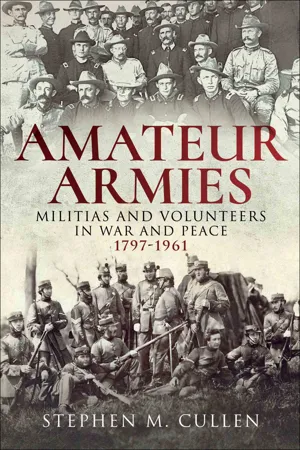
A history of volunteer armies spanning from the French Revolutionary Wars and the War of 1812 to pre-1914 Ireland and the Bay of Pigs.
Amateur Armies examines the military and social history of volunteer armies around the western world from the failed French invasion of South Wales in 1797 to the disastrous anti-Communist invasion of the Bay of Pigs in Cuba in 1961.
It brings together some fascinating military actions across more than a century and a half of history and explores the social and political context in the countries involved. Stephen Cullen's absorbing and original book is the first general survey of the role of amateur armies during the period.
Included are chapters on a series of wars in which militias played critical parts. In each case, their actions and effectiveness are described as is the background from which they came, and the social and political circumstances in which they operated. This pioneering study offers a valuable insight into each of the amateur armies covered and opens up an important and hitherto neglected aspect of military history.
Information
Chapter 1
From Wales to Cuba, 1797–1961
The Roman Legionary is one of the most recognised figures from history, and the general perception of the Legions as an extraordinarily effective military force is common. That commonplace view is built upon the Roman army as it developed in the second and first centuries BC as Rome began to spread beyond the Mediterranean, beginning the process that Scipio Africanus called, in his pre-battle speech to the Legions at the Battle of Zama in 202 BC, ‘the conquest of the world’. That rise to pre-eminence was enabled by the professional legionaries of Marius, the general credited with the creation of a new type of legionary ‘for whom military service was a career rather than a temporary interlude’.1 These professionals became the model of military organisation that, following the collapse of the Empire in the west, princes and kings dreamt of recreating, and it is a model that still, today, defines the western military tradition. Yet, the very term legio, or legion, meant a mass levy of citizens, and the temporary call-out of able-bodied male citizens which formed the basis of Rome’s first half millennia of existence. The change from a citizen army to a professional army brought with it political as well as military change, as ‘the army ceased to represent the whole Roman people under arms and became more and more separate from the rest of society, their loyalty focusing more on their legion than on Rome’.2 It was a change that enabled the continued growth of the Empire, but could not, in the end, prevent Imperial collapse in the West. Even though the habits and practices of Rome faded, the creation of a permanently embodied professional army had established a formula that survived, and returned fully in Europe during the eighteenth century. But, just as the model of the professional soldier survived through the centuries of war bands, knights, retainers, and the armed peasant, so, too, did the amateur soldier survive in the world of the professional army.
This book examines the role of the amateur soldier in the modern period, the period when warfare, at least in the Western world, has been characterised by the dominance of the professional soldier and the standing army. Despite that dominance, the amateur soldier, the part-timer, men embodied for local defence, and the volunteer, have played a constant role in military history, and, sometimes, a key role. Further, just as Rome’s original levy, its part-time legionaries, had a political and social role, so, too, have many amateur soldiers and their units. For example, Chapter 7 in this book examines the vital role of amateur soldiers in the age of nuclear war, in Cuba in 1961. That year, the Cuban National Revolutionary Militia (MNR) played a crucial role in defending Castro’s communist revolution on the island from invading Cuban exiles at the Bay of Pigs. The MNR not only had a military role, but also had political and social functions related to securing the revolution, and repressing any opposition. These were quite deliberately part of the role of these amateur soldiers (both men and women), but other amateur soldiers, who were not the creation of any government or revolution, also took on political and social roles. An example is discussed in Chapter 4, with the history of the Rifle Volunteer Movement in Victorian Britain. It was not until almost the end of the Volunteer Movement’s existence that any of these amateur soldiers saw active service, but they had a noted place in Victorian society and culture. They were, in effect, an important part of one of the great projects of the long Victorian century, the creation of an orderly, stable civil society out of the social chaos of the Industrial Revolution. But, they also stood ready to face the French invasion which, at various times up until the defeat of France in 1871, seemed imminent.
Amateurs and Professionals
Almost fifty years ago, the prolific military historian, Major C.J.D. ‘Jock’ Haswell, turned his attention to the amateur soldier in his book Citizen Armies.3 In his history, Haswell attempted the tricky task of defining what is meant by the terms ‘amateur soldier’ and ‘citizen army’, and arrived at a four-part definition:
Firstly, it should have come into being as the result of a supreme national crisis arising from an actual or threatened attack on a country’s territory and, or, its “freedom”. Its original motives were therefore primarily defensive: to protect a “way of life”. Secondly, the army thus raised must have had, from the beginning, the approval and support of the recognized local government within the country concerned. Thirdly, it must have developed into a properly constituted field force; and fourthly, the majority of its soldiers and officers must have been volunteers whose lives and interests, certainly for several years before the war began, were not associated with soldiering, and who, when the war was over, returned to the lives they had been leading.4
This definition has only partial applicability to the amateur soldiers and armies examined here. It applies in the case of the various amateur military units that came together to frustrate the last French attempt at invading Britain, at Fishguard in 1797, but does not really match with the various volunteer units that rallied to the Stars and Stripes in 1898 to fight in Cuba against the Spanish; while the Rifle Volunteers persisted over long periods when there was no real threat to Britain from France, and, in fact, only saw action in 1899 against the Boer Republics. Further, the military structures that the various Canadian and US volunteers rallied to during the War of 1812 were already in place before any ‘supreme national crisis’ transpired. In addition, there is the case of the astonishing range of militias that prosecuted the Spanish Civil War, especially in the crucial initial stages when the outcome hung in the balance. In Spain in 1936, the regular army, split between those loyal to the Republic and those who rallied to the nationalist rebels, formed only part of the fighting forces of both sides, with anarchists, socialists, communists, Falangists, and Carlists putting large numbers of militia into the field. It was militia from these opposing political groups which determined the fate of the Alcázar in 1936, which is examined here in Chapter 6. The other strongly political militia and volunteer example in this book is that of the Castroist MNR, but this was a very large force organised by the new Cuban regime, as opposed to the Spanish Civil War where the political militias represented bottom-up creations at a time when there was no effective government which controlled all of Spain.
Considering the amateur armies covered in this book, it is possible to modify Jock Haswell’s definition of what constitutes the amateur soldier and the citizen army. There is a difference of focus in that Haswell’s approach was to consider amateur armies, his ‘citizen armies’, as emergency creations of established governments and existing states. The impetus for the rallying of Haswell’s amateur soldiers came from the top, even if, in the case of the American and French Revolutions, the governments were very new creations. Interestingly, these two cases differ, in that the American revolutionaries were drawing, at first, on an established and inherited tradition of the English militia to create the revolutionary ‘Minuteman’, ready at a moment’s notice to leave his place of work, pick up his musket and face the professionals of the British Army, while the French revolutionaries, although inspired by the example of America, turned instead to mass levies, organised from above, and rallied as the ‘nation in arms’. The latter went on to act as a model for the armies of continental Europe, while the former, Anglo-Saxon tradition, continued to dominate in North America, Britain, and its Empire, right up until the First World War, which Britain, initially, tried to fight on the basis of the volunteer alone. The examples in this book represent both the top-down amateur army and the bottom-up creation, with some, particularly in North America, representing a combination of the two, with existing, but usually semi-moribund, militia structures being rapidly filled with enthusiastic volunteer soldiers at some time of need.
The amateur armies considered here cover a long time span, from the French Wars of the late eighteenth century to the Cold War, but there are constants that can be identified throughout. For an army, or any military unit to successfully take the field there are two basic requirements which relate to organisation and motive. The first reflects the fact that ‘the essence of an army is that it should be organised’, 5 and that even an almost totally amateur force still needs, if it hopes to be effective, discipline and some leadership by either professional soldiers, or those with prior military experience. This is best illustrated here by the case of the Defence of the Alcázar in 1936, where a large force of Republican militias failed to take the fortress and barracks of the Alcázar in Toledo. The Republican militias, largely anarchist and socialist in composition, lacked discipline and were quick to reject the leadership of regular Spanish officers. This contrasted with the defending nationalists, composed of regular officers, Falangist and other militia volunteers, and police, all of whom accepted the discipline and leadership of professional soldiers and officers, and, as a result, triumphed despite what was, apparently, a hopeless position. In a similar vein, the great explosion of amateur enthusiasm that created, in the face of government opposition, the British Rifle Volunteer Movement was, once it became apparent that it represented an unstoppable popular movement, provided with professional adjutants and non-commissioned officers who were responsible for organisation and training.
In addition to the demands of organisation and discipline, the amateur soldier is, more than the professional, a soldier motivated by idealism, by a cause. Jock Haswell’s citizen armies, created by governments to defend their immediate interests at times of national crisis, stressed the mercurial idea of ‘freedom’ as the core motivator for the newly embodied amateur soldier:
Invariably, the ‘cause’ was Freedom, or one of its synonyms: liberty, independence, emancipation or immunity, and nearly always the freedom for which much blood was shed turned out in the end to be nothing of the sort … Yet Freedom, the cause which has no substance, has been the inspiration of most citizen armies.6
There is a good deal in this, which applies to many of those amateur soldiers who fought, or prepared to fight, in the cases examined in this book. But there was, in many cases, more than this. When the USA found that it was on a path to war with Spain in 1898, there was no threat to the freedoms of ordinary Americans, and, until the sinking of the USS Maine, the generalised hostility (fed by the US press) towards Spanish rule in Cuba had not been transformed in any concrete fashion in terms of volunteering for the life of a soldier. However, once the Maine had been sunk, war fever took hold of a sizeable proportion of American manhood, and, eventually, a very large volunteer movement forced itself on the planning of the US War Department and the professional military men. In this case, the motive was more akin to national pride and the determination to prove the superiority of American manhood over the ‘Dons’ and the ‘Garlics’ (as the American soldiers termed the Spanish) than a desire to defend American freedoms. Those motivations enabled ordinary Americans to insist that the political decision-making of their country take into account their demands, and, in that, showed that another constant of the amateur soldier, and his armies, is the link with politics.
Amateur soldiers and politics
Clausewitz’s famous reflections on war included the statement that ‘war is a mere continuation of policy [politics] by other means’, and that ‘war is not merely a political act, but also a real political instrument, a continuation of political commerce, a carrying out of the same by other means’.7 However, Clausewitz’s central concern was war between nations, and the politics he was concerned with was high politics, diplomacy and war on the grand scale. That concern is present in a number of the cases examined here, but there is also a pronounced current of internal national politics that, frequently, arises when one examines the activities of amateur soldiers and their armies. Even in the examples where amateur soldiers rallied to defend their homelands against invaders, such as in Britain during the French Wars, or in British North America in 1812, internal politics were involved to a greater or lesser degree. The more that the amateur armies were the product of popular initiative (as opposed to government-led), the more, it seems, that politics featured. That tendency was not always welcomed by governments or by professional soldiers and regular armies. It was, for example, enthusiastic, patriotic Britons who created the Rifle Volunteers in the face of official opposition. This was a pattern that re-emerged in Britain again during the First and Second World Wars, when the popular instinct to defend the country was ahead of official policy in the creation of the Volunteer Training Corps (VTC) in 1914, and the Local Defence Volunteers (LDV) in 1940. In cases where existing military structures existed, such as militias or reserve forces, they were often neglected by governments and when times of crises did occur, the sudden rallying of amateurs to their flag also involved internal politics. This was the case, in particular, when the public commitment to national defence could often enhance the personal political ambitions of those who saw themselves as the officer corps of newly raised armies. Perhaps the best example in this book is that of ‘Teddy’ Roosevelt, a New York-based politician, whose heroic role as second-in-command of the US Volunteers 1st Cavalry, the famed ‘Rough Riders’, in the Spanish-American War helped, with judicious press coverage, propel Roosevelt to the White House.
If internal politicking was an aspect of the amateur military story, then revolutionary politics also played a part. In this book, the Spanish Civil War provides an example of the para-militarisation of politics of all types, and the pursuit of internal political goals through organised violence on a large scale. Interestingly, the various militias of the Republic and the nationalist rebels soon found themselves being corralled into more formal armies by their respective governments, before they were finally forced to conform to the political diktats of the Communists on the one side, and of the personal rule of General Franco on the other. The Cuban episode of the Bay of Pigs invasion in 1961 offers a different case of the amateur army and politics. To some degree the invading Cuban exiles, supported and armed by the CIA, were an amateur force, but the core of Brigade 2506, as it was known, was made up of men who were well trained and led by experienced fighters. More in keeping with the amateur tradition were the militia of the new Castro government, and it is this amateur army that is the focus of the account in Chapter 7. These examples are, of course, only two of many in the modern military history.
Two other good examples can be found in Ireland before the First World War, and in Germany after that war. The history of Ireland was effectively determined by two opposing amateur armies which emerged during the period of the UK Liberal government, 1906–14. One of the great constitutional issues of that time was that of the status of Ireland as a part of the United Kingdom; in particular, whether the island would be granted Home Rule by the Westminster government. In response to that possibility, the largely Unionist and Protestant north of Ireland created a popular army in the shape of the Ulster Volunteer Force (UVF). This force, founded in 1912, was able to put up to 100,000 men into the field, and claimed to be ‘the first to use motorcycle despatch riders and motor transport on a large scale and the first to use armoured lorries for street patrols’.8 This dramatic move by Loyalists brought a similar response from Irish nationalists, who created the Irish Volunteers (Óglaigh na hÉireann) from a range of nationalist and Republican groups. The Irish Volunteers, who, like the UVF, were partly armed by Germany, reached 200,000 by September 1914, when the First World War brought a very temporary end to both forces. Large numbers of men from the rival armies then volunteered for the British Army, forming both the National Volunteers, some of whose members fought in the 10 and 16 (Irish) Division, and the Ulster Volunteers who formed the 36 (Ulster) Division. While both varieties of Irishmen fought on the Western Front, a smaller, Republican amateur force of a few thousand, under Patrick Pearse, carried out the Easter rebellion, largely centred in Dublin in 1916, an event that led to the war of independence, the partition of Ireland, and civil war in the newly founded Éire.
Just as...
Table of contents
- Cover
- Title
- Copyright
- Contents
- List of Illustrations
- Acknowledgements
- 1. From Wales to Cuba, 1797–1961
- 2. Fishguard, 1797: Militia, Fencibles, and Volunteers
- 3. The War of 1812: War, Society and Politics – Militias in the United States and Canada, 1812–15
- 4. The Rifle Volunteers: The ‘Wonder of the Age’, the Victorian Amateur Soldier
- 5. The Spanish-American War, Cuba 1898
- 6. Spain, 1936–39: Ideological War and Murder; Militias in the Spanish Civil War
- 7. Cuba 1960–61: Defending the Revolution – From the Escambray Mountains to the Bay of Pigs
- 8. Amateurs in the Age of the Professional
- Notes
- Bibliography
- Plate section
Trusted by 375,005 students
Access to over 1.5 million titles for a fair monthly price.
Study more efficiently using our study tools.
Frequently asked questions
Yes, you can cancel anytime from the Subscription tab in your account settings on the Perlego website. Your subscription will stay active until the end of your current billing period. Learn how to cancel your subscription
No, books cannot be downloaded as external files, such as PDFs, for use outside of Perlego. However, you can download books within the Perlego app for offline reading on mobile or tablet. Learn how to download books offline
Perlego offers two plans: Essential and Complete
- Essential is ideal for learners and professionals who enjoy exploring a wide range of subjects. Access the Essential Library with 800,000+ trusted titles and best-sellers across business, personal growth, and the humanities. Includes unlimited reading time and Standard Read Aloud voice.
- Complete: Perfect for advanced learners and researchers needing full, unrestricted access. Unlock 1.5M+ books across hundreds of subjects, including academic and specialized titles. The Complete Plan also includes advanced features like Premium Read Aloud and Research Assistant.
We are an online textbook subscription service, where you can get access to an entire online library for less than the price of a single book per month. With over 1.5 million books across 990+ topics, we’ve got you covered! Learn about our mission
Look out for the read-aloud symbol on your next book to see if you can listen to it. The read-aloud tool reads text aloud for you, highlighting the text as it is being read. You can pause it, speed it up and slow it down. Learn more about Read Aloud
Yes! You can use the Perlego app on both iOS and Android devices to read anytime, anywhere — even offline. Perfect for commutes or when you’re on the go.
Please note we cannot support devices running on iOS 13 and Android 7 or earlier. Learn more about using the app
Please note we cannot support devices running on iOS 13 and Android 7 or earlier. Learn more about using the app
Yes, you can access Amateur Armies by Stephen M. Cullen in PDF and/or ePUB format, as well as other popular books in History & Military & Maritime History. We have over 1.5 million books available in our catalogue for you to explore.