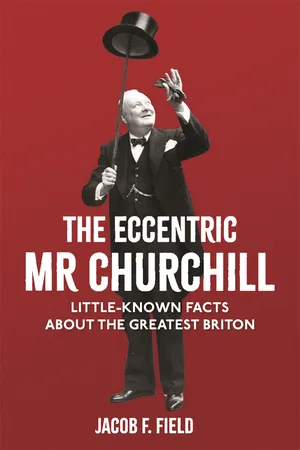
This fascinating and highly entertaining book contains little-known anecdotes, facts and details from the life of Winston Churchill, the 'man of the century' who, in 2002, was voted the Greatest Briton of all time. As well as providing a new insight into the epochal historical events that Churchill was a part of, it documents some of the lesser known moments of his life, as well as intriguing facts about how he lived and worked, his friends and enemies, loves and hates. Did you know that: - Churchill invented the 'belly band' around cigars?- A duck-billed platypus – named Winston – was sent from Australia to join Churchill's menagerie at Chartwell?- He escaped from a POW camp during the Second Boer War?- He was a handy bricklayer in his spare time?These and many more extraordinary facts are detailed in this book. It will provide even the Churchill aficionado with another perspective on the great man, who remains a figure of fascination for millions worldwide.
- English
- ePUB (mobile friendly)
- Available on iOS & Android
eBook - ePub
About this book
Trusted by 375,005 students
Access to over 1.5 million titles for a fair monthly price.
Study more efficiently using our study tools.
Information
CHAPTER 1
The Early Years

THE DUKES OF MARLBOROUGH
WSC was a member of one of the most illustrious aristocratic families in England, the Spencer-Churchills. He directly descended from the famed general John Churchill, his great, great, great, great, great, great grandfather. Queen Anne awarded John Churchill the title of Duke of Marlborough in 1702 for his service as a general (during the 1930s WSC would write a four-volume biography of him). The family’s seat was Blenheim Palace, built for them by the government between 1705 and 1722, which included 186 rooms set in seven acres of grounds. It was named in honour of the first duke’s great victory over the French at the Battle of Blenheim (1704) in the War of the Spanish Succession.
The Dukes of Marlborough became the Spencer-Churchills as a result of the marriage of the first duke’s daughter Anne to the statesman Charles Spencer, Earl of Sunderland. Their son Charles Spencer-Churchill became the third duke in 1733. WSC tended not to use his full surname, simply going by ‘Churchill’, although he would adopt ‘S’ as a middle initial. The Dukes of Marlborough were a central presence in English political life throughout the eighteenth and nineteenth centuries. WSC was the grandson of the seventh Duke of Marlborough, John Winston, a Conservative politician and minister. His father’s older brother George inherited the duchy in 1883. WSC’s cousin Charles, nicknamed ‘Sunny’ because one of his titles was the Earl of Sunderland, became the ninth duke in 1892. Until the birth of Sunny’s son John in 1897, WSC was next in line to inherit the title.
LORD RANDOLPH
Randolph Churchill, WSC’s father, was born on 13 February 1849 at 3 Wilton Terrace in Belgravia, London, to the seventh Duke of Marlborough and Lady Frances Anne Vane, the daughter of the Marquess of Londonderry, who had extensive estates in Ireland. As he was the second of their sons to survive into adulthood, he did not inherit the duchy. However, Randolph was allowed to use the courtesy prefix of ‘Lord’ (although he could not pass it on to his children). He attended Eton and matriculated at Merton College, Oxford, in 1867. Despite concentrating more on sport and drink-fuelled carousing (like Boris Johnson and David Cameron, he was a member of the Bullingdon Club), he graduated with a 2:1 in jurisprudence and modern history in 1870. Interested in politics from an early age, Randolph was elected as the Conservative MP for Woodstock in Oxfordshire in the February 1874 General Election.
JENNIE JEROME
WSC’s mother, Jeanette (although she was always known as Jennie), was born in Brooklyn, New York, on 9 January 1854. Her father, Leonard Jerome, was a wealthy businessman who owned a majority share in The New York Times, several racehorses and an opera house, while her mother, Clara Hall, was the daughter of a landowner. Jennie’s parents separated in 1867; happily, there was little acrimony and Leonard gave Clara enough income to allow her to move to Paris with Jennie and their two other surviving daughters, Clarita and Leonie. In Paris, Jennie developed into a glamorous and charming sophisticate with striking good looks. Fluent in French and German, she was also a skilled pianist.

Jennie Churchill had a small tattoo of a serpent on her left wrist, kept hidden by a bracelet she almost always wore.
RANDOLPH AND JENNIE
Cowes Week is a sailing regatta held every August off the Isle of Wight. The festival attracts thousands of wealthy and aristocratic visitors; in 1873 they included Randolph Churchill and Jennie Jerome. They first met at a reception and ball held on the HMS Ariadne to introduce members of the visiting Russian imperial family to High Society. Randolph and Jennie immediately hit it off; both were well travelled and keen horse riders. The next day Randolph came to dinner at the house where Jennie was staying with her mother and sisters. Jennie impressed Randolph with her expert piano-playing, and within days of meeting they were engaged.
Neither family was wildly enthusiastic about the match. Jennie’s mother wanted someone of higher status for her daughter than the relatively impoverished second son of a duke, while Randolph’s parents were not keen on their son marrying an American. Nonetheless, they began negotiating the marriage settlement. Disaster struck when Jennie’s father withdrew his consent for the match in November 1873 when he found out the seventh Duke of Marlborough was looking into his business affairs in New York. However, following a personal meeting with Randolph (and his successful election as an MP), he once more gave his consent to the union in February 1874. Jennie’s dowry was £50,000 and the couple was given a joint annual income of £4,000. The wedding was celebrated at the chapel of the British embassy in Paris on 15 April. Following a European honeymoon and a brief period at Blenheim, they moved into a rented house in London’s West End at 1 Curzon Street in Piccadilly.
THE BIRTH OF WINSTON
WSC was born at 1.30 a.m. on 30 November 1874 at Blenheim Palace. His parents had planned to have the birth at their home in London, but Jennie, so it is said, went into labour two months prematurely, during a visit to Blenheim. The baby was delivered after an eight-hour labour, overseen by Frederic Taylor, a local doctor. As WSC was born early, his parents had to borrow baby clothing from the wife of Mr Thomas Brown, a solicitor who lived near Blenheim. On 27 December WSC was baptized at the chapel in Blenheim, and named Winston after his paternal grandfather and Leonard for his maternal grandfather, who also stood as his godfather. His godmother was his paternal great-aunt Clementina, Marchioness Camden. In the new year, Randolph, Jennie and WSC returned to their London residence before moving to a new four-storey property at 48 Charles Street in Mayfair.
WSC was a plump infant, so naturally he was nicknamed ‘Skinny’.

‘WOOMANY’
Like most upper-class Victorian parents, Randolph and Jennie mainly left child-rearing duties to hired help. Fortunately for Winston (and his younger brother Jack, born in 1880) their nanny, a Kentish woman called Mrs Elizabeth Ann Everest, was both capable and loving. The ‘Mrs’ was an honorific – she never married. WSC called her ‘Old Woom’ or ‘Woomany’, while she affectionately called him ‘Winny’. When WSC left for school she continued to write to him about his health, even recommending heroin for toothache. She frequently travelled to tend WSC when he fell ill at boarding school, and attended speech day at Harrow with him instead of his parents. In 1891 Everest was moved on to join the staff of WSC’s grandmother in London, but was abruptly fired after two years there. She eventually retired to live in Crouch End with her sister. Her health began to fail in the summer of 1895. WSC (now serving in the Army) rushed from his barracks in Aldershot to be with her. She died on 3 July with WSC by her side. He and Jack paid for and organized her funeral and tombstone. For the rest of his life WSC kept a photograph of her in his room.
A ROYAL SCANDAL
WSC’s uncle George was married to Lady Albertha Hamilton, with whom he had four children. Until he inherited the title of Duke of Marlborough in 1883, George was known as the Marquess of Blandford. Around 1874, Blandford embarked on an affair with Edith, the wife of the Earl of Aylesford (also known as ‘Sporting Joe’), having been introduced by the Prince of Wales. After Albertha found out about the affair, she left her husband. In November 1875, Aylesford joined the Prince of Wales on his tour of India, which gave Blandford the chance to get closer to Edith by moving into a hotel near her country house in Warwickshire. In early 1876, Edith wrote to her husband in India telling him she wished to elope with Blandford. When Aylesford returned to England he began divorce proceedings, naming Blandford as the co-respondent, blackening his name across London. To defend his brother’s reputation Randolph leant on the Prince to force Aylesford to drop the suit, threatening to release racy, personal letters that the Prince had written to Edith. Incensed, the furious Prince was ready to duel Randolph in France, where the practice was still permitted. Queen Victoria called on Prime Minister Disraeli to calm the situation; he managed to get the families to reconcile, helped persuade Aylesford to drop the divorce case and had the incriminating letters burned. Disraeli then arranged for the seventh Duke of Marlborough to become Lord Lieutenant of Ireland. Randolph would act as his personal secretary, which meant he would have to reside in Dublin, removing him from London Society. He was joined by his wife, the two-year-old WSC and, of course, Mrs Everest.
LIFE IN IRELAND
The Churchills’ Dublin home was the ‘Little’ White Lodge. It was situated in Phoenix Park, the estate that housed the official residence of the Lord Lieutenant. Although Randolph made frequent visits back to London (he was still a sitting MP), he developed an interest in Irish affairs and with Jennie visited all thirty-two counties. They also helped raise over £135,000 in charitable donations to a famine relief fund. WSC’s first memories were of Ireland and were mostly fond, although in 1879 he fell off his donkey and was seriously concussed, leading to years of recurrent headaches. The Dublin interlude ended in March 1880, when Randolph had to return to England to prepare for the General Election. Although Randolph regained his Woodstock seat, his party lost power to the Liberals, leading to the appointment of a new Lord Lieutenant of Ireland. Now permanently returned to London, the Churchills settled in a new house at 29 St James’s Place in Piccadilly before moving again in 1883 to 2 Connaught Place in Bayswater.
After Randolph was named Secretary of State for India in 1885, WSC made extra money by selling his father’s signature to fellow students at Harrow. Later on, WSC also sold his mother’s signature.

ST GEORGE’S SCHOOL
WSC was first sent to boarding school at the age of seven. He attended St George’s School in Ascot, which was opened in 1877 and run by a cruel disciplinarian called Herbert Sneyd-Kynnersley. Sneyd-Kynnersley made liberal use of the cane, often giving boys twenty strokes for even small offences, usually drawing blood. Once he caned WSC for taking some sugar; in retaliation young Winston kicked the man’s straw hat to pieces. Unsurprisingly, WSC despised St George’s, where he was bottom of the class, and left in July 1884 following a bout of illness. In 1904 St George’s became a girl’s school, and it is still operating (in fact, Princess Beatrice of York attended from 2000 to 2007, and was Head Girl).
MOVING TO BRIGHTON
Following his unhappy time in Ascot, WSC was enrolled at a school in Brighton in September 1884, where he remained for nearly four years. Located near Hove, the school was run by two sisters called Kate and Charlotte Thomson. The sickly and asthmatic WSC was sent there on the recommendation of his doctor, Robson Roose, whose clinic was located nearby. In his early weeks there he found himself in trouble when, during a drawing examination, he got into an argument with another student about a knife they both needed. The quarrel ended with WSC being stabbed in the chest, leaving a quarter-inch-deep wound.
In March 1886, WSC suffered from a severe, possibly life-threatening, fever, when his temperature peaked at 104.3 degrees Fahrenheit (40 degrees Celsius), but he was brought back to health following the ministrations of Dr Roose. Overall, WSC was much more content at the school, learning to swim, box and ride, enjoying his study of French, classics and history, and winning prizes f...
Table of contents
- Cover
- Title Page
- Copyright
- Contents
- Dedication
- Introduction
- 1 The Early Years
- 2 Friends and Enemies
- 3 Writer and Soldier
- 4 Churchillian Recreation
- 5 Libations and Victuals
- 6 Winston’s Menagerie
- 7 The (Right) Honourable Member
- 8 The Churchill Look
- 9 Never Surrendering, Always Inspiring
- 10 At Home With Winston
- Selected Bibliography
- Index
Frequently asked questions
Yes, you can cancel anytime from the Subscription tab in your account settings on the Perlego website. Your subscription will stay active until the end of your current billing period. Learn how to cancel your subscription
No, books cannot be downloaded as external files, such as PDFs, for use outside of Perlego. However, you can download books within the Perlego app for offline reading on mobile or tablet. Learn how to download books offline
Perlego offers two plans: Essential and Complete
- Essential is ideal for learners and professionals who enjoy exploring a wide range of subjects. Access the Essential Library with 800,000+ trusted titles and best-sellers across business, personal growth, and the humanities. Includes unlimited reading time and Standard Read Aloud voice.
- Complete: Perfect for advanced learners and researchers needing full, unrestricted access. Unlock 1.5M+ books across hundreds of subjects, including academic and specialized titles. The Complete Plan also includes advanced features like Premium Read Aloud and Research Assistant.
We are an online textbook subscription service, where you can get access to an entire online library for less than the price of a single book per month. With over 1.5 million books across 990+ topics, we’ve got you covered! Learn about our mission
Look out for the read-aloud symbol on your next book to see if you can listen to it. The read-aloud tool reads text aloud for you, highlighting the text as it is being read. You can pause it, speed it up and slow it down. Learn more about Read Aloud
Yes! You can use the Perlego app on both iOS and Android devices to read anytime, anywhere — even offline. Perfect for commutes or when you’re on the go.
Please note we cannot support devices running on iOS 13 and Android 7 or earlier. Learn more about using the app
Please note we cannot support devices running on iOS 13 and Android 7 or earlier. Learn more about using the app
Yes, you can access The Eccentric Mr Churchill by Jacob F. Field in PDF and/or ePUB format, as well as other popular books in History & Political Biographies. We have over 1.5 million books available in our catalogue for you to explore.