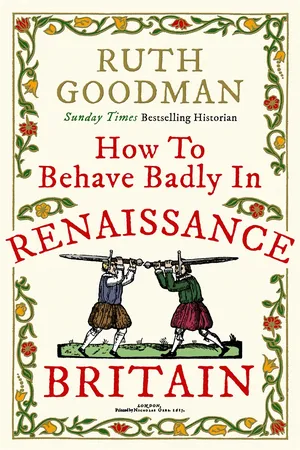
Historian and popular BBC TV presenter Ruth Goodman, author of How to Be a Tudor, offers up a history of Renaissance Britain – the offensive language, insulting gestures, insolent behaviour, brawling and scandal of the sixteenth and seventeenth centuries – with practical tips on just how to horrify the Tudor neighbours. From royalty to peasantry, every age has its bad eggs, those who break all the rules and rub everyone up the wrong way. But their niggling, anti-social and irritating ways not only tell us about what upset people, but also what mattered to them, how their society functioned and what kind of world they lived in.In this brilliantly nitty-gritty exploration of real life in the Tudor and Stuart age, you will discover: - how to choose the perfect insult, whether it be draggletail, varlet, flap, saucy fellow, strumpet, ninny-hammer or stinkard - why quoting Shakespeare was very poor form - the politics behind men kissing each other on the lips - why flashing the inside of your hat could repulse someone - the best way to mock accents, preachers, soldiers and pretty much everything else besidesRuth Goodman draws upon advice books and manuals, court cases and sermons, drama and imagery to outline bad behaviour from the gauche to the galling, the subtle to the outrageous. It is a celebration of drunkards, scolds, harridans and cross dressers in a time when calling a man a fool could get someone killed, and cursing wasn't just rude, it worked! 'Ruth is the queen of living history – long may she reign!' Lucy Worsley
Anyone who has ever tried to learn a new language knows that it is the rude words that somehow stick in the memory, even when one is struggling to remember the basics of ordering coffee and cake at a café. Renaissance Britain was an English-speaking nation, but the language has since undergone just enough subtle change to slow and befuddle our modern understanding. If we want to get under the skin of Tudor and Stuart minds we are going to have to take a little time to ‘tune in’ and decode many linguistic quirks and shifts. So let’s begin with the easy bit – the rude words.
‘A turd in your teeth’
What a delightful way to begin! This was a phrase that was screeched in the street and intended to shock and disgust. How could you not be repelled if someone spat that in your face? And it is a phrase that lends itself to a loud, angry, spitting sort of delivery. This is offensive speech in its rawest, earthiest, most aggressive and public form. We could, of course, have started with something much more recognizable and far less real.
Many people are familiar with the witty and inventive language of insult and repartee found in Shakespeare and other Renaissance writers. Dip into Henry IV Part 1, for example, and there you will find Falstaff in just one single scene calling his friend Bardolph ‘a perpetual triumph, an everlasting bonfire light’ because of the redness of his nose, riffing on the theme for about ten minutes. He goes on to berate his hostess, saying that ‘There’s no more faith in thee than in a stewed prune’ and likens her to an otter that counts as neither fish nor flesh, then he calls the Prince ‘a Jack, a sneak-cup’ behind his back and a ‘lion-whelp’ to his face. In between he delivers expletives like ‘’Sblood’ and ‘God-a-mercy!’ But there is something essentially comical and unthreatening about all this. It is just bluster and only the more po-faced and religiously sensitive of audiences, both period and modern, would truly take offence.
Poking fun at someone’s appearance is not exactly kind, but when the raillery is original, varied and linguistically clever, much of the sting is taken out. Indeed, the name-calling can become nothing but a game. ‘[T]his sanguine coward, this bed-presser, this horse back-breaker, this huge hill of flesh,’ exclaims Prince Henry earlier in the play, laughing at Falstaff’s large girth only to be insulted in turn for his own relative skinniness: ‘Away, you starveling, you elf skin, you dried neat’s tongue, bull’s pizzle, you stockfish. – O for breath to utter what is like thee! – you tailors yard, you sheath, you bow-case, you vile standing-tuck.’ These comparisons are made more cutting by their reference not just to being long and thin but hollow and empty, extending the conflict out from the initial criticism of bodily form into the realm of character. Yet there is little real anger here; the characters are clearly enjoying the competitive nature of the exchange and we the audience are called upon to applaud the sharpness of wit. Such exchanges made Falstaff one of Shakespeare’s most popular characters. Leonard Digges, in his preface to the second edition of Shakespeare’s works published in 1640, claimed that when plays by other authors have ‘scarce defrayd the Seacole fire, And doore-keepers; but let Falstaff come, Hal, Poins and the rest, you shall scarce have room.’ Other plays might run at a loss with barely enough audience to pay for upkeep and admission staff but a play with Falstaff and his witty banter packed the house night after night.
‘A turd in your teeth’ is a rather different matter. For a start it’s not from a play or any other consciously literary source but is a report of real speech, hurled in anger in the street. There is no carefully thought-out subtext and no personalization. This is a standard stock phrase used by many people in many situations and recorded in court cases about disputes between people as diverse as a fishwife and her neighbour, and a moneyer and the pastor of Stepney. It’s short, easy to remember in a moment of deep frustration and it is a disgusting image along the lines of today’s phrase ‘eat shit’. It is not meant to be clever or witty and it can be aimed at anyone who annoys you. If you truly intended to behave badly in Renaissance Britain, this was the sort of language that you needed; forget the flowery language of literature (unless you intend to launch into print yourself), and concentrate instead upon the stuff that hurts, that gets under the skin and turns people’s faces bright red.
If you got tired of ‘a turd in your teeth’ then you could vary it a little with the ever popular ‘kiss my arse’. ‘Kiss my arse’ can, however, require a little caution as it does leave an opening for a sharp reply such as that in the following exchange. Mary Goates and Alice Flavell were arguing in the London street outside their respective houses when Mary went for ‘kiss my arse’; quick as a flash, Alice retorted: ‘Nay, I will leave that for John Carre’ – implying not only that Mary had an illicit lover, but that he was a subservient and perverted one, and Mary was a low-value whore. Few people, however, had the presence of mind to manage such a come-back in the heat of the moment. (I’d like to make it clear that this is not the relatively polite modern US usage of ‘kiss my ass’ that refers to buttock kissing, but rather to the British ‘arse’ or ‘arsehole’.)
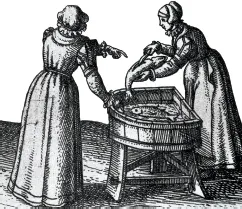
Fishwives were notorious for the volume and caustic content of their speech.
‘Kiss my arse’ remained an effective insult in most situations and was particularly useful against those who set themselves up as moral superiors. It was the sort of thing you could say if someone tried to tell you off about your level of drinking or the noise you were making in the street. It was a phrase that epitomized good old-fashioned insolent defiance. If you felt the need to expand upon the admittedly rather concise ‘kiss my arse’, you could add ‘I care not a fart for you’, which, again rather neatly, told the busybodies and overly righteous that you did not accept their reproofs.
Defying authority like this was, of course, not supposed to happen. According to preachers and philosophers alike, everyone was to know their place and behave gravely and soberly with due deference to those located above them in a divinely ordered world hierarchy. Men above women, adults above children, masters over servants, those able to financially support themselves over their dependents, the titled in strict rank order holding sway over the commoner, with God and his ministers holding authority over all. Each person occupied a particular niche within this structure, one that could change over time as they grew from child to adult and moved from the single into the married life. Marriage increased the honour of one’s standing, while old age and infirmity often brought about a decline. A person’s place was constantly redefined and reinforced by those around them, reminding them of their duties towards their ‘betters’.
It was the element of divine organization that gave this idea its overwhelming power and authority. It wasn’t just luck and circumstance that meant some were born rich and some were born poor, or that you happened to be male or female. God himself had chosen both the structure of society and who would fill each role within it. No social division of our own age and in the Western world carries anything like this weight and psychological importance. When one woman screams ‘a turd in your teeth’ to her neighbour, a social equal, it is of course offensive; but for John Pye – our moneyer – to say such a thing to a man of the cloth, an ordained minister of God, was a much more serious and socially disruptive act. Thank goodness he didn’t use the term ‘kiss my arse’, with its deep sense of disrespect. Insubordination threatened the divine plan; it was a direct challenge to the whole of society, not just the individual. While Mary Goates and Alice Flavell’s altercation resulted in a case brought by the one against the other for defamation of character in the church courts, John Pye’s words were passed on up the chain by the churchwardens to the Bishop of London’s Commissary. The women’s grievances were primarily a private affair concerned with their local reputation, but the same words hurled across a social boundary required a much more concerted community response.
Bad language such as ‘kiss my arse’ was fundamentally a deviation from the rules about social harmony, order and respect. Disrupting the peace by voicing discord or attempting to undermine authority was one of the main thrusts that rendered speech offensive. A shouting match in the street unsettled everyone within earshot. There was a danger that such hostility was magnified and spread by this linguistic behaviour, severing ties within the community, prolonging and deepening personal feuds, damaging the daily cooperation that many people relied upon for survival. In some ways the actual words used were irrelevant, the offence was in the situation. ‘A turd in your teeth’ aimed at an authority figure was not necessarily an attack upon that individual, but upon the authority that he represented.
Up Close and Personal
Many of the recorded incidents of insult were, however, entirely personal and individually targeted. Pointing out the deviancy of others formed the second main prong of verbal shenanigans and most common when the insult was focused upon an individual. As we move forwards through a list of all the hurtful and upsetting things that you could shout at people in the street, we will encounter again and again accusations that the victim is failing to live up to expectations in some way. Much of the efficacy of the insult is derived from taunting a person with inappropriate, antisocial behaviour. You may be behaving badly by your disruptive name-calling, but it is nothing in comparison to the alleged bad behaviour of your victim.
Most foul words were strongly gendered: there were things you said only to women and things you said only to men. Only a man, for example, could be called a ‘knave’. Don’t be fooled, however, into thinking that this is a mild insult to be shrugged off just because it has largely gone out of use. It was once a perfectly respectable title for someone of lowly birth, but the meanings of words change and even as the Tudor dynasty took the throne the emphasis was shifting. A ‘knave’ became someone not just lowly in birth but uncultured and unmannered. The anonymously authored The Babees Book of 1475, aimed at teaching manners to high-born boys, described larking about at inappropriate moments as ‘Knavis tacches’ (knavish tricks) but, just a few years later, a ‘knave’ came to mean a man whose morals were in question as well as his manners. For most of Henry VIII’s reign the word was a relatively polite, descriptive one for someone both crude and rather deceitful. By the close of Elizabeth I’s reign, however, a ‘knave’ was the scum beneath your feet, someone not fit to be in the company of decent people and most emphatically not a word that one could use in a book aimed at children. The word had changed from a simple signifier of social status into an insult, and an insult, moreover, that increasingly stung.
Part of the power of ‘knave’ lay in its ability to attack the social status of a man. Titles were deeply important to the self-respect of Renaissance men. Those born to noble or gentle families were genuinely perceived as being ‘better’ than common people. Medical men even held that their bodies were subtly different, having ‘finer’ digestive processes that demanded a different diet from the common man. No labourer could be expected to derive nourishment from the delicate meats served at a nobleman’s table (they would burn away to nothing in his hot strong stomach), just as no nobleman could survive upon the coarse bread of the labourer (where it would sit cold and hard in his more gently heated belly). Denying or denigrating a man’s title cut to the core of his being. Within social brackets, each man journeyed through life hoping to be afforded a series of graded respect titles as he moved from child to adult to patriarch, with increased responsibilities and social standing along the way. Even the humblest man hoped to be accorded the title of ‘Goodman’ once he was married, rather than be known purely by his given name. A large proportion of the adult male population also felt themselves entitled to the epithet ‘Master’ as they employed servants or apprentices. The word ‘knave’ at the latter end of the sixteenth century, however, downgraded even simple Goodman Carter who made his living labouring for neighbouring farmers. At this point in time it made him appear sub-adult, irresponsible and untrustworthy. Social respect was a prize that came with appropriate titles; the wrong title was hurtful and degrading.
As we all know, a single, one-syllable word is rarely completely satisfying when used in anger – you need just a little bit more. As a result, ‘knave’ was often used in conjunction with some other term. While ‘knave’ attacked social standing, most of the additional words associated with it undermined a man’s self-image as an upstanding pillar of the community. You might shout ‘filthy knave’, ‘lying knave’, ‘canting knave’ (one that holds forth loudly on subjects he knows nothing about) or, one of my favourites, ‘polled knave’ (‘polled’ meaning castrated). All of these words were digs at the popular image of man as the embodiment of familial power and authority. A man who could not keep himself clean, uphold the truth, guard his tongue and father children was failing in his duties as head of the household. Along with the word ‘knave’, these terms downgraded him from a respectable adult with a stable position in his community to the much lower status of a feckless and footloose youth. John Barker combined several versions when he blew his top in 1602. In response to ‘some speeches’ by the vicar, the Reverend Foster, John ‘in angry, brawling, quarrelling and chiding manner’ called him ‘a knave, a rascal knave, a scurvy rascal knave’, while several of the neighbours tried to step in and calm things down. Such words could often spill over into violence.
‘Varlet’ was a less popular insult. It stemmed from a similar source, a word for someone of lowly origins, but it never had quite the same bite as ‘knave’, carrying fewer overtones of dishonesty. ‘Sirra’ and ‘saucy fellow’ were likewise milder in tone than ‘knave’, while ‘Jack’ stood somewhere in the mid-range of derogatory terms along with ‘rogue’. All implied worthlessness but each had a subtly different hue. ‘Sirra’ was slavish and servile, ‘saucy fellow’ was insolent and mouthy, and ‘Jack’ was more thuggish, while a ‘rogue’ was distinctly criminal in his behaviour.
Combinations and compounds once again added to the effect. Calling someone ‘Jacksauce’ conjured up images of a worthless, loud-mouthed bully full of meaningless but unpleasant bluster, and the oft-used ‘jackanapes’ linked ‘Jack’ with an ape to produce an insult that derided someone as subhuman, a mere mockery of human form with no self-control. ‘Wastrel’ was a much simpler concept that had the advantage of cutting to the chase, describing a good-for-nothing waste of space.
Stupidity provided another rich seam of potential for insult. A man could be a ‘fool’, a ‘gul’, a ‘clowne’, a ‘blockhouse’, a ‘loggerhead’, a ‘ninny-hammer’ or an ‘ass’. It was ‘fool’ that held the most vitriol. Similarly to ‘knave’, this word sounds mild to modern ears, but don’t be lulled into a false sense of security: ‘fool’ was no mealy mouthed cop-out. Its present mildness probably stems, like that of ‘knave’, from overuse gradually eroding its power to shock.
Within my own lifetime I have seen many words lose their edge as far as offence goes. The word ‘tart’, for example, was distinctly more uncomfortable in the 1970s, and one barely encountered ‘fuck’ at all. Now we live in a world in which to be a ‘tart’ is almost a good thing and the f-word is everywhere and frankly not all that shocking any more. Words are slippery things.
The word ‘knave’ was probably at its most offensive in the 1590s, but it still packed a punch in the 1620s and ’30s before gradually starting to slide out of use from the 1650s onwards. The word ‘fool’ had a slightly longer period of virulence and was still provoking full-scale fist fights in the 1650s. It got under a man’s...
Table of contents
Cover
PRAISE FOR HOW TO BE A TUDOR
PRAISE FOR HOW TO BE A VICTORIAN
Title page
Copyright page
CONTENTS
Introduction
Chapter 1: Offensive Speech
Chapter 2: Insolent, Rude and Threatening Gestures
Chapter 3: Mockery
Chapter 4: Outright Violence
Chapter 5: Disgusting Habits
Chapter 6: Repulsive Bodies
Conclusion: The Complete Scoundrel
Bibliography
Acknowledgements
List of Illustrations
Index
Trusted by 375,005 students
Access to over 1.5 million titles for a fair monthly price.
Study more efficiently using our study tools.
Frequently asked questions
Yes, you can cancel anytime from the Subscription tab in your account settings on the Perlego website. Your subscription will stay active until the end of your current billing period. Learn how to cancel your subscription
No, books cannot be downloaded as external files, such as PDFs, for use outside of Perlego. However, you can download books within the Perlego app for offline reading on mobile or tablet. Learn how to download books offline
Perlego offers two plans: Essential and Complete
Essential is ideal for learners and professionals who enjoy exploring a wide range of subjects. Access the Essential Library with 800,000+ trusted titles and best-sellers across business, personal growth, and the humanities. Includes unlimited reading time and Standard Read Aloud voice.
Complete: Perfect for advanced learners and researchers needing full, unrestricted access. Unlock 1.5M+ books across hundreds of subjects, including academic and specialized titles. The Complete Plan also includes advanced features like Premium Read Aloud and Research Assistant.
Both plans are available with monthly, semester, or annual billing cycles.
We are an online textbook subscription service, where you can get access to an entire online library for less than the price of a single book per month. With over 1.5 million books across 990+ topics, we’ve got you covered! Learn about our mission
Look out for the read-aloud symbol on your next book to see if you can listen to it. The read-aloud tool reads text aloud for you, highlighting the text as it is being read. You can pause it, speed it up and slow it down. Learn more about Read Aloud
Yes! You can use the Perlego app on both iOS and Android devices to read anytime, anywhere — even offline. Perfect for commutes or when you’re on the go. Please note we cannot support devices running on iOS 13 and Android 7 or earlier. Learn more about using the app
Yes, you can access How to Behave Badly in Renaissance Britain by Ruth Goodman in PDF and/or ePUB format, as well as other popular books in History & Early Modern History. We have over 1.5 million books available in our catalogue for you to explore.