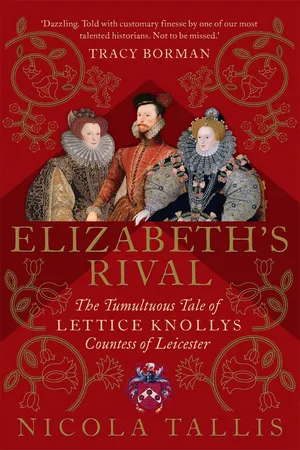
The first biography of Lettice Knollys, one of the most prominent women of the Elizabethan era. Cousin to Elizabeth I – and very likely also Henry VIII's illegitimate granddaughter – Lettice Knollys had a life of dizzying highs and pitiful lows. Darling of the court, entangled in a love triangle with Robert Dudley and Elizabeth I, banished from court, plagued by scandals of affairs and murder, embroiled in treason, Lettice would go on to lose a husband and beloved son to the executioner's axe. Living to the astonishing age of ninety-one, Lettice's tale gives us a remarkable, personal lens on to the grand sweep of the Tudor Age, with those closest to her often at the heart of the events that defined it. In the first ever biography of this extraordinary woman, Nicola Tallis's dramatic narrative takes us through those events, including the religious turmoil, plots and intrigues of Mary, Queen of Scots, attempted coups, and bloody Irish conflicts, among others. Surviving well into the reign of Charles I, Lettice truly was the last of the great Elizabethans.
eBook - ePub
Elizabeth's Rival
The Tumultuous Tale of Lettice Knollys, Countess of Leicester
- English
- ePUB (mobile friendly)
- Available on iOS & Android
eBook - ePub
About this book
Trusted by 375,005 students
Access to over 1.5 million titles for a fair monthly price.
Study more efficiently using our study tools.
Information
CHAPTER 1

Hiding Royal Blood
IN THE HEART of the Chiltern Hills in the Oxfordshire countryside lies the picturesque village of Rotherfield Greys. At the centre of the village is the idyllic restored Norman church of St Nicholas, which houses the magnificent double tomb of Sir Francis Knollys and his wife, Katherine Carey.1 Commissioned by the couple’s second son William, Earl of Banbury, in 1605 as a memorial to his parents, surrounding the tomb are the kneeling effigies, or ‘weepers’, of the Knollys’s children. One in particular, depicted at the head of her sisters and dressed in a red robe with a rich coronet indicative of her status, is striking: the third Knollys child, Lettice.2 Her resplendent effigy does not convey any of the turbulence and drama that consumed her life, or her reputation as one of the most notorious women of the Elizabethan era. Hers was a life that was full of ambition, danger and tragedy, and it was at Rotherfield Greys that it all began.
Greys Court, her parents’ manor house in Rotherfield Greys, was the setting for the birth of Lettice Knollys on ‘the Tuesday present after all Hallows Day’, 6 November 1543.3 A birth date given with such precision is unusual for this period, and is solely thanks to the Latin dictionary produced in Venice, and still in its original calf binding, that was once owned by Lettice’s father, Sir Francis Knollys.4 Sir Francis not only used the dictionary to document Lettice’s date of birth in his own hand, but also proudly recorded the date of his marriage to Lettice’s mother in 1540. He also noted the births and times of day in date order of thirteen of Lettice’s siblings.5 Almost exactly a year after their marriage and prior to the arrival of Lettice, her mother had given birth to her first child, Henry (or Harry), ‘the Tuesday before Easter Day [12 April] 1541’.6 Henry was named after the King, Henry VIII, while the choice of name following the birth of a daughter in October 1542, Mary, was in honour of her maternal grandmother. Lettice’s unusual choice of Christian name was a compliment to her paternal grandmother and was a shortened form of Laetitia, the Latin word for happiness.7 It was a fitting name for a girl born into such a close and loving family that cared deeply for its members. Her parents were devoted both to one another and to their children, and raising their family would be their greatest priority.

SIR FRANCIS KNOLLYS had been born in around 1512, probably at Rookes Manor in Hampshire, and was the eldest son of Robert Knollys and his wife, Lettice Peniston.8 The Knollys family had a history of royal service to the Tudor family, and Robert Knollys had been a henchman to the first Tudor king, Henry VII. He was later appointed to wait on the King’s eldest son, Prince Arthur, for which he received £5 (£2,400) per year as reward.9 Following Arthur’s untimely death in 1502, Robert reverted to serving the King, assuming the role of Gentleman Usher of the Chamber. Robert continued to faithfully serve his successor, the handsome and athletic Henry VIII who succeeded in April 1509, and was well favoured for his loyal service. In around 1510 Robert was married to Lettice Peniston, the daughter of Sir Thomas Peniston and Alice Bulstrode.10 The Penistons were a family of Buckinghamshire descent, settling in Hawridge, and it may have been that the match was arranged through Robert’s contacts at court. On 9 July 1514, the King jointly granted the couple the manor of Rotherfield Greys, and they were fortunate in so much that the annual rent the property commanded was a single red rose, payable at midsummer.11 Thus began the Knollys family’s residency and association with the Oxfordshire manor of Greys Court.
Robert and Lettice had four children, of which Francis was the eldest. His birth was followed by those of Henry, Mary and Jane, although all of their birth dates are unrecorded.12 Henry never married, and Francis remained on close terms with his brother into adulthood. Nothing, however, is known of his relationships with his sisters.13 Few details of Francis’s early life and education are known; according to tradition he attended Magdalen College, Oxford, but there is no contemporary evidence to support this.14 The abilities and interests that he displayed later in life suggest that he was well educated, and it may well be that he did attend one of the notable colleges. Francis may also have spent some time during his early years at court, for when his father died in 1521 the hand of Henry VIII’s royal patronage was extended to his heir.15 Francis’s mother remarried, taking as her second husband Sir Robert Lee, who hailed from her native Buckinghamshire.16 Lee was a Knight of the Body to Henry VIII, thereby providing Francis with another close link to the royal court. Similarly, in 1527 when Henry VIII began annulment proceedings in order to end his marriage to Katherine of Aragon, splitting from the Catholic Church in Rome and establishing the Church of England with himself at its head, Francis was supportive of the King’s bold move. His primary motivation was religion, for Francis became well known for his Protestant beliefs. He was also steadfastly loyal to the Crown, and would remain active in its service for the rest of his life. From 1534 he began to sit in Parliament, another occupation that he treated with the utmost seriousness, and in which he would continue for the next six decades.
Francis’s portraits, painted in later life, show a serious-looking man with a beard that had turned grey, and a long face and nose. The best surviving likeness of him, which now hangs at his former home, Greys Court, was painted in 1586 by an unknown English artist, and depicts him in his later role of Lord Treasurer of the Household.
In 1539, Francis was evidently well regarded by the King, for in that same year he was appointed one of fifty Gentlemen Pensioners, or Troop of Gentlemen as they were originally called: a ceremonial mounted guard who acted as an escort to protect the King. This was a great honour, and he would remain among its numbers until 1544. It was in November 1539 that, at court, Francis met and fell in love with his future wife, Katherine Carey. Katherine had only recently arrived, having been appointed to serve the King’s bride-to-be, Anne of Cleves, who was currently embarking on her journey to England. Anne was not to the King’s liking, though, and he was supposedly repelled by her personal qualities. Nevertheless, in January 1540 he and Anne were married; it was to be a marriage that lasted just six months before being annulled. Elsewhere, however, the twenty-eight-year-old Francis’s courtship with Katherine was of short duration, for as Francis’s Latin dictionary reveals, just five months after Katherine’s arrival at court, on 26 April 1540, he and the sixteen-year-old Katherine were married. No details of the wedding survive, but as Katherine was part of Anne of Cleves’ household it seems likely that the marriage was conducted in London where the court was in residence. The marriage was particularly advantageous for Francis, for in Katherine’s veins almost certainly flowed the royal blood of the Tudors, a fact of which he, and many others, were likely aware.
On the surface Katherine Carey purported to be the daughter of Sir William Carey and his wife, Mary Boleyn. Though the Carey family had been well-respected courtiers hailing from Wiltshire, it was the Boleyns who were in possession of the more prestigious links. Katherine’s mother, Mary, was the eldest daughter of Sir Thomas Boleyn and Lady Elizabeth Howard, the daughter of the second Duke of Norfolk.17 The Boleyns were a family of Norfolk origin, but at the start of the sixteenth century they had settled at Hever Castle in Kent. Sir Thomas Boleyn was in high favour with Henry VIII, and was particularly valued for his diplomatic service abroad. It was through Sir Thomas’s auspices that in 1514 his young daughter Mary had been fortunate enough to secure a placement in the entourage of the King’s younger sister, eighteen-year-old Mary, who was travelling to the French court in order to marry the French King, Louis XII. At fifty-two Louis was in poor health, and he died on New Year’s Day 1515, bringing his marriage to an abrupt end after just three months. Though her mistress returned home in May – once again a married woman after conducting a clandestine marriage with the Duke of Suffolk – Mary Boleyn remained in France. Here she embarked on a very brief affair with the new French King, François I, lending support to Robert Lacey’s claim that ‘It was not for nothing, whispered her [Lettice’s] many detractors, that her grandmother had been the lascivious Mary Boleyn.’18 Lacey, the biographer of Lettice’s son the Earl of Essex, was not the only writer to seize upon this, using Mary’s royal affairs as a way of extrapolating her personality and making her appear sexually promiscuous. Royal affairs aside, however, there is no evidence that this was so. In 1519, Mary’s father summoned her home to England, and when she returned she found a place in the household of Henry VIII’s wife, Katherine of Aragon. Before long her father’s thoughts turned to arranging her marriage. He settled on the rising courtier William Carey, who was well favoured by the King, and on 4 February 1520 Mary and William were married in the Chapel Royal at Greenwich Palace.19 It was a sumptuous wedding, which the King himself honoured with his attendance.
However, Mary did not settle into matrimonial harmony for evermore. At some time, almost certainly after her marriage to William Carey, Mary caught the King’s eye and the two began an affair.20 Mary was not the first of Henry VIII’s mistresses. For the most part, though, the King conducted his extramarital affairs discreetly, and as such his liaison with Mary was shrouded in such secrecy that there is no evidence to prove precisely when it started, its duration, or when it ended. Grants made by the King to William Carey indicate that it may have begun around February 1522 and ended in 1524, but the affair may never have come to light had it not been for the events which followed.21 What is more, the affair would have the most profound consequences.
In 1523, Mary Boleyn fell pregnant at exactly the same time as her affair with Henry VIII is likely to have been in full swing. The following year she gave birth to a daughter, and the King was almost certainly her father. In an ironic twist given the nature of their adulterous relationship, the baby was named after Henry’s Queen, Katherine of Aragon; baby Katherine was born in around March or April 1524. By this time, Mary’s affair with the King may have come to an end – perhaps because of her pregnancy. As the King’s mistress, Mary had never attracted any attention, and no reference was made to her daughter’s paternity. For this reason Katherine was easily passed off as being William Carey’s daughter. The King certainly never acknowledged Katherine Carey as his, and her sex rendered him unlikely to do so. Although those involved almost certainly knew the truth of the matter, Katherine was never acknowledged as anything more than Elizabeth’s cousin.
Henry did have one – or possibly two – other illegitimate children. However, he only ever acknowledged a son, Henry Fitzroy, who was the result of an affair with Bessie Blount, and was later created Duke of Richmond. Fitzroy was so beloved by his father that, despite Henry already having a legitimate heir in his daughter Mary, for a time many people believed that in the absence of a legitimate male heir Henry would allow Fitzroy to succeed him. Fitzroy’s untimely death in 1536 put an end to all such rumours.22
Mary Boleyn’s circumstances were very different from those of Bessie Blount. Unlike Bessie, Mary was a married woman at the time of her affair, and there were her husband’s feelings to consider.23 If the King were to acknowledge Katherine, then it would have been a source of public humiliation for William Carey, who would have been ridiculed as a cuckold. Likewise, Katherine’s sex rendered her of no political use to the King, and it was therefore far better for everyone involved if the matter remained under wraps. As such, Katherine took William Carey’s name and was raised as his child.
Mary remained William Carey’s wife, and two years after the birth of her daughter she gave birth to another child. On 4 March 1526, a son, named Henry after the King, joined her daughter in the nursery. By this time Mary’s affair with the King was certainly over, and unlike Katherine, baby Henry was probably the child of William Carey.24 How much William knew of his wife’s affair or of Katherine’s paternity is unknown. If he was aware of what was going on then, in public at least, he turned a blind eye, as would have been expected of him. The grants of lands made to him during this time may have been made as a grateful acknowledgement of his compliance. In return, the affair was conducted with such discretion that little is known of the circumstances, and at the time few of his contemporaries are likely to have had any knowledge of it. In any case, William’s feelings did not ...
Table of contents
- Cover
- Praise for Crown of Blood
- ABOUT THE AUTHOR
- Title page
- Copyright page
- Dedication page
- CONTENTS
- List of Illustrations
- Genealogical Tables
- Dramatis Personae
- Timeline
- Author’s Note
- Introduction
- Prologue
- 1 Hiding Royal Blood
- 2 Darling to the Maiden Queen
- 3 Captive to the Charms of Lettice Knollys
- 4 The Goodliest Male Personage in England
- 5 Flirting with the Viscountess
- 6 Death with his Dart hath us Bereft
- 7 Faithful, Faultless, Yet Someway Unfortunate, Yet Must Suffer
- 8 His Paramour, or his Wife
- 9 Great Enmity
- 10 Up and Down the Country
- 11 A Marriage in Secret
- 12 One Queen in England
- 13 A She-Wolf
- 14 My Sorrowful Wife
- 15 Our Mistress’s Extreme Rage
- 16 A Continual Fever
- 17 My Best Friend
- 18 Disgraced Persons
- 19 Some Wonted Unkind Words
- 20 The Arch-Traitor Essex
- 21 Mildly Like a Lamb
- 22 The Wars with Thunder, and the Court with Stars
- Epilogue
- Appendix 1: Epitaph to Lettice, Countess of Leicester
- Appendix 2: Following in Lettice’s Footsteps – Places to Visit
- Notes and References
- Bibliography
- Acknowledgements
- Index
Frequently asked questions
Yes, you can cancel anytime from the Subscription tab in your account settings on the Perlego website. Your subscription will stay active until the end of your current billing period. Learn how to cancel your subscription
No, books cannot be downloaded as external files, such as PDFs, for use outside of Perlego. However, you can download books within the Perlego app for offline reading on mobile or tablet. Learn how to download books offline
Perlego offers two plans: Essential and Complete
- Essential is ideal for learners and professionals who enjoy exploring a wide range of subjects. Access the Essential Library with 800,000+ trusted titles and best-sellers across business, personal growth, and the humanities. Includes unlimited reading time and Standard Read Aloud voice.
- Complete: Perfect for advanced learners and researchers needing full, unrestricted access. Unlock 1.5M+ books across hundreds of subjects, including academic and specialized titles. The Complete Plan also includes advanced features like Premium Read Aloud and Research Assistant.
We are an online textbook subscription service, where you can get access to an entire online library for less than the price of a single book per month. With over 1.5 million books across 990+ topics, we’ve got you covered! Learn about our mission
Look out for the read-aloud symbol on your next book to see if you can listen to it. The read-aloud tool reads text aloud for you, highlighting the text as it is being read. You can pause it, speed it up and slow it down. Learn more about Read Aloud
Yes! You can use the Perlego app on both iOS and Android devices to read anytime, anywhere — even offline. Perfect for commutes or when you’re on the go.
Please note we cannot support devices running on iOS 13 and Android 7 or earlier. Learn more about using the app
Please note we cannot support devices running on iOS 13 and Android 7 or earlier. Learn more about using the app
Yes, you can access Elizabeth's Rival by Nicola Tallis in PDF and/or ePUB format, as well as other popular books in History & Historical Biographies. We have over 1.5 million books available in our catalogue for you to explore.