'Governments around the world are using behavioural insights to help people achieve their goals. This great new book shows how you can use the same tools in your own life. Go nudge yourself!'- Richard Thaler, winner of the 2017 Nobel Prize in Economics
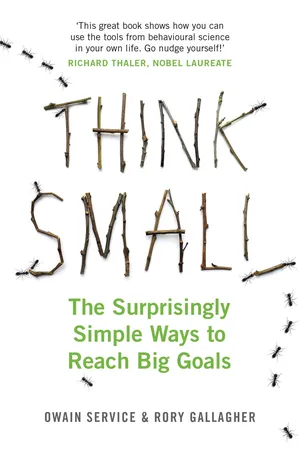
A simple and accessible plan for success, based on seven scientifically tested steps that really work. We're often told to dream big, the sky's the limit and that nothing is impossible. While it is undoubtedly good advice to set yourself goals that have the potential to make you and those around you healthier and happier, how to reach those goals is often less clear. From getting fit or securing a new job to becoming a better manager or parent, simply setting your mind to something will rarely get you where you want to be, and big plans can quickly become overwhelming, leaving us feeling as though we've failed.Most of us set goals with very good intentions, so why do our best-laid plans so often go awry? When we're so committed to making positive changes and fulfilling our ambition at the outset, is there a way of avoiding the common roadblocks that stand between our goals and us? Thankfully, the answer is yes – and it's much easier to achieve than you might think.Working inside the world's first Nudge Unit, Owain Service and Rory Gallagher know the huge impact that small changes and clear plans, based on a scientific understanding of human behaviour, can have from an individual to an international level. For the first time, Think Small takes these successful approaches and translates them into an easy, simple framework that has the potential to make a big difference to all our lives.
- English
- ePUB (mobile friendly)
- Available on iOS & Android
eBook - ePub
About this book
Information
Topic
Personal DevelopmentSubtopic
Personal Success1
SET
It is Monday lunchtime and Sarah is sitting at her desk in the office of the luxury hotel she runs. She is surrounded by copies of the new menu for the hotel’s restaurant and eating a lobster linguini freshly made by the head chef. Her office has big glass walls, through which she can see the reception. Happy guests are checking in and out, smiling as they ask the concierge to get them a taxi for the airport. Other guests are sauntering down from the on-site restaurant, which has just won an award for the quality of its food, all sourced from local manufacturers and farms.
Suddenly a bell rings and Sarah snaps out of her daydream. She’s not in a hotel office any more. She’s in the canteen of her Further Education College and in front of her lies not a lobster linguini but a half-eaten plate of tuna pasta. The bell marks the start of afternoon lessons, and for Sarah it’s not something she is looking forward to. It’s her maths class, her least favourite subject. She’s always struggled during maths classes and found it frustrating when others seem to be more capable than her of grasping the concepts. So it wasn’t that much of a surprise to her or anyone else when she failed her maths GCSE the previous year and was made to re-sit it. As the bell for lessons rang, she couldn’t help but feel it would be easier if she maybe just skipped today’s lesson, as she had done many times before.
That day, though, Sarah decided to pick herself up and drag herself to the class. When she got there, she realized that it wasn’t going to be a traditional maths lesson. There weren’t going to be any equations on the board. She wasn’t going to have to do any algebra or work out any percentages. In fact, it wasn’t a regular lesson at all. It was the beginning of a set of modules that were aimed at encouraging Sarah and her fellow learners to set themselves stretching goals and then to put in place steps to help them achieve those goals. She was pretty sceptical to begin with. But anything, she thought, was preferable to a maths lesson, so she sat down in front of the computer and decided to take it seriously. The first thing that Sarah was asked to do was to think about the things in her life that she really wanted to achieve and to set herself a ‘stretch goal’ to challenge herself to get there. She had never been asked to do anything like this before and for a moment her mind wandered back to the scene in the hotel. She was really interested in travel and the tourism industry, and her passion was food. So, when she was asked what goal she wanted to set herself, she decided that passing her hospitality qualification was going to be it. If she didn’t get that qualification, she’d never be able to pursue her passion.
Next, she was told that she would need to break down her goal into the steps needed to get there. The more specific, the better. She was given the analogy of a singer who wants to get better at a song. The singer doesn’t just proclaim ‘I’m going to be brilliant at this song’; she identifies the parts of the song that need most work and then focuses on those parts until she has mastered them. So Sarah started to break down her headline goal into chunks. And this meant focusing on her GCSE maths. That was Sarah’s equivalent of the parts of the song that needed most work. Without at least a C in maths, she’d fail overall. So she focused on the things that she could do to get at least a C. She told herself that she needed to spend more time studying and doing mock exams in the library, particularly on algebra and probability. She also needed to change the way she worked, drawing on a few of the techniques she’d learnt through the programme. For example, she found it hard to concentrate for an hour at a time, so she stopped working in hour-long slots. She later explained: ‘Half-an-hour slots are really good for me because I take it all in. I have a fifteen-minute break and then I get back into it again.’
The exercises slowly began to change the way Sarah worked. ‘It gave me a chance to do what I needed to do,’ she said. ‘It helped [me to] improve myself and other people too.’ And it showed. She was taking home past exam papers to work on them without distractions. She stayed in the library after her lessons had finished. And she was no longing skipping classes. She could more easily see the connection between the individual classes and her longer-term dream of making it in the world of hospitality.
Sarah got a B in her maths exam that year and so was able to start pursuing her next qualification (with a bit less emphasis on algebra). She wasn’t the only one. She was in fact part of the biggest trial ever conducted in Further Education Colleges involving some 9,000 learners across nineteen colleges. The exercises were devised by the Behavioural Insights Team in partnership with Professor Angela Duckworth and her team of world-leading psychologists at the University of Pennsylvania. Like all the other programmes that we run, we tested these changes against the standard approach, to see if they might help people to attend college lessons and ultimately to boost achievement. The results are showing remarkable promise. We are finding that the changes are helping lots of learners to stick at their college programmes. They led to an impressive 10 per cent increase in the number of people who turned up to lessons.
At their heart is a focus on the small steps needed to achieve your goals. The learners aren’t told to dream big and then assume that everything will follow. Unfortunately, life doesn’t work like that. Instead they are told that if you want to achieve your objectives in life, you need to start by being clear about what those objectives are, before thinking about the small steps required to get there.
This chapter is a little different to the others in this book. Before giving you techniques for helping you to achieve your goal, we will first encourage you to ask yourself what the goal, and the steps towards it, should be. But in keeping with the rest of the book, we have put in place three simple rules that will help you along the way. The three rules to goal setting are:

Rule 1: Choose the right goals
Imagine that you are out for a stroll one summer’s morning when you’re approached by someone who makes an unusual request. She offers you an envelope containing $20. There is a catch, but it turns out to be a pleasant one: by 5 p.m. that day you have to spend the money on a gift for yourself, or to pay off any of your expenses. The woman then continues on her way, leaving you to start thinking about what you’re going to buy yourself.
Now imagine exactly the same situation, but with a small twist. You are approached by the very same person, who gives you an envelope containing $20. But this time she asks you to spend it on someone else, or to use it to make a donation to charity.
When researchers Elizabeth Dunn, Lara Aknin and Mike Norton ran this experiment in Vancouver, British Columbia, they found that there was lots of variety in the kinds of things that people bought. When asked to buy something for themselves, they bought earrings, coffee and sushi. When instructed to buy for others, they bought toys for young relatives, gave money to the homeless and purchased food and coffee for friends.
But what Dunn, Aknin and Norton were really interested in was not what kinds of purchases the individuals made, but what effect they had on their levels of happiness. So before the money was handed over, they asked participants a few questions to measure their baseline levels of happiness, and then asked similar questions that evening after they had made their purchases. What they found was that people who spent the money on others (‘pro-social spending’) were significantly happier than those who spent the money on themselves. They also discovered that the amount of money didn’t seem to matter – it made no difference if it was $5 or $20. The same effect was found when Dunn, Aknin and Norton analysed the levels of happiness of those who’d recently received a bonus of around $5,000. Those who’d spent the money on gifts for themselves or to pay off bills were less happy than those who’d bought something for someone else or made a donation to charity. The more of the bonus they spent on ‘pro-social spending’, the greater their happiness and this was more important than the size of the bonus.1 It’s for this reason that the Behavioural Insights Team splits in-year bonuses into two pots. One is for the recipient to spend on themselves (ideally on an experience – more on that later); the other is explicitly marked for them to spend on people who have helped them achieve whatever they got the bonus for in the first place.
The reason that experiments of this kind are important is that we are not very good at predicting the things that will make us happier. When it comes to spending money, for example, a clear majority of people say that they would be happier to spend $20 on themselves than others.2 But as we have seen, when you run an experiment to test this hypothesis, you discover that the reverse is in fact the case. These aren’t isolated examples. We dream about a big house in the country, without realizing that the longer commute may make us less happy overall. We buy material goods, thinking they will enhance our lives, when the evidence shows that buying experiences such as holidays and days out will be more likely to improve our wellbeing. And many of us spend countless hours staring at our computer and television screens, when the evidence shows we’d be better off investing in our social connections and relationships.
So, before you set your goals, it is really important that you pause to think about what will make you or others happy. The evidence on happiness and ‘subjective wellbeing’ is growing fast and is attracting the interest of governments around the world. Indeed, in the UK the government now routinely collects and publishes wellbeing data. Given the broader outlook and nuances of this research, we won’t attempt to provide a comprehensive overview here (if you are interested in delving deeper into the evidence on happiness and wellbeing, we would point you to the pioneering work of Ed Diener, Lord Richard Layard, Martin Seligman, Dan Gilbert and David Halpern3). But we will draw on a summary of the things that most directly impact on your wellbeing and happiness and that are important to consider when setting goals over which you have some control.
One of the first things you may notice is that money is not on the list. While there is a relationship between income and wellbeing (rich people are generally happier than poorer people), as we saw with the giving experiments, it’s not money per se that brings improvements in your wellbeing.4 It’s what your income enables you to do.5 For many living in poverty, increasing their income (and particularly their savings) is likely to be a common and important goal. But for those of us who are fortunate enough not to live in poverty, we are likely to benefit more by focusing on how to spend our time and money, rather than primarily striving to increase our income. In other words, ‘if money doesn’t make you happy, you probably aren’t spending it right’. So we encourage you to focus your goal setting on five of the factors that have most consistently been shown to improve your wellbeing. The five factors are:6
Most of us are aware of the importance of our social relationships, but it’s only recently been shown just how critical they are to our wellbeing. In a nutshell, people who have lots of social contact are likely to be significantly happier than those who do not. If you see others regularly, are in a long-term relationship, or belong to a meaningful group (like a religious congregation or a sports club), you’re likely to experience higher levels of happiness.7 This helps explain why being unemployed is so detrimental to our wellbeing. It results in a loss of social contact.8 When you do have a job, social relationships remain critical in explaining differences in levels of wellbeing. For example, if you rate your relationship with your boss one point higher on a ten-point scale, it is statistically equivalent to a 30 per cent pay rise.9 Strong social connections at work and in our personal lives aren’t just good for our mental health, they even affect our physical health – and to a much greater extent than we might expect. One famous review of the evidence, which drew together the results from 148 separate studies covering more than 300,000 people, concluded that people with adequate social support benefit from a 50 per cent increase in the odds of survival over their counterparts with poorer social connections.10 To put it another way, social isolation has a similar effect to smoking fifteen cigarettes a day. So you may wish to focus your goal on broadening or deepening your social relationships.
Lots of us will have set a goal at some point in our life to become healthier and clearly there are good reasons for doing so. Studies consistently show a strong relationship between health and wellbeing.11 The better you consider your own health to be, the higher you are likely to rate your levels of life satisfaction.12 Happier people also tend to be healthier too – the medical literature has shown links between low wellbeing scores and heart disease, strokes and even the length of your life. If you have a more positive outlook in life, you’re also less likely to catch a cold, and more likely to recover faster in the event that you do. Healthier and happier employees are also likely to be more productive and engaged at work, which is one of the reasons why workplace health initiatives are becoming increasingly popular.13 So setting yourself a goal to become healthier, particularly if you consider yourself to be in poor health, is a good idea.
One way in which many of us will think about getting healthier is to become more active. Regular physical activity is associated with higher levels of wellbeing and reduced rates of anxiety. This is why, in the UK, exercise can even be prescribed by a doctor and is considered to be especially useful for people with mild to moderate depression.14 It seems there are a complex range of factors that explain why this might be the case. They include biophysical responses to exercise (for example by boosting the release of endorphins), but it has also been shown that exercise increases our sense of ‘self-efficacy’, or our perceived ability to succeed in a task. These benefits can all flow from setting a goal to increase, often by modest amounts, the amount of physical activity we do. So, as you can see, it’s important to think about goals that can help make you and others healthier and happier.
A less well known route to improved wellbeing is learning. We usually think of learning something new in quite instrumental terms. You learn something in order to be able t...
Table of contents
- Cover
- Title page
- Copyright page
- Dedication page
- CONTENTS
- Foreword by David Halpern
- Introduction
- 1 Set
- 2 Plan
- 3 Commit
- 4 Reward
- 5 Share
- 6 Feedback
- 7 Stick
- Conclusion
- Appendix 1: Thinking Small in Action
- Appendix 2: The Golden Rules
- Acknowledgements
- Bibliography
- Notes
- Index
Trusted by 375,005 students
Access to over 1.5 million titles for a fair monthly price.
Study more efficiently using our study tools.
Frequently asked questions
Yes, you can cancel anytime from the Subscription tab in your account settings on the Perlego website. Your subscription will stay active until the end of your current billing period. Learn how to cancel your subscription
No, books cannot be downloaded as external files, such as PDFs, for use outside of Perlego. However, you can download books within the Perlego app for offline reading on mobile or tablet. Learn how to download books offline
Perlego offers two plans: Essential and Complete
- Essential is ideal for learners and professionals who enjoy exploring a wide range of subjects. Access the Essential Library with 800,000+ trusted titles and best-sellers across business, personal growth, and the humanities. Includes unlimited reading time and Standard Read Aloud voice.
- Complete: Perfect for advanced learners and researchers needing full, unrestricted access. Unlock 1.5M+ books across hundreds of subjects, including academic and specialized titles. The Complete Plan also includes advanced features like Premium Read Aloud and Research Assistant.
We are an online textbook subscription service, where you can get access to an entire online library for less than the price of a single book per month. With over 1.5 million books across 990+ topics, we’ve got you covered! Learn about our mission
Look out for the read-aloud symbol on your next book to see if you can listen to it. The read-aloud tool reads text aloud for you, highlighting the text as it is being read. You can pause it, speed it up and slow it down. Learn more about Read Aloud
Yes! You can use the Perlego app on both iOS and Android devices to read anytime, anywhere — even offline. Perfect for commutes or when you’re on the go.
Please note we cannot support devices running on iOS 13 and Android 7 or earlier. Learn more about using the app
Please note we cannot support devices running on iOS 13 and Android 7 or earlier. Learn more about using the app
Yes, you can access Think Small by Owain Service,Rory Gallagher in PDF and/or ePUB format, as well as other popular books in Personal Development & Personal Success. We have over 1.5 million books available in our catalogue for you to explore.