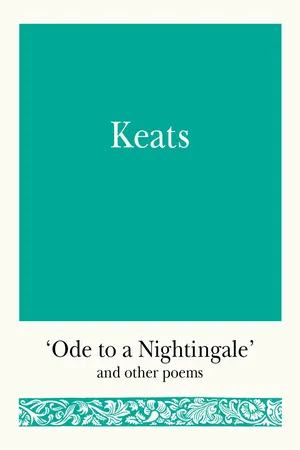
Arguably the greatest of all the English Romantic poets, John Keats left behind him an astonishingly large body of work almost as remarkable for its maturity as for its beauty. Whether in longer narrative works like 'The Eve of St Agnes', or in such sonnets as 'On First Looking Into Chapman's Homer', or in magnificent odes like those 'To a Nightingale' and 'To Autumn', his verse resonates with lyricism and with sensuous imagery, however melancholy his tone or his subject. His finest poems are among the greatest in the language; almost all of them strike a chord in the heart of even the most jaded reader.This compact selection includes many of Keats's greatest shorter poems, as well as extracts from his longer works.
- English
- ePUB (mobile friendly)
- Available on iOS & Android
eBook - ePub
About this book
Information
Topic
LiteraturSubtopic
Europäische PoesieA Thing of Beauty is a Joy For Ever, from Book 1 of Endymion
(1818)
A thing of beauty is a joy for ever:
Its loveliness increases; it will never
Pass into nothingness; but still will keep
A bower quiet for us, and a sleep
Full of sweet dreams, and health, and quiet breathing.
Therefore, on every morrow, are we wreathing
A flowery band to bind us to the earth,
Spite of despondence, of the inhuman dearth
Of noble natures, of the gloomy days,
Of all the unhealthy and o’er-darken’d ways
Made for our searching: yes, in spite of all,
Some shape of beauty moves away the pall
From our dark spirits. Such the sun, the moon,
Trees old and young, sprouting a shady boon
For simple sheep; and such are daffodils
With the green world they live in; and clear rills
That for themselves a cooling covert make
’Gainst the hot season; the mid-forest brake,
Rich with a sprinkling of fair musk-rose blooms:
And such too is the grandeur of the dooms
We have imagined for the mighty dead;
All lovely tales that we have heard or read:
An endless fountain of immortal drink,
Pouring unto us from the heaven’s brink.
Nor do we merely feel these essences
For one short hour; no, even as the trees
That whisper round a temple become soon
Dear as the temple’s self, so does the moon,
The passion poesy, glories infinite,
Haunt us till they become a cheering light
Unto our souls, and bound to us so fast
That, whether there be shine or gloom o’ercast,
They always must be with us, or we die.
Therefore, ’tis with full happiness that I
Will trace the story of Endymion.
The very music of the name has gone
Into my being, and each pleasant scene
Is growing fresh before me as the green
Of our own valleys: so I will begin
Now while I cannot hear the city’s din;
Now while the early budders are just new,
And run in mazes of the youngest hue
About old forests; while the willow trails
Its delicate amber; and the dairy pails
Bring home increase of milk. And, as the year
Grows lush in juicy stalks, I’ll smoothly steer
My little boat, for many quiet hours,
With streams that deepen freshly into bowers.
Many and many a verse I hope to write,
Before the daisies, vermeil rimm’d and white,
Hide in deep herbage; and ere yet the bees
Hum about globes of clover and sweet peas,
I must be near the middle of my story.
O may no wintry season, bare and hoary,
See it half-finish’d: but let Autumn bold,
With universal tinge of sober gold,
Be all about me when I make an end.
And now at once, adventuresome, I send
My herald thought into a wilderness:
There let its trumpet blow, and quickly dress
My uncertain path with green, that I may speed
Easily onward, thorough flowers and weed.
O Solitude! If I Must With Thee Dwell
(1817)
O Solitude! if I must with thee dwell,
Let it not be among the jumbled heap
Of murky buildings: climb with me the steep, –
Nature’s observatory – whence the dell,
In flowery slopes, its river’s crystal swell,
May seem a span; let me thy vigils keep
’Mongst boughs pavilion’d, where the deer’s swift leap
Startles the wild bee from the foxglove bell.
But though I’ll gladly trace these scenes with thee,
Yet the sweet converse of an innocent mind,
Whose words are images of thoughts refined,
Is my soul’s pleasure; and it sure must be
Almost the highest bliss of human-kind,
When to thy haunts two kindred spirits flee.
Ode to Psyche
(1820)
O Goddess! hear these tuneless numbers, wrung
By sweet enforcement and remembrance dear,
And pardon that thy secrets should be sung
Even into thine own soft-conchèd ear:
Surely I dreamt to-day, or did I see
The wingèd Psyche with awaken’d eyes?
I wander’d in a forest thoughtlessly,
And, on the sudden, fainting with surprise,
Saw two fair creatures, couchèd side by side
In deepest grass, beneath the whisp’ring roof
Of leaves and trembled blossoms, where there ran
A brooklet, scarce espied:
’Mid hush’d, cool-rooted flowers, fragrant-eyed,
Blue, silver-white, and budded Tyrian,
They lay calm-breathing on the bedded grass;
Their arms embracèd, and their pinions too;
Their lips touch’d not, but had not bade adieu,
As if disjoinèd by soft-handed slumber,
And ready still past kisses to outnumber
At tender eye-dawn of aurorean love:
The wingèd boy I knew;
But who wast thou, O happy, happy dove?
His Psyche true!
O latest-born and loveliest vision far
Of all Olympus’ faded hierarchy!
Fairer than Phoebe’s sapphire-region’d star,
Or Vesper, amorous glow-worm of the sky;
Fairer than these, though temple thou hast none,
Nor altar heap’d with flowers;
Nor virgin-choir to make delicious moan
Upon the midnight hours;
No voice, no lut...
Table of contents
- Cover
- Title page
- Copyright page
- Contents
- Introduction
- Dedication. To Leigh Hunt, Esq.
- How many bards gild the lapses of time!
- On First Looking into Chapman’s Homer
- To Chatterton
- A Thing of Beauty is a Joy For Ever, from Book 1 of Endymion
- O Solitude! If I Must With Thee Dwell
- Ode to Psyche
- La Belle Dame Sans Merci
- From The Eve of St Agnes
- Written in the Cottage where Burns was born
- Ode on a Grecian Urn
- The day is gone
- Ode to a Nightingale
- If by Dull Rhymes Our English Must be Chain’d
- Ode on Melancholy
- Sonnet to a Cat
- Sonnet: Why did I laugh to-night?
- Two Sonnets on Fame
- To Fanny
- Fancy
- I had a dove
- You Say You Love
- His Last Sonnet
- When I have fears
- Ode to Fanny
- Ode to Autumn
- Stanzas: In drear-nighted December
- To Hope
- To Some Ladies
- On receiving a curious Shell
- Epistle: To my Brother George
- Sonnet: To my Brother George
- Sonnet: To My Brothers
- To a Friend who sent me some Roses
- To one who has been long in city pent
- Addressed to Haydon
- Addressed to the Same
- On the Grasshopper and Cricket
- Written on the day that Mr Leigh Hunt left Prison
- Happy is England! I could be content
- Robin Hood
- Lines on the Mermaid Tavern
- Sonnet: On the Sea
- The Poet
- A draught of Sunshine
- Sonnet to the Nile
- Sonnet: Written in Disgust of Vulgar Superstition
- Fragment of an Ode to Maia, written on May Day, 1818
- A prophecy: To George Keats in America
- A Song of Opposites
- Sonnet to a lady seen for a few Moments at Vauxhall
- Ode to Apollo
- Sonnet on sitting down to read King Lear once again
- Written on Top of the Ben Nevis
- Ode on Indolence
- The Human Seasons
- Women, wine, and snuff
- Modern Love
- On Death
- Index of first lines
Trusted by 375,005 students
Access to over 1.5 million titles for a fair monthly price.
Study more efficiently using our study tools.
Frequently asked questions
Yes, you can cancel anytime from the Subscription tab in your account settings on the Perlego website. Your subscription will stay active until the end of your current billing period. Learn how to cancel your subscription
No, books cannot be downloaded as external files, such as PDFs, for use outside of Perlego. However, you can download books within the Perlego app for offline reading on mobile or tablet. Learn how to download books offline
Perlego offers two plans: Essential and Complete
- Essential is ideal for learners and professionals who enjoy exploring a wide range of subjects. Access the Essential Library with 800,000+ trusted titles and best-sellers across business, personal growth, and the humanities. Includes unlimited reading time and Standard Read Aloud voice.
- Complete: Perfect for advanced learners and researchers needing full, unrestricted access. Unlock 1.5M+ books across hundreds of subjects, including academic and specialized titles. The Complete Plan also includes advanced features like Premium Read Aloud and Research Assistant.
We are an online textbook subscription service, where you can get access to an entire online library for less than the price of a single book per month. With over 1.5 million books across 990+ topics, we’ve got you covered! Learn about our mission
Look out for the read-aloud symbol on your next book to see if you can listen to it. The read-aloud tool reads text aloud for you, highlighting the text as it is being read. You can pause it, speed it up and slow it down. Learn more about Read Aloud
Yes! You can use the Perlego app on both iOS and Android devices to read anytime, anywhere — even offline. Perfect for commutes or when you’re on the go.
Please note we cannot support devices running on iOS 13 and Android 7 or earlier. Learn more about using the app
Please note we cannot support devices running on iOS 13 and Android 7 or earlier. Learn more about using the app
Yes, you can access Keats by John Keats in PDF and/or ePUB format, as well as other popular books in Literatur & Europäische Poesie. We have over 1.5 million books available in our catalogue for you to explore.