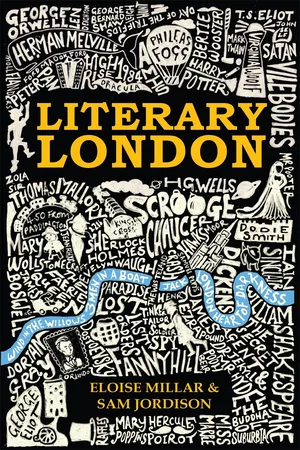
A fascinating guide to the best literary landmarks in London that takes the reader into publishing houses and along paths of inspiration, revealing the stories behind the stories. * One of the world's greatest literary cities, London has streets full of stories and buildings steeped in history.* The biggest and most beloved names in English literature have all been here, and you can still see or visit their stomping grounds and favourite places.* Follow Oscar Wilde from the literary salons to Clapham Junction; roam with Julian McClaren Ross through Fitzrovia, dropping in for a pint or three with Dylan Thomas at the Bricklayers' Arms; muse darkly over the Thames with Spencer, Eliot and Conrad; and watch aghast as Lord Byron terrorizes his publisher on Albemarle Street...Moving through time and genre, from Spencer and Shakespeare to Amis and Barnes, from tragedy and romance to chick-lit and science fiction, Literary London is a snappy and informative guide, showing just why – as another famous local writer put it – he who is tired of London is tired of life.
- English
- ePUB (mobile friendly)
- Available on iOS & Android
eBook - ePub
Literary London
About this book
Information
Topic
Personal DevelopmentSubtopic
Literary BiographiesCHAPTER ONE
BEGINNERS AND IMMORTALS
London began in swamp – an empty plain near a wide winding river, surrounded by low hills and not much else. We don’t know when the first houses arrived there, but we do know it was a long time ago. In 2010 the remains of a large timber building dating back to 4500 BC were found in the Thames mud, near the present site of Vauxhall Bridge, so we can assume there have been people in the London area for at least 6,000 years, although things remain murky until AD 100, when the settlement became the capital of Roman Britannia. Even after that there were many dark years. There’s sparse information about Roman London, and even less about what happened after the collapse of Roman rule, when it’s thought that the city was abandoned. The next good lead comes in the ninth-century Anglo-Saxon Chronicle, which says that the city was ‘refounded’ by Alfred the Great in AD 886.
Alfred was usefully occupied not just in burning cakes, but also in building and fortifying the wall, developing a new street plan, and acting as an early literary patron who summoned religious scholars to translate some of the great Latin works into Old English. Still, the products of any wider literary scene were either sparse, or have been lost in the mists of time.
Things come into sharper focus in the medieval period. Yet even then, most early mentions arise in passing. Quite literally so in the case of Richard of Devizes, a monk from Winchester who walked through the city sometime in the late twelfth century. He didn’t recommend that others should follow. ‘You will come to London,’ he wrote. ‘Behold! I warn you, whatever of evil or of perversity there is in any, whatever in all parts of the world, you will find in that city alone.’ He next provided a long list of all the fun to be had in the area, with its ‘effeminate sodomites’ and ‘lewd musical girls’. Less amusingly, he also became the first person to use the word ‘holocaust’ in reference to a massacre of the city’s Jewish population.
In the same century, William Langland (c.1332–86) grew up and became a ‘loller’ and ‘idler’ in the Cornhill area of London. But nothing is certain about his life, since all the information we have comes from the text of his own Piers Plowman – a poem where reality is never certain and real life elides with dreams, allegory and mystical Christian quests. This visionary work is thought to have been written in the years between 1370 and 1390, making it contemporary with another great Middle English poem – and the one that is credited with changing and shaping the English language for ever: The Canterbury Tales.
It was in London, in the final years of the fourteenth century, that Geoffrey Chaucer (c.1343–1400) produced his long series of stories recounted by pilgrims on their way to Canterbury. Crucially, instead of writing in French or Latin, the dominant literary languages of the time, he chose to compose his verses in a Middle English vernacular – one based on his own London dialect – and so helped set the template for everything that followed.
He also set another useful pattern for London literature by kicking things off in a pub. The Canterbury Tales starts in the Tabard on Borough High Street, a real-life tavern which was only pulled down at the end of the nineteenth century. (These days, the site is occupied by a business called ‘Copyprints’, which seems appropriate for the spiritual home of a work which became in 1478, thanks to William Caxton (1422–91), the first book in English to be printed on a commercial printing press.)
Even though Chaucer’s talkative pilgrims soon leave the Tabard and head towards Kent, London makes repeated appearances throughout the narrative. There are references to ‘draughts’ of ‘London ale’; there’s chatter about seeking ‘chanterys for souls’ (endowments for a priest to sing masses) in ‘Saint Paul’s’; and local taverns in Cheapside and Southwark are name-checked. Madame Eglantine, Chaucer’s prioress, also speaks French with a cockney accent – ‘And Frenssh she spak ful faire and fetisly, after the scole of Stratford atte Bowe’. (‘Fetisly’ means fluently, ‘scole’ is school . . . You will easily work out the rest.)
And then there’s the fact that Chaucer was a Londoner himself. He was probably born in the city around 1343, and his father and grandfather were established London vintners. The latter was murdered near his house in Aldgate in 1313, a time when the area was notorious for its after-dark thefts, rapes and murders. Luckily, Chaucer survived, and lived for much of his life at 2 Aldgate High Street, in a twin-towered gatehouse that he got free of rent on the proviso that he allowed troops to use the towers in time of attack. (Which means that they presumably used it in 1381, when Wat Tyler and his angry followers stormed into the capital from the countryside during the Peasants’ Revolt (see here), passing directly under Chaucer’s windows.)
Chaucer was a busy man. He worked as a courtier, diplomat, civil servant, and Clerk of the King’s Works. He also studied law at the Inner Temple – and who knows how he also made time to write The Canterbury Tales (especially after 1374, when Edward III granted him a daily ‘gallon of wine’ for the rest of his life).Yet he managed it, producing endless ribald jokes and thousands of lines of exquisite poetry. He continued to work on The Canterbury Tales almost until the day he died.
Chaucer’s last years were spent in Somerset, but he moved back to the capital in 1399, taking a lease on a residence within the close of Westminster Abbey. He also became the first person to be buried in Poets’ Corner, a stone’s throw from his home, in late 1400. Very few other landmarks from Chaucer’s time remain: the closest you’ll get are St Paul’s (although the building Chaucer knew was destroyed in the Great Fire) and St Botolph Aldgate (which, while it has also been remodelled, has stood on the same spot for over 1,000 years). If you want to get a taste for something a little less devout, head over to Southwark’s Borough High Street, where at no. 77 you’ll find the George, the only remaining coaching inn in London, and pleasingly close to the site of Chaucer’s Tabard.
‘The city of London, that is to me so dear and sweet, in which I was forth growen; and more kindly love have I to that place than to any other on earth.’
Geoffrey Chaucer, The Testament of Love
Less keen on drink was Margery Kempe (c.1373–c.1438). She was a religious mystic from King’s Lynn who chronicled her many pilgrimages, conversations with God and arguments with unworthy men in her great work of autobiography and visionary fiction The Book of Margery Kempe. She also made a few visits to London. The first time around, she went in poverty, dressed in sackcloth. Happily, she was well received by pious widows and was soon out and about speaking ‘boldly and strongly’ to the capital’s many ‘cursers, liars, swearers’ and ‘vicious people’. These strong speeches apparently profited ‘many people very much’. On a later visit she stayed in London ‘a long time’ and was ‘well received by many worthy men’ – which was a welcome advance on the humiliation and reproof she often found on her travels through medieval England.
Following Kempe’s came another great prose work with a London connection, Thomas Malory’s Le Morte D’Arthur. At least, we think it was by Malory – the facts are hazy. The Malory in question didn’t always live in London, but spent his early years around Warwickshire, cattle-raiding and committing more serious crimes like rape and murder. However, he did spend several years in London’s Newgate Prison in the 1460s, and it’s there that scholars think he wrote his great work of swords and chivalry, before his death in 1471.
Popular as Malory’s Arthurian legends may have been, poetry was still regarded as the highest form of literature, and when Edmund Spenser (c. 1552–99) wrote The Faerie Queene, his epic hymn of praise to Queen Elizabeth I, he did so in verse form.
Perhaps unsurprising for a man best known for asking the ‘sweet Thames’ to ‘run softly’, Spenser spent most of his adult life outside London. It’s most likely, in fact, that he wrote The Faerie Queene in Ireland, sometime between 1590 and 1596. But he had been born in London, in East Smithfield, as well as educated at the Merchant Taylors’ School (which then lay within the city walls), and he travelled to London to publish and promote his book.
He died in London too – and did so in poverty (for ‘want of bread’ is how Ben Jonson put it) – even though Elizabeth I, as reward for The Faerie Queene, had granted Spenser £50 a year for the rest of his life – a considerable sum in the sixteenth century. Whether this was never actually paid or he managed to fritter it away is open to speculation; either way, when he was forty-seven he joined Chaucer in Poets’ Corner.
Another pupil of the Merchant Taylors’ School (and contemporary to Spenser) was Thomas Kyd (1558–94), who wrote the first revenge tragedy: The Spanish Tragedy, first performed in 1592. In 1593 he shared a lodging room with his fellow playwright Christopher Marlowe (1564–93), probably in Norton Folgate or Shoreditch, where all of the fashionable actors lived. It was there that Kyd was arrested and brutally tortured after a search of his and Marlowe’s room uncovered literature unpalatable to the local authorities.
At the time, libellous pamphlets had been making the rounds in London. These were signed ‘Tamburlaine’, the name of Marlowe’s most famous character, and because of their content and signature, surveillance had homed in on the theatrical world. A warrant was issued for Marlowe’s arrest, too; he was killed (supposedly in a brawl) twelve days later. Kyd was released, but as a broken man, who died the following year. His mother buried him at St Mary Colechurch in the City of London (located at 82 Cheapside and burned down in the Great Fire of London; an Alliance & Leicester office now stands on the site).
As for Christopher Marlowe (to borrow a metaphor from one of his famous contemporaries), his candle burned brief, but it shone bright. During the six years he was writing plays (from 1587 until 1593) he produced immortal classics like Tamburlaine the Great and Doctor Faustus – crucial works in a new and daring age of literature. Marlowe was one of the first to use blank verse, and for his literary talent alone was revered by those around him (including Shakespeare, who borrowed at least 100 lines of Marlowe’s and used them in his own plays).
Marlowe was relentlessly controversial, repeatedly crossing the lines in what could and couldn’t be said, whether on the monarchy or religion (he may have been an atheist). He also, arguably, wrote Britain’s first homosexual love story in Edward II, which dealt with the star-crossed romance of Edward and Piers Gaveston. Many think it was this kind of troublemaking that earned him a knife thrust in the eye.
After his death, Marlowe was buried in an unmarked grave in St Nicholas Church, Deptford, where a memorial plaque is dedicated to him on the churchyard wall. But even if he was buried anonymously, his legacy has lived on. His life has also inspired new works of literature, in books like Dead Man in Deptford by Anthony Burgess (1917–93) – evidence of how much myth-making has gathered around Marlowe.
Burgess’s novel is also a fine survey of the city in Marlowe’s time, should you be interested – and you should be, because London in the 1580s and 1590s was something special. In 1400 the population had been around 50,000. By the late sixteenth century it had swelled to over 200,000 and was still soaring. A Swiss visitor to London at the time declared: ‘One simply cannot walk for the crowds.’ The playwright and pamphleteer Thomas Dekker (1572–1632) gave a vivid description of the noise and bustle in his pamphlet The Seven Deadly Sins of London:
Carts and coaches make such a thundering din as if the world ran on wheels; at every corner men, women, and children meet in such shoals that posts are set up to strengthen the houses lest with jostling with one another they should shoulder them down. Besides, hammers are beating in one place, tubs hooping in another [the noise made by coopers or barrel makers], pots clinking in a third, water-tankards running at tilt in a fourth . . . Tradesmen, as if they were dancing galliards are lusty at legs and never stand still . . .
Dekker, who is sometimes seen as a precursor to Dickens in his depictions of the smoky, pest-ridden and yet gloriously energetic capital, was a prolific author. Not even imprisonment in Southwark (at the King’s Bench) for debt – and for seven whole years – appeared to stop him, and he’s one of the best sources we have for London life during Shakespeare’s era. Plays like The Shoemaker’s Holiday take in the lives of normal Londoners; his pamphlet The Wonderful Yeare provides a vivid journalistic account of London during a plague outbreak (as well as of the death of Elizabeth I and ascension of James I). Newes from Hell and The Seven Deadly Sins of London deliver a judgement on the city, but also an affectionate portrait of the ebullient daily life of the streets.
Though it wasn’t just the streets that mattered in early modern London. The Thames – running through the surging, thronging powerhouse of the capital – was never quite as sweet as Spenser claimed. In fact, refuse and sewage impeded its flow. But the river must still have been something to behold. It was wider than today, lined with stairs and landings on both banks, and thronged with barges and ferries (one of which probably took Shakespeare to the theatre in Southwark on most days) . . . Sometimes it froze over and frost fairs were held on the ice (as recalled by Virginia Woolf (1882–1941) in Orlando), complete with dancing, stalls selling food and drink, and on one notable occasion in 1564 attended by Queen Elizabeth I herself. There was only one bridge – London Bridge – from which there occasionally protruded, on iron spikes, the rotting heads of traitors.
London Bridge led to Southwark and Bankside, an area which had a reputation for trouble. As well as the stamping ground of writers and intellectuals, it was the haunt of bear-baiters, cutpurses, prostitutes and highwaymen, not to mention the location of a good half-dozen jails (such as the infamously cruel Clink) and countless taverns. But it was also a booming commercial zone, full of markets, travellers and merchants. Rich men lived there too – and had done for ...
Table of contents
- Cover
- Half-title Page
- Title Page
- Dedication
- Copyright
- Contents
- Preface
- 1: Beginners and Immortals
- 2: Radicals and Subversives
- 3: Preachers and Converts
- 4: Mystics and Magicians
- 5: Diarists and Lexicographers
- 6: Gossips and Rivals
- 7: Romantics and Corpses
- 8: Eminent Victorians and Secret Bohemians
- 9: Crime . . .
- 10: . . . and Punishment
- 11: Children and Talking Animals
- 12: Modernists and Vorticists
- 13: Bloomsberries and Back-Stabbers
- 14: Boozers and Bright Young Things
- 15: Publishers and Booksellers
- 16: Angry Young Men . . .
- 17: . . . and Women
- 18: Beats and Hippies
- 19: Spies and Cold Warriors
- 20: Immigrants and Expats
- 21: Monsters and Apocalyptics
- Acknowledgements and Additional Reading
- Index
Trusted by 375,005 students
Access to over 1.5 million titles for a fair monthly price.
Study more efficiently using our study tools.
Frequently asked questions
Yes, you can cancel anytime from the Subscription tab in your account settings on the Perlego website. Your subscription will stay active until the end of your current billing period. Learn how to cancel your subscription
No, books cannot be downloaded as external files, such as PDFs, for use outside of Perlego. However, you can download books within the Perlego app for offline reading on mobile or tablet. Learn how to download books offline
Perlego offers two plans: Essential and Complete
- Essential is ideal for learners and professionals who enjoy exploring a wide range of subjects. Access the Essential Library with 800,000+ trusted titles and best-sellers across business, personal growth, and the humanities. Includes unlimited reading time and Standard Read Aloud voice.
- Complete: Perfect for advanced learners and researchers needing full, unrestricted access. Unlock 1.5M+ books across hundreds of subjects, including academic and specialized titles. The Complete Plan also includes advanced features like Premium Read Aloud and Research Assistant.
We are an online textbook subscription service, where you can get access to an entire online library for less than the price of a single book per month. With over 1.5 million books across 990+ topics, we’ve got you covered! Learn about our mission
Look out for the read-aloud symbol on your next book to see if you can listen to it. The read-aloud tool reads text aloud for you, highlighting the text as it is being read. You can pause it, speed it up and slow it down. Learn more about Read Aloud
Yes! You can use the Perlego app on both iOS and Android devices to read anytime, anywhere — even offline. Perfect for commutes or when you’re on the go.
Please note we cannot support devices running on iOS 13 and Android 7 or earlier. Learn more about using the app
Please note we cannot support devices running on iOS 13 and Android 7 or earlier. Learn more about using the app
Yes, you can access Literary London by Eloise Millar,Sam Jordison in PDF and/or ePUB format, as well as other popular books in Personal Development & Literary Biographies. We have over 1.5 million books available in our catalogue for you to explore.