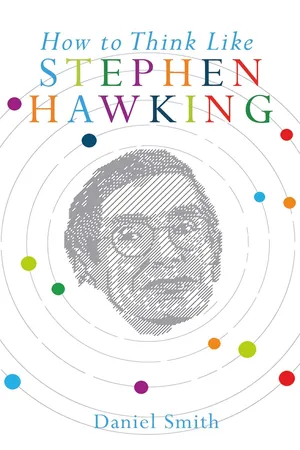
A unique insight into the mind of one of the world's most extraordinary thinkers. Undoubtedly the most famous scientist on the planet and the very face of physics over the last half-century, Stephen Hawking is remarkable for many reasons. Not least because he has continued to strive to achieve so much while being hamstrung by debilitating illness. He has demonstrated categorically that if you put your mind to it, you can achieve anything, no matter your physical state.Of course, it helps if you happen to possess a mind such as his. His work on black holes put him on the map, and he became globally famous for his A Brief History of Time, communicating the most difficult scientific ideas at a period when he'd lost the ability to speak.How to Think Like Stephen Hawking reveals the key motivations, desires and philosophies that make Hawking one of the world's most enduring talents. Studying how he overcame great adversity, fought his demons as well as his detractors and looked back to the origins of the universe, with quotes and passages by and about him, you too can learn to think like the man who claims he can think in eleven dimensions.
- English
- ePUB (mobile friendly)
- Available on iOS & Android
eBook - ePub
How to Think Like Stephen Hawking
About this book
Information
Topic
Ciencias físicasLandmarks in a Remarkable Life
1942 | Stephen William Hawking is born on 8 January in Oxford, England, to Frank and Isobel Hawking. The family return to their home in North London at the end of the Second World War. |
1950 | The Hawkings relocate to St Albans, about twenty miles north of London. |
1953 | Hawking wins a place at St Albans School. In his last year there he is accepted to study at the University of Oxford. |
1959 | He begins his undergraduate degree in natural sciences at Oxford’s University College, his father’s alma mater. |
1962 | He completes his degree, receiving a First. Hawking then moves to the University of Cambridge to commence postgraduate studies in cosmology. He also meets his future wife, Jane Wilde. |
1963 | He is diagnosed with amyotrophic lateral sclerosis (ALS). |
1964 | He attends a lecture by Birbeck mathematician Roger Penrose in London. Penrose’s theories on singularities prove highly influential on Hawking. |
1965 | Hawking marries Jane Wilde. |
1966 | On finishing his doctorate, he is awarded a fellowship at Cambridge’s Gonville and Caius College. Hawking undertakes research into singularities and black holes, working with Roger Penrose. |
1967 | Jane Hawking gives birth to a son, Robert. |
1969 | As his ALS worsens, Hawking begins to use a wheelchair. |
1970 | He reports that, in accordance with the rules of Einstein’s general theory of relativity, the universe may have emerged from a singularity. Jane Hawking gives birth to a daughter, Lucy. |
1971 | Hawking shows how a black hole’s event horizon expands with time. In the same year, he co-publishes the ‘no-hair’ theorem with Brandon Carter. |
1973 | He joins the staff at Cambridge’s Department of Applied Mathematics and Theoretical Physics (DAMTP). Hawking and George Ellis publish The Large Scale Structure of Space-Time. He is also co-author of four laws of black hole mechanics. |
1974 | He publishes a paper in the journal Nature entitled ‘Black Hole Explosion’. It introduces to the wider world the theory that makes his name – Hawking radiation. He is also appointed Professor of Gravitational Physics at Cambridge. |
1975 | Hawking relocates his family to the USA so that he can work at the California Institute of Technology (Caltech). While there, he meets Kip Thorne, who becomes a long-time collaborator and friend. Meanwhile, Hawking is awarded the Pius XI Gold Medal for Science by the Vatican. |
1977 | Hawking and Gary Gibbons develop a revolutionary system of Euclidean quantum gravity. |
1978 | Hawking receives the Albert Einstein Medal. |
1979 | He is appointed to the prestigious chair of Lucasian Professor of Mathematics at Cambridge, a post previously held by Sir Isaac Newton, Charles Babbage and Paul Dirac. He is also made a fellow of the Royal Society. Jane Hawking gives birth to a second son, Timothy. |
1982 | He is made a Commander of the Order of the British Empire. |
1983 | Hawking publishes the ‘no-boundary’ theory in partnership with James Hartle, which describes how the universe could have emerged from nothing. |
1985 | A bout of pneumonia almost kills him while he is visiting the European Organization for Nuclear Research (CERN) in Switzerland. A resulting tracheostomy leaves him unable to speak naturally. |
1987 | He is awarded the Paul Dirac Medal. |
1988 | His popular science book, A Brief History of Time: From the Big Bang to Black Holes, is published and becomes an instant classic while breaking sales records. |
1989 | He is made a Companion of Honour. |
1990 | Hawking splits from his wife, Jane, and moves in with his former nurse, Elaine Mason. |
1993 | Publication of Black Holes and Baby Universes and Other Essays. Hawking also releases details of his research with John Stewart into ‘thunderbolt singularities’. In addition, he becomes the first person t... |
Table of contents
- Cover
- By the same author
- Title page
- Dedication and Copyright page
- Contents
- Introduction
- Landmarks in a Remarkable Life
- Follow Your Own Path
- Natural Talent Helps …
- … But It’s Nothing Without Hard Work and Perseverance
- Grasp the Big Picture
- Stare into the Abyss
- Rewriting the Book
- Tackle the Really Big Questions
- Stand Upon the Shoulders of Giants
- Hawking and Einstein
- Be an Iconoclast
- Have No Limit to Your Ambition
- Imagine the Universe in Your Head
- The Many-Worlds Interpretation
- Don’t Let Misfortune Define You
- What is Amyotrophic Lateral Sclerosis?
- Overturn the Odds
- Keeping a Sense of Humour
- Listen Like Hawking
- Two Heads Are Better Than One
- Joining Forces
- Even a Brilliant Intellect Needs Emotional Succour
- A Brief History of Marriage and Divorce
- Careers Are Made, Not Born
- The Nobel Snub?
- Getting It Wrong is Not a Sin
- Read Like Hawking
- Stand Up for What You Believe in
- Work With Your Intuition
- Write Like Hawking
- How A Brief History of Time Became a Phenomenon
- Enjoy Your Celebrity
- Hawking the TV Guest Star
- Looking to the Future: Is Time Travel Possible?
- The Chronology Protection Conjecture
- Beware, the End is Nigh (But Probably Not That Nigh)
- Are Advanced Civilizations Fated to a Short Existence?
- Is There Anybody Out There?
- Never Stop Challenging Yourself
- Hawking and God
- Hawking’s Legacy
- Selected Bibliography
Trusted by 375,005 students
Access to over 1.5 million titles for a fair monthly price.
Study more efficiently using our study tools.
Frequently asked questions
Yes, you can cancel anytime from the Subscription tab in your account settings on the Perlego website. Your subscription will stay active until the end of your current billing period. Learn how to cancel your subscription
No, books cannot be downloaded as external files, such as PDFs, for use outside of Perlego. However, you can download books within the Perlego app for offline reading on mobile or tablet. Learn how to download books offline
Perlego offers two plans: Essential and Complete
- Essential is ideal for learners and professionals who enjoy exploring a wide range of subjects. Access the Essential Library with 800,000+ trusted titles and best-sellers across business, personal growth, and the humanities. Includes unlimited reading time and Standard Read Aloud voice.
- Complete: Perfect for advanced learners and researchers needing full, unrestricted access. Unlock 1.5M+ books across hundreds of subjects, including academic and specialized titles. The Complete Plan also includes advanced features like Premium Read Aloud and Research Assistant.
We are an online textbook subscription service, where you can get access to an entire online library for less than the price of a single book per month. With over 1.5 million books across 990+ topics, we’ve got you covered! Learn about our mission
Look out for the read-aloud symbol on your next book to see if you can listen to it. The read-aloud tool reads text aloud for you, highlighting the text as it is being read. You can pause it, speed it up and slow it down. Learn more about Read Aloud
Yes! You can use the Perlego app on both iOS and Android devices to read anytime, anywhere — even offline. Perfect for commutes or when you’re on the go.
Please note we cannot support devices running on iOS 13 and Android 7 or earlier. Learn more about using the app
Please note we cannot support devices running on iOS 13 and Android 7 or earlier. Learn more about using the app
Yes, you can access How to Think Like Stephen Hawking by Daniel Smith in PDF and/or ePUB format, as well as other popular books in Ciencias físicas & Biografías de ciencia y tecnología. We have over 1.5 million books available in our catalogue for you to explore.