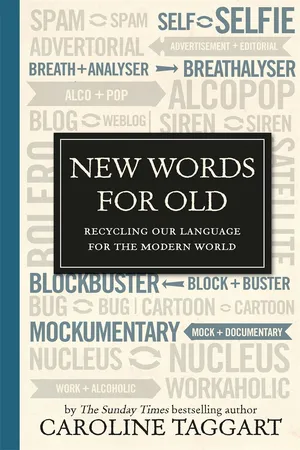
The English language is a versatile and agile thing, and as our world changes, so too does the way we use it. Sometimes we coin new words for new creations, but very often we adopt and adapt existing words to suit new purposes, or simply put two together to form a third. New Words for Old looks at the story behind some of the words we use every day and how their meanings have changed over time. From technology and fashion to politics and music, our language displays centuries of imagination and creativity, so often overlooked. Tracing the development of green from the days when it was just a colour, web when it was something spiders made and trolls when they were nothing more threatening than the baddies in fairy tales, this is a fascinating tour through the history of the words we use every day and demonstrates just how wide we cast the net when trying to describe something new.
- English
- ePUB (mobile friendly)
- Available on iOS & Android
eBook - ePub
About this book
Information
CHAPTER ONE
Fun and Games

One of the main areas in which we’ve adopted words in the last hundred years or so is the entertainment business. This chapter looks at photography, the cinema, radio and television, but also at games, reading material and – for the benefit of those who see it as a leisure activity – shopping.
acoustic
As a branch of physics concerned with sound, acoustics dates back as far as the seventeenth century, when a record of the proceedings of the Royal Society proposed the existence of three types of hearing – direct, refracted and reflected, or, more technically, acoustics, diacoustics and catacoustics. It seems a shame that neither of the last two passed into common use: a lot of fun could surely have been had – and a lot of silly photos posted on Twitter – from a misunderstanding of catacoustics.
No matter. Acoustics did catch on, both as a science and as a description of the way sound was transmitted in a building, particularly a concert hall. Early sound recordings were made acoustically – that is, using sound waves, which were collected in a horn and channelled towards a thin diaphragm, causing it to vibrate. These vibrations drove a stylus that recorded the sound on a wax cylinder or DISC.
This method was superseded in the 1920s by electric recording using a microphone. Then in due course came the 1950s and the Fender Stratocaster – not the first electric guitar, but the one that really made the idea take off. As electrical instruments became the norm in ROCK ’n’ roll bands, it was taken for granted that a guitar was electric unless otherwise specified: so the ‘unplugged’ guitar that had been in use for centuries came to be called an acoustic guitar – one that relied on sound waves rather than electricity.
Much the same was true of pianos and various other instruments. The process is comparable to what is now happening with reading: the object that for hundreds of years we have called simply a book now needs to be designated a print book in order to distinguish it from the increasingly popular e-variety.

advertorial
A combination of advertisement and editorial, used to mean an advertisement feature presented as if it were a factual report, this modern-sounding word has in fact been around for a hundred years. It is found in 1918 in the works of the British publicist and author Charles Higham, who established the advertising agency that bore his name, and from the context it’s clear that the concept, if not the term, had been known in the fledgling insurance companies that grew up in the London coffee houses of the seventeenth century.
A present-day New Zealand website advising on how to write a good advertorial suggests that you should use simple, everyday language and avoid slogans such as ‘You’ve tried the rest, now try the best’; that you should tell a story rather than just fill the piece with facts; and that, although you should include your contact details, you shouldn’t mention a price, as ‘This tips the story too much towards the “advertisement” end of the scale.’ I’m inclined to think that most readers know an advertisement when they read it and, if they don’t, the words ‘advertisement feature’, which invariably heads the page, may give them a clue.

album
The Latin albus means ‘white’ and the neuter form album was used as a noun to describe a blank tablet, something on which you could write whatever you wanted. The sense of a blank book in which you or your friends could write messages or mementoes had emerged in English by the seventeenth century and the photograph album followed as soon as photography was sufficiently widespread for the expression to be needed. Thus the derivation of the word was obscured: the important thing about an album came to be not that it had started out as blank, but that it enabled you to build up a collection.
With the advent of recorded sound this new meaning became firmly established. In the 1920s, an album of records was a number of records on the same theme or by the same artist, sold as what today we would call a boxed set. This sense was largely abandoned after 1948, when the first ‘long-player’ was introduced by Columbia Records. Unlike the earlier ‘78s’, which had a single song on each side, an LP could play for fifteen to twenty minutes a side and thus accommodate perhaps twelve songs on a single DISC. From being a collection of songs on a number of discs, therefore, an album evolved to be what it remains to this day – a collection of songs, usually by the same artist or from the same film, on a single record or, as FORMATS changed, a single CD or download.
biopic
A biographical picture, with ‘picture’ here meaning motion picture or movie, the biopic differs from the docudrama in that it tells the whole story of someone’s life, rather than focusing on a particular incident. The concept is as old as cinema itself – the pioneering French film-maker Georges Méliès made a short biography of Joan of Arc in 1900. However, the website filmreference.com tells us that the biopic ‘emerged as a recognizable subgenre in the 1930s’ and that the first is generally considered to be the 1929 film Disraeli. Subjects ranging from Abraham Lincoln to Florence Nightingale soon followed, the only defining feature apparently being a resolute refusal to let the truth get in the way of a good story. 1940s biographies of composers, from Chopin to Cole Porter, were particularly notorious in this respect, though the paying public seems to have been willing to forgive most liberties if it got enough good tunes.
As for a docudrama, it’s a cross between a documentary and a drama, reporting real-life events but using actors and probably fictionalizing some of the story for dramatic effect. The word dates back to the 1960s and in the cinema acclaimed films such as All the President’s Men, Argo and Selma can be classed under this heading. On television, however, docudrama often mixes documentary techniques such as voiceover, a presenter talking to camera or news footage with the dramatization, producing an unhappy, ‘between two stools’ mix that suggests it’s aimed at audiences who don’t have the powers of concentration to take their documentaries straight.
See also MOCKUMENTARY.
blockbuster
A block in this context is a city block, the area bounded by two pairs of parallel streets – a common way of measuring distance in North America, where you are more likely to say, ‘It’s five blocks away’ than ‘It’s ten minutes’ walk.’ This meaning of the word has been around since the late eighteenth century, with bust as a colloquial alternative to break only fractionally younger. The two were first put together during the Second World War, when a blockbuster meant a bomb capable of destroying a whole block. Once the war was over, the word quickly developed a figurative and more positive sense – to describe something as a blockbuster of an idea, for example, was to say that it was terrific, imaginative, breaking new ground.
Hollywood soon latched on to the term, applying it to 1950s films such as Ben-Hur or The Ten Commandments and then, over the decades, to Cleopatra, Superman, Batman, Titanic, Avatar and many others. The defining features of a blockbuster movie are massive production costs and huge marketing budgets, with perhaps less emphasis on the quality of the script or the acting (though the list I have given contains honourable exceptions to that stricture).
A blockbuster novel also tended to have a big marketing spend behind it; it was by definition long and usually broad in its scope, often covering several generations or continents, or describing a character’s rise from grinding poverty to wealth beyond the dreams of anyone but a blockbuster novelist. Among the blockbusters of the 1970s and 1980s, written by the likes of Barbara Taylor Bradford and Shirley Conran, was a subgenre known as ‘sex and shopping’, to which in the late 1980s British writer Sue Limb brought a new twist. Under the pseudonym Dulcie Domum (which translates very roughly as ‘the sweetness of home’), she wrote a column in the Guardian called ‘Bad Housekeeping’; in it Dulcie is struggling to write a novel her spouse describes as a bonkbuster. Dulcie’s description of the new gardener – ‘stocky, balding Slav, with magnetic eyes and masterful manner with turnips’ – gives an idea of the tone. Nobody who took their writing seriously would describe their work as a bonkbuster, but it has caught on among those who are dismissive of the genre and those who don’t mind admitting that they are reading rubbish for the fun of it.
cameo
In the jewellery sense, a cameo is made from a precious or semi-precious stone, with two layers in different colours, carved so that the top layer – usually white or cream and often a head-and-shoulders portrait in profile – stands out from the lower one. Standing out is the point here: a cameo part in a play or film is a comparatively small role, often played by a famous actor, written so as to give that actor the chance to shine. Although cameo had been used to describe short literary sketches in the nineteenth century, the theatre and cinema sense didn’t appear until the middle of the twentieth.
cartoon
The cartoons produced by Renaissance artists such as Raphael and Leonardo da Vinci weren’t meant to make people laugh and didn’t depict politicians with exaggerated facial features or wearing th...
Table of contents
- Cover
- By the same author
- Title page
- Copyright page
- Contents
- Introduction
- 1 Fun and Games
- 2 Sex ’n’ Drugs ’n’ Rock ’n’ Roll
- 3 Hi- and Lo-Tech
- 4 A Transport of Delight
- 5 Politics, Business and Science
- 6 Fashion Tips
- 7 A Splash of Colour
- Acknowledgements
- Bibliography
- Index
Trusted by 375,005 students
Access to over 1.5 million titles for a fair monthly price.
Study more efficiently using our study tools.
Frequently asked questions
Yes, you can cancel anytime from the Subscription tab in your account settings on the Perlego website. Your subscription will stay active until the end of your current billing period. Learn how to cancel your subscription
No, books cannot be downloaded as external files, such as PDFs, for use outside of Perlego. However, you can download books within the Perlego app for offline reading on mobile or tablet. Learn how to download books offline
Perlego offers two plans: Essential and Complete
- Essential is ideal for learners and professionals who enjoy exploring a wide range of subjects. Access the Essential Library with 800,000+ trusted titles and best-sellers across business, personal growth, and the humanities. Includes unlimited reading time and Standard Read Aloud voice.
- Complete: Perfect for advanced learners and researchers needing full, unrestricted access. Unlock 1.5M+ books across hundreds of subjects, including academic and specialized titles. The Complete Plan also includes advanced features like Premium Read Aloud and Research Assistant.
We are an online textbook subscription service, where you can get access to an entire online library for less than the price of a single book per month. With over 1.5 million books across 990+ topics, we’ve got you covered! Learn about our mission
Look out for the read-aloud symbol on your next book to see if you can listen to it. The read-aloud tool reads text aloud for you, highlighting the text as it is being read. You can pause it, speed it up and slow it down. Learn more about Read Aloud
Yes! You can use the Perlego app on both iOS and Android devices to read anytime, anywhere — even offline. Perfect for commutes or when you’re on the go.
Please note we cannot support devices running on iOS 13 and Android 7 or earlier. Learn more about using the app
Please note we cannot support devices running on iOS 13 and Android 7 or earlier. Learn more about using the app
Yes, you can access New Words for Old by Caroline Taggart in PDF and/or ePUB format, as well as other popular books in Languages & Linguistics & Linguistics. We have over 1.5 million books available in our catalogue for you to explore.