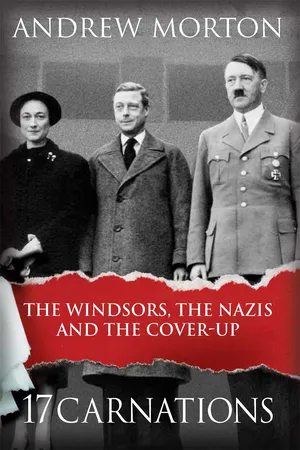
The true story of Edward Windsor and Wallis Simpson's involvement with the Nazi regime, and the post-war cover-up. The story of the love affair between Wallis Simpson and King Edward VIII, and his abdication, has provoked endless fascination. However, the full story of their links with the German aristocracy and Hitler has remained untold.* 17 Carnation s chronicles Hitler's attempts to matchmake between Edward and a German noblewoman, and Wallis's affair with the German foreign minister, who sent her a carnation for every night they had spent together.
*Pro-German sympathizers, the couple became embroiled in a conspiracy to install Edward as a puppet king after the Allies' defeat.
* The Duke's letters were hidden for years as the British establishment attempted to cover up the connection between the House of Windsor and Hitler.Thoroughly researched, 17 Carnations reveals the whole fascinating story, throwing sharp new light on this dark chapter of history.
- English
- ePUB (mobile friendly)
- Available on iOS & Android
eBook - ePub
About this book
Information
CHAPTER ONE

The Peter Pan Prince
He was the first royal sex symbol of the modern age, the wistful features of the Prince of Wales adorning the bedside tables and dormitory walls of thousands of schoolgirls and young women across Britain and the empire. He may have been the despair of his austere father, King George V, but Prince Edward—David to his family—was the undisputed darling of the empire.
Even republican America fell for the winsome charms of a bona fide war hero with matinee idol good looks. Hard-nosed celebrity journalist Adela Rogers St. Johns was such a fan that she had a picture of the Prince of Wales in a silver frame on her dressing table. “The dream of every American girl was to dance with him,” she recalled. Over the next few years he tried to oblige.
During the twenties, only silent screen star Rudolph Valentino, whose seductive performances in The Sheik and Blood and Sand transformed the one-time busboy into an international heartthrob, could possibly compare with the compelling charm of the future king-emperor.
His face was everywhere, on cigarette cards, in gossip magazines and daily newspapers, his every public appearance slavishly chronicled by Pathé News and shown at the local Roxy. An appearance by the Prince of Wales set female hearts fluttering and mothers wringing their hands in the hope that their daughter would be the chosen one. Men copied his natty dress sense, the Prince of Wales popularizing and adapting the eponymous check first worn by his grandfather, King Edward VII. He had only to appear in a particular Fair Isle pullover and factories would be working overtime to keep up with demand.
His appeal, though, lay in something more than his ubiquitous presence in the popular prints. Unlike his forbears, the unsmiling Queen Victoria, the haughty Edward VII, and his stern father, King George V, there was something pliable, friendly even, about the Prince of Wales. He looked more human than the others, almost vulnerable. Perhaps it was his clean, boyish good looks—he shaved infrequently throughout his life—or the slim wiry stature that earned him the nickname, not to his face, of “little man.” Most likely it was the seeming sadness that lay behind his haunted spaniel eyes which intrigued many. If eyes were truly a window into the soul, here was a young man in torment. He had what Lord Esher described as an expression of weltschmerz, the gloomy acknowledgment of the world as it is as opposed to the world as it should be. It was the look of a man who had seen more than his ration of sorrow and suffering, a quality he shared with those returning soldiers who survived the horrors of the trenches. He was the symbol, the human bridge between the war-weary millions still clinging to the fast-dimming certainties of a world before the horrors of 1914 and a fractious future where nationalism was on the rise, labour on the march, and aristocracy in retreat.
Wartime prime minister Lloyd George instinctively recognized that the prince was the most glittering jewel in the royal crown. It was, he argued, a jewel that should be on display. At the end of the war in 1918 the prince was asked to tour the colonies and Dominions to thank the people for their support of and sacrifice for the mother country. The Welsh politician wanted the Prince of Wales to play a “gay, many sided natural role.” If the empire’s star salesman could drum up trade for Britain’s exhausted manufacturers, so much the better.
With five emperors, eight kings, and four imperial dynasties rendered obsolete by the conflict, there was never a better time to emphasize that the newly minted House of Windsor—George V changed the family name from Saxe-Coburg und Gotha in 1917 to deflect anti-German sentiment—remained the unchanging keystone in the edifice of an empire upon which the sun never set. The slaughter of Czar Nicholas II of Russia and his family at Ekaterinburg in July 1918 by Bolshevik rebels reinforced this imperial imperative, especially as George V bore an uncanny likeness to the murdered czar. Not only did the barbaric incident shake the king’s “confidence in the innate decency of mankind,” it inspired his son’s lifetime loathing of the Bolsheviks, the murder of his godfather, Nicholas II, setting his heart against the Soviets and all their works.
Thus his seemingly endless and arduous imperial tours—during the 1920s he visited some forty-five countries and travelled an estimated 150,000 miles by sea and train—were a golden opportunity to reinforce the relevance of the monarchy and to introduce the man who one day would rule. It was a daunting assignment for a somewhat naïve young man, still only twenty-five, who was frequently overwhelmed by the straining sea of strange faces, the nervous demands of public speaking—a skill that did not come naturally—and of course the endless handshaking. The tone was set on his first tour, to Canada in September 1919, where he crisscrossed the country by train, laying wreaths and foundation stones, watching parades and pageants. His arrival was greeted with such hysteria that his right hand was so badly bruised and swollen after shaking so many eager hands that he had to resort to using his left.
At times this worship of the royal personage bordered on the messianic, the prince hearing people cry “I’ve touched him, I’ve touched him” as he walked through the press of flesh. As he laconically observed: When they were unable to pat him in person, hitting or prodding him with a rolled-up newspaper sufficed. It was a remarkable step change from the days of his grandfather, Edward VII: He would arrive at an engagement in his horse-drawn carriage, receive a loyal address, cut a ribbon, and declare something or other open without ever leaving his carriage.
This quasi-religious royal adulation was not confined to the colonies. In November 1919, when he completed his marathon three-month visit to Canada, he headed for a brief tour of Washington and New York, meeting with war wounded and rubbing shoulders with senators and congressmen. He also paid a private visit to the White House, where President Wilson was recovering from a stroke.
America was an unknown quantity and he was initially apprehensive about his reception. His only previous contact with Americans was during the war, when he reviewed a parade of some 25,000 troops at Coblenz and found himself impressed by their discipline. At the time, the military review received scant publicity, but the story of him dancing with American nurses at a later function sure did.
It was no exception: During his East Coast visit, dances laid on in his honour left many a debutante in a swoon. As one of his aides observed: “The prince holds very strongly that he can influence American feeling even better by dancing with Senators’ daughters than by talking to Senators.” As the world’s most eligible bachelor, he was linked to so many young women that he started a “My Brides” book where he glued in all the erroneous newspaper stories about when and whom he was to marry.
His first visit culminated in a ticker-tape parade through the streets of Manhattan, which was “thrilling beyond description.” As the prince later recalled: “Half asphyxiated by the smell of gasoline, I found myself sitting up on the back of the motor, bowing and waving like an actor who had been summoned by a tremendous curtain call.”
Such was the excitement generated by the brief royal progress that playwright Albert E. Thomas was inspired to pen a romantic comedy, strangely prophetic, called Just Suppose, about a prince who falls in love with an American beauty and offers to give up the throne for her hand in marriage.
Enthusiasm on the East Coast was matched by wild adulation on the West. The following April, when he stopped in San Diego on his way to Australia and New Zealand onboard HMS Renown, the princely presence excited considerable civic interest. Politically his arrival on American soil suggested that all was well with the “special relationship,” even if the Senate had rejected the Treaty of Versailles and membership in the League of Nations. As the first truly international royal celebrity, the prince was seen as a man of the New World, his youthful good looks, endless courtesy, and informal manner singling him out as a regular guy, modern, approachable, and democratic, not some feudal anachronism.
“That he is human is the pleasing point about him,” opined a local reporter, while another observer declared that the prince was as “American” as any boy in our public schools. At a reception onboard USS New Mexico, the flagship of the Pacific fleet, the prince and his travelling companion and friend Lord Mountbatten met a snaking line of local dignitaries. In the reception line were Lieutenant Winfield Spencer and his wife, Wallis. They shook hands and moved on. Years later, Wallis would complain to Mountbatten and her husband, now the Duke of Windsor, that they did not recall the brief encounter. Naturally Wallis, who remembered that she was “dressed to kill” for her first royal meeting, did.
Unaware of the momentous nature of this encounter, the royal party sailed on for the antipodes, the prince once again experiencing the spontaneous adulation and adoring affection that characterized his North America trip. “They murdered him with kindness,” recalled Mountbatten. It was a similar story in India, Nigeria, South Africa, and many other nations that made up the empire, or trading partners like Argentina and Japan where he was Britain’s super salesman. During his tour of Australia, Prime Minister Billy Hughes told him: “The people see in you the things they most believe.”
They were worshipping a false god. It was all a grotesque illusion, a monstrous charade played out before an innocent public. The mute, immovable reality was that the prince did not believe either in himself or in his future position as sovereign. In his reflective moments of melancholy and self-doubt, which were frequent, he felt he was living a lie, trying to match an image that bore no relation to the real man. He baulked at the very thought of becoming king and being revered by these adoring millions and hated a daily existence of what he derisively called “princing.”
“If only the British public really knew what a weak, powerless misery their press-made national hero was,” he told his girlfriend, Freda Dudley Ward.
His despondency manifested itself in frequent denunciations of his future role as king. It was such a recurring theme of his life that friends and advisors feared for the future of the Crown. A life of service was not high on his royal agenda. “Princing,” as he endlessly complained to Freda Dudley Ward, “was much easier abroad. I guess it’s because one isn’t hit up with a lot of old-fashioned and boring people and conventions.”
Prone to bouts of brooding depression, at the heart of his darkness the gloomy prince considered suicide as the only sure way out of his lifelong prison sentence. Upon his return from his wildly successful tour of North America in 1919, his morbid temperament was in full spate. He told his private secretary, Sir Godfrey Thomas, that he felt “hopelessly lost,” as if he were going mad. “I loathe my job now. . . . I feel I am through with it and long and long to die.” As an indication of his yearning to escape, he bought a 1,600-acre ranch in Alberta, the prince beguiled by a romantic vision of living the simple life, away from the cares of his position. It was, though, a bolt-hole he visited only four times in the forty years that he owned the property.
His depressions were frequent and prolonged, especially on long sea voyages during his interminable imperial tours. Lord Mountbatten recalled that the miserable prince often said how he longed to change places with his travelling companion. Before he left for his tour of Australia and New Zealand he was in floods of tears, ostensibly because he was leaving his lover, Freda Dudley Ward. As Mountbatten recalled: “He was moody—had fits of downright gloom. He made a fine appearance . . . but then one of his fits would come over him—and they came like a flash—and he’d shut himself in his cabin for days, alone, face drawn, eyes brooding. He was basically a lonely person, lonely and sad.”
When he finally got his way and walked away from the throne in 1936, his childhood nanny Charlotte “Lalla” Bill wrote a plaintive note to Queen Mary: “Do you remember, Your Majesty, when he was quite young, how he didn’t wish to live, and he never wanted to become King?” In his mind the abdication was the final renunciation of a lie that had begun in childhood. As far as the prince was concerned, the perception of the royal family in the popular imagination as the ideal family was a grotesque myth. “I had a wretched childhood,” he told American writer Charles Murphy. “Of course there were short periods of happiness but I remember it chiefly for the miserableness I had to keep to myself.” Beaten by sadistic nannies and tutors, bleakly observed with stiff disapproval by his remote mother and father, King George V and Queen Mary, and bullied by his peers, this sensitive, intelligent, and lonely boy realized early on that personal happiness played no part in the royal equation of existence.
The diarist Sir Henry “Chips” Channon described talking to Queen Mary as like “having a conversation with St. Paul’s Cathedral,” and letters the prince received from his parents during his imperial tours were “stiff and unnatural,” as if from the head of a company to a line manager. In his rather pathetic attempt to find some common ground between himself and his parents, the young prince learned to crochet to please his mother. A dreaded summons to his father’s library was invariably the prelude to a royal admonition to work and try harder. “Remember your position and who you are” was his father’s constant refrain.
He was expected to sacrifice his life on the altar of monarchy, exchanging his privileges and status for a lifetime yoked to duty and service. It was not a contract he wanted to sign, his inner turmoil expressed in his nervy behaviour—he was continually fiddling with his cufflinks, tugging at the knot in his tie, and never without a cigarette in his hand or pipe in his mouth. Heavy bouts of drinking helped him forget, the prince arriving late for official engagements still hungover.
To the modern eye, his distorted self-image, his belief that he was fat even though he was painfully thin, his bouts of violent exercise and frugal diets—he never ate lunch—indicate that he may well have suffered from the pernicious eating disorder anorexia nervosa. At the time, his private secretary, not knowing about eating disorders, contented himself with describing the prince’s eccentric lifestyle and eating habits as “idiotic” and “utterly insane and unreasonable.”
More than anything else he wanted to be treated like anyone else, to blend in. He was continually reminded of his apartness, often cruelly. From the time he was enrolled into Osborne naval college at age thirteen—the prince later went to Dartmouth naval college—he had what he termed “a desperate desire to be treated like any other boy of my age.” Instead he was regarded as a curiosity by the other cadets, who bullied and teased him, on one occasion dying his hair with red ink, on another staging a mock execution when they forced his head out of a sash window and brought it down on his neck like a guillotine.
Later he attended Magdalen College, Oxford, at the same time as his regal contemporary, Prince Paul of Yugoslavia. Unlike his royal friend, he was, according to Prince Paul, “reserved and shy and unable to enter into undergraduate life, or indeed make real friendships.” “A lost lamb” was how one of his tutors described him, the prince leaving the college after two years without graduating.
The outbreak of World War One in August 1914 brought home the acute realization that however hard he tried, whatever he did, the Prince of Wales was different from his friends and compatriots. Even though, after much lobbying, he was granted a commission in the Grenadier Guards, he was forced to stay behind in England when his unit was ordered to the fighting in France. He asked the army commander, Lord Kitchener: “What does it matter if I am killed? I have four brothers.” In the face of this fatalistic hyperbole, Kitchener explained that he could not permit the future king to be placed in harm’s way, especially if he were likely to be captured and held hostage.
It was, the prince would recall, the biggest disappointment of his life; to be in war and not to see battle was utterly devastating. He went through a prolonged period of self-loathing and despair, his sense of inadequacy manifest in his meagre eating habits. At his most troubled his situation provoked thoughts of suicide, a recurring theme in his life. Eventually he was allowed to join military headquarters in France, where he was occasionally permitted near to the front lines. The experience had a sobering effect, shaping his world view profoundly, the prince blaming the malign behaviour of politicians for creating conflict between ordinary Germans and Englishmen who, he believed, had much in common.
On September 29, 1915, he joined Major General (later Field Marshal) Lord Cavan on a tour of the front line at Loos. As the party were making their way forward, a shell burst forty yards away, forcing them towards no-man’s-land.
He later recorded: “Of course the dead lie out unburied and in the postures and on the spots as they fell and one got some idea of the horror and ghastliness of it all. Those dead bodies offered a pathetic and gruesome sight, so cruel to be killed within a few yards of your objective after a 300-yard sprint of death. This was my first real sight of war and it moved and impressed me most enormously.”
When they returned to Vermelles church, where he had left his car and driver, they discovered that the prince’s chauffeur had been killed by a burst of shrapnel. It was a tragic event that underlined the casual, random nature of death in wartime.
Prince Edward came from a generation haunted by the First World War, the industrial scale of the killing leaving a permanent scar. Years later he recalled: “I have only to close my eyes to see once more those awful charred battlefields, miles and miles of duck board winding across a sea of mud, columns of heavily laden men trudging up to the front, columns of men trudging back, their vitality gone, their eyes dead. I remember the blood-stained shreds of khaki and tartan; the ground gray with corpses, mired horses struggling as they drowned in shell holes.”
When Prince Edward returned home it was as though the war to end all wars had never taken place. His father’s life continued at the same imperturbable pace; at Sandringham, his Norfolk country estate, the clocks were set half an hour fast to give more daylight hours for shooting. When the guns were silent, the king busied himself with ordering his extensive royal stamp collection. For the sovereign it was a soothing pleasure, for the Prince of Wales it represented a royal court that was not just dull but stuck in the previous century. A man who considered himself a leading member of the so-called Jazz Age, he recoiled from a future mapped out in an unappealing vista of ceremonial tree plantings, laying cornerstones, meeting local worthies, and patronizing worthy charities.
As he later explained: “Being a monarch . . . can surely be one of the most frustrating and over the duller stretches the least stimulating jobs open to an educated independent-minded person. Even a saint would find himself driven to exasperation.”
That the king never dreamed of giving his sons any sor...
Table of contents
- Cover
- Also by Andrew Morton
- Title page
- Copyright page
- Dedication page
- Contents
- Acknowledgments
- 1 The Peter Pan Prince
- 2 Adolf Hitler, Royal Matchmaker
- 3 Sex, Drugs, and Royal Blackmail
- 4 Seduced by von Ribbentrop’s Dimple
- 5 Courting the New King
- 6 Edward on a Knife Edge
- 7 Love in a Cold Climate
- 8 Hitler’s Good Queen Wallis
- 9 The Game of Thrones
- 10 Plot to Kidnap a King
- 11 A Shady Royal in a Sunny Place
- 12 Tropic of Rancour
- 13 The Hunt for Pirate Gold
- 14 Sovereigns, Secrets, and Spies
- 15 Fight for the File
- 16 Burying the “Hot Potato”
- 17 Traitor King or Duped Duke?
- Source Notes
- Select Bibliography
- Index
- List of Illustrations
Trusted by 375,005 students
Access to over 1.5 million titles for a fair monthly price.
Study more efficiently using our study tools.
Frequently asked questions
Yes, you can cancel anytime from the Subscription tab in your account settings on the Perlego website. Your subscription will stay active until the end of your current billing period. Learn how to cancel your subscription
No, books cannot be downloaded as external files, such as PDFs, for use outside of Perlego. However, you can download books within the Perlego app for offline reading on mobile or tablet. Learn how to download books offline
Perlego offers two plans: Essential and Complete
- Essential is ideal for learners and professionals who enjoy exploring a wide range of subjects. Access the Essential Library with 800,000+ trusted titles and best-sellers across business, personal growth, and the humanities. Includes unlimited reading time and Standard Read Aloud voice.
- Complete: Perfect for advanced learners and researchers needing full, unrestricted access. Unlock 1.5M+ books across hundreds of subjects, including academic and specialized titles. The Complete Plan also includes advanced features like Premium Read Aloud and Research Assistant.
We are an online textbook subscription service, where you can get access to an entire online library for less than the price of a single book per month. With over 1.5 million books across 990+ topics, we’ve got you covered! Learn about our mission
Look out for the read-aloud symbol on your next book to see if you can listen to it. The read-aloud tool reads text aloud for you, highlighting the text as it is being read. You can pause it, speed it up and slow it down. Learn more about Read Aloud
Yes! You can use the Perlego app on both iOS and Android devices to read anytime, anywhere — even offline. Perfect for commutes or when you’re on the go.
Please note we cannot support devices running on iOS 13 and Android 7 or earlier. Learn more about using the app
Please note we cannot support devices running on iOS 13 and Android 7 or earlier. Learn more about using the app
Yes, you can access 17 Carnations by Andrew Morton in PDF and/or ePUB format, as well as other popular books in History & Historical Biographies. We have over 1.5 million books available in our catalogue for you to explore.