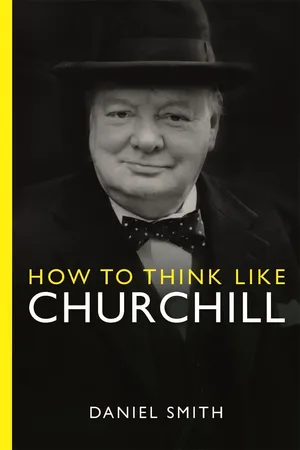
Looking at defining moments in Winston Churchill's life and revealing his key principles, philosophies and decisions, this book will teach you how to think just like Churchill. Remembered for his leadership during the Second World War, Churchill's commitment to 'never surrender', as well as his stirring speeches and radio broadcasts, helped inspire British resistance to the Nazi threat when Britain stood alone against an occupied Europe. As well as a hugely successful politician, Churchill was an officer in the British Army, a journalist, historian and a writer, winning the Nobel Prize for Literature in 1953. As one of the few voices warning about Nazi Germany in the 1930s, he returned to government to play his part in defeating Nazism, becoming one of the defining figures of the twentieth century. Studying how and why he accomplished what he did, how he overcame personal and professional adversity and stood strong in the face of overwhelming odds, with quotes and passages by and about the great man, you too can learn to think like Churchill.
- English
- ePUB (mobile friendly)
- Available on iOS & Android
eBook - ePub
How to Think Like Churchill
About this book
Information
Landmarks in a Remarkable Life
| 1874 | | | Winston Leonard Spencer-Churchill is born at Blenheim Palace in Oxfordshire on 30 November to Rt. Hon. Lord Randolph Churchill (the third son of the 7th Duke of Marlborough) and his American wife, Jennie Jerome. |
| 1880 | | | Winston’s brother, John Strange Spencer-Churchill, born on 4 February. |
| 1882 | | | Winston attends St George’s School in Ascot, Berkshire. |
| 1884 | | | Moves from school in Ascot to one in Hove. |
| 1888 | | | Begins at Harrow School. |
| 1893 | | | Commences training as a cavalry cadet at Sandhurst Royal Military Academy. |
| 1895 | | | Winston’s father dies on 24 January, aged forty-five. Winston joins the 4th Hussars as a second lieutenant and is granted permission to serve with the Spanish forces in Cuba, coming under live fire for the first time. He also makes his first visit to the USA. |
| 1896 | | | Posted with the army to India. |
| 1897 | | | Serves with the Malakand Field Force on the North-West Frontier. |
| 1898 | | | Is present at the Battle of Omdurman in Sudan. |
| 1899 | | | Retires from the army to pursue his political ambitions. Fails to win the parliamentary seat for Oldham in Lancashire. Travels to South Africa as a journalist, reporting on his experiences. He is briefly held as a prisoner of war by the Boers before making an audacious escape. Afterwards joins the South African Light Horse. |
| 1900 | | | Elected Conservative Member of Parliament (MP) for Oldham. Publishes first and only novel, Savrola. |
| 1901 | | | Makes maiden speech in Parliament. Joins the Territorial Army and is later commissioned as a captain in the Queen’s Own Oxfordshire Hussars. |
| 1904 | | | Swaps allegiance from the Conservative Party to the Liberal Party. |
| 1905 | | | Appointed Under-Secretary of State for the Colonies. |
| 1906 | | | Elected Liberal MP for the Manchester North West constituency. |
| 1907 | | | Becomes a Privy Councillor. |
| 1908 | | | Becomes Liberal MP for Dundee in Scotland, a seat he holds until 1922. He completes a landmark year by marrying Clementine (Clemmie) Hozier on 12 September and being appointed President of the Board of Trade. |
| 1909 | | | The Churchills’ first child, Diana, is born. |
| 1910 | | | Becomes Home Secretary in February, holding the post for some eighteen months. |
| 1911 | | | A son, Randolph, is born. Churchill appears on the scene at the infamous Siege of Sidney Street. In October he is named First Lord of the Admiralty. |
| 1914 | | | Outbreak of First World War. Churchill personally oversees the defence of Antwerp for a period in October. Meanwhile, Clemmie gives birth to a second daughter, Sarah. |
| 1915 | | | Resigns as First Lord of the Admiralty in May following the Dardanelles disaster. Becomes Chancellor of the Duchy of Lancaster, a post he holds until November. He also rejoins the army and sees active service on the Western Front in the First World War. |
| 1917 | | | Appointe... |
Table of contents
- Cover
- Title page
- Dedication page
- Copyright page
- Contents
- Introduction
- Landmarks in a Remarkable Life
- Don’t Let a Slow Start Hold You Back
- Address Your Shortcomings
- Read Like Churchill
- Entertain Ambition
- Indulge Your Spirit of Adventure
- The Great Escape
- Know How to Spin a Yarn
- From Hack to Nobel Laureate
- Find Your Perfect Partner-in-Crime
- Clemmie
- Refine Your Ideology
- Churchill, Conservatism and Liberalism
- Roll with the Punches
- The Dardanelles Disaster
- Be Pragmatic ...
- ... But Don’t Forget Your Guiding Principles
- Churchill the Democrat
- See Which Way the Wind is Blowing
- Hope for the Best and Prepare for the Worst
- Churchill and Hitler
- Bounce Back with Grace
- Moving into Number 10
- Lead from the Front
- It’s the Way You Say It
- Maintain a Sense of Humour
- Churchill and the Black Dog
- Connect with the Common People
- Fight, Not Flight
- Churchill’s Dark Side
- Churchill and the Empire
- Make Time for Life’s Finer Things
- Be Magnanimous in Victory
- Get the Churchill Look
- Maintain a Life Outside of Politics
- Churchill the Painter
- Carve Out a Legacy: the Search for a Lasting Peace
- Churchill and the Bomb
- Think Global
- Come to an Accommodation with God
- The Greatest Briton
- Selected Bibliography
Trusted by 375,005 students
Access to over 1.5 million titles for a fair monthly price.
Study more efficiently using our study tools.
Frequently asked questions
Yes, you can cancel anytime from the Subscription tab in your account settings on the Perlego website. Your subscription will stay active until the end of your current billing period. Learn how to cancel your subscription
No, books cannot be downloaded as external files, such as PDFs, for use outside of Perlego. However, you can download books within the Perlego app for offline reading on mobile or tablet. Learn how to download books offline
Perlego offers two plans: Essential and Complete
- Essential is ideal for learners and professionals who enjoy exploring a wide range of subjects. Access the Essential Library with 800,000+ trusted titles and best-sellers across business, personal growth, and the humanities. Includes unlimited reading time and Standard Read Aloud voice.
- Complete: Perfect for advanced learners and researchers needing full, unrestricted access. Unlock 1.5M+ books across hundreds of subjects, including academic and specialized titles. The Complete Plan also includes advanced features like Premium Read Aloud and Research Assistant.
We are an online textbook subscription service, where you can get access to an entire online library for less than the price of a single book per month. With over 1.5 million books across 990+ topics, we’ve got you covered! Learn about our mission
Look out for the read-aloud symbol on your next book to see if you can listen to it. The read-aloud tool reads text aloud for you, highlighting the text as it is being read. You can pause it, speed it up and slow it down. Learn more about Read Aloud
Yes! You can use the Perlego app on both iOS and Android devices to read anytime, anywhere — even offline. Perfect for commutes or when you’re on the go.
Please note we cannot support devices running on iOS 13 and Android 7 or earlier. Learn more about using the app
Please note we cannot support devices running on iOS 13 and Android 7 or earlier. Learn more about using the app
Yes, you can access How to Think Like Churchill by Daniel Smith in PDF and/or ePUB format, as well as other popular books in Politica e relazioni internazionali & Biografie in ambito politico. We have over 1.5 million books available in our catalogue for you to explore.