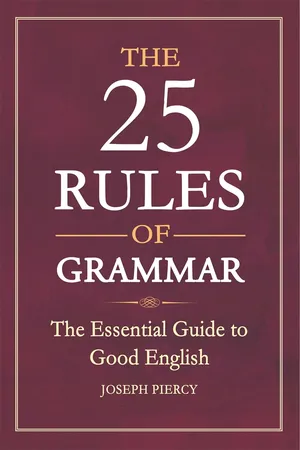
Everything you need to know about the 25 essential rules of English grammar. English grammar is often said to be over-complicated and difficult to get to grips with but the truth is that, while there are certain rules that should be obeyed, the language evolves and develops over time – and quite rightly so. In this useful book, Joseph Piercy outlines the 25 rules that should be adhered to in written and spoken English, defining the rules themselves and then decoding them for the layman so that he or she understands each rule and how it has been used and developed over time. Here the author highlights the most common misuses – or plain errors – in the language, such as apostrophes, 'who' and 'whom', and avoiding split infinitives and double negatives, while also setting the reader on to the right path to speaking and writing in good, plain English.
- English
- ePUB (mobile friendly)
- Available on iOS & Android
eBook - ePub
About this book
Information
Rule 1

When is a Sentence Not a Sentence?
The Rule: Sentences must contain a subject and a predicate, express a complete idea, begin with a capital letter and end with appropriate punctuation marks.
The parts of speech are the building blocks used to create grammatical units commonly known as sentences. Think of these word classes in terms of a vast Lego set where the constituent parts can be combined and recombined to create wondrous and great-looking things. However, similar to Lego, not all of the pieces fit comfortably together and need to be attached in the right place and correct sequence in order to achieve their goal. Sentences are often described as containing and expressing a complete idea and this idea can satisfy a variety of different functions. A declarative sentence contains statements and observations, such as ‘I am a writer’. An interrogative sentence, as the name suggests, asks questions and elicits information such as ‘Am I a writer?’ (this could also be a rhetorical question, of course). Exclamatory questions also contain statements but have added emphasis to express feeling and emotion as in ‘I am a writer! I am not a banker!’. The fourth function of sentences is provided by imperative sentences containing commands and instructions such as ‘I must write!’
In linguistic terms, sentences can be divided into three main classes according to their structure: simple sentences, compound sentences and complex sentences (some grammarians have identified a fourth class, the compound-complex sentence but that is just showing off ). These classifications are based on the number and type of clauses an individual sentence contains. The traditional definition of a clause is a collection of words that contains a subject and a predicate. Without wishing to get too bogged down with linguistic terminology regarding what constitutes a subject and predicate, the simplest explanation is the subject is who or what is actively ‘doing’ something and the predicate is everything else. In the sentence ‘the dog barks’, ‘the dog’ is the subject and ‘barks’ the predicate. The above example is a simple sentence in that it contains a single main clause (also called an independent clause) that contains a complete idea. The sentence ‘the dog barks, and the cat meows’, is a compound sentence because it contains two independent clauses linked by a conjunction (‘and’).
Complex sentences are sentences that contain an independent clause and a secondary dependent clause (also called a subordinate clause). Dependent clauses, as the name suggests, depend on the main (independent) clause in order to make sense. Dependent clauses provide additional information that can modify the main clause or act as a constituent part. For example:
The dog barks because it is hungry, but the cat meows because it is tired, or when it wants to be stroked.
The sentence above contains two independent clauses (as identified previously) plus three subordinate clauses (because it is hungry/tired/when it wants to be stroked) so strictly speaking it is what is known as a compound-complex sentence but personally I have an issue with fussy terminology and besides, something is either simple or it’s complex, let’s not overcomplicate the complex.
So that, in essence, is how to identify what constitutes a sentence, the function or purpose it satisfies and its constituent parts, but doesn’t fully explain what isn’t a sentence.
As stated earlier, a sentence, in order to be a sentence, must contain a subject and a predicate (a verb and quite often an object) and most importantly must express a complete idea and function in the form of a main or independent clause, and start with a capital letter and end with a full stop, question or exclamation mark. Consider the ‘sentences’ below:
1. In Britain, after The Great War and before the outbreak of hostilities in 1945.
2. Many students reading about grammar in the local library.
3. Although she was by far the better writer and had an excellent felicity with words.
At first glance, sentences one to three seem to be complete sentences in that they make sense and express ideas. They are, however, what is known as sentence fragments and on closer inspection there seems to be something not quite right about them. Sentence one, although containing a good deal of subject material and context (time/place) doesn’t actually contain a subject or a verb and so can’t be a complete sentence. Sentence two qualifies as a fragment for although it appears to have a subject (students) and a verb (reading), the verb is actually a dangling present participle and doesn’t have an auxiliary verb preceding it so therefore isn’t actually a verb at all. ‘Many students were reading about grammar in the local library’ is a complete sentence. Sentence three is a sentence fragment that seems to throw our rule out of the window as it contains a subject (she) and two verbs (was and had) but the problem here is that the sentence contains the word ‘although’, which is what is known in grammatical terms as a ‘subordinating conjunction’. The word ‘although’ modifies the clause, making it a dependent clause (or subordinate clause) that requires an independent or main clause to make sense:
Although she was by far the better writer and had an excellent felicity with words, the judges gave the literary prize to somebody else instead.
Is Too Much Better Than Not Enough?
The ability to handle multiple subordinate clauses skilfully is considered to be the signature of fine writing. There are dangers and pitfalls in getting carried away by linking too many ideas together in the same sentence. The result is that even the most attentive reader will find the writer’s train of thought difficult to follow. Below are two examples from classics of English literature that at first glance are bewilderingly long sentences:
‘He got a good estate by merchandise, and leaving off his trade, lived afterwards at York, from whence he had married my mother, whose relations were named Robinson, a very good family in that country, and from whom I was called Robinson Kreutznaer; but, by the usual corruption of words in England, we are now called – nay we call ourselves and write our name – Crusoe; and so my companions always called me.’
The Adventures of Robinson Crusoe
Daniel Defoe
‘This great man, as is well known to all lovers of polite eating, begins at first by setting plain things before his hungry guests, rising afterwards by degrees as their stomachs may be supposed to decrease, to the very quintessence of sauce and spices.’
The Adventures of Tom Jones
Henry Fielding
Conversely, short, sharp staccato sentences can be equally perplexing as the opening to Charles Dickens’ Bleak House demonstrates:
‘London. Michaelmas term lately over, and the Lord Chancellor sitting in Lincoln’s Inn Hall.
Implacable November weather.’
Dickens demonstrates three very different forms of sentences in this brief passage, none of which contain a finite verb (sitting being a present participle). The great man just about gets away with it though under the rule that a sentence is an idea contained within a capital letter and a full stop, and just to show he can do other types of sentence as well, the passage continues with some delightful subordinate clauses, especially the giant lizard, which is such a terrific image he mentions it twice (see Rule 15):
‘As much mud in the streets as if the waters had but newly retired from the face of the earth, and it would not be wonderful to meet a Megalosaurus, forty feet long or so, waddling li...
Table of contents
- Cover
- By the same author:
- Title page
- Copyright page
- Dedication page
- Contents
- Epigraph page
- Acknowledgements
- Introduction: Does Grammar Really Matter?
- The Essential Tools: Building Blocks and Basics
- Rule 1: When is a Sentence Not a Sentence?
- Rule 2: Recognizing the Subject and the Object in a Sentence
- The Essential Tools: The Naming of Things
- Rule 3: How to Use ‘Much’ and ‘Many’?
- Rule 4: The Spelling Conventions for Singular and Plural Nouns
- The Essential Tools: Being and Doing: The Business of Verbs
- Rule 5: How to Spot the Difference Between Regular and Irregular Verbs
- Rule 6: Don’t Feel Tense About the Tenses
- Rule 7: Dangling Participles Mangle Meaning
- The Essential Tools: Adverbs – It Ain’t What You Do It’s The Way That You Do It!
- Rule 8: ‘Neither/Nor’ and ‘Either/Or’ Must Always be Used Together
- Rule 9: Try Not to Ever Split Infinitives
- The Essential Tools: Problems with Pronouns
- Rule 10: The Correct Use of ‘That’ and ‘Which’
- Rule 11: When to Use ‘Who’ and ‘Whom’
- Rule 12: The Proper Use of ‘You and I’/ ‘Me, Us and We’
- The Essential Tools: Give Us a Clue: Adjectives
- Rule 13: Don’t Use No Double Negatives
- Rule 14: When to Use ‘Different To’, ‘Different From’ or ‘Different Than’
- Rule 15: Tautology: Beware of Repeating Yourself and Saying the Same Thing Twice
- The Essential Tools: The Correct Uses of the Different Forms of Punctuation
- Rule 16: How to Use Apostrophes Correctly
- Rule 17: Uses and Abuses of Commas, Colons and Semicolons
- The Essential Tools: Advanced Grammar
- Rule 18: Ending Sentences with Prepositions Can Bring You Down
- Rule 19: And Avoid Starting Sentences with Conjunctions
- Rule 20: Pronouns Must Always be Agreeable
- Rule 21: How to Spot Misplaced Correlatives
- Rule 22: The Differences Between the Four Grammatical Cases in English
- Rule 23: Be Careful What You Wish For in the Subjunctive Mood
- Rule 24: Selecting the Correct Preposition
- Rule 25: Commonly Confused, Misused and Misspelled Words
- When Grammar Goes Wrong
- And Finally . . . A Grammarian Walks into a Bar . . .
- How Much Do You Know About Grammar? A Quick Quiz
- Quiz Answers
- Glossary of Basic Grammatical Terms
- Selected Bibliography
- Index
Trusted by 375,005 students
Access to over 1.5 million titles for a fair monthly price.
Study more efficiently using our study tools.
Frequently asked questions
Yes, you can cancel anytime from the Subscription tab in your account settings on the Perlego website. Your subscription will stay active until the end of your current billing period. Learn how to cancel your subscription
No, books cannot be downloaded as external files, such as PDFs, for use outside of Perlego. However, you can download books within the Perlego app for offline reading on mobile or tablet. Learn how to download books offline
Perlego offers two plans: Essential and Complete
- Essential is ideal for learners and professionals who enjoy exploring a wide range of subjects. Access the Essential Library with 800,000+ trusted titles and best-sellers across business, personal growth, and the humanities. Includes unlimited reading time and Standard Read Aloud voice.
- Complete: Perfect for advanced learners and researchers needing full, unrestricted access. Unlock 1.5M+ books across hundreds of subjects, including academic and specialized titles. The Complete Plan also includes advanced features like Premium Read Aloud and Research Assistant.
We are an online textbook subscription service, where you can get access to an entire online library for less than the price of a single book per month. With over 1.5 million books across 990+ topics, we’ve got you covered! Learn about our mission
Look out for the read-aloud symbol on your next book to see if you can listen to it. The read-aloud tool reads text aloud for you, highlighting the text as it is being read. You can pause it, speed it up and slow it down. Learn more about Read Aloud
Yes! You can use the Perlego app on both iOS and Android devices to read anytime, anywhere — even offline. Perfect for commutes or when you’re on the go.
Please note we cannot support devices running on iOS 13 and Android 7 or earlier. Learn more about using the app
Please note we cannot support devices running on iOS 13 and Android 7 or earlier. Learn more about using the app
Yes, you can access The 25 Rules of Grammar by Joseph Piercy in PDF and/or ePUB format, as well as other popular books in Languages & Linguistics & Grammar & Punctuation. We have over 1.5 million books available in our catalogue for you to explore.