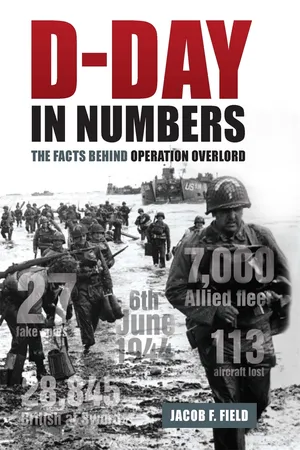
D-Day, 6 June 1944, the day on which the Allies landed on the beaches of Normandy with the intention of reclaiming mainland Europe from German occupation. The significance of the operation has captured the collective imagination to become the defining moment of World War Two and represents the ending to the struggles of the early twentieth century. D-Day in Numbers follows the course of the war in Europe from 1939 through to the D-Day landings and their aftermath, taking in the most poignant events and looking at each through the numbers involved. Each number signifies an important moment within a larger story as they are explained in the context of the surrounding events. And with the vast amount of planning that went into the execution of such an ambitious operation, the numbers involved are staggering, surprising and often inspiring. Broken down into chapters that set the scene of the war in Europe so far, the planning and preparation of D-Day, the landings, the battles and the aftermath.Discover the numbers that promised to change the balance of power in Europe, and indeed, the world, as Deliverance Day, 1944 got underway.
- English
- ePUB (mobile friendly)
- Available on iOS & Android
eBook - ePub
About this book
Information
Subtopic
Military & Maritime HistoryIndex
HistoryChapter 1:
The War in Europe So Far
£6,600,000,000
THE 11 NOVEMBER 1918 armistice ended the fighting in World War I. It took several months for the Allied Powers (led by France, the United States, and the United Kingdom) and Germany to negotiate the Treaty of Versailles, signed on 28 June 1919. Its major point was Article 231, the ‘War Guilt’ clause, under which Germany accepted responsibility for starting the war. She was liable to pay reparations for the damages the Allies suffered, valued in 1921 at £6,600,000,000, to be paid in a mixture of cash and commodities such as coal. Allied troops were to occupy the Rhineland for fifteen years. This region was in western Germany and an important centre of industry. Germany was to cede territory in Europe, give up its colonies, and was forbidden from joining with Austria. Versailles stripped Germany of its military capacity by limiting its army to 100,000 and its navy to 15,000. Her armed forces were forbidden to use armed aircraft, tanks, or submarines. Many Germans found the treaty offensive, believing that Germany, never fully defeated in the field, had been ‘stabbed in the back’ by politicians. During the Great Depression of the 1930s high unemployment and hyperinflation struck Germany, leading to a rise in support for radical groups like Adolf Hitler’s Nazis. One of Hitler’s promises was to tear up Versailles, and restore Germany’s greatness. As for the reparations, they were suspended in 1932 due to the Depression, and never resumed. Germany only paid one-eighth of their value. Once in power Hitler sought to reverse Versailles; he built up the size and strength of the German armed forces, in 1936 he remilitarized the Rhineland, and in 1938 Germany annexed Austria.
10,000,000 copies
ADOLF HITLER’S MEIN KAMPF (‘My Struggle’) was a mixture of autobiography, ideology, and political manifesto, steeped in a virulent mixture of anti-Semitism and anti-Communism. Hitler started the work while he was imprisoned after a failed uprising in 1923. It was published in 1925, and sold 23,000 copies in five years. As Hitler rose to power, the book’s popularity and circulation increased. By 1945 around ten million copies had been sold or distributed. Royalties from Mein Kampf meant Hitler built up a large private fortune.
288 seats
ON 5 MARCH 1933, the last free elections before the Nazi takeover of Germany were held. Hitler had been chancellor since January, but his National Socialist Workers’ Party did not have a majority. Despite this, Hitler had been able to repress the Communist Party by arresting its members and launching a propaganda campaign against them. On Election Day Nazi supporters roamed the streets, attempting to sway the vote with the threat of violence. Despite this, the Nazis won only 288 seats with forty-four per cent of the vote. This left them thirty-six seats short of a majority in the Reichstag, meaning they had to form a coalition. This did not stop Hitler from passing the Enabling Act on 23 March, which allowed his cabinet to pass laws without consulting the Reichstag. Trade unions were banned and other political parties were suppressed or forced to disband. On 2 August 1934, the head of state, President Paul von Hindenburg, died. His office was abolished and merged with that of the chancellor. Hitler now became Führer und Reichskanzler – head of government and head of state. Hitler became Supreme Commander of the German armed forces, who would be made to swear an oath of loyalty to Hitler. In 1935 the Nazi symbol, the swastika, was proclaimed to be Germany’s sole national flag. In just a few years Germany had transformed from a multi-party democracy into a militaristic, single-party fascist dictatorship.
10 years old
THE HITLER YOUTH was founded in 1922 as the youth wing of the Nazis. After 1936 all German boys over the age of ten were expected to join its junior section, the Deutsches Jungvolk (‘German Youth’). There was a similar organization for girls and young women called the Bund Deutscher Mädel (‘League of German Maidens’). By 1939 membership of the Hitler Youth was made compulsory for all boys between ten and eighteen. It placed great emphasis on preparing boys for military service, as well as inculcating them with Nazi ideology. After the Hitler Youth many boys would go on to join the elite Nazi group, the Schutzstaffel (SS). As World War II went on and German manpower was depleted, the Hitler Youth became a military reserve force. Many of its teenage members fought in the Battle of Normandy and young boys were involved in the doomed defence of Berlin.
158,962,555,217,826,360,000 settings
The German Enigma machine, which was used to encode messages, had nearly 159 quintillion possible settings. The machine was developed for commercial use in the 1920s by the German engineer Arthur Scherbius. Its military application quickly became apparent. The Enigma relied on a series of rotating wheels, which scrambled letters entered into the machine’s keyboard by the operator. The resulting scrambled message, an unintelligible mess of letters, was then communicated via Morse Code. It could only be decoded if the recipient knew the exact settings used when it was written. Once the fighting began, the German armed forces usually changed their Enigma settings daily, believing it would make their communications impossible to decode. Events later in the war would show this confidence was misplaced.

3,500,000 shelters
SIR JOHN ANDERSON was the government official responsible for preparing Britain for bombing raids before the outbreak of World War II. His name was given to the Anderson shelter, designed by a team at the Institution of Civil Engineers. It was the main air-raid shelter used by the British public. From February 1939 until the end of the war, over 3.5 million shelters were erected. They were made of fourteen sheets of corrugated iron, which formed a shelter buried four feet into the ground. These shelters could hold up to six people. They were given free to households earning less than £250 per year. The Morrison shelter was designed to be used indoors. It was a heavy table fortified by a steel plate and wire-mesh sides. This shelter was issued as a kit assembled at home. By the end of the war around 600,000 had been distributed.
£1 8s per week
THE WOMEN’S LAND ARMY (WLA) was created during World War I to organize female replacements for male agricultural workers who were fighting. With conflict looming again, the WLA was revived in June 1939. They were paid a weekly wage of one pound and eight shillings and also received room and board. Through a mixture of volunteers and conscription, the WLA grew to 80,000 members. Most were from rural areas but around one-third came from large cities. Female labour was vital to the British economy during the war. Between 1939 and 1943 four out of five people added to the labour force were women who had not previously worked full-time.
387 feet
GLIWICE (OR GLEIWITZ) RADIO TOWER is the tallest wooden structure in Europe, standing nearly four hundred feet tall. Built in 1935, it resembles the Eiffel Tower – except with a wooden framework. Although now in Poland, in 1939 the tower was in Germany. It was the focus of Operation Himmler, a series of events the Germans staged to give the impression of Polish aggression and give Hitler a public justification for invading Poland. On 31 August, a group of Germans, dressed in Polish uniforms, staged a fake raid on the tower and broadcast a brief anti-German message. Several prisoners from Dachau concentration camp were poisoned, dressed in Polish uniforms, and riddled with bullets to give the impression there had been a firefight. That day there were several other faked attacks on other locations on the border. On 1 September, Hitler addressed the Reichstag, and used these incidents as a pretence for launching an invasion he had long been planning. France and the United Kingdom had vowed to declare war on Germany if they invaded Poland, but Hitler did not believe they would act on this threat.
11 cavalry brigades
POLAND HAD LONG EXPECTED a German invasion. She had built up her military capacity to nearly one million men. Cavalry units still formed ten per cent of their strength. They were mainly used as mobile infantry and for reconnaissance (it is a misconception that they charged German tanks with sabres and lances). The German invasion on 1 September 1939 caught the Polish by surprise and they were unable to mobilize all of their forces. At eight in the morning German troops had crossed into Poland. They were the first of an invading army of 1.5 million. The Germans had nearly six times as many aircraft and over three times as many tanks, and generally enjoyed technical superiority. On 3 September, the United Kingdom and France declared war on Germany. They could do little to help Poland, whose armies fought valiantly but were pushed steadily back. On 17 September, a Soviet army of 800,000 invaded from the east. This was no surprise to Germany. Germany and the Soviet Union had signed a secret pact in August 1939 carving up Eastern Europe into separate spheres of influence. Fighting ended on 6 October. Over ninety-five per cent of the Polish armed forces were lost – dead, wounded, or captured. Two hundred thousand Polish civilians were killed. Poland was wiped from the map and divided between Germany, Slovakia, and the Soviet Union.

European Borders Before World War II
44 formal declarations of war
GERMANY INVADED POLAND without declaring war. Two days later the United Kingdom and France declared war on Germany as a result. Following this, there were forty-three other formal declarations of war made during World War II. Some of the lesser-known declarations include Albania declaring war on the United States on 17 December 1941, Bolivia’s declaration of war against the Axis powers (Germany, Italy and Japan) on 2 April 1943, and San Marino formally entering the conflict against Germany on 21 September 1944. The final declaration of World War II was made on 8 August 1945, when the Soviet Union declared war on Japan.
103,000 teachers evacuated
OPERATION PIED PIPER was a British effort to move children, mothers, pregnant women, and the disabled from cities at risk of being bombed to safer areas. In addition, 103,000 teachers were evacuated. In total, 3.5 million people were relocated. The evacuations began on 1 September, two days before the declaration of war on Germany. Many children stayed in cities; for example, 800,000 children remained in London.
1,500 observation posts
THE ROYAL OBSERVER CORPS was a volunteer civilian organization that manned over 1,500 observation posts in Britain, day and night, for nearly the whole duration of the war. At its peak 33,100 male and 1,000 female volunteers were on the look-out for enemy aircraft.
51 ships sunk
DURING THE BATTLE OF THE ATLANTIC, Axis and Allied powers vied for maritime supremacy as they both sought to prevent supplies reaching land. German submarines (U-boats) were highly effective at locating and sinking enemy ships, hunting in ‘wolf packs’, which descended on Allied convoys with brutal swiftness. The most lethal was U-48, launched six months before the conflict began. In the course of twelve patrols, from 1939 to 1941, U-48 sank fifty-five ships with a combined tonnage of 321,000. As the war went on, the Allies adopted new tactics and weapons that limited the effectiveness of the U-boats, meaning more shipments got through to Britain unharmed. In total, U-boats sank 2,603 merchant ships (with the loss of 30,000 lives and a combine...
Table of contents
- Cover
- Title page
- Copyright page
- Dedication page
- Contents
- Introduction
- Chapter 1: The War in Europe So Far
- Chapter 2: Planning and Preparation
- Chapter 3: Order of Battle and the Crossing
- Chapter 4: The D-Day Landings
- Chapter 5: The Battle for Normandy
- Chapter 6: Aftermath
- SELECT BIBLIOGRAPHY
- INDEX
Trusted by 375,005 students
Access to over 1.5 million titles for a fair monthly price.
Study more efficiently using our study tools.
Frequently asked questions
Yes, you can cancel anytime from the Subscription tab in your account settings on the Perlego website. Your subscription will stay active until the end of your current billing period. Learn how to cancel your subscription
No, books cannot be downloaded as external files, such as PDFs, for use outside of Perlego. However, you can download books within the Perlego app for offline reading on mobile or tablet. Learn how to download books offline
Perlego offers two plans: Essential and Complete
- Essential is ideal for learners and professionals who enjoy exploring a wide range of subjects. Access the Essential Library with 800,000+ trusted titles and best-sellers across business, personal growth, and the humanities. Includes unlimited reading time and Standard Read Aloud voice.
- Complete: Perfect for advanced learners and researchers needing full, unrestricted access. Unlock 1.5M+ books across hundreds of subjects, including academic and specialized titles. The Complete Plan also includes advanced features like Premium Read Aloud and Research Assistant.
We are an online textbook subscription service, where you can get access to an entire online library for less than the price of a single book per month. With over 1.5 million books across 990+ topics, we’ve got you covered! Learn about our mission
Look out for the read-aloud symbol on your next book to see if you can listen to it. The read-aloud tool reads text aloud for you, highlighting the text as it is being read. You can pause it, speed it up and slow it down. Learn more about Read Aloud
Yes! You can use the Perlego app on both iOS and Android devices to read anytime, anywhere — even offline. Perfect for commutes or when you’re on the go.
Please note we cannot support devices running on iOS 13 and Android 7 or earlier. Learn more about using the app
Please note we cannot support devices running on iOS 13 and Android 7 or earlier. Learn more about using the app
Yes, you can access D-Day in Numbers by Jacob F. Field in PDF and/or ePUB format, as well as other popular books in History & Military & Maritime History. We have over 1.5 million books available in our catalogue for you to explore.