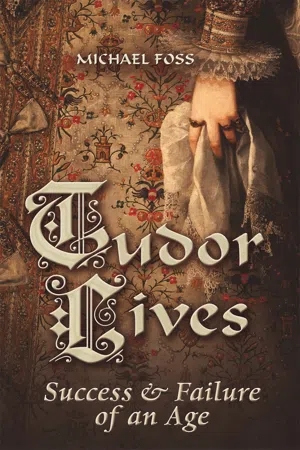
The triumphs of the Tudor age are well known; less apparent is the pain that went hand-in-hand with success. This book considers the cost of great achievement. Michael Foss, author of The World of Camelot and The Search for Cleopatra, holds a microscope up to the lives of key Tudor figures. He paints a portrait of key Tudor figures undone by the stern course of the century - Walsingham, made poor and hurried to the grave by the laborious demands of Elizabeth's administration; Philip Sidney, who found no place for his chivalrous idealism in the faithless world of contemporary polity - in an age which resembled 'a bow too long bent'.
- English
- ePUB (mobile friendly)
- Available on iOS & Android
eBook - ePub
About this book
Information
Subtopic
British HistoryIndex
History1
Tudor Monarchs
THE ENGLISH MONARCHY sank low in the fifteenth century. Philippe de Commines saw the Duke of Exeter, brother-in-law of Edward IV, trudging barefoot in the retinue of the Duke of Burgundy; the members of the House of Lancaster, Commines wrote, were poorer than street beggars. Never was the crown so disregarded, so despised, so bullied; never was the king in such danger of deposition and murder. In 1485 Henry VII, from an obscure family with only the slightest tinge of royal blood, came to the throne in the manner of the century, by force of arms, and in one reign raised the crown from impotent beggary to settled and prosperous power. ‘From the time of William the Conqueror to the present’, wrote an Italian envoy in 1498, ‘no king has reigned more peaceably than he has, his great prudence causing him to be universally feared.’
Within fifteen years the wounds of the feudal discord were healed. The astute Relation of the Island of England, which the Venetian envoy wrote as a guide for his fellow countrymen to this far northern realm, pictured a well-favoured land. The fields were rich and gave forth with great abundance so that the people lived easily enough, cultivating just sufficient for their needs. The country was forested with a great variety of trees, and the envoy noted ‘all our fruit trees’ with the exception of the olive and the orange. Animals, both domestic and wild, were plentiful and well-grown so that ‘stags, goats, fallow-deer, hares, rabbits, pigs, and an infinity of oxen’ were available for meat. The rivers and the coastal waters provided good fishing, and various fowl were highly regarded, in particular pea-fowl, partridges, pheasants and swans ‘which are eaten by the English like ducks and geese’.1 Tilling the fields was the chief occupation of the people, but the most notable feature of the countryside was the ‘enormous number of sheep’. The wool trade was already the greatest source of England’s wealth, and the lamentable policy of enclosure, which later caused such rural misery, was much practised. Besides the weaving of the wool, there was little industry, though iron and silver were produced and valuable mines existed for tin and lead.
The envoy noted that the countryside was very thinly populated while London was crowded and vigorous. The domestic architecture was not distinguished and the streets were a mess; ravens, kites and crows, far from being birds of ill-omen, as they were in Italy, were encouraged by the English to clear the offal and the garbage from the streets. The townsmen lived comfortably but not too fastidiously; Erasmus commented on the dirt and carelessness of the English household. If the houses were poor, the churches were grand. The greater monasteries were ‘more like baronial palaces than religious houses’, and the shrines of the saints were resplendent. The envoy wondered especially at the tomb of St Thomas Becket at Canterbury, ‘entirely covered over with plates of pure gold’ studded with sapphires, diamonds, rubies and emeralds.
Indeed, luxurious richness was apparent everywhere. ‘The riches of England’, wrote the envoy, ‘are greater than those of any other country in Europe.’ A small innkeeper might well have silver drinking-cups; a modest householder might have silver-plate to the value of £100. In the parish churches the crucifixes, candlesticks, patens, censers and cups were usually silver, and the quantity of wrought silver was ‘the most remarkable thing in London’. In one street by St Paul’s ‘there are fifty-two goldsmith’s shops, so rich and full of silver vessels, great and small, that in all the shops of Milan, Rome, Venice, and Florence put together, I do not think there would be found so many of the magnificence that are to be seen in London’.
The citizens, whom the envoy found ‘handsome and well-proportioned’, dressed well, ate well and drank well; they were polite and quick-witted, but not learned. They went through the forms of piety, going to Mass often and distributing alms, but the Venetian thought that they had ‘various opinions concerning religion’. He thought the reputation of English soldiers was well earned ‘from the great fear the French entertain of them’. But he agreed with an older authority that the English were liable to break off the battle for a good feast, and to ride to war loaded with wine and cheeses rather than armour and lances. The chief characteristic of Englishmen, however, was nationalism. ‘The English’, said the envoy, ‘are great lovers of themselves, and of everything belonging to them; they think that there are no other men than themselves, and no other world but England.’ And consequently they disliked all foreigners, suspecting that ‘they never come into their island, but to make themselves masters of it, and to usurp their goods’. An insular, rugged, proud race, children of a beneficent land, kept from greatness, perhaps, by ignorance and lack of confidence.
The qualities of Henry VII, the man who raised England to such prosperity in so few years, were not those that make a man loved. Francis Bacon, who admired him, called Henry ‘sad, serious and full of thoughts’; he was also cold, suspicious and avaricious. He supported justice in the State but overrode it in his own interests. He was not cruel, ‘but the less blood he drew the more he took of treasure’. He had, however, the patience and sagacity to overcome all the disadvantages of a cold nature. From the first he showed a remarkable political wisdom, what the Venetian envoy called his ‘prudence’. As he had won the throne on the battlefield, he did not disguise the source of his power. He had his battle standards laid in state at St Paul’s, and would not marry Elizabeth of York, whose hand would give him some title to the crown, until after the coronation and confirmation of his place by Parliament. He chose, said Bacon, ‘rather to keep state and strike a reverence into the people than to fawn upon them’. The sanction of power was a recognized reality; as a later writer put it, ‘the sword hath always been better than half the title to get, establish or maintain a kingdom’. In the lawless age of the fifteenth century very little divinity surrounded the King, and Henry was not thought any the worse because he came to the throne by force of arms. He made his title good, not by doubtful claims or fraudulent pedigrees, but by his care of the country. Wise observers noted how he drove himself in the work of government. Ayala, the Spanish envoy, called him ‘old for his years, but young for the sorrowful life he has led’. His chilly calculations were what good sense recommended for the well-being of the land. Bacon imputed his actions ‘to nature, age, peace, and a mind fixed upon no other ambition or pursuit’.
Henry VII saw a strong monarchy as the most secure bulwark against the anarchy which had weakened England for so many years. During the wanderings of his exile in France he had seen the advantages of a centralized royal administration, and he was determined to try the same system in England. Monarchs, who before had been very often the pawns of circumstance, became by the deliberate policy of the Tudors the majestic and all-powerful governors of the State. To impress both countrymen and strangers with the glory of the English crown, Henry, who relentlessly extracted every last penny from the pockets of his poor subjects and hated war as a consumer of treasure, was prepared to spend lavishly on the upkeep of the royal family and the court. His own clothes were the most expensive that could be found and his tailors scoured Europe for jewels and precious metals, cloth of gold, silks, satins, furs and velvets. The Queen and the royal children were also radiantly dressed, and even the royal buckhounds went in silks of eight different colours ‘garnished with crowns, roses, fleurs-de-lis, and other our badges’. Entertainments at court were done with the maximum of show and the greatest cost. The Venetion noted that six or seven hundred people might sit down to dinner at court and be regaled with a vast array of food. For the feast of Henry’s nuptials with Elizabeth, in 1487, there were some fifty different dishes, from lampreys to sturgeon, from swans to plovers, from ‘jelly hippocras’ to ‘custard royal’. The Venetian envoy wrote that Henry, ‘though frugal to excess in his own person’, spent £14,000 a year on his table. ‘There is no country in the world’, a Spanish traveller commented, ‘where queens live with greater pomp than in England, where kings have as many court officers.’
Not only feasting, but also patronage of the arts became a duty for Renaissance kings seeking grandeur. Henry himself was not a learned man; Bacon called him studious rather than cultivated. His knowledge of French was good from his years in exile, and his Latin was adequate. But with his usual practical wisdom he knew what was wanted in his northern kingdom for so long ravaged by war and starved of thought and wit, and he set out to encourage the arts and sciences. His mother, the redoubtable Lady Margaret, was a great friend of scholarship, and perhaps under her influence he ensured that his children were educated up to the standard of princes. At the age of eleven, Arthur, the eldest son, impressed the Milanese ambassador with his learning; in 1494 Henry, the second son, was given John Skelton, poet and ‘laureate’ of Oxford, Cambridge and Louvain, as his tutor. At a time when England was noted for music, the royal family was musical. The children had the best training and the King maintained vocal and instrumental musicians, to sing in the Chapels Royal and to provide the entertainment at his interludes; he also, as his meticulous account books reveal, made many payments to trumpeters, fiddlers, organists, harpists, and even bagpipers.
Having seen to the education of his own household, Henry tried to increase the stock of public knowledge. Foreign scholars such as Pietro Carmeliano and Barnard Andre were welcomed. The printers Wynkin de Worde and Pynson were encouraged; Peter Artois was licensed to import books and manuscripts, and to sell them free of customs duties. The Italian Polydore Vergil was commissioned to write the history of England, which he wrote in Latin and finished in 1507. Henry was also a great builder. In his reign additions were made to the palace of Westminster, to the Tower of London, and to several of the royal manors. In 1503 the foundations were laid for the Henry VII Chapel at Westminster Abbey, the finest example of late perpendicular architecture in England.
Since Henry did most things by calculation it is hard to say what joy he got from his own magnificence. Perhaps his only real recreation was in sports and hunting which, like all the Tudors, he followed enthusiastically. The chief business of his reign was neither pleasure nor the fostering of the arts, but the accumulation of money, which he did with single-minded purpose. Again, he did this not so much from personal greed or ambition, but because his understanding of the condition of the country taught him that this was the best thing for England. ‘There may no realm prosper’, wrote Sir John Fortescue in the chaotic days of the Wars of the Roses, ‘or be worshipful under a poor king.’ The trading part of the nation, growing in importance under the new economic climate of capitalism and with the potential riches of the wool trade before their eyes, were tired of the disrupting anarchy of feudal war and supported a king who understood their interests. Henry, wrote Bacon, ‘could not endure to have trade sick’; he husbanded the resources of the crown as carefully as any merchant. He was a trader himself, hired out his ships, and loaned money on interest. He preserved and improved all the means of raising revenue. He demanded excessive fines for the slightest wrongdoing and under the colour of the law extracted very large sums from towns, noblemen, mayors, aldermen and private citizens. He wrung from Parliament large grants to wage his minor, cautious and inexpensive campaigns, on all of which he made a profit. And he persuaded the French King to grant him a pension as the price of peace. By this ruthless economy he cleared off the debts of the crown in the first seven years of his reign. He then began to save and for the rest of his reign grew richer and richer. When he died it was estimated that he left over a million pounds in currency, jewels, plate, bonds and notes.
The wealth of the crown went hand-in-hand with a new prosperity in the country. At the start of the reign a Spanish ambassador had written that ‘Henry likes to be much spoken of, and to be highly appreciated by the whole world. He fails in this because he is not a great man’. The Spaniard missed Henry’s strength. Despite his disagreeable personality, his lack of humanity, generosity and warmth, Henry made England an important power. He had conserved her resources by avoiding war; he had fostered her commerce; he had prepared the ground for an efficient administration. No wonder England looked so strong to a later observer. In the midst of contending nations, wrote the Milanese envoy, the English King ‘can stand like one at the top of a tower looking on at what is passing in the plain’.
In most ways Henry VII was a conventional man who followed the habits of his predecessors. He made no great innovations, even in his favourite field of taxation. What he achieved came from efficient practicality rather than new theory—as Bacon wrote, ‘what he minded he compassed’. But the inheritance he left his son was the sure basis for the future success of his dynasty. A most brilliant foreign policy made a peaceful country respected abroad. Careful management, a ruthless will and canny self-advertisement gave the crown a new authority and prestige. Commercial success and the sense of power that comes from riches left a people united in an ever-rising nationalism.
Henry VIII, unlike his father, was royally bred and given every advantage of the Renaissance prince. The grace and the accomplishments of his early years were stunning. His learning, his abilities in poetry and music, his bodily prowess, his charm made him seem by right the first man in the kingdom. Whereas his father wore the kingship like a disguise, Henry VIII wore it like a natural part of the body. His qualities and his training invested the kingship with a new radiance, and his speculative mind formed a theory of majesty which made explicit the despotism that had been present, but still hidden in the conduct of his father. In former times the king had been addressed as ‘Your Grace’; Henry VIII was the first to be called ‘Your Majesty’, a title which was soon expanded into ‘Your Sacred Majesty’.
The new title clothed a real new power; the king became, in the words of the French ambassador, ‘a statue for idolatry’. Englishmen imagined themselves to be sturdy freemen while most continentals were slaves, but foreigners were astonished by the servility that Henry demanded from all his subjects. Even the princesses knelt before their father, never speaking ‘but in adoration and kneeling’. And Marillac, the French ambassador, was amazed by the fawning of church dignitaries in the royal presence. The authority, almost the divinity, that Henry claimed for himself was something quite new in English history. The best minds of the Middle Ages had derived sovereignty from the people. They agreed that all dominion came ultimately from God, but between God and the ruler they interposed the community whose interests were paramount. In Henry’s view, however, the prince was divinely ordained to be the shepherd of his people, and was the image of God in his own realm. He referred to the ‘kingly power given him by God’, and so plain was his authority that soon the idea of his divine right became the dogma of the age. Though a few bold spirits such as the Catholic Sir Thomas More and the Protestant Hugh Latimer contested this pretension, most Englishmen fell into line and echoed to some degree the cringing opinion of the lawyer Richard Crompton who declared that subjects must submit to all royal orders, even those against the word of God. The notion of the king’s divinity became a commonplace of the drama. ‘He that condemneth a King’, said the old play King John, ‘condemneth God without doubt.’ Shakespeare wrote in Hamlet of the divinity that ‘doth hedge a king’, while Marlowe, always infatuated with power, put into the mouth of his Queen Dido a statement that did justice to the Tudor view of kingship:
Shall vulgar peasants storm at what I do?
The ground is mine that gives them sustenance,
The air wherein they breathe, the water, fire,
All that they have, their lands, their goods, their lives.
But the strange thing was that Henry VIII gave himself these semi-divine and despotic powers with the active consent of the people. All his revolutionary steps were incorporated in Acts of Parliament; his additions to the statute book take up more space than all the earlier Acts together. Before his time the influence of Parliament had been declining; when he had finished his critics could complain bitterly at ‘this new-found article of our creed, that Parliament cannot err’. Like all Tudors he was quite prepared to bully Parliament and pack it with his supporters, but hardly found it necessary. Parliament was made up of property owners only—the landlords, the squires, the merchants, the lawyers, the burgesses—and Henry very quickly discerned that their interests coincided with his own. He made this self-seeking body the major instrument of his reform, and from the Reform Parliament in 1529 until the end of his reign he relied on Parliament to support his legislation. ‘He has’, the ambassador of the Emperor admitted, ‘always fortified himself by the consent of Parliament.’
What Henry had done by his legislation was to put himself at the head of a unified and independent state that answered the national aspirations of most Englishmen. The country gave him the deference he demanded because he had won freedom from foreigners, and had made Englishmen the sole governors of English life. Faith was never an issue in Henry’s mind; in his own opinion he was an orthodox Catholic until he died. His vast conceit helped him to maintain this opinion, but he never did regard his recasting of the English Church as anything more than a rational step in English policy. And with this peculiar blindness he was surprised that his actions had led to such bitter religious controversy. In his last speech to Parliament he denounced Catholics for calling Protestants heretics, and Protestants for calling Catholics papists and hypocrites. He was ‘sorry to hear how unreverently that most precious jewel, the word of God, is disputed, rhymed, and jangled in every alehouse and tavern’. In his own opinion he had not created a merely secular state. With the blasphemy of one who felt he could do no wrong, he took himself seriously as Head of the Church, and saw no reason why his theology should not be as authoritative as his policy. But his political sense never deserted him for a moment. Everything he did was done with legal form; he never acted as the king alone, but always as the king through Parliament, the king through his Council, or the king through Convocation. H...
Table of contents
- Cover
- Title Page
- Copyright
- Foreword
- Contents
- Illustrations
- 1 TUDOR MONARCHS
- 2 SIR THOMAS MORE
- 3 ROBERT KETT
- 4 MARY TUDOR
- 5 SIR THOMAS GRESHAM
- 6 SIR FRANCIS WALSINGHAM
- 7 SIR HUMPHREY GILBERT
- 8 RICHARD HOOKER
- 9 SIR PHILIP SIDNEY
- 10 ROBERT GREENE
- 11 TUDOR PLAYWRIGHTS
- A Short Bibliography
- Index
Trusted by 375,005 students
Access to over 1.5 million titles for a fair monthly price.
Study more efficiently using our study tools.
Frequently asked questions
Yes, you can cancel anytime from the Subscription tab in your account settings on the Perlego website. Your subscription will stay active until the end of your current billing period. Learn how to cancel your subscription
No, books cannot be downloaded as external files, such as PDFs, for use outside of Perlego. However, you can download books within the Perlego app for offline reading on mobile or tablet. Learn how to download books offline
Perlego offers two plans: Essential and Complete
- Essential is ideal for learners and professionals who enjoy exploring a wide range of subjects. Access the Essential Library with 800,000+ trusted titles and best-sellers across business, personal growth, and the humanities. Includes unlimited reading time and Standard Read Aloud voice.
- Complete: Perfect for advanced learners and researchers needing full, unrestricted access. Unlock 1.5M+ books across hundreds of subjects, including academic and specialized titles. The Complete Plan also includes advanced features like Premium Read Aloud and Research Assistant.
We are an online textbook subscription service, where you can get access to an entire online library for less than the price of a single book per month. With over 1.5 million books across 990+ topics, we’ve got you covered! Learn about our mission
Look out for the read-aloud symbol on your next book to see if you can listen to it. The read-aloud tool reads text aloud for you, highlighting the text as it is being read. You can pause it, speed it up and slow it down. Learn more about Read Aloud
Yes! You can use the Perlego app on both iOS and Android devices to read anytime, anywhere — even offline. Perfect for commutes or when you’re on the go.
Please note we cannot support devices running on iOS 13 and Android 7 or earlier. Learn more about using the app
Please note we cannot support devices running on iOS 13 and Android 7 or earlier. Learn more about using the app
Yes, you can access Tudor Lives by Michael Foss in PDF and/or ePUB format, as well as other popular books in History & British History. We have over 1.5 million books available in our catalogue for you to explore.