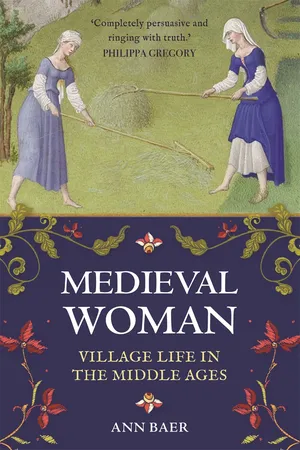
A year in the life of a peasant woman in medieval England is vividly evoked in this extraordinary portrait of Marion, a carpenter's wife, and her extended family. Based on years of research, Ann Baer brings to life the reality of a world that has been lost.Rising before dawn in a tiny village to a day of gruelling hard work, Marion and her husband face the daily struggle for survival. Starvation is never far away and travel to the next village is virtually unheard of. Existing without soap, paper or glass and with only the most basic of tools, sickness, fire and natural disaster ever threaten to engulf the small, tightly knit community.At the mercy of the weather and the Lord of the Manor, each equally unpredictable and inescapable, Marion's life is burdensome but also displays an admirable dignity and fortitude in the face of adversity.The little village is at one with the natural world around it and each member has a role to play and a place in the hierarchy.Simple people, living unrecorded lives in remote villages not on the way to anywhere are brought back into focus in Medieval Woman. Ann Baer defines and celebrates the woman at the heart of the community.This is a unique approach to history, compressing decades of in-depth research on the Middle Ages into one single, immersive, compelling narrative.
- English
- ePUB (mobile friendly)
- Available on iOS & Android
eBook - ePub
About this book
Information
JULY
Beneath the pastures willow shade
Whose foliage shines so cool and grey
Amid the sultry hues of day
As if the mornings misty veil
Yet lingered in their shadows pale
Marion was woken as if by a thud of grief falling on her heart, and instantly attendant anxieties fluttered round the grief. Her sleepy mind likened the feeling to the thud of a new log falling beneath the saw, and dust and shavings flying up in the air where it landed. The image persisted and her dreaming thoughts struggled to separate log from grief and shavings from anxiety. Lying still, eyes shut, body relaxed, she realized that she was fully awake, that a dream was a dream, but the grief was real and terrible – for Dick Shepherd was dead.
His death had caused in Marion and in everyone else in the village, an unusual state of shock. They, so well used to death – deaths of so many of their babies, deaths after brief illnesses of so many of their children, the expected deaths in winter of the old, the not infrequent deaths of young women in childbirth – had nevertheless been shocked and frightened by the death of Dick. He had been a man in his prime, a man with kinglike strength, their father figure, although he was only Sir Hugh’s servant. Marion, in numbed surprise, had been trying to get used to this terrifying deprivation. She remembered, more sharply, that she once had been a bit in love with him.
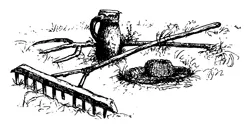
She went over in her mind the events of his death. It had been soon after the sheep-shearing was finished. The sheep had not returned to the hills but were pastured in Sir Hugh’s orchard, when it was decided that the grass in the largest pasture field was almost ready for cutting, and the weather as propitious as could be hoped for. Sir Hugh dithered, Rollo advised waiting a week, Sir Hugh dithered again until Dame Margaret told him to take Simon Miller’s opinion – which he did, and issued a general order for hay-cutting. This meant almost every able-bodied man in the village must present himself, scythe in hand, at the Hall. The weather had remained dry all that week, not hot and often cloudy, but the rain held off and with every scythe in the village working, after three days of unceasing effort the greater part of the hay-making was completed. Only men scythed; women and children raked and tossed. It was a sight familiar to Marion from her childhood, the row of men, mostly with misshapen straw hats on, many wearing only their loin cloths, but with boots as well, as the hay stubble was prickly even to hardened feet, swaying slowly from side to side as they swung their scythes, and intoning in unison the sing-song repetitions of
Dobbin and Robin and Buck and Jo
Went up to the meadow to mow, to mow
Went up to the meadow to mow.
Where we now reap there once we did sow
Up in the meadow we mow, we mow
Up in the meadow we mow.
Only now and then a mower would pause, pull up the whetstone hanging at his waist on a cord, and the harsh whistle of whetting a scythe blade broke into the rhythm of the song. Then picking up the rhythm and the words, he rejoined the others in swaying and singing.
There followed some more days of raking and tossing, piling up the hay into tall cocks. The weather held, in fact became hot and muggy, and by the fifth day most of the big Mill field and three-quarters of the Common had been cut, dried and stacked on the stubble when the accident occurred. So tiny an accident it was that no one regarded it.
Dick had been one of the party with Marion and Peter and a few others raking in the far corner of the big field. They had stopped work and were resting in the shade of an oak, lying under it on the short grass which was not long enough to be worth scything. Hilda had brought a bucket of thin ale and had kept it all the morning in the cool grass in a ditch beyond the oak. Marion had brought two loaves and a bit of hard cheese, and she had watched Peter holding the loaf against his chest and slicing it by drawing the knife towards his own throat. She had seen him do this all her married life and had never seen the knife slip – but she still wished he would not. Hilda dipped her small horn cup into the bucket and passed it round and the thirsty rakers poured the cool ale down their throats and ate the hard bread hungrily. They pulled the crusts from their teeth, they stuffed the cheese into already full mouths and called on Hilda for another hornful. Marion recalled the scene in detail: Hilda sitting cross-legged by her bucket, her cap off, her dark hair tied back at the neck, her sleeves rolled up showing her thin freckled arms, her body twisting round as she dipped the horn in the bucket and twisting back again to pass it into some red-pricked, thick-fingered hand that reached out for it; Dick lying flat on his back, his orange hair flowing over the hat that he had scrunched up to rest his head on, his eyes gazing up at the branches of the oak, his beard, sprinkled with breadcrumbs, sticking out below his chin and just showing the ridgy redness of his Adam’s apple. The grasshoppers whirred, occasionally a pigeon complained in the nearby forest, or a jay screeched. No one spoke for they had nothing much to say. After so many hours of hard work all were glad to lie in the cool undazzling shade and eat and quench their thirst.
Marion had Peterkin and Alice with her. Peterkin worked, raking and tossing, and Alice was minded by the Shepherds’ little girls. They had all more or less finished eating when Peterkin said, ‘Father, who’s Buck?’
‘What Buck?’
‘In the song. No one’s called “Buck”.’
‘Don’t know,’ said Peter. ‘It’s just in the song, always was.’
‘Maybe there was once a person called Buck lived in the village,’ Dick muttered, still gazing up into the branches.
‘Buckercuck,’ said Alice, and collapsed into giggles at her own wit. Marion looked at the squirming little girl and thought how different Alice was from other children. No other village child – or certainly none of Marion’s children not even Nolly – had ever made themselves laugh. I suppose most mothers think their children are different from others at some time – but she’s not my Nolly, thought Marion.
Peter, always conscientious, was the first to rouse himself, start relacing his boots, and then one by one they all rose up stiffly, finding their hats, stepping behind the tree to urinate and arguing whose rake was whose. Someone had left Dick’s rake lying on the stubble athwart a depression in the ground. Someone must have stepped on it and partly split the handle, which, when the pressure was removed, straightened out so that the split was concealed. Dick took it up, seeing nothing wrong, but when he ran his right hand up the shaft, a long sharp sliver of wood, lying close to the shaft and barely visible as separate, pierced the ball of his thumb deeply. He yelped, jerking his hand away and the sliver broke off leaving an inch of wood sticking out of his hand. Hilda was by him in a flash as he gripped the sharp inch of wood and pulled it out with, ‘Eeeh,’ his mouth tense.
‘It’s nothing,’ he said, putting his hand to his mouth and sucking the wound. ‘It’s out. Give me a bit of something to wrap round it, Hilda. Look, it’s not even bleeding.’
Marion saw that the sliver he had pulled out was over two inches long, so that it must have penetrated deep into his hand. What neither she nor anyone else knew then was that the point of the sliver, quite a long bit, had been broken off in the wound. He made light of it, bound his thumb round with a bit of cloth that Hilda tore from the cover of the bucket, honed the handle of his rake smooth and went back to the field with the others. Once or twice during the afternoon Marion saw him using his left hand only on the rake and guessed it hurt more than he liked to admit.
They worked long, hour after hour. Marion met Ellen, who was with the party scything the middle of the field, when their raking lines met, and they paused to rest and chat about the weather and Marion mentioned Dick’s mishap. They worked on.
The sky was still clear and blue when they all began to feel real exhaustion. Three more long lines of hay on the ground must be tossed and tossed and reraked, but Hilda said she must now take her children home, and would take Alice too and give her some milk. As soon as she had disappeared down the field, carrying Alice in the now empty bucket, followed by the little girls begging for a similar ride, Dick told Peter that he had to go to look at two of the sheep in the orchard that he suspected were ill, and he took himself off. Marion well knew how he and everyone else looked for excuses to leave the hayfield. The pricking feet, the aching backs, the weary shoulders could be endured only so long – and the July days were longer than endurance. ‘You go off and rest on the Green,’ Peter told her, and gladly she too wandered down the path at the edge of the field on her way back to the village.
She was rather startled when, near the end of the path, she came upon Dick seated on a fallen ash trunk with his head bowed on his left arm and his right arm cradled in it. He had not heard her coming.
‘Dick! Are you bad? Thought you were going to the orchard?’
He raised an embarrassed face. ‘Must have dozed off,’ he said. He smiled, but she saw how gingerly he moved his right hand and how slowly he straightened the arm. ‘Perhaps I’m not used to this work – this sort of work. Sheep are quieter.’
He stood up and they walked the rest of the way to the Green in silence. Then he went round the Hall to the Orchard and she saw him no more that day. He must have gone straight home from the orchard for he was not on the Green when Peter and the rest of the scythers joined Marion. The women, who had gone home earlier to their cottages, came out with baskets of bread and small buckets of milk, and Rollo, obviously reluctant, came from the Hall and ordered Tom to bring a big pitcher of ale. The supper was eaten as the golden sky shone on their sunburnt, silently munching faces, and only a glimmer of dusky light was left by the time Marion and Peter had walked the last quarter-mile back to their cottage, with Peterkin limping behind them, silent with exhaustion. The top half of the door was open, but it was too dark to see anything. She felt for the cradle, slid her hand in and found Alice’s warm body. Hilda had fed her and put her in the cradle faithfully. Alice was deeply asleep.
After such physical exertion Marion had slept well. It had grown cold in the early hours and she had pulled up the feather quilt over her and heaved nearer to Peter’s warmth. At the first still hint of grey dawn she rose and peered out of the top half of the door. It was patchy cloud as before, cool, no wind, dry. They would go on haymaking.
It was later, when Peter and Peterkin had departed for the fields, and Marion had prepared and was packing the bread into a basket, that Hilda looked in over the half-door.
‘Dick’s suffering with his hand,’ she said. ‘He says it’s nothing, but he was groaning in the night with it.’
‘Have you put anything on it?’
‘Yes, the soaked herbs Dame Margaret gave me when Meg stepped on a rusty nail. It healed up quickly then. I’ve bandaged his hand, but it hurt him awfully. At first he wouldn’t let me touch it.’
‘Where is he now?’
‘Gone to the fields as usual. Are you ready? I’m going as soon as the girls are ready.’
‘We are ready,’ said little voices from below the half-door. So they all went up to the fields and tossed the hay and looked at the clouds and felt anxiety in the thundery air. Dick was working away. Marion saw him some distance down a line of hay, and though he was raking, she noticed he held his rake in one hand while the other rested in the opening of his tunic. When they stopped and relaxed under the oak tree, Marion noticed he ate very little, and when one of his little girls bounced down beside his prone body and pulled his right arm he gave a screech of pain that startled them all, and the child, blank-faced, hid behind her mother.
When they picked themselves up to resume work, Dick muttered, ‘I’ll rest a bit longer – I feel a bit queer.’ He lay there with his head on an oak root, for a long time.
In mid-afternoon Hilda came to Marion to ask for help, her lips trembled as she spoke. ‘I think he can’t walk much. Will Peter and Hodge help him home?’
In the end Peter and Hodge half led and half carried Dick down the path and through the village. By the bridge he collapsed, semiconscious. They fetched a hurdle and lifted him on to it and with great difficulty carried him home over the Common with Hilda and the two frightened children following. Meanwhile up in the fields Marion finished her day’s haymaking as soon as she could, humped Alice on her back and set off for home. At the ash tree she paused for a moment, then turned aside from her own cottage and went to Hilda’s. The door, west facing, was fully open, so it was light inside. Hilda sat on a log close to the bed. Dick was lying there, eyes shut, breathing unevenly. Hilda glanced up at once as Marion’s form took the light from the interior. ‘Look,’ she whispered, all in horror.
Marion went in. Dick’s right arm lay beside him, naked, unbandaged, so hugely swollen that it no longer resembled an arm, purple and red in patches with a greenish yellow area round the ball of the thumb.
‘He screamed when they lifted him off the hurdle,’ Hilda said, her voice grating as much as his breathing. ‘He hasn’t moved since; he can’t speak,’ and she stopped as if to bank down her rising hysteria.
‘It’s poisoned,’ said Marion. ‘All that yellow is the poison.’ She spoke firmly as she looked at Hilda. ‘There’s no one here and no time to lose – we’ll have to do it ourselves. We must cut the wound and get the poison out. Where’s the sharpest knife you’ve got? And where’s the herb potion?’
Marion had sharpened the knife on the stone threshold. She did not dare wait for any other help as the light was beginning to go. Hilda was to hold his arm still with all her strength and Marion would cut round the hole made by the sliver. Of course, at the touch of Hilda’s hands Dick roared and wrenched it away, but Hilda held firm and Marion made two large cuts in the thumb, enlarging the wound so a great deal of the yellow pus came out. They tried again but could not hold him, and Hilda’s tears were blinding her in this act of torturing her lover. They had to give up. They hoped most of the poison had come out, but doubted it, the whole arm was so swollen. All they could do now was to drip the herb potion on to the wound.
He lay semiconscious, the two women watching him. The little girls sat in the growing dusk, watching too, not daring to speak or move, holding the sleeping Alice between them. It was almost quite dark when Marion picked up Alice, told Hilda to send for her in the night if she was needed and went back to her own cottage.
Peter and Peterkin had just arrived, having had bread and ale at the Hall as before. She told them what had happened. Before sleeping they had stood at their cottage door looking across to Dick’s. No sound came from it.
‘Perhaps he’s sleeping now,’ Marion said. ‘Perhaps I did get most of the poison out … ’ Perhaps – perhaps – all might still be well.
Peter looked at the sky. ‘Thunder clouds gone – sky’s clear now. We could still get the hay in in the dry.’
At dawn Marion woke because she heard steps outside. She opened her eyes and in the square of light from the half-door, open all night, Hilda’s dark silhouette of head and shoulders appeared.
‘I think he’s dead,’ she whispered. Even in whispers her voice was not recognizable. Marion had immediately gone to Hilda’s cottage with her. It was too dark to see anything inside but Marion recalled Hilda’s trembling hand on her wrist urging her forward, pulling her down to the bed, guiding her hand to the corpse. She remembered with horrid vividness touching the taut skin of the swollen arm by mistake before her hand was guided to his body. The tunic had been pulled open and she could feel under the curly hair on his chest the damp and unresponding skin. She could feel no movement of breath or heart.
‘Have you a candle?’
‘I’ve no fire.’
As Marion knew, there had been no fires in their cottages these last few days when everyone had been in the hay fields. ‘Open your shutter then,’ she said.
The little shutter was pushed open and a faint glimmer from the eastern sky made the rafters of the cottage just visible, and anything of pale tone – the sheepskin hood hanging on a nail, the milk in a scrubbed wooden bucket, the two half-grown chickens huddled tog...
Table of contents
- Cover
- Title page
- Copyright
- Epigraph
- Contents
- List of Characters
- March
- April
- May
- June
- July
- August
- September
- October
- November
- December
- January
- February
Trusted by 375,005 students
Access to over 1.5 million titles for a fair monthly price.
Study more efficiently using our study tools.
Frequently asked questions
Yes, you can cancel anytime from the Subscription tab in your account settings on the Perlego website. Your subscription will stay active until the end of your current billing period. Learn how to cancel your subscription
No, books cannot be downloaded as external files, such as PDFs, for use outside of Perlego. However, you can download books within the Perlego app for offline reading on mobile or tablet. Learn how to download books offline
Perlego offers two plans: Essential and Complete
- Essential is ideal for learners and professionals who enjoy exploring a wide range of subjects. Access the Essential Library with 800,000+ trusted titles and best-sellers across business, personal growth, and the humanities. Includes unlimited reading time and Standard Read Aloud voice.
- Complete: Perfect for advanced learners and researchers needing full, unrestricted access. Unlock 1.5M+ books across hundreds of subjects, including academic and specialized titles. The Complete Plan also includes advanced features like Premium Read Aloud and Research Assistant.
We are an online textbook subscription service, where you can get access to an entire online library for less than the price of a single book per month. With over 1.5 million books across 990+ topics, we’ve got you covered! Learn about our mission
Look out for the read-aloud symbol on your next book to see if you can listen to it. The read-aloud tool reads text aloud for you, highlighting the text as it is being read. You can pause it, speed it up and slow it down. Learn more about Read Aloud
Yes! You can use the Perlego app on both iOS and Android devices to read anytime, anywhere — even offline. Perfect for commutes or when you’re on the go.
Please note we cannot support devices running on iOS 13 and Android 7 or earlier. Learn more about using the app
Please note we cannot support devices running on iOS 13 and Android 7 or earlier. Learn more about using the app
Yes, you can access Medieval Woman by Ann Baer in PDF and/or ePUB format, as well as other popular books in History & European Medieval History. We have over 1.5 million books available in our catalogue for you to explore.