History is a rich, varied and fascinating subject, so it's rare to find the whole lot in one book... until now. The History of the World in Bite-Sized Chunks pulls it all together, from the world's earliest civilizations in 3500 BC to the founding of the United Nations in 1945, passing by the likes of Charlemagne, the Ottoman Empire and the Crimean War, to name a few. Here's your chance to introduce yourself to the full spectrum of world history, and discover just how the modern world came to be.
- English
- ePUB (mobile friendly)
- Available on iOS & Android
eBook - ePub
The History of the World in Bite-Sized Chunks
About this book
Information
CHAPTER ONE:
FIRST EMPIRES AND CIVILIZATIONS
3500 BC to 800 BC
MIDDLE EAST AND AFRICA
SUMERIA
In about 5000 BC, farmers settled on the fertile land of southern Mesopotamia (now Iraq) known as Sumer, and from these humble beginnings the world’s first great civilization formed. Living along the river valleys of the Tigris and Euphrates (Mesopotamia is Greek for the land ‘between two rivers’), Sumerian farmers were able to grow an abundance of grain and other crops, the surplus of which enabled them to settle in one place. Sumerians also traded this surplus food for metals and tools with people as far away as present-day Pakistan and Afghanistan, and they dug a network of ditches and canals as drainage channels on their fertile but flood-prone lands.
By 3000 BC, a number of city-states had developed in Sumer, the largest being Ur, with a population of 40,000. The first known system of writing originated in Sumer: at first pictographic, it gradually evolved into a series of simplified wedge-shaped signs formed using reed stalks on clay tablets (the script came to be called ‘cuneiform’, meaning ‘wedge-shaped’ in Latin). Sumerians also devised complex administrative and legal systems, developed wheeled vehicles and potters’ wheels, and built great ziggurats and buildings with columns and domes.
The first great empire of Sumer was established by Sargon, king of Akkad (an ancient kingdom situated north of Sumer), in about 2350 BC. All Sumerian cities were united under his control and the empire stretched from Syria to the Persian Gulf. This dynasty was destroyed in about 2200 BC but after 2150 BC the kings of Ur re-established Sumerian authority in Sumer and also conquered Akkad. Following an invasion by the Elamites (a civilization to the east of Sumer) and the sack of Ur in around 2000 BC, Sumer came under Amorite rule, out of which emerged the great city-state of Babylon (see here).
ANCIENT EGYPT: THE OLD KINGDOM
The first great civilization in Africa began with the settlement of the Nile valley in the north-east of the continent in around 5000 BC. It’s now thought these early settlers were from the Sahara, where, some 2,000 years earlier, Africa’s first farming societies had developed before climate change had turned the Sahara into desert. This same climate change had dried out the swamps of the Nile valley, making it more of an attractive settlement for farming people.
By the mid-fourth millennium BC, the valley of the Nile was densely populated, towns had grown and the region had been divided into two Egyptian kingdoms. Traditional Egyptian chronology tells us that in 3200 BC, the pharaoh (ruler) Menes unified the two kingdoms of Egypt to create a single state. This saw the beginning of a 3,000-year civilization that was marked by monumental tomb-building projects and a flourishing of Egyptian culture.
The earliest period of Ancient Egypt, known as the Old Kingdom (c. 2575–2130 BC), was ruled by a number of powerful pharaohs and saw major developments in technology, art and architecture. During this era, hieroglyphic script was developed and the Great Sphinx and Giza pyramids were constructed (during which thousands of ordinary Egyptians died). The pyramids provided for the after-life of the pharaoh, and were closely associated with the cult of the sun-god Ra – their flared shape resembled the rays of the sun and provided for the deceased king a stairway to the gods.
ANCIENT EGYPT: THE MIDDLE AND NEW KINGDOMS
A period of stability in Egypt, known as the Middle Kingdom (c. 1938–1630 BC), followed a century of severe drought, famine and the collapse of central government.
Thereafter, Egypt’s pharaohs restored the country’s prosperity and stability, by securing its borders, increasing its agricultural output and acquiring vast mineral wealth (partly by reconquering land in lower Nubia that was rich in quarries and gold mines). This era was known for its jewellery and goldsmiths’ designs. The worship of Osiris, god of death and rebirth, also spread across Egypt, leading to the prevailing belief that everyone, not just the pharaohs, would be welcomed by the gods after death.
Ambitious building and mineral projects, along with severe floods along the Nile, led to a weakening of the pharaoh’s power in Egypt, enabling foreign settlers (mainly Hyksos, who were probably from Palestine) to seize control. The shift from a bronze- to an iron-based economy also contributed to the decline. This was followed by the New Kingdom (c. 1539–1075 BC), when control was re-established by the pharaohs and Egyptian influence extended into Syria, Nubia and the Middle East. Regarded as one of the greatest chapters of Egyptian history, many great temples were built, including the painted tombs of the Valley of the Kings. The era also included the reign of some of Egypt’s most famous pharaohs, including the female ruler Hatshepsut and the boy-king Tutankhamun.
Following the death of Egypt’s last great pharaoh, Rameses III, in 1070 BC, Egypt went into slow decline as it split into several small kingdoms. In around 719 BC, the Kushites (see here) conquered Egypt and ruled as pharaohs until they were pushed back to their own borders by Assyrians in 656 BC. Assyrian rule was followed by Persian conquest in 525 BC, occupation by Alexander the Great in 332 BC and finally Roman conquest in 30 BC.
BABYLONIA
Political power in Mesopotamia eventually moved north to the city of Babylon in Akkad, so that the entire plain became known as Babylonia. The first great dynasty of Babylon lasted about 300 years from around 1894 BC, reaching the peak of its influence under King Hammurabi (c. 1795–1750 BC).
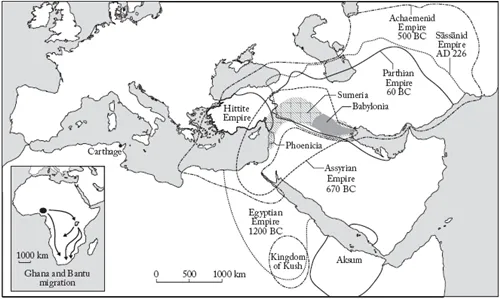
1 Ancient Empires: Africa and the Middle East c. 3500–60 BC
During Hammurabi’s rule, the empire of Babylonia expanded to include all of southern Mesopotamia (including Sumer) and part of Assyria to the north. Hammurabi is famed for instituting the world’s first known set of laws (the code of Hammurabi) and also promoting science and scholarship.
After Hammurabi’s death, the Babylonian Empire declined, and from 1595 BC was dominated by Hittites (see below) and then by Kassites (mountain people from the east of Babylonia) who established a 400-year dynasty. During this time Assyria broke away from Babylonia, and a struggle ensued over several centuries for the control of Babylon. By the ninth century BC, Assyrian kings ruled Babylonia until the fall of the Assyrian Empire in the late seventh century BC.
Thereon, Babylonia fell under the power of the Chaldeans (a little-known Semitic people) and the empire prospered again, most notably under Nebuchadrezzar II (604–562 BC). He conquered Assyria and Palestine and revitalized the city of Babylon, rebuilding the temple of Marduk (the main god of Babylonia) and constructing the celebrated ‘Hanging Gardens’. In 539 BC Babylon was invaded by the Persians, under Cyrus the Great (see here), and the Babylonian Empire came to an end – although the city of Babylon remained important well into the fourth century BC.
HITTITE EMPIRE
The warrior people known as the Hittites, one of the great powers of the Bronze Age, ruled much of modern-day Turkey and Syria for over a thousand years. Their empire, which reached its greatest size between 1450 and 1200 BC, rivalled the empires of Babylonia and Assyria, as well as Ancient Egypt.
Much of what we know about the Hittites stems from the discovery of 10,000 cuneiform clay tablets in Hattusas, Turkey, in 1906. These, along with the remains of some of their ancient cities, revealed that the Hittites were feudal tribesmen who, not long after 3000 BC, swept south from a region north of the Black Sea into Anatolia, or Asia Minor, which is today the Asian part of Turkey. They rode horses and chariots, and were equipped with bronze daggers. By 2000 BC, Hittite dominions were united into an empire, with its capital at Hattusas. One of the first Hittite kings, Hattusili I (1650–1620 BC), invaded Syria, and his successor, Mursili I, sacked Babylon, although he was later killed and Hittite conquests were lost.
A still more powerful Hittite Empire arose in 1450 BC and by c. 1380 BC the great Hittite king Suppiluliumas had built an empire that encompassed Syria almost to Canaan (modern-day Israel). By the time of his descendant Muwatallis, Egypt and the Hittite Empire competed over dominance in Syria, which led to a fierce and much famed battle between the Egyptian pharaoh Rameses II and Muwatallis at Qadesh (c. 1300 BC).
It’s thought that the Hittites were the first civilization to produce iron on a large scale, using it for tools and weaponry, thus initiating the Iron Age (although iron wasn’t used by most civilizations until several centuries later). Hittite power suddenly collapsed when migrants, including Aegean Sea people (a mysterious coalition of migrants from the eastern Mediterranean), invaded the region c. 1193 BC.
ASSYRIA
In the fourteenth century BC, Assyria broke away from Babylonia (see here) and established an independent empire originally centred on the city of Assur in northern Mesopotamia.
Constant warfare with invaders from the north and south turned the Assyrians into fierce fighters, much famed for their cruelty. With a language almost identical to the Babylonians (whose culture the Assyrians has absorbed), the Assyrians were innovative in their weapon technology, developing the use of siege engines. It is also believed that they were the first to use horses as cavalry, rather than as chariot bearers.
The most famous of Assyrian kings, Sargon II (722–705 BC), moved the capital to Nineveh and conquered, amongst other places, Damascus and Israel, exiling 30,000 Israelites (the basis behind the legend of the Ten Lost Tribes of Israel).
By the seventh century BC, Assyria had become the largest empire the world had ever seen, and the last of the great Assyrian kings, Ashurbanipal (668–627 BC), ruled over an empire that stretched from the Persian Gulf up to and including Egypt. To govern such an empire, the Assyrians built roads and organized a highly effective mail service, whilst Ashurbanipal created and constructed in Nineveh the Middle East’s first organized library, which contained thousands of text and clay tablets. Some 20,720 of these cuneiform tablets are now housed in the British Museum.
The Assyrian state was finally defeated in 612 BC by a coalition of Medes (Indo-European people related to the Persians) and Chaldeans. Over the following centuries, Assyria was ruled by Babylon, the Persian Empire, Alexander the Great (who renamed it Syria), the Parthians, and the Romans.
PHOENICIA
By 2000 BC, many people had settled on the coast of the eastern Mediterranean in modern-day Lebanon, Syria and Israel. Living on a narrow, coastal strip that formed the natural communication point between Asia, Africa and beyond, these settlers grew and produced various commodities, including cedar wood (used for building), olives, wine and cloth, which they traded with Egypt, Cyprus, Crete and places as far away as Troy in western Turkey.
By 1500 BC, new cities had begun to be built in the region to add to the cities of Ugarit and Byblos, which had been founded as early as 4000 and 3000 BC respectively. Set against the decline of parallel empires, Phoenician cities – the greatest being Tyre, Sidon and Berot, all famed for their embroideries – had entered into a golden age by 1000 BC.
Trade continued to form the cornerstone of Phoenician prosperity, in particular the manufacture and trade of luxury items such as gold and silver ornaments, fine glassware and carved ivory. Phoenician dyes and – most notably – its famous purple textiles became much sought after (purple fabrics were increasingly associated with superior social status). Indeed the name Phoenicia is derived from the Greek word for ‘purple’.
Becoming a maritime power, the Phoenicians began to establish colonies in ...
Table of contents
- Cover
- Title page
- Dedication page
- Copyright page
- Contents
- LIST OF MAPS
- INTRODUCTION
- CHAPTER ONE: First Empires and Civilizations
- CHAPTER TWO: The Ancient World
- CHAPTER THREE: The Middle Ages
- CHAPTER FOUR: World on the Move
- CHAPTER FIVE: Revolution and European Imperialism
- CHAPTER SIX: A New World Order
- BIBLIOGRAPHY
- INDEX
Trusted by 375,005 students
Access to over 1.5 million titles for a fair monthly price.
Study more efficiently using our study tools.
Frequently asked questions
Yes, you can cancel anytime from the Subscription tab in your account settings on the Perlego website. Your subscription will stay active until the end of your current billing period. Learn how to cancel your subscription
No, books cannot be downloaded as external files, such as PDFs, for use outside of Perlego. However, you can download books within the Perlego app for offline reading on mobile or tablet. Learn how to download books offline
Perlego offers two plans: Essential and Complete
- Essential is ideal for learners and professionals who enjoy exploring a wide range of subjects. Access the Essential Library with 800,000+ trusted titles and best-sellers across business, personal growth, and the humanities. Includes unlimited reading time and Standard Read Aloud voice.
- Complete: Perfect for advanced learners and researchers needing full, unrestricted access. Unlock 1.5M+ books across hundreds of subjects, including academic and specialized titles. The Complete Plan also includes advanced features like Premium Read Aloud and Research Assistant.
We are an online textbook subscription service, where you can get access to an entire online library for less than the price of a single book per month. With over 1.5 million books across 990+ topics, we’ve got you covered! Learn about our mission
Look out for the read-aloud symbol on your next book to see if you can listen to it. The read-aloud tool reads text aloud for you, highlighting the text as it is being read. You can pause it, speed it up and slow it down. Learn more about Read Aloud
Yes! You can use the Perlego app on both iOS and Android devices to read anytime, anywhere — even offline. Perfect for commutes or when you’re on the go.
Please note we cannot support devices running on iOS 13 and Android 7 or earlier. Learn more about using the app
Please note we cannot support devices running on iOS 13 and Android 7 or earlier. Learn more about using the app
Yes, you can access The History of the World in Bite-Sized Chunks by Emma Marriott in PDF and/or ePUB format, as well as other popular books in History & History Reference. We have over 1.5 million books available in our catalogue for you to explore.