Didn't take Classics at school? Or maybe you've forgotten most of what you once knew? To save you looking it up, Classics is the study of the culture of the ancient Greeks and Romans, and takes in all aspects of their life and learning - from the languages to literature, philosophy, art, and much more besides. A Classical Primer is an accessible and enjoyable look back at classical civilization; how they lived, and how many aspects of our own daily lives have been directly influenced by theirs, from roads and concrete, to central heating, the twelve-month calendar, cranes and even the modern-day favourite, pizza! This handy, informative and enjoyable book is the perfect primer for people of all ages, and shows that even a basic knowledge of Classics is not only essential, bus also incredibly fascinating.
- English
- ePUB (mobile friendly)
- Available on iOS & Android
eBook - ePub
About this book
Information
Topic
PhilosophySubtopic
Greek Ancient HistoryCHAPTER 1
GREEK AND LATIN LANGUAGES
THE GREEK LANGUAGE: FROM ALPHA TO OMEGA
Ancient Greek is not an easy language to master. However, its influence over so much of our language today means that it deserves a few moments to pick up the basics – at the very least so that you might be able to recognize the difference between a ταβερνα and an ακροπολις on your next holiday.
HISTORY
The oldest surviving form of Ancient Greek is Mycenaean Greek, which used an alphabet now known as Linear B from as early as 1600 BC. Scholars spent years trying to decipher Linear B from remnants unearthed in Crete, Mycenae and elsewhere, and it wasn’t until 1952 that its syllabic letters were finally cracked.
The current Greek alphabet, derived from Phoenician, didn’t appear for another 800 years or so, in about 800 to 700 BC. (The Phoenicians were an ancient civilization based around the eastern Mediterranean and beyond, who had important trading and cultural influences across the whole region from around this time. Whole books could be written on them – and indeed have been – but we really must crack on.) The mountainous mainland and the isolation of the country’s islands meant that many dialects of the language were able to exist side by side for many centuries, until a common Greek (Koine Greek) was settled on in the fourth century BC. This was probably as a result of Alexander the Great’s incredible expansion of the Greek empire during this time (all the way to India), which required tens of thousands of soldiers to come together and be coherently governed with one common language.
THE ALPHABET
You’ll be pleased to hear that it won’t take decades of research to pick up the basics of the alphabet, though, and we’ll have you reading simple words in no time. In these examples, you’ll see how many of the words we use today are derived from Ancient Greek words – or, in some cases, straightforward transliterations of the original word.
There will be no vocabulary test at the end.
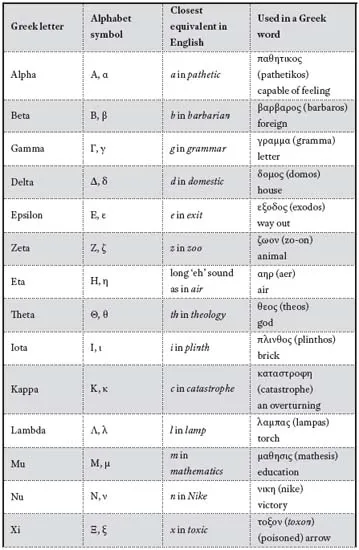
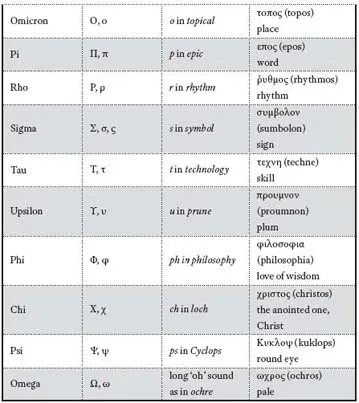
NOT AN IOTA OF DIFFERENCE
On top of these twenty-four characters, there is a whole heap of accents called diacritics. They began to be seen in texts from about 400 BC onwards in answer to some of the ambiguities in the language. They can appear on any of the seven vowels in the alphabet and are used to denote either tone of the vowel or stress on the syllable.
Luckily for modern Greeks, the tonal diacritics were officially scrapped in 1982 (probably for being far too confusing). Unfortunately for students of Ancient Greek, we need to know the difference between the letter η with no diacritic, and one with an iota subscript (ῃ). And the less we say about the differences between ῂ and ῇ, the better. In fact, the letter η on its own can have about six different meanings, dependent on the placement or not of the various diacritics.
The only diacritic that perhaps you should pay attention to is the aspiration, which is almost like a very small c-shape that can be placed over any of the vowels and also over a Rho as in ῥ (rh), ἁ (ha) or ἑ (he). The aspiration gives any letter a breathing h sound, which doesn’t exist as a letter in Greek in its own right. This gives us the silent h in many English words that are derived from Greek, such as rhythm. For simplicity, I have left out all diacritics from this book except for the aspiration.
A QUICK TRIP TO HONOLULU
Way back in the twentieth century, an American linguist discovered something truly staggering in the Greek language: when comparing some of the language’s basic words, he found remarkable similarities with similar words in the Hawaiian language.
Observing the list of words below indicated some ancient link between the two languages.
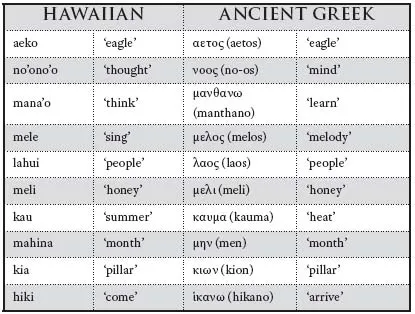
I know what you’re thinking: what on earth is going on? Is it possible that the Ancient Greeks took a wrong turn on the way to Athens and accidentally found themselves on Waikiki Beach?
Alexander the Great managed to extend the Greek Empire all the way to India, but even he would have had quite some difficulty making the 8,000-mile trip to Hawaii, teaching the locals some Greek words, and heading back in time for dinner. Keeping the holiday a secret from any historians would also have been tricky.
A few theories have been put forward to explain this linguistic phenomenon. And the one that most academics have settled on is quite possibly the most irritating: it is just a coincidence. I won’t go into any more detail than that, since we’re clearly wasting our time.
THE GRAMMAR BASICS
(IN ANY LANGUAGE)
You may have heard some rather scary things about Latin and Greek grammar. But I can assure you that there are some simple basics that will help you understand how the languages work with only minimal effort. Long tables of verbs and nouns can be daunting – but, when put into context, they need not be anything to fear. First, a quick look at how the Latin and Greek (and indeed English) languages are structured.
Different languages structure sentences in different ways. In English, we rely very heavily on the order of our words to dictate what is going on. So, in the very different sentences ‘Jack loves Jill’ and ‘Jill loves Jack’, you can tell who is loving whom by the order of the words. Latin and Greek tend not to care a jot for word order, so have to use other indicators to let you understand what on earth is going on.
Verbs in the languages use different endings to indicate who is doing tha...
Table of contents
- Cover
- Author biography
- Title page
- Copyright page
- Contents
- INTRODUCTION
- CHAPTER 1: GREEK AND LATIN LANGUAGES
- The Greek language: from Alpha to Omega
- CHAPTER 2: CLASSICAL HISTORY
- Greek and Roman history in a nutshell
- CHAPTER 3: AN INTRODUCTION TO GREEK LITERATURE
- Homer
- CHAPTER 4: AN INTRODUCTION TO LATIN LITERATURE
- Virgil: The Aeneid
- CHAPTER 5: PHILOSOPHY
- The Pre-Socratic philosophers: What is everything?
- CHAPTER 6: ANCIENT ARCHITECTURE
- The Parthenon
- CHAPTER 7: SCIENCE AND TECHNOLOGY
- Pythagoras
- SELECT BIBLIOGRAPHY
- INDEX
Trusted by 375,005 students
Access to over 1.5 million titles for a fair monthly price.
Study more efficiently using our study tools.
Frequently asked questions
Yes, you can cancel anytime from the Subscription tab in your account settings on the Perlego website. Your subscription will stay active until the end of your current billing period. Learn how to cancel your subscription
No, books cannot be downloaded as external files, such as PDFs, for use outside of Perlego. However, you can download books within the Perlego app for offline reading on mobile or tablet. Learn how to download books offline
Perlego offers two plans: Essential and Complete
- Essential is ideal for learners and professionals who enjoy exploring a wide range of subjects. Access the Essential Library with 800,000+ trusted titles and best-sellers across business, personal growth, and the humanities. Includes unlimited reading time and Standard Read Aloud voice.
- Complete: Perfect for advanced learners and researchers needing full, unrestricted access. Unlock 1.5M+ books across hundreds of subjects, including academic and specialized titles. The Complete Plan also includes advanced features like Premium Read Aloud and Research Assistant.
We are an online textbook subscription service, where you can get access to an entire online library for less than the price of a single book per month. With over 1.5 million books across 990+ topics, we’ve got you covered! Learn about our mission
Look out for the read-aloud symbol on your next book to see if you can listen to it. The read-aloud tool reads text aloud for you, highlighting the text as it is being read. You can pause it, speed it up and slow it down. Learn more about Read Aloud
Yes! You can use the Perlego app on both iOS and Android devices to read anytime, anywhere — even offline. Perfect for commutes or when you’re on the go.
Please note we cannot support devices running on iOS 13 and Android 7 or earlier. Learn more about using the app
Please note we cannot support devices running on iOS 13 and Android 7 or earlier. Learn more about using the app
Yes, you can access A Classical Primer by Dan Crompton in PDF and/or ePUB format, as well as other popular books in Philosophy & Greek Ancient History. We have over 1.5 million books available in our catalogue for you to explore.