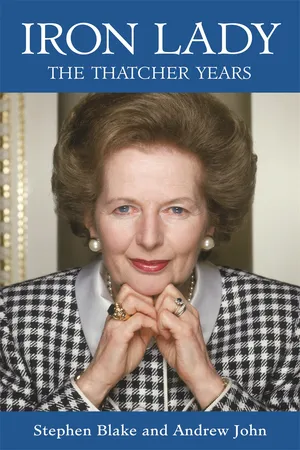
Allowing you to uncover the woman behind the 'Iron Lady' image, 'Iron Lady: The Thatcher Years' takes a thorough at the life and times of Britain's longest-serving twentieth-century prime minister. As both the first woman to become leader of a European country and the first British premier to achieve re-election for three consecutive terms, Margaret Thatcher's has left behind a long and hugely important legacy. Reflecting on her life and character, from her early days growing up as the daughter of a Lincolnshire grocer, to her years as one of the most powerful and controversial of leaders, through to her iconographic status as an international statesman and thinker, this study is accompanied by a selection of quotes by and about this formidable woman.
- English
- ePUB (mobile friendly)
- Available on iOS & Android
eBook - ePub
About this book
Information
LIFE BEFORE LEADERSHIP:
Margaret’s Road to Power



1975
In 1925 John Logie Baird transmitted the first television broadcast from his laboratory; Al Capone took over the bootlegging racket in Chicago; Ben-Hur, costing a record-breaking $3.95 million to make, was released; the worst tornado in American history hit Illinois and Indiana. And, on 13 October, Margaret Hilda Roberts was born in Grantham, Lincolnshire, second daughter of Alfred and Beatrice Roberts.
Margaret’s father was a grocer who owned a corner shop on the Great North Road. Alfred had started out from a very poor background, and he brought his daughters up in the puritanical mould, with few luxuries and with the emphasis very much laid on hard work and parsimony. Most accounts of Margaret’s early days leave one with the image of a home run strictly in accordance with Victorian values, and of familial duties performed without question and with a great sense of obligation:
Margaret’s mother, Beatrice Stephenson, was born at 10 South Parade in Grantham (it’s now number 55). She could hardly have thought that her ‘Number 10’ was a precursor to the Number 10, which would be occupied by her daughter from 1979 to 1990.
Alfred and Beatie – as he called Beatrice – had saved enough money to marry by 1917, and two years later they had taken out a mortgage on the North Parade premises that were to be his famous grocer’s shop, which was bought as a going concern.
Alfred was also to become a town councillor in Grantham, although his political affiliations were somewhat woolly: he has been described as a closet Conservative and a ‘moderate’ Labourite, as well as a Gladstonian Liberal. The way Margaret remembers it, you didn’t fight local council elections as a party member back then. It just wasn’t the done thing. Alfred stood as an independent – but, as his daughter acknowledged in later years, at heart he was a conservative:
Alfred, just as his daughter would in 1979, achieved a political first: he became the town’s youngest alderman in 1943. He also became the mayor of Grantham in 1945.
Alfred was a fundamentalist when it came to religion. His religion was entirely Bible-based – and this, along with the religious nature of his wife, was to have a considerable influence on the future Prime Minister of Great Britain and Northern Ireland. He did not approve of popular protest, being a great believer in upholding authority, as evidenced by his attitude towards the Jarrow marchers in 1936, when, as Margaret Thatcher was to say in 1975, ‘He did not think that what they were doing was right.’ In the matter of collectivism, as in others, Margaret was to turn out to be very much her father’s daughter.
The Roberts family were Methodists, and Margaret was brought up with a very strong sense of duty: duty to one’s spiritual side, and duty to provide for oneself and for one’s family. Her upbringing contributed significantly to the development of her political philosophies, which emphasized the independence of the individual and the role of private charity, and which were opposed to socialism in all its many manifestations. Her family’s brand of Methodism helped to instil the notion that what a person did voluntarily with his money was his own affair, and that giving in this way was morally superior to any welfare system financed by the taxpayer. This notion was expressed in its most extreme – and controversial – form in the autumn of 1987, when Margaret pronounced that there was ‘no such thing as society’:
Though this proved to be a highly inflammatory comment, providing a great deal of ammunition for her opponents, it was a indication of her deep belief in the role of the individual, which would become such a defining feature of Thatcherism.
In later years Margaret Thatcher famously – or perhaps infamously – appeared to discount her mother’s role when asked about her early family life. ‘I owe almost everything to my father,’ she once said. Even her Who’s Who entry described her simply as the ‘d. of Alfred Roberts, Grantham, Lincs’, omitting all mention of Beatrice. In November 1985, she was quizzed by Dr Miriam Stoppard on a Yorkshire Television programme, Woman to Woman. She seemed to want to sidestep any discussion of her mother, wishing instead to concentrate on her father. ‘Oh, Mummy backed up Daddy in everything,’ she told her interviewer. Dr Stoppard persisted in her questioning, but, for all her efforts, extracted only grudging comments. For instance, when she asked Mrs Thatcher about familial discussions on current affairs, all she would say was, ‘Mummy didn’t get involved in the arguments. She had probably gone out to the kitchen to get the supper ready.’
However, years later, she did indirectly acknowledge that she owes something to her mother’s housewifely skills. In her memoir, The Path to Power, she talks a little more about Beatrice, saying that she had learned from her ‘what it meant to cope with a househ...
Table of contents
- Cover
- Title page
- Copyright page
- Contents
- PREFACE
- LIFE BEFORE LEADERSHIP: Margaret’s Road to Power
- LADY IN WAITING: Margaret Becomes a Leader of Men
- THE END OF WINTER: Margaret Steps into the Sunshine
- A QUESTION OF SOVEREIGNTY: Margaret Goes to War
- THE BATTLE FOR THE PITS: Margaret Takes On King Coal
- BRAVERY IN BRIGHTON: Margaret Survives the Assassin’s Bomb
- TARZAN AND THE FLYING MACHINES: Rifts in Margaret’s Cabinet
- TAXING TIMES: Margaret Defends the Indefensible
- END OF AN INNINGS: Margaret Makes a Tearful Exit
- THE MUMMY REMAINS: Margaret Battles On
- APPENDIX: Margaret’s Quotable Quotes
- A SHORT BIBLIOGRAPHY
Trusted by 375,005 students
Access to over 1.5 million titles for a fair monthly price.
Study more efficiently using our study tools.
Frequently asked questions
Yes, you can cancel anytime from the Subscription tab in your account settings on the Perlego website. Your subscription will stay active until the end of your current billing period. Learn how to cancel your subscription
No, books cannot be downloaded as external files, such as PDFs, for use outside of Perlego. However, you can download books within the Perlego app for offline reading on mobile or tablet. Learn how to download books offline
Perlego offers two plans: Essential and Complete
- Essential is ideal for learners and professionals who enjoy exploring a wide range of subjects. Access the Essential Library with 800,000+ trusted titles and best-sellers across business, personal growth, and the humanities. Includes unlimited reading time and Standard Read Aloud voice.
- Complete: Perfect for advanced learners and researchers needing full, unrestricted access. Unlock 1.5M+ books across hundreds of subjects, including academic and specialized titles. The Complete Plan also includes advanced features like Premium Read Aloud and Research Assistant.
We are an online textbook subscription service, where you can get access to an entire online library for less than the price of a single book per month. With over 1.5 million books across 990+ topics, we’ve got you covered! Learn about our mission
Look out for the read-aloud symbol on your next book to see if you can listen to it. The read-aloud tool reads text aloud for you, highlighting the text as it is being read. You can pause it, speed it up and slow it down. Learn more about Read Aloud
Yes! You can use the Perlego app on both iOS and Android devices to read anytime, anywhere — even offline. Perfect for commutes or when you’re on the go.
Please note we cannot support devices running on iOS 13 and Android 7 or earlier. Learn more about using the app
Please note we cannot support devices running on iOS 13 and Android 7 or earlier. Learn more about using the app
Yes, you can access Iron Lady by Andrew John,Stephen Blake in PDF and/or ePUB format, as well as other popular books in Social Sciences & Political Biographies. We have over 1.5 million books available in our catalogue for you to explore.