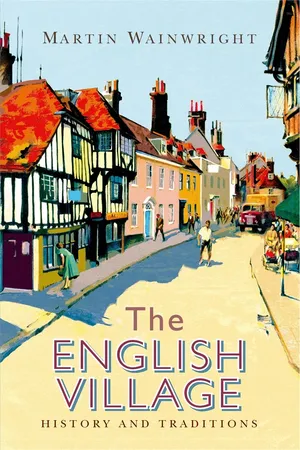
The village remains a quintessential and much-loved treasure of the English countryside. This rural idyll has inspired generations of great poets, novelists and artists including the likes of Constable, Hardy, Wordsworth, as well as providing the picturesque setting for modern TV series such as Lark Rise to Candleford and Cranford. The English Village celebrates all that is unique and loved about a typical village - the pub, the green, the school, the church, the pond, the local shop and more - as well as exploring how the village has changed over the centuries. Also includes fascinating information on the origins of village names - Siddington, for example, means the farm of the valley ( sidd: valley, in: belonging to, ton: farmland). Filled with facts, figures, customs and lore, there is a wealth of fascinating information to be discovered in this charming book.
- English
- ePUB (mobile friendly)
- Available on iOS & Android
eBook - ePub
About this book
Information
CHAPTER ONE
FIFTEEN CENTURIES YOUNG
Townfolk know pleasures, country people joys.
MINNA ANTRIM (1861–1950)
Britain rushes around on its bypasses and motorways. Rapid roads and trains connect city to city, home to office, school-collection to shops. The traffic lights have gone green, the circle and slant of the derestricted sign allows the speedometer to flick to 70. Was that a field, some cows, a wood, a farm? Whatever, it’s gone.
But then the cars and lorries jam, or autumn leaves block the line, and quietly and gently an older pattern of England steals back into its ancient and astonishingly little-altered place. What do those beguiling signs mean, inviting you to somewhere, something, maybe even someone called Huttons Ambo, The Alconburys or Mavis Enderby? Why go to the bog-standard motorway services when the satnav flashes up an icon for the Cottage of Content near Ross-on-Wye or the George at Stamford whose tag reads: ‘Three kings have stayed here, as well as one of the fattest Englishmen ever – Daniel Lambert, who weighed 52 stone.’ And didn’t someone famous find that his train stopped unexpectedly at Adlestrop (alas, the station was closed in 1966)? Wasn’t their curiosity just like yours?
Get off, branch off, turn off, and the greenery of village England enfolds you with the certainty and confidence of settlements which have survived for up to a millennium and a half, and in some cases more. Devastation has often visited them in the form of the Black Death, civil war, evictions and the collapse of harvests. But a spell seems to girdle their familiar template of church and manor house, green and mill stream, tavern, beacon, war memorial, pond and stocks. Even where a town or city has rolled outwards and engulfed the ancient buildings themselves, road signs keep the past alive: Southfield Square, Chapel Close, Sheep Lane.
They touch something equally certain in millions of visitors. We may not have been here before, but our grandparents or their grandparents or their grandparents almost certainly led a life circumscribed by the seasons, rotation of crops and the demands of living in a close-knit community. Perhaps this was in The Alconburys, a cluster of hamlets just off the A1M north of Huntingdon, or at Mavis Enderby in Lincolnshire, whose shared sign with a neighbouring village is often converted by wags to read: ‘To Old Bolingbroke and Mavis Enderby – the gift of a son.’ Or it may have been somewhere very different in geographical terms: a life in thatched rondavel huts along the coast of West Africa or in a mountain hamlet in the Punjab. But the essence is there in every case, because the village way of life was so simple and the way that almost all of humanity lived for so long.
It has a special resonance in England, even among the ghosts of the relatively few communities which failed. Between today’s thriving villages which have adjusted successfully to enormous economic and social change, you will occasionally find hummocky graveyards marking the sites of their lost counterparts; places where the plague, enclosures or even the whim of a powerful landlord who wanted an uncluttered view led to the abandonment of farms and homes. But here too, the essence of a village is so ingrained that the traditional features and patterns can still be seen. Only the larks and Marbled White butterflies now live at Wharram Percy in the Yorkshire Wolds, but a visitor can walk above the buried streets and work out where each of the familiar buildings stood. Drought conditions in the Lake District see the skeletal remains of Mardale Green emerge from the falling waters of Haweswater. Here was the church, there the pub, and behind them the grazing for the ponies which raced every summer at the Mardale fair.
The English countryside has also been fought over, brutalized and exploited from humanity’s first arrival, and our means of changing things are today so devastating that the threat of irreversible damage to landscape, flora and fauna is a constant. But the scars of tragedy at battlefields such as Towton near Tadcaster, where in 1461 more Englishmen – 30,000 – died than at any other single place in the country, have long been engulfed by what the seventeenth-century poet Andrew Marvell called ‘a green thought in a green shade’. The red-and-white ‘York and Lancaster’ rose runs riot over the hedges leading down to the Cock beck. No one is out of walking distance of such greenery and who does not relish that? For all that the English cluster more closely in towns and conurbations than any other European nation apart from the space-starved Dutch, we have a dreamy love of the countryside implanted in our national character. And the idyll within that dream is the village.
‘Blood runs thicker than water and nothing is as thick as English village blood,’ says Sir Simon Jenkins, chairman of the National Trust, contemplating the way in which we imagine these small communities to represent life at its best. ‘An English village is like a medieval monastery, a place apart yet blessed with an innate goodness that trickles down to all society.’ Is this a myth, or a partial truth? That is a question which has been asked for at least 1,600 years.
When did it all start? Were there villages in prehistoric Britain? We cannot be sure but little evidence has yet been found of settled communities. Rather, there were transitory camps for nomadic herdsfolk, flimsy dwellings which a tribe or group of families were ready to leave in the face of plague or invasion, dangers which threatened them all year round. Alfred Wainwright’s Coast-to-Coast walking route threads through a slope of gentle dips and small mounds covered with rough grass which were once a typical example: the settlement at Severals above the valley of Smardale Gill and the Scandal Beck. Excitable archaeologists describe this lonely perch on the limestone plateau as the Manchester of the Bronze Age.
Then came the Romans, bringing civil order, roads and baths. But villages? No. Even in the imperial heartland of Italy the countryside was organized around large villas, the equivalent of the biggest of Europe’s later stately homes. Family, labourers and slaves lived together in a unitary complex, a sprawling mansion with courts and outbuildings all in the ownership of the dominus, or master of the clan. In conquered Britain, this pattern soon emerged. If there were native hutments on the fringe of each mansion-farm, they were even more transitory than those which had gone before.
So it is the Anglo-Saxons, arriving in the fourth century AD, to whom we owe the pattern of settlements that we see today, and it is back to their time that the lineage of church, manor, mill and cottages can be directly traced. Rudyard Kipling put this into verse after immersing himself in the shadowy era of the legions’ departure in AD 410 and the pirates of the ‘Saxon shore’ before the Vikings swept in, for books such as Puck of Pook’s Hill. He wrote:
Behind the feet of the legions and before the Northmen’s ire
Rudely but greatly begat they the body of state and shire.
Each group of invaders from northern Germany stuck with the habits of their home country, choosing a site for their Ing, Thwaite or By – all terms for a village – with an eye to the long term. The majority were built close to means of communication, along ridges, in valleys, or at the edge of a navigable river but high enough to avoid winter floods. This was important to the extraordinary longevity of England’s villages. Today’s roads follow the routes of military roads built from the capital originally designed to quell potentially rebellious regions or to counter invasions from Scotland and Wales. The sheer number of bypasses in the country and the importance of the word in our modern vocabulary are similar evidence of how closely the village and the highway have always been intertwined.
But Anglo-Saxon villages were not defensive places. They ignored the prehistoric tradition of the hill fort and the castra, or military camp, of the Romans. They were accessible, even vulnerable. From the Viking invasions onwards, many were sacked and burned and temporarily abandoned, but the villagers almost always returned and began again. They would have understood the feelings of Lord Dunsany, a celebrated novelist in the 1940s, who wrote an anthem for the Home Guard which began:
Give us for badge what some child’s hand
Might gather in our fields.
Give us no star of blazonry
Of Crown or crest, but let it be
Rather some simple blend
Of Traveller’s Joy and bryony,
Or such wild blooms as feed the bee
On hills that we defend.
The village has never been a physical fortress. It is the ideals which it represents which have been the inspiration for defence and the reason why the pattern of rural settlements established between AD 410 and 1066 survives to this day.
Fertile, level and well-watered ground was reserved for grazing domestic animals or growing crops, so the land chosen by the Anglo Saxons for their dwellings was often inferior. Architecture was similarly practical. Most villagers lived in modest two-roomed huts or cabins, half for the family, the other half as a byre for their animals, with a 16-foot opening to admit a pair of yoked cattle. Modest, usually thatched churches often served a similar dual purpose on a communal basis, if large numbers of cattle or sheep needed shelter in rough weather. The same could even be true of the largest domestic building, the hall from which ruled the clan chief, or thane. The surrounding countryside was used generously; every simple home was endowed with plentiful land to ensure a viable living.
The Norman Conquest overturned the Saxon ruling elite but absorbed the social order. In the place of the thane came the baron or knight-at-arms. Instead of a hall, he ruled more often from a fortified stockade which in time could became a keep, a pele tower, a crenellated manor house or even a castle. Military duties and the expansionist, aggressive nature of the Norman state and Catholic Church frequently took the actual lord of the manor away from his home, leaving a bailiff to rule in his place. These middlemen were often out for themselves and a byword for thieving and injustice. The great story of Robin Hood fighting for villagers’ rights against the usurpers of their true lords, is an amalgam of hundreds of smaller local stories of injustice.
The other central pillar of English village life was the church, whose organization had gone hand in hand with the Saxons’ establishment of their kingdoms and shires. The concept of the parish fitted seamlessly with secular arrangements, down to the biblical foundations of the tithe system. Every villager surrendered a portion of their produce to the needs of the poor, via the church, for the good of their souls, just as they did to the thane and then the baron in return for guarantees of civil order and protection. Church and state together offered help when age, illness or mischance left a villager unable to cope.
Local priests were also at the baron or knight’s right hand when it came to the structures of civil power. The Normans were more than comfortable with Saxon divisions of the shire into wapentakes, literally ‘weapon takes’, which were calculated on how many armed men an area could provide. To maintain the prowess of these arms, every village grew yew trees for longbows in the churchyard in order to protect young trees from rooting animals and animals from yew’s poisonous berries. Each also had an area known as the Butts. Still remembered on many road signs or parish maps, this was set aside for compulsory archery practice after Matins on Sundays. As late as 1549 during one of many invasion scares, Bishop Latimer scolded Justices of the Peace who had been ‘negligent in executing the law so that everyone has gone whoring into the towns instead of shooting in the fields’. He preached a whole sermon on the importance of archery as ‘God’s instrument whereby he hath given us many victories against our enemies’.
Throughout the medieval and Tudor period, virtuous priests such as Latimer were easy to find, but the legend of Robin Hood makes far more of the other sort: fat and greedy exploiters of the credulous who rashly allowed their wagons of coin and plate to take short cuts through Sherwood Forest. The emphasis given to such perversions of the social ideal is only partly an indicator of the way things were; it is more significant as a reinforcement of its opposite: the powerful, communal and ultimately national sense that village life was very precious and needed to be defended powerfully. The feudal system as refined by the Normans was rigid but within its boundaries it was also generous, especially by the standards of the time. There were usually a few sokemen, or freeholders from Saxon days, within large villages, even after the Conquest. And the ordinary serfs or villeins, while largely sticking to the simple Saxon design of two large rooms for their homes, were given plots called virgates, each of 30 acres, to cultivate in strips of different crops or use as pasture.
To call the medieval period between the Conquest and the Tudors a golden age is to be misty-eyed, but it is not difficult to see why the pattern became so deeply entrenched. Homes and farms were supported by a range of suppliers which grew as village products increased in number and sophistication: a mill, a joiner, a blacksmith, a forge. Each enjoyed the lord of the manor’s protection in return for dues and each exacted their own dues from those who used their services.
It was over these four centuries, too, that the particular softness of the classic English village developed, as oak beams mellowed with age and wattle and daub settled into what the perceptive French writer Philippe Daudy described as a ‘genial portliness’ with low-slung cottages assuming a cosy, curled-up feline air beneath roofs like tilted hats. Joining the long procession of observers who see the village as one of the key motifs of the English character, he was entranced by the surrounding greenery, especially the village green with its pump, well and pond. ‘We see only the lawns and gardens and forget the rain which makes them so green,’ he wrote in his classic study The English. Within the Arcadian setting, a mutual bond of duties and obligations made for social harmony, reconciling two contradictory essentials of the English character: individualism and docility. The most humble and the most powerful lived very close together. The bonds were strong enough to survive the devastation of the Black Death in 1348, which killed an estimated third of England’s then population of six million, and the Peasant’s Revolt of 1381, which was less a cry for reform of feudalism than a howl against punitive taxes imposed by King Richard II on the still-devastated countryside.
But however agreeable to most English people, the village system was to suffer a series of man-made shocks, whose first rumble came when the monasteries buckled to the newly centralized Tudor state between 1536 and 1541. Ambitious locals on the make took advantage of the resulting uncertainty, the Crown’s tacit encouragement of ‘new gentry’, and the sudden availability of a quarter of all registered land. Far grander manor houses than had been seen since Roman days suddenly became a new feature of the village, many built like Fountains Hall in North Yorkshire from the ‘quarry’ of high-quality stone available in abandoned abbeys. Land-grabbers also began a ruthless fencing-off of common land, creating enclosures to pasture animals, especially sheep, on a far greater scale than previously seen.
This was a triumph of individualism at odds with the feudal contract, although some portents had been evident in the old system. Apparently rigid social contracts could be more flexible than the official account of manorial rolls and church tithe payments suggests. Many small-scale medieval farmers had found ways of renting and sometimes buying extra land. Families hired out their children as servants and used the income to pay for employees of their own. Modest entrepreneurs developed the cottage-weaving system, as well as quarrying, mining in one-man bell pits, and iron-forging, all of which established themselves as potential alternatives to farming. The term ‘cottage industry’ sounds picturesque compared to the Industrial Revolution’s factory system with its enormous mills and automaton-like workforces. But it could be big business by anyone’s standards, and a village full of looms going at full stretch was a noisy place. Not for nothing were the specialist textile cottagers in one of Cumbria’s prettiest settlements known from the sixteenth century as ‘the terrible knitters of Dent’.
This restlessness, and the flexing of muscles by the Tudors’ ‘new gentry’ to which it led, had many influential opponents, including Sir Thomas More whose famous book Utopia laments of the enclosures: ‘They stop the course of agriculture, destroying houses and towns, reserving only the churches, and enclose grounds that they may lodge their sheep in them.’ There were frequent and bloody insurrections too, but behind the greed of the local grabbers was a calmer realization by government that ancient ways of farming no longer served an expanding nation. With outdated laws and customs being broken wholesale, the response was not to punish the lawbreakers but to change the law. By the eighteenth century, the ever-increasing enclosu...
Table of contents
- Cover
- Title page
- Copyright page
- Contents
- INTRODUCTION
- CHAPTER ONE FIFTEEN CENTURIES YOUNG
- CHAPTER TWO THE BIG HOUSE
- CHAPTER THREE GOD’S ACRE
- CHAPTER FOUR FESTIVALS AND FROLICS
- CHAPTER FIVE TILL AND TITHE
- CHAPTER SIX A HAUNT OF GOOD SOULS
- CHAPTER SEVEN MAKING AND MILLING
- CHAPTER EIGHT THE ENGLISHMAN’S HOME
- CHAPTER NINE GHOSTS AND GRIME
- CHAPTER TEN VILLAGE HAMPDENS FACE THE FUTURE
- BIBLIOGRAPHY
- INDEX
Trusted by 375,005 students
Access to over 1.5 million titles for a fair monthly price.
Study more efficiently using our study tools.
Frequently asked questions
Yes, you can cancel anytime from the Subscription tab in your account settings on the Perlego website. Your subscription will stay active until the end of your current billing period. Learn how to cancel your subscription
No, books cannot be downloaded as external files, such as PDFs, for use outside of Perlego. However, you can download books within the Perlego app for offline reading on mobile or tablet. Learn how to download books offline
Perlego offers two plans: Essential and Complete
- Essential is ideal for learners and professionals who enjoy exploring a wide range of subjects. Access the Essential Library with 800,000+ trusted titles and best-sellers across business, personal growth, and the humanities. Includes unlimited reading time and Standard Read Aloud voice.
- Complete: Perfect for advanced learners and researchers needing full, unrestricted access. Unlock 1.5M+ books across hundreds of subjects, including academic and specialized titles. The Complete Plan also includes advanced features like Premium Read Aloud and Research Assistant.
We are an online textbook subscription service, where you can get access to an entire online library for less than the price of a single book per month. With over 1.5 million books across 990+ topics, we’ve got you covered! Learn about our mission
Look out for the read-aloud symbol on your next book to see if you can listen to it. The read-aloud tool reads text aloud for you, highlighting the text as it is being read. You can pause it, speed it up and slow it down. Learn more about Read Aloud
Yes! You can use the Perlego app on both iOS and Android devices to read anytime, anywhere — even offline. Perfect for commutes or when you’re on the go.
Please note we cannot support devices running on iOS 13 and Android 7 or earlier. Learn more about using the app
Please note we cannot support devices running on iOS 13 and Android 7 or earlier. Learn more about using the app
Yes, you can access The English Village by Martin Wainwright in PDF and/or ePUB format, as well as other popular books in Social Sciences & British History. We have over 1.5 million books available in our catalogue for you to explore.