Ilya Budraitskis, one of the country's most prominent leftist political commentators, explores the strange fusion of free-market ideology and postmodern nationalism that now prevails in Russia, and describes the post-Soviet evolution of its left. He incisively describes the twists and contradictions of the Kremlin's geopolitical fantasies, which blend up-to-date references to "information wars" with nostalgic celebrations of the tsars of Muscovy. Despite the revival of aggressive Cold War rhetoric, he argues, the Putin regime takes its bearings not from any Soviet inheritance, but from reactionary thinkers such as the White ?migr? Ivan Ilyin.
Budraitskis makes an invaluable contribution by reconstructing the forgotten history of the USSR's dissident left, mapping an entire alternative tradition of heterodox Marxist and socialist thought from Khrushchev's Thaw to Gorbachev's perestroika. Doubly outsiders, within an intelligentsia dominated by liberal humanists, they offer a potential way out of the impasse between condemnations of the entire Soviet era and blanket nostalgia for Communist Party rule-suggesting new paths for the left to explore.
eBook - ePub
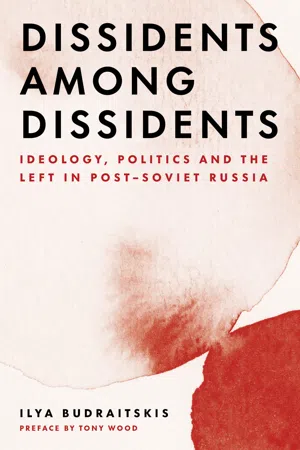
Dissidents among Dissidents
Ideology, Politics and the Left in Post-Soviet Russia
- 224 pages
- English
- ePUB (mobile friendly)
- Available on iOS & Android
eBook - ePub
About this book
Information
PART ONE
Fantasy Worlds of Power
CHAPTER ONE
Putin Lives in the World
that Huntington Built
that Huntington Built
In 2014, at the same time as the Kremlin announced that Crimea was joining the Russian Federation – official propaganda preferred to call it a ‘restitution’ – it also proclaimed ‘Russia’s return to history’. The phrase implied the idea of a centuries-long struggle for Russia’s rightful place in the world, one that was only briefly interrupted by the two decades the country spent hanging around in an unsuccessful market ‘transit zone’. Now, however, Russia had abandoned its doomed attempts to fit into a model of international relations that had been concocted by others and, indeed, built against Russia. Such an interpretation led the Western media to call Putin a dangerous fantasist who, according to a remark by Angela Merkel, ‘lives in a world of his own’. Putin himself insisted that his position was that of a realist, and that the hectoring tone of the West was a relic of the universalist illusions of the past.
This dispute over universal values, surfacing in the guise of international tensions, emerged at a theoretical level a quarter of a century ago. Samuel Huntington’s The Clash of Civilizations and the Remaking of World Order was published in 1996 and immediately deemed, alongside Francis Fukuyama’s The End of History, one of the authoritative texts explaining how the post-Cold War world would be built. But where Fukuyama (Huntington’s former student at Harvard) assumed that the West’s historical victory was a permanent condition that would lead to a tedious, stable and highly predictable future, Huntington’s conclusions were extremely pessimistic. More than two decades after the appearance of The Clash of Civilizations, and in the wake of such major world events as 9/11, American armed interventions in the Islamic world and the conflict in Ukraine, Huntington may seem like a prophet who foretold the future. Yet it is also possible that there is another explanation: did not this ‘authoritative book’ simply find some rather powerful readers – George Bush, Vladimir Putin, Marine Le Pen or, let us say, the former leader of the so-called Islamic State, Abu Bakr al-Baghdadi? In other words, the question arises as to what exactly Huntington created: an extraordinarily accurate explanation of reality, or a primitive ideological construct that was turned into a terrible reality?
All too many people consider Huntington’s hard-boiled theory of a cultural ‘war of the worlds’ to be more useful for understanding the present than either Hegel or Marx. This is mainly because the basic framework of his theory is much easier to grasp. Huntington claims that the global ideological confrontation between capitalism and communism – a fault line running through societies and continents – has been replaced with a return to the ancient and somewhat forgotten rules of the game, whereby peoples and cultures fight for their natural interests. The West, according to The Clash of Civilizations, should not flatter itself with its victory over the collapsed ‘socialist camp’. On the contrary, this victory should return it to a sober awareness of its condition as just one, albeit the most powerful one, of eight or nine civilizations that divide up the world between them. The post-ideological epoch will be a time of war, civilizational rifts and temporary coalitions based upon identity and a transhistorical attachment to one community or another.
Huntington does not aspire to give a large-scale tour of the past and he makes little effort to explain precisely why there are eight civilizations rather than, say, twenty-eight; the main point for him is that this has already happened, and that, in the near future, their number will remain unchanged. In time, each of the civilizations will acquire and become aware of its natural boundaries. Those that were ‘put out of action’ and had less influence in the past – for example, the Chinese and Islamic civilizations – will gain in strength, whereas others (the West) should, on the contrary, more critically evaluate their own claims. In order to persuade the West of the vanity of its hope for universal modernization and social progress, Huntington tends to invoke the work of Edward Said and Immanuel Wallerstein even more often than that of his direct predecessors in the ‘civilizational’ approach (for example, Arnold J. Toynbee). The author of The Clash of Civilizations by no means shares the pessimism of Oswald Spengler regarding the ‘decline’ of the West, but he calls upon the West to soberly evaluate its own potential in face of a rapidly changing demographic balance. Europeans are becoming fewer and fewer whereas Asians are growing in number: this key component of Huntington’s theory is backed up with statistics intended to persuade the reader.
In Huntington’s world, the question ‘Whose side are you on?’ has been replaced by another: ‘What are you?’ The Cold War, as an ideological confrontation between two blocs, has become a thing of the past; the time has therefore come to reassess the role of the international institutions created in that previous era. Hence, NATO should transform itself from a military organization of the ‘free world’ into an alliance defending the interests of only one civilization, namely the West. There is no point in the European Union considering the integration of countries belonging to Orthodox or Islamic civilizations, since this would only create major problems in the future. For a new balance of forces to be established, each civilization needs to align itself with its ‘kin country’, a kind of geopolitical big brother. For the West, that state is the USA; for the Orthodox world, Russia. Consequently, alongside most of Ukraine and Belarus, the sphere of Russian natural interests would include Serbia, Bulgaria and Greece (whose accession to the European Union Huntington openly called a mistake).
In short, at the centre of each civilization is a country – and at the centre of each country is God. Religion defines identity, and the church is the institution able to give the only true response to the question ‘What are you?’ Huntington calls this ‘the revival of religion’ (alluding to Gilles Kepel’s notion of la revanche de Dieu), though ‘the return of the gods’ would have been a more accurate phrase. Indeed, in this anti-universalist world, a coherent monotheism would appear to be little more than a simple relic relating to that old question ‘Whose side are you on?’
Huntington bemoans the West’s obliviousness to this new reality and the fact that it continues to ‘export democracy’ to non-Western countries. In this new world of eight civilizations, sovereignty is not defined by the rule of popular representation but by the correspondence of the state to its own political culture, its particular local religion and ethical norms. The regimes of Iran, Saudi Arabia and Russia purport to follow precisely these principles. Moreover, if the Islamic world, torn apart by conflicts between Shiites and Sunnis, is not at present in a condition to determine its main kin-country, then Orthodox civilization has been more fortunate: it has Russia.
Throughout its existence, the Putin regime has been Huntington’s star pupil. Building up an authoritarian ‘vertical of power’, as early as the mid-2000s Putin’s administration proclaimed its ‘sovereign democracy’ to be unlike other political systems. Due to Russia’s distinct political culture, it was also not to be measured by any other democratic standards. The repressive political regime, clerical rhetoric, obscurantism in cultural life and military pressure on neighbouring countries: all these were only stages along the path taken by a civilization as it returned to its true nature. This destiny cannot be altered – it can only be submitted to.
Yet this image of Putin as the authoritarian leader of an aggressive ‘Orthodox civilization’ was not thought up by Putin himself. It is well known that the main justifications the Kremlin has offered for its policies is that they are merely a symmetrical response to Western expansion. And, in Huntington’s terms, this is quite true. The result of US aggressions over the past two decades – from the invasions of Afghanistan and Iraq to the expansion of NATO into Eastern Europe – has indeed been the creation of ideal partners, according to the logic of a clash of civilizations. Each of them, from the Islamic State to Putin’s Orthodox Russia, requires only ‘understanding’ – a recognition of their special nature and the right to do whatever they like within their natural ‘civilizational borders’.
According to Huntington, it is precisely this conception of civilizations with equal rights that is the only possible guarantee against global wars in the future. The kin-countries should agree among themselves and split the world into eight parts, each with its gods and moral values. The religious beliefs of the eight large tribes will always be impenetrable to each other; all that is required is to respect the borders between them. This image of the future, as described in The Clash of Civilizations, has turned into reality before our very eyes. The oppressive and mesmerizing force of this image is such that it does not allow for any choice. There is no need to answer the question ‘What are you?’ The answer is given to you by those who stand at the helm of these civilizations and define their boundaries.
Over the past few decades, the circle of influential decision-makers has been radically narrowed down to a few elite clubs such as the G8. In these conditions, it becomes considerably easier for the picture of the world existing in the minds of people such as Huntington to acquire certain real traits: the world thought up by Huntington has become the world in which Putin lives. In order to understand it better, other world leaders have migrated to this world, aiming to take with them the remaining populations who will soon learn to suffer, die and kill for their gods. For those who wish to avoid entering that world, it is not enough simply to renounce the need to define one’s own identity in such civilizational terms. One must struggle against the very state of affairs in which the world of one man turns with such ease into the world of everyone else.
CHAPTER TWO
The Spectres of Munich
The Official Language of Russia:
Reading between the Lines
Reading between the Lines
In the run-up to the 2017 Munich Security Conference, one of the most important forums for the European political elite, the organizers published a document with an eloquent title: ‘Post-Truth, Post-West, Post-Order?’ It sounds a note of high drama from its very first lines: ‘The world is facing an illiberal moment. Across the West and beyond, illiberal forces are gaining ground.’ Unambiguously alluding to the imagery of The Communist Manifesto, the authors of the Munich Report describe the dual trajectory of this ‘spectre of illiberalism’: ‘From within, Western societies are troubled by the emergence of populist movements that oppose critical elements of the liberal-democratic status quo. From outside, Western societies are challenged by illiberal regimes trying to cast doubt on liberal democracy and weaken the international order.’1
In contrast to the Marxian spectre – a working class grounded in real, material conditions striving to attain its ideal – the spectre of illiberalism was purely imaginary. The triumphal march of this spectre was the apparent outcome of growing fear and ignorance, and of liberalism’s waning confidence in its own strengths. It represented a flight from freedom in all its manifold forms – a conscious political choice away from the movement of labour, goods and finance towards an orientation to cultural particularism and closed-mindedness. The difference between right and left populisms is erased in this joint rejection of a liberal consensus based on reason and balance.
Following the logic of this approach, Russia emerged as the leading foreign ally of domestic illiberal forces. Subverting the natural liberal foundations of the West, it affirmed its own nature: an authoritarian attachment to one-person rule, facilitated by a submissive population. Alongside its satellites in what the Munich report called the ‘Populist International’ (whose members included Viktor Orbán, Recep Tayyip Erdogan and Donald Trump, among others), the Kremlin undermined Western civilization and world order. A new condition of turbulence and chaos was replacing this order, which had guaranteed a stable and flourishing world – a condition in which all previous ideas lose their meaning and interconnections. Truth becomes Post-Truth, and the West, Post-West.
In this schema, Putin appears as a permanent revolutionary in the most primitive understanding of this term: a purely destructive force, without offering anything in return.2 This image of Putin as a revolutionary became commonplace in the Western media. Just after the 2017 Munich Security Conference, the New Yorker exclaimed that it was Putin himself who was behind Trump’s victory in the 2016 US elections.3 Putin had struck a blow against democracy: he devalued its foundations (liberal values) by using its formal contradictions against it. Indeed, the very idea of democracy was being eroded, reduced to a mere mechanism for expressing the will of the masses, deprived of responsibility and common sense. This Russian-led revolt against the elites was primarily cultural and moral in character, nihilistically rejecting everything that is essentially Western: the common European home, multiculturalism and free trade. The unity of European order was being lost while democracy turned towards its dark side: ochlocracy, or arbitrary mob rule.
It was emblematic that Russia itself was absent from the Munich report’s list of countries at risk of political turbulence; indeed, on the contrary, predictability was held to rule there. In contrast to the West, Russian authoritarian power was seen as fully corresponding to national identity, commanding widespread support from below. Putin’s Russia appeared not so much as a non-West, but rather as the anti-West, the embodiment of this rejection of the liberal and humanist tradition. In this guise, Russia sheds its national borders and turns into a global partisan (in the spirit of Carl Schmitt), shaking the foundations of world order in the destructive spirit of the times. It is hard not to notice how this Manichaean picture – a confrontation between these two principles – finds its mirror-like reflection in the legitimations offered by Putin’s Russia of its own world mission.
THE REVOLUTION TURNED UPSIDE DOWN
Ten years earlier, at the 2007 Munich Security Conference, Vladimir Putin gave a famous speech in which he issued a challenge to the model of the unipolar world. This world of ‘one master, one sovereign’ represented a threat not only to its neighbours, but also ‘for the sovereign itself, because it destroys it from within’.4 Breaking with this model was a moral issue, since the West had rejected its own identity for the sake of coercing other countries to submit to the universality of its principles.
Just as the West hurled against Putin the accusation of organizing instability in the US, Putin himself has long made the criminalization of revolution an integral part of his ideological agenda. According to the Russian propaganda line, any revolution has, primarily, a foreign source. Even the centenary of the Revolution of 1917 was used by the official media to convey to the country’s population the simple notion that all revolutions are generously financed from abroad. In this sense, the Bolshevik October, the Arab Spring and the Ukrainian Maidan have much in common. Violent upheavals represent, above all, a dangerous technology, one component of which is its toxic effect on mass consciousness. The confrontation with America has centrally involved, among other things, a resistance to regime change, which in the Kremlin’s view sows false hope and thus leads only to more chaos and violence.
If Russia presents itself as the pole of reason and tradition, then Western elites represent revolutionary forces which, like the Jacobins and the Bolsheviks, wish to transform human nature and force humanity to worship new false gods. Such a revolutionary religion is intent on replacing traditional values and verges on dictatorship – an uncompromising one blinded by the dogmatic violence of the minority over the majority, inverting the essence of democracy.
From this perspective, it is as though Putin were intervening in the name of all those who are not ready to sacrifice their identity and authentic freedom for the sake of a liberal chimera. He addresses himself over the heads of the elites, who are in the grip of revolutionary madness, to the native populations, the everymen who wish to live in accordance with their own historical nature. By warning of the sovereign West’s imminent self-destruction, Putin helps the West save itself and its own identity.
Not only do both sides portray each other as the revolutionary wreckers of order, but they produce competing versions of the Post-West. For Russia and its right-wing associates, the West is losing its authentic foundations: Christianity, the traditional family and racial homogeneity. Admirers of today’s Russia such as Pat Buchanan, the American paleoconservative and author of bestselling The D...
Table of contents
- Cover Page
- Halftitle Page
- Title Page
- Copyright Page
- Contents
- Preface
- Introduction
- Part One: Fantasy Worlds of Power
- Part Two: Cultural Politics in the Putin Era
- Part Three: The Soviet Inheritance and the Left
- Notes
- Index
Trusted by 375,005 students
Access to over 1.5 million titles for a fair monthly price.
Study more efficiently using our study tools.
Frequently asked questions
Yes, you can cancel anytime from the Subscription tab in your account settings on the Perlego website. Your subscription will stay active until the end of your current billing period. Learn how to cancel your subscription
No, books cannot be downloaded as external files, such as PDFs, for use outside of Perlego. However, you can download books within the Perlego app for offline reading on mobile or tablet. Learn how to download books offline
Perlego offers two plans: Essential and Complete
- Essential is ideal for learners and professionals who enjoy exploring a wide range of subjects. Access the Essential Library with 800,000+ trusted titles and best-sellers across business, personal growth, and the humanities. Includes unlimited reading time and Standard Read Aloud voice.
- Complete: Perfect for advanced learners and researchers needing full, unrestricted access. Unlock 1.5M+ books across hundreds of subjects, including academic and specialized titles. The Complete Plan also includes advanced features like Premium Read Aloud and Research Assistant.
We are an online textbook subscription service, where you can get access to an entire online library for less than the price of a single book per month. With over 1.5 million books across 990+ topics, we’ve got you covered! Learn about our mission
Look out for the read-aloud symbol on your next book to see if you can listen to it. The read-aloud tool reads text aloud for you, highlighting the text as it is being read. You can pause it, speed it up and slow it down. Learn more about Read Aloud
Yes! You can use the Perlego app on both iOS and Android devices to read anytime, anywhere — even offline. Perfect for commutes or when you’re on the go.
Please note we cannot support devices running on iOS 13 and Android 7 or earlier. Learn more about using the app
Please note we cannot support devices running on iOS 13 and Android 7 or earlier. Learn more about using the app
Yes, you can access Dissidents among Dissidents by Ilya Budraitskis in PDF and/or ePUB format, as well as other popular books in Politics & International Relations & Communism, Post-Communism & Socialism. We have over 1.5 million books available in our catalogue for you to explore.