This short book calls to account the government misrulers and corporate criminals who made suffering from the global coronavirus pandemic more acute. Modeled on a famous 1940 bestseller--a pamphlet exposing appeasers of Nazi Germany--Guilty Men shows how the crisis has been stoked by the callous and opportunistic decisions of powerful men.
The rogues gallery begins with Donald Trump, who deliberately downplayed the crisis despite knowing its dangers, as well as his international political allies, above all Boris Johnson. Billionaire politicians like Georgia senator Kelly Loeffler moved stocks at the same time they were telling Americans all was well . Political charlatans like Education Secretary Betsy DeVos undermined public safety in order to advance their agenda, Trump-controlled agencies, led by the ever-crooked Federal Reserve, bailed out Wall Street while failing to provide basic relief for workers. Libertarian "think tanks" like the Ayn Rand Institute decried public expenditures but were first in line to get bailout checks. Pharmaceutical companies gamed the vaccine race, and the most rapacious global corporations like Facebook, Visa, and Pfizer have found the pandemic to be very profitable indeed, vastly enriching the already grotesquely bloated fortunes of trillionaires like Jeff Bezos, Mark Zuckerberg, and Charles Koch.
Guilty Men closes with a call for a version of the Pecora Commission, initiated by newly elected Franklin Roosevelt, that took aim at what FDR called "speculation, reckless banking, class antagonism, and profiteering" that stoked the Depression. The commission led to some of the most far-reaching reforms in US history, as well as sensational hearings that led to the fall of the leading bankers and financiers of that era.
eBook - ePub
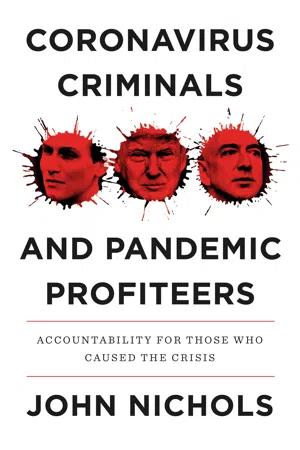
Coronavirus Criminals and Pandemic Profiteers
Accountability for Those Who Caused the Crisis
- 336 pages
- English
- ePUB (mobile friendly)
- Available on iOS & Android
eBook - ePub
Coronavirus Criminals and Pandemic Profiteers
Accountability for Those Who Caused the Crisis
About this book
Information
1
The Killing Presidency of Donald Trump
If the impeachment provision in the Constitution of the United States will not reach the offenses charged here, then perhaps that eighteenth-century Constitution should be abandoned to a twentieth-century paper shredder!
—US Representative Barbara Jordan, to the House Judiciary Committee, 1974
Donald Trump was appropriately impeached seven days before the end of a debauched presidency for his incitement of insurrection on January 6, 2021, just as he was appropriately impeached a little over a year earlier for his solicitation of foreign influence to disrupt the election of 2020. Only an excess of Republican partisanship spared him conviction for those high crimes in the Senate trials that followed his impeachments. Yet, history, if it is accurately written, will record that the forty-fifth president’s highest crime was not an incitement or a foreign intrigue. It was his lethal failure to respond to the coronavirus pandemic that killed 400,000 Americans during the final year of his presidency—and that, because of patterns set in place by Trump’s deliberate distortions and steady rejections of science, continued to cause thousands of unnecessary deaths after he left the position from which he was removed by the American people.
No American should forget that as Trump finished his presidential term, the United States experienced its highest single-day level of Covid-19 deaths since the beginning of a pandemic he consistently refused to combat with the full power of his office. No American should forgive the former president who acknowledged to journalist Bob Woodward that he deliberately downplayed the threat posed by a deadly virus. No American should casually “move on” after Trump lied, peddled conspiracies and mismanaged the coronavirus response so horribly that tens of thousands of preventable deaths occurred on his watch.
When Trump exited the White House on January 20, 2021, he did so “with blood on his hands,” according to presidential historian Thomas Whalen, who said of Covid-19, “He knew this was a threat and really did not do what was necessary to respond to it in a thoughtful and resourceful way.”
That is a polite way of saying that Trump failed the country he was duty-bound to protect and serve—and that this failure was particularly devastating to the people of color and immigrants Trump so frequently disparaged. This is one of the reasons why the Republican president was voted out of office after a campaign in which Joe Biden said, “Anyone who’s responsible for that many deaths should not remain as president of the United States of America.” Yet too many Americans imagine that Trump cannot—or, worse yet, should not—face investigation, prosecution and punishment for willfully mismanaging a catastrophe that caused the largest number of deaths from a single event on a president’s watch in more than a century.
That’s wrong. Trump and his co-conspirators should face accountability for their Covid crimes.
But political accountability is never guaranteed. It has to be achieved.
Some years ago, I wrote a book on the genius of impeachment. In the process, I became something of an expert on the failure of contemporary Congresses to effectively employ impeachment as an accountability tool. That put an end to any naivete I might have retained from Mrs. Stanek’s eighth-grade civics class about the US Constitution as a protection against the most serious maladministrations of presidents in general and Donald Trump in particular. It was entirely predictable that the Congress that failed to remove Trump after he had provoked a deadly riot inside the US Capitol would fail to address Trump’s high crime of presiding over a mass casualty event. As Dr. Steven Woolf, director emeritus of the Center on Society and Health at Virginia Commonwealth University, explained: “What’s so troubling about this loss of life is it was preventable. This is an infectious disease we knew how to prevent, and as difficult as it is, far easier to solve than defeating Nazi Germany. And yet, we did not mount a response to wage war against this virus as we have in these other situations.”
The failure of congressional duty and imagination ought not diminish our understanding of Trump’s criminality and his guilt. Nor should it discourage us from seeking accountability in all of the legal and logical forms available to an American people who must protect themselves and their future. Americans cannot let their sense of outrage be numbed by the multitude of Trump’s sins. They cannot allow themselves to be distracted by the fertilizing propaganda spewed from the mouths of the former president’s desperate defenders, who continue to claim that the election of 2020 was stolen and that Trump had no role in sending a seditious mob into the citadel of democracy.
This is about much more than hating on Donald Trump. This is about future presidencies, and future pandemics. Constitutional scholars were right to argue that if a defeated president could not be held to account for seeking to overturn the results of an election in which voters chose to remove him from office, then the precedent would be set for future presidents to conspire to retain power by inspiring violence of the sort that on January 6 left hundreds injured and five people—including a Capitol Police officer—dead.
But it is equally dangerous to limit our definition of executive responsibility in a way that would have Americans believe that a former president cannot, or should not, be held to account for actions that left millions injured and hundreds of thousands dead. The genius of the impeachment power is that it is broad enough to encompass all high crimes and misdemeanors. There was a clear recognition at the founding of the American project—which extended from a revolt against the repeated “injuries and usurpations” of mad King George III—that officials could be penalized not merely for gross violations of their oaths of office but for gross damage to the republic and its people.
The purpose of the impeachment clauses that were added to the Constitution in the summer of 1787 was to answer the questions posed by George Mason after he explained to the Constitutional Convention, “No point is of more importance than that the right of impeachment should be continued.” Mason demanded to know: “Shall any man be above Justice? Above all, shall that man be above it, who can commit the most extensive injustice?” The delegates to that convention responded by creating an instrument of accountability that was intended to be understood as former president Gerald Ford did, when he said, “An impeachable offense is whatever a majority of the House of Representatives considers it to be at a given moment in history; conviction results from whatever offense or offenses two-thirds of the other body considers to be sufficiently serious to require removal of the accused from office.”
Early in Trump’s term, House Speaker Nancy Pelosi suggested that while the president had “acted in a way that is strategically incoherent, that is incompetent, that is reckless … that is not grounds for impeachment.” In fact, incoherence, incompetence and recklessness have been recognized from the earliest days of the republic as credible grounds for impeachment. The first federal official to be removed from office after being impeached, New Hampshire federal judge John Pickering, became the target of congressional action in 1803 because of concerns about his erratic and irresponsible behavior. The following year, Supreme Court Justice Samuel Chase was impeached for, among other things, “intemperate and inflammatory … peculiarly indecent and unbecoming … [and] highly unwarrantable” behavior.
Those prosecutions occurred when the people who authored the Constitution were still active members of the Congress and presidential administrations. They understood that the impeachment power could be appropriately applied to a wide range of high crimes and misdemeanors. No doubt, incitement of insurrection is among the highest. But so, too, is deliberately failing to address the threat posed by a pandemic.
Each new commander-in-chief swears an oath pledging that they will “faithfully execute the office of President of the United States, and will to the best of my ability, preserve, protect and defend the Constitution of the United States.” That Constitution begins with a commitment to “promote the general welfare” of the American people. Deliberately downplaying the danger of a deadly virus that is rapidly spreading through the land is not a faithful execution of the office of the presidency. Creating a circumstance in which hundreds of thousands of Americans are allowed to fall ill and die preventable deaths attacks the general welfare. These are truths that we should hold to be self-evident, and we should boldly apply them when assessing the high crimes of Donald Trump.
The most important point in seeking accountability is to understand that this is about more than punishing Trump as an individual. The same goes for the many other subjects of this book, whose criminal, civil and political wrongdoing will be detailed in ensuing chapters. The pursuit of accountability involves more than judging the moral character of our elites, or rebuking them for bad behaviors in personal relationships or business dealings. What’s at stake is something far more vital than resolving individual grievances associated with politics. There must be a consideration of the deeper issue of systemic failure, and the deeper need for systemic change. Americans have to answer the question of whether anyone who is politically or economically powerful can be held to account in America, a subject that will be explored more thoroughly in a concluding chapter. The struggle to answer this question steers us toward the even more serious issue of whether we, as a people and as a nation, can reassemble ourselves so that the United States—and the world it so greatly influences—will never again be at the mercy of a president, Cabinet member, senator or CEO who would sacrifice the health and lives of Americans on the altar of his own ambition, or avarice, or remorseless brutality.
Trump sought and accepted a position of the greatest responsibility. He said that he understood what that entailed. Like presidents before him, Trump announced, “My first duty as president is to protect the American people.” Yet when he was called upon to answer a threat so severe that it would in barely three months leave more Americans dead than were killed in World War I, Trump deliberately lied. He played down the danger of the disease in the critical early stages of the fight, and he continued to lie as the death toll ticked upward past 100,000, past 200,000, past 300,000, all the way to 400,000.
So many of those deaths were preventable. But Trump’s lies made them inevitable. This is not hyperbole. This is not political exaggeration. It is the stark fact of Donald Trump’s infamy—a deliberate dereliction of duty that in a time of declared war would be identified as treasonous.
On February 7, 2020, after he had been repeatedly briefed in detail on Covid-19, Trump spoke to the Washington Post’s Bob Woodward. “This is deadly stuff,” he told Woodward. “You just breathe the air, and that’s how it’s passed.”
A president who recognized his duty to protect the American people would have moved aggressively to address the threat, as leaders of other countries did. If international relations were strained, with China, with any other country, or with global organizations, this would have been the time to sort differences out. If the domestic infrastructure was insufficient, if bureaucrats were inattentive, a duty-bound president would have made urgent changes. He would have acted decisively. He would have leveled with the American people and built the trust necessary to overcome the threat. Instead, Donald Trump denied the danger in words and deeds, until the rates of infection and death surged during the course of 2020 to levels that at several points had the United States suffering with the worst coronavirus outbreak in the world.
On February 24, two weeks after he spoke to Woodward about “deadly stuff,” Trump tweeted, “The Coronavirus is very much under control in the USA.” On February 27, he said: “It’s going to disappear. One day, it’s like a miracle, it will disappear.” On March 10, he said: “And we’re prepared, and we’re doing a great job with it. And it will go away. Just stay calm. It will go away.” But it did not go away. It grew into a public health crisis of epic proportions that would rapidly leave tens of thousands of Americans dead, millions infected and tens of millions unemployed as the economy shut down.
If in March Trump had taken urgent action to enforce social distancing and other precautions instead of promising “it will go away,” roughly 54,000 Covid-19 deaths would have been prevented in the early stages of the crisis, according to Columbia University analysts. Even as his failure became evident to all, including members of his own clueless cabal of aides and advisers, Trump continued to soft-pedal the danger. And people continued to die. At the conclusion of his presidency, a commission associated with the medical journal Lancet determined that had Covid-19 death rates in the US corresponded with those of other G7 countries during the period when Trump was in charge, 40 percent fewer Americans would have died.
On the day Trump left office, the Covid-19 death toll in the US stood at roughly 400,000. Forty percent of that figure is 160,000. The policies that Trump put in place—or failed to put in place—extended beyond his presidency. So if we wanted to blame all of the excess death rate in the US on Trump, the figure would actually be much higher. But, in fairness to Trump, policies that he inherited made both the crisis, and the prospects for his mismanagement of it, worse. “The US has fared so badly with this pandemic, but the bungling can’t be attributed only to Mr. Trump; it also has to do with these societal failures,” Dr. Mary T. Bassett, director of Harvard University’s FXB Center for Health and Human Rights and a member of the Lancet commission, told the Guardian. The paper also reported that the commission report drew a line “from neoliberal policies pushed in the past forty years, such as those that intensified the drug war and resulted in mass incarceration, to health inequities Trump exacerbated while in office. Many of the connections date back even further, to the colonization of the Americas and the persistence of white supremacy in society.”
This book recognizes these connections, which is one of the reasons why it considers so many guilty men and women who are not named Trump, including several who are not conservatives and not Republicans. There were Democrats who got things horribly wrong. There were officials in other countries, including but not exclusively China, whose actions merited concern at the time and warrant continued scrutiny. There is plenty of blame, historic and contemporary, to go around. The list of guilty parties is long. But some parties are guiltier than others.
The Lancet Commission on Public Policy and Health in the Trump Era put things in perspective by considering the global pandemic and then focusing on the unique factors that made Trump’s presidency so dangerous in the crisis moment. The commissioners recognized that the forty-fifth president had assumed the office after Trump, as a 2016 contender, “stirred up the underlying racial animus of US society to deflect attention from policies that abet billionaires’ accretion of wealth and power. His racist, anti-immigrant and nationalist appeals found resonance in some middle-income and low-income white communities seeking scapegoats for their declining life prospects, even as they retained some privileges denied to people of color.”
With this in mind, the commissioners explained:
Although Trump’s ascent to the presidency was propelled by racism, nativism and fear of privation, his policies constituted an intensified attack on the health and well-being of people in the USA and elsewhere. His signature legislative achievement, a trillion-dollar tax cut for the wealthy, opened a budget hole that served as justification for cuts to food and housing subsidies that prevent malnutrition and homelessness for millions of people in the USA; the number of homeless school children increased by 150,000 in the first year of Trump’s presidency. Trump’s mismanagement of the Covid-19 pandemic—compounded by his efforts to dismantle the USA’s already weakened public health infrastructure and the Affordable Care Act’s (ACA) coverage expansions—has caused tens of thousands of unnecessary deaths. His elimination of the National Security Council’s global health security team, and a 2017 hiring freeze that left almost 700 positions at the Centers for Disease Control and Prevention (CDC) unfilled, compromised preparedness. The number of people without health insurance had increased by 2–3 million during Trump’s presidency, even before pandemic-driven losses of employment-based coverage increased the number of uninsured people by millions.
Then, of course, there was Trump’s reaction to the pandemic itself. After detailing how “the global Covid-19 pandemic has had a disproportionate effect on the USA,” the commissioners concluded: “Many of the cases and deaths were avoidable. Instead of galvanizing the US populace to fight the pandemic, President Trump publicly dismissed its threat (despite privately acknowledging it), discouraged action as infection spread and eschewed international cooperation. His refusal to develop a national strategy worsened shortages of personal protective equipment and diagnostic tests. President Trump politicized mask-wearing and school reopenings and convened indoor events attended by thousands, where masks were discouraged and physical distancing was impossible.”
Disdain for science and cuts to global health programs and public health agencies, wrote the commissioners, “have impeded the response to the Covid-19 pandemic, causing tens of thousands of unnecessary deaths.” That tracked with an assessment by the Washington Post in October 2020, when the US death toll was around 220,000. Noting the failures of the Trump administration, the Post concluded that “tens of thousands of those deaths, at least, were preventable,” and that “tens of thousands of more deaths will occur, many of them also preventable.” How many tens of thousands? The Post pointed to estimates by the Trump administration’s coronavirus task force from March 2020, which suggested that “a successful pandemic response” by the government at that early point would result in a total of “only 100,000 to 240,000 deaths.”
By the time Trump left the presidency, the death toll was at least 160,000 higher—perhaps 300,000 higher—than what his own task force had suggested a successful response would produce in a worst-case scenario. In other words, Trump and his associates failed, by a horrifyingly wide margin. And there was a general consensus that this failure resulted from deliberate actions by a president who admitted that he lied about the threat the pandemic posed, who ridiculed the advice and counsel of scientists who knew how to respond, and who modeled such bad behavior that his own schedule was packed with “superspreader events” at which close aides and allies got sick and he himself would fall seriously ill.
Why didn’t the president of the United States protect the American people? “I wanted to always play it down,” Trump told Woodward on March 19, 2020. “I still like playing it down, because I don’t want to create a panic.” That statement—which should have been reported immediately but wasn’t—was not an acknowledgme...
Table of contents
- Cover Page
- Halftitle Page
- Title Page
- Copyright Page
- Contents
- Preface: Accountability Is a Dish Best Served Fresh, and Hot
- Acknowledgments
- Introduction: In the name of Mike Jackson
- 1. The Killing Presidency of Donald Trump
- 2. Mike Pence: Yes-Man of the Apocalypse
- 3. The Grounding of Jared Kushner
- 4. The Unmasking of Mark Meadows
- 5. Mike Pompeo’s Cold War against Science and Solidarity
- 6. How Betsy DeVos Tried to Leverage a Pandemic to Privatize Public Education
- 7. Elaine Chao Let Them Die
- 8. Mitch McConnell’s Fatal Bargain
- 9. How Rand Paul Got Covid-19 Wrong, Wrong and Wrong Again
- 10. Have Another Shot of Hydroxychloroquine, Ron Johnson
- 11. The Kristi Noem Nightmare
- 12. Ron DeSantis’s Imperial Overreach
- 13. Andrew Cuomo’s Broken Halo
- 14. The Deadly Delusions of Wisconsin Supreme Court Justice Rebecca Bradley
- 15. That Time Rahm Emanuel Offshored America’s Ability to Fight a Pandemic
- 16. Pfizer’s Vaccine Profiteering
- 17. Drowning Grover Norquist’s Anti-Government Delusion in the Bathtub of His Own Hypocrisy
- 18. The Pandemic Profiteering of Jeffrey Preston Bezos
- Conclusion: The United States of Impunity
- A Note on Sources
- Index
Trusted by 375,005 students
Access to over 1.5 million titles for a fair monthly price.
Study more efficiently using our study tools.
Frequently asked questions
Yes, you can cancel anytime from the Subscription tab in your account settings on the Perlego website. Your subscription will stay active until the end of your current billing period. Learn how to cancel your subscription
No, books cannot be downloaded as external files, such as PDFs, for use outside of Perlego. However, you can download books within the Perlego app for offline reading on mobile or tablet. Learn how to download books offline
We are an online textbook subscription service, where you can get access to an entire online library for less than the price of a single book per month. With over 1.5 million books across 990+ topics, we’ve got you covered! Learn about our mission
Look out for the read-aloud symbol on your next book to see if you can listen to it. The read-aloud tool reads text aloud for you, highlighting the text as it is being read. You can pause it, speed it up and slow it down. Learn more about Read Aloud
Yes! You can use the Perlego app on both iOS and Android devices to read anytime, anywhere — even offline. Perfect for commutes or when you’re on the go.
Please note we cannot support devices running on iOS 13 and Android 7 or earlier. Learn more about using the app
Please note we cannot support devices running on iOS 13 and Android 7 or earlier. Learn more about using the app
Yes, you can access Coronavirus Criminals and Pandemic Profiteers by John Nichols in PDF and/or ePUB format, as well as other popular books in Politics & International Relations & Political History & Theory. We have over 1.5 million books available in our catalogue for you to explore.