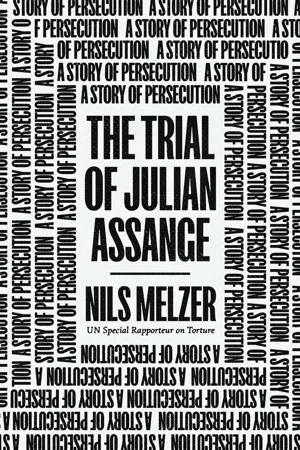
Nils Melzer, the UN Special Rapporteur on Torture, uncovers a systematic campaign to persecute Assange. He reveals that Assange has faced grave and systematic due process violations, judicial bias, collusion and manipulated evidence. He has been the victim of constant surveillance, defamation and threats. Melzer also gathered together consolidated medical evidence that proves that the prison has suffered prolonged psychological torture.
Melzer's compelling investigation puts the UK and US state into the dock, showing how, through secrecy, impunity and, crucially, public indifference, unchecked power reveals a deeply undemocratic system. Furthermore, the Assange case sets a dangerous precedent: once telling the truth becomes a crime, censorship and tyranny will inevitably follow.
- 368 pages
- English
- ePUB (mobile friendly)
- Available on iOS & Android
eBook - ePub
About this book
Information
PART I
A GLIMPSE BEHIND
THE CURTAIN
THE CURTAIN
1
How to Miss
an Elephant
an Elephant
Out of Sight, Out of Mind!
It was just before Christmas 2018, and I was sitting at my desk working on my annual report for the Human Rights Council in Geneva. This is the UN body that had appointed me and to which I reported, as an independent expert, on the worldwide compliance with the prohibition of torture and ill-treatment. Twice a year I was expected to collectively address the UN member states: in the spring at the Human Rights Council in Geneva, and in the autumn at the General Assembly in New York. These were my opportunities to freely choose an issue relevant to the prohibition of torture and ill-treatment and to put it on the agenda of the world organization. The mandates of UN special rapporteurs are unpaid honorary positions. Like most colleagues, I earn my living as an academic: I am a professor of international law at the University of Glasgow and the Geneva Academy of International Humanitarian Law and Human Rights. The most powerful asset of UN special rapporteurs is their independence. Once elected, mandate holders are to be guided solely by their service to the cause of human rights and may not be influenced by anyone in the performance of their duties. In the exercise of their functions, they enjoy diplomatic immunity and operate largely outside the organization’s hierarchies, structures and decision-making processes, which are strongly dominated by political interests.
In an ideal world, with adequate budgets and sufficient staff, dedicated special rapporteurs could achieve a great deal. In the real world, however, states lack not only the financial means but also, and above all, the political will to effectively and comprehensively implement human rights, as this would require them to overcome outdated power structures, privileges and exploitation, which often are deeply intertwined with national politics. A proven means for states to limit the influence of special rapporteurs is the incessant creation of additional mandates and commissions on new human rights topics without increasing the overall budget available for the work of independent experts. In any case, the structural lack of financial and human resources for the special rapporteurs is hardly accidental.
In December 2018, I was busy finalizing my report, this time on the interrelation between corruption and torture (A/HRC/40/59), when suddenly a small window popped up on my screen, indicating the arrival of a new email. ‘Julian Assange is seeking your protection’, the subject line read. Julian Assange? Was this not the founder of WikiLeaks, the shady hacker with the white hair and the leather jacket who was hiding out in an embassy somewhere because of rape allegations? Out of nowhere, I was overtaken by a host of disparaging thoughts and almost reflexive feelings of rejection. Assange? No, I certainly would not be manipulated by this guy. After all, I had more important things to do: I had to take care of ‘real’ torture victims! I closed the pop-up window with a single click – out of sight, out of mind! Then I turned back to my report on overcoming prejudice and self-deception in connection with official corruption. Not until a few months later would I realize the striking irony of this situation.
What’s a UN Special Rapporteur?
Anyone can transmit allegations on violations of the prohibition of torture and ill-treatment to the special rapporteur on torture, or, as my full title reads, the ‘United Nations Special Rapporteur on torture and other cruel, inhuman or degrading treatment or punishment’. Requests for intervention can be submitted at any time, by standard letter or email, even before any violation has occurred and regardless of whether police reports, court proceedings or other formalities have been initiated.
All special rapporteurs are appointed directly by the forty-seven member states of the UN Human Rights Council in a lengthy selection process and carry out their functions with the strictest independence. We have no hierarchical superiors and may not seek or accept any instruction as to the exercise of our mandates, whether from the United Nations or from individual governments or other actors. My office is located in the Office of the High Commissioner for Human Rights in Geneva, which is the organizational branch of the UN that deals with the protection of human rights. Two staff members are assigned to my mandate there, so-called Human Rights Officers. Every week, we receive about fifty requests for intervention and other enquiries. These can be initiated by torture victims themselves, but also by lawyers, NGO representatives, relatives, witnesses or even by other authorities, states or UN bodies. It is then up to my team to review the requests and, where necessary, obtain additional information in order to assess their credibility. Once consolidated, the case file is passed on to me for consideration and decision on the action to be taken.
Consistent with my mandate, my interventions are generally concerned with the prevention, investigation, prosecution, and redress of torture, corporal punishment and other cruel or degrading treatment, inhumane conditions of detention, and extraditions or deportations to states where people are at risk of being exposed to such abuse. The relevant violations may have been committed by state officials or at their instigation, or merely with their consent or acquiescence. In case of violations, I can intervene directly with the foreign ministers of all UN member states through the diplomatic missions in Geneva. This means that I transmit allegations I have received of torture and ill-treatment to the state concerned, that I request the government to clarify and comment on these allegations, and that I make recommendations on the measures to be taken. This correspondence and the government’s response initially remain confidential but, after sixty days, both are published on the High Commissioner’s website. In urgent cases, there is also the possibility of alerting the public through a press release. As special rapporteur, I do not exercise any judicial function, and my conclusions and recommendations are not binding on states.
Of the requests for intervention submitted to my office, we can address one in ten at best. A team of three simply cannot manage more, given that we also have to prepare official country visits, draft official reports and cooperate with other mechanisms for the protection of human rights, first and foremost with the other UN special rapporteurs, Working Groups and relevant committees. Every day we are therefore forced to set priorities and take difficult decisions without the luxury of lengthy reflection. When in doubt, we always prioritize urgent cases where it may still be possible to prevent imminent human rights violations. Depending on the workload, the requests received by my office result in between 100 and 200 official interventions per year. Of these, about a third do not even receive a response. While the remaining two-thirds of our interventions generally do receive responses, these are almost always inadequate in terms of the human rights protection sought. Thus, states often provide lengthy letters replete with diplomatic smooth-talk and assurances but, ultimately, fail to provide the requested information or to initiate the investigations and other measures required under international law. The bottom line is that in the vast majority of cases, documented abuse is neither acknowledged nor punished, corrected or compensated. Unfortunately, this does not apply only to states notorious for their human rights violations. When it comes to protecting their reputation or their economic and security policy interests, even mature democracies priding themselves on longstanding traditions in the rule of law suddenly start compromising on human rights.
As I demonstrated through a comprehensive statistical analysis in my annual report of 2021 (A/HRC/46/26), barely 10 per cent of my interventions receive the ‘full cooperation’ required by the Human Rights Council and are adequately resolved. It is a deplorable success rate, even if one disregards the countless additional requests that cannot even be acted upon due to the lack of resources. This trend has remained largely unchanged since the creation of my mandate in 1985 and seriously calls into question the credibility of the routinely celebrated commitment of all UN member states to the universal prohibition of torture. On individual allegations of torture, states hardly ever agree to engage in a serious dialogue that goes beyond diplomatic niceties, as this would require genuine changes of behaviour and uncomfortable decisions with which they are generally not prepared to follow through.
Due to our heavy caseload, I refer as many applicants as possible to other institutions and authorities that have greater resources and are better placed to follow individual cases in the long term. For example, it is certainly not the purpose of my mandate to replace the investigative authorities of functioning democracies, so long as the police, prosecutors and courts can actually be relied upon to accomplish their tasks in line with the rule of law. This question must always be weighed very carefully, because even in mature democracies things can go wrong – for example, when suspects are pressured to confess through ‘coercive detention’; when police brutality is not prosecuted and punished with sufficient determination; or when persons face extradition or deportation to a state where they would be exposed to a real risk of torture.
An entirely different assessment must be made for requests concerning states in which police and intelligence services are known to routinely kidnap and disappear people in broad daylight. In such cases, family members of the missing often cannot reasonably be expected to trust the local authorities. So I always have to conduct a careful evaluation and be on my guard. Finally, I must never allow my mandate to be misused for political or other extraneous purposes: beyond the loss of my own credibility, the mandate itself could be irreparably damaged.
Caught in My Own Prejudice
And now this request for help from Julian Assange’s lawyers? At some point during the next few hours, I brought myself to skim the full text of the message. Assange’s living conditions in the Ecuadorian embassy in London, where he had been staying since June 2012, were claimed to be incompatible with the prohibition of inhumane treatment and, therefore, to come within the scope of my mandate. I read this but was not convinced, or simply did not take it seriously. The possibility that Assange might truly be ill-treated did not even occur to me. Sure, I could imagine that he was no longer happy staying at the embassy and that he might be suffering a few health issues. Six years can be an eternity for someone confined to the same building. At the same time, I was still affected by all those headlines in the mainstream media which I had almost unconsciously absorbed over recent years: Assange, the cowardly rapist refusing to turn himself in to the Swedish authorities. Assange, the hacker and spy evading justice in the Ecuadorian embassy. Assange, the ruthless narcissist, traitor and bastard. And so forth.
Only later did I realize how much my perception had been distorted by prejudice. Years of exposure to scandalous headlines and biased reporting, though hardly perceived by my conscious mind, had formed an opinion deeply anchored in my emotions – an opinion which I was convinced was based on reliable facts. Thus, even after having read the email, I saw no reason to seriously consider the case of Julian Assange. ‘Manufacturing consent’ is the term introduced by Edward Herman and Noam Chomsky in the late 1980s to describe the communication model of the American mass media, one that has long since been globalized. They showed how self-censorship, anticipatory obedience and economic constraints lead many media institutions to smoothen their reporting in line with the generally accepted consensus. This is precisely what happened in the Assange case. The official narrative had the desired effect on public opinion – myself included.
The irony was striking. There I was, drafting my report on the links between corruption and torture, and failing to even notice that the intervention request submitted by Assange’s lawyers presented me with a prime example of my topic. In reality, the case of Julian Assange is primarily about political corruption, with judicial institutions and processes having been – and still being – abused for political purposes: for suppressing press freedom and freedom of information; for impunity over torture and war crimes; for the political persecution of dissidents, and for the secrecy of machinations incompatible with democracy and the rule of law.
I was not the only UN expert contacted by Assange’s lawyers in late 2018. They also wrote to the special rapporteur on the situation of human rights defenders and the UN Working Group on Arbitrary Detention (WGAD). On 21 December 2018, these colleagues issued a joint press release entitled ‘UN experts urge UK to honour rights obligations and let Mr. Julian Assange leave Ecuador embassy in London freely.’ I had been invited to join but declined. Instead, I shelved the letter from Assange’s lawyers without much thought and barely even noticed the press statement. To me, like to most people around the world, Assange was just a rapist, hacker, spy, and narcissist. Like so many, I was convinced that I knew the truth about him, even though I couldn’t quite remember where that knowledge had come from. It would be another three months before my opinion fundamentally changed.
2
WikiLeaks’ Role
in Society
in Society
‘Collateral Murder’: When War Becomes Real
It was only in 2010 that I took proper notice of WikiLeaks: a disclosure platform that obtains classified information from whistleblowers and other sources and guarantees them anonymity, that is, protection from exposure and prosecution. WikiLeaks makes a point of clarifying that, due to an encrypted data transmission technology preventing their tracing, even the organization itself is unable to identify its sources – fully dedicated to the cypher-punk slogan, ‘privacy for the weak, transparency for the powerful.’ Thus, starting in 2006, a publicly accessible archive of previously secret documents was created, and its growing contents soon came to be feared by powerful governments, corporations and organizations. Early revelations exposed, for example, the corruption of the Kenyan government, toxic waste dumping by the Trafigura corporation in Ivory Coast, the methods of Scientology, the US Army’s guidelines for the treatment of Guantánamo detainees, and the dubious business practices of the Swiss bank Julius Baer. First hits, but nothing compared to the overwhelming power of what was to come.
On 5 April 2010, at Washington’s National Press Club, Julian Assange presented ‘Collateral Murder’ to the world. The eighteen-minute video opened with a quote from George Orwell: ‘Political language is designed to make lies sound truthful and murder respectable, and to give an appearance of solidity to pure wind.’ After that, nothing but disturbing images in black and white. ‘Collateral Murder’ places the viewer inside a US combat helicopter circling at low altitude over a residential area of Baghdad. It is 12 July 2007, just another day in a deplorable war of occupation, the news coverage of which has been dominated almost exclusively by the Western military coalition. Now, suddenly, viewers are immersed onboard the helicopter and see everything from the real-time perspective of the gunner. Radio messages go back and forth. Somewhere on the ground, out of sight, American troops are on the move, and the area is being searched from the air for insurgents and other potential threats.
Suddenly, the helicopter crew reports about twenty men standing about on the road in several small groups. Then they appear on the screen. All of them wear civilian clothing, and most are visibly unarmed. Two of the men have something slung across their shoulders which – judging by shape and size – clearly cannot be rifles. It later turns out that they are journalists carrying photo cameras. Another two men appear to be carrying assault rifles or similar long-barrel firearms. All of the men move around unsuspectingly, talk to each other, some cross the open street – it is obvious that they are not about to take cover or prepare an ambush. Other pedestrians also seem to be going about their everyday business. No one seems to notice the two helicopters. The crew reports over the radio: ‘Have five to six individuals with AK-47s [Kalashnikov-type assault rifles]. Request permission to engage.’ A few seconds later, the permission to open fire arrives, but at the last moment – due to the flight path – a building intrudes between the cannon and the group of people. While the helicopter circles in the distance and moves back into position, a journalist’s raised telephoto lens is mistaken for a rocket-propelled grenade (RPG) ready to fire. Shortly thereafter, the line of sight is clear and the gunner opens fire. Ten men are literally mowed down. Some try to escape, but the gunner intercepts them with the next volley. After less than thirty seconds all of them are dead or seriously wounded on the ground. The helicopter continues to circle the attack site, and the troops can be heard commenting: ‘Hahaha, I hit them.’ – ‘Oh yeah, look at those dead bastards.’ – ‘Nice.’ – ‘Good shot.’ – ‘Thank you.’
A few moments later, a seriously wounded man comes into view. He is trying to crawl to safety, but he can hardly move. ‘There’s one guy moving down there but he’s wounded,’ the crew reports. ‘Roger, we’re gonna move down there,’ the ground troops reply. ‘Roger, we’ll cease fire,’ the crew assures in response. Apparently, there was initially every intention of rescuing the injured man, as required by the law of war. Shortly thereafter, the crew reports back: ‘He’s getting up.’ – ‘Maybe he has a weapon down in his hand?’ – ‘No, I haven’t seen one yet.’ The wounded man almost pushes himself up onto his knees, but immediately collapses again. ‘Come on, buddy,’ the gunner comments, aiming the crosshairs at his helpless target. ‘All you gotta do is pick up a weapon.’ But the wounded man won’t do him the favour. It will emerge that he is a forty-year-old Reuters journalist, Saeed Chmagh. Less than a minute later, a civilian minibus appears on the scene, the driver gets out, and, together with two other men, tries to evacuate the wounded man. All three rescuers wear civilian clothing and are clearly unarmed. Agitated, the helicopter crew reports: ‘We have a van approaching … possibly picking up bodies and weapons. Can I shoot?’ A few seconds later comes a clarification request that will be decisive for the legal assessment: ‘Picking up the wounded?’ – ‘Yeah, we’re trying to get permission to engage.’ – ‘Come on, let us shoot!’ The wounded man is being carried to the minibus. Then, authorization to open fire is given, and the minibus is literally shot to pieces with the helicopter’s 30-mm gun. The driver and the two other rescuers are killed instantly. His five-year-old daughter and ten-year-old son are seriously injured in the back seat of the minibus. They reportedly had been on their way to school with their father. Chmagh himself dies from his injuries shortly afterwards – he, too, a father of four. The soldiers congratulate each other once again on a job well done, as if it were a team sport. When the ground troops arrive on the scene and report that a child has been wounded, the crew only comments, ‘Ah, damn. Oh well.’ And then, after a pause that must have been weighed down by heavy doubt: ‘Well, it’s their fault for bringing their kids into a battle.’ – ‘That’s right.’ According to US military officials, an AK-47 assault rifle, an RPG rocket launcher with two grenades, and the cameras of the two killed Reuters journalists are later found at the scene.
‘Collateral Murder’ – A War Crime?
Whether the conduct shown in the ‘Collateral Murder’ video amounts to a war crime, and who bears personal responsibility for it, should be for a court of law to decide. However, given that no such judicial assessment has ever taken place, the question rightly arises as to how this omission by the US authorities should be classified. Was it that lawful acts of war had been taken out of context and unfairly dramatized by WikiLeaks? Or were the US authorities indeed responsible for covering up a murder? When, in the following, I provide my personal views on this question, I am not concerned with determining the criminal culpability or innocence of individual soldiers. Rather, I would like to raise the question of the government’s good faith right from the outset and sharpen the reader’s eye for it. For the question of the good faith of public authorities runs like a red thread through the entire Assange case, and, even in complex circumstances, always provides external observers with reliable, objective guidance.
When I comment on the ‘Collateral Murder’ video from the perspective of the law of war, I am not infallible, of course, but I do so nonetheless with a certain amount of expertise and experience. As a former legal advisor and delegate to the International Committee of the Red Cross (ICRC) and as a professor of international law, I have spent more than twenty years intensively studying the practice of the law of war, particularly the rules governing the use of force during military engagements. I have analysed hundreds of operations, both on paper and on the ground in various contexts of war. I have not only written books and academic articles on the subject, I h...
Table of contents
- Cover Page
- Halftitle Page
- Title Page
- Copyright Page
- Dedication
- Contents
- Introduction
- Part I: A Glimpse Behind the Curtain
- Part II: Anatomy of a Persecution
- Part III: Fighting for the Truth
- Epilogue
- Selected Documents
- Index
Trusted by 375,005 students
Access to over 1.5 million titles for a fair monthly price.
Study more efficiently using our study tools.
Frequently asked questions
Yes, you can cancel anytime from the Subscription tab in your account settings on the Perlego website. Your subscription will stay active until the end of your current billing period. Learn how to cancel your subscription
No, books cannot be downloaded as external files, such as PDFs, for use outside of Perlego. However, you can download books within the Perlego app for offline reading on mobile or tablet. Learn how to download books offline
Perlego offers two plans: Essential and Complete
- Essential is ideal for learners and professionals who enjoy exploring a wide range of subjects. Access the Essential Library with 800,000+ trusted titles and best-sellers across business, personal growth, and the humanities. Includes unlimited reading time and Standard Read Aloud voice.
- Complete: Perfect for advanced learners and researchers needing full, unrestricted access. Unlock 1.5M+ books across hundreds of subjects, including academic and specialized titles. The Complete Plan also includes advanced features like Premium Read Aloud and Research Assistant.
We are an online textbook subscription service, where you can get access to an entire online library for less than the price of a single book per month. With over 1.5 million books across 990+ topics, we’ve got you covered! Learn about our mission
Look out for the read-aloud symbol on your next book to see if you can listen to it. The read-aloud tool reads text aloud for you, highlighting the text as it is being read. You can pause it, speed it up and slow it down. Learn more about Read Aloud
Yes! You can use the Perlego app on both iOS and Android devices to read anytime, anywhere — even offline. Perfect for commutes or when you’re on the go.
Please note we cannot support devices running on iOS 13 and Android 7 or earlier. Learn more about using the app
Please note we cannot support devices running on iOS 13 and Android 7 or earlier. Learn more about using the app
Yes, you can access The Trial of Julian Assange by Nils Melzer in PDF and/or ePUB format, as well as other popular books in Politics & International Relations & Human Rights. We have over 1.5 million books available in our catalogue for you to explore.