This book documents how COVID-19 impacts gender, agriculture, and food systems across the globe with on-the-ground accounts and personal reflections from scholars, practitioners, and community members.
During the coronavirus pandemic with many people under lockdown, continual agricultural production and access to food remain essential. Women provide much of the formal and informal work in agriculture and food production, distribution, and preparation often under precarious conditions. A cadre of scholars and practitioners from across the globe provide their timely observations on these issues as well as more personal reflections on its impact on their lives and work. Four major themes emerge from these accounts and are interwoven throughout: the pervasiveness of food insecurity, the ubiquity of women's care work, food justice, and policies and research that can that can result in a resilience that reimagines the future for greater gender and intersectional equality. We identify what lessons we can learn from this global pandemic about research and practices related to gender, food, and agricultural systems to strive for more equitable arrangements.
This book will be of great interest to students, scholars and practitioners working on gender and food and agriculture during this global pandemic and beyond.
The Open Access version of this book, available at www.taylorfrancis.com, has been made available under a Creative Commons Attribution-Non Commercial-No Derivatives 4.0 license.
1 COVID-19, gender, and small-scale farming in Nepal
Stephanie Leder, Gitta Shrestha, Rachana Upadhyaya, and Yuvika Adhikari
DOI: 10.4324/9781003198277-2
Introduction: gender and small-scale farming in Nepal in the context of COVID-19
The COVID-19 pandemic, as in most other major socioeconomic crises, affects the health and food security of marginalized populations the most. Social and economic inequalities become visible because households’ and communities’ responses rely on their existing financial resources, social networks, and reliable information.
In rural Nepal, the most marginalized farmers had limited access to health care facilities, quick financial support, food, and relief measures during COVID-19. For households where everyday food needs are covered through daily wage labor or remittances from out-migrated family members, a pandemic has direct health and food security consequences (Egger et al., 2021). Harmful impacts are immediate income loss, restricted mobility for migrants, and the disruption of food production and market supply chains. However, as Agarwal (2021) argues, COVID-19 not only affects earnings and food insecurity, but also intra-household dynamics and gendered vulnerabilities such as the depletion of savings and assets, social isolation, and mobility loss.
This chapter addresses the impact of COVID-19 lockdown on women farmers, with a particular focus on our field sites in the Far-Western region of Nepal. We review Nepal’s government response to COVID-19 with regard to the exclusionary effects of relief and recovery measures for women smallholders. In this context, we highlight the importance of local women’s organizations and inclusive (digital) platforms to create awareness of the needs of the most marginalized, and how to effectively reach out to them. Finally, we conclude with recommendations for future research in a post-COVID-19 context.
COVID-19 impacts on women farmers
Access to resources and social networks is gendered, reducing women’s resilience to the impacts of pandemics and disasters. Social and gender discriminatory norms within households impact women’s health and well-being negatively in rural Nepal. Eating last in the family and dropping first from education falls on women and girls during emergencies. Ensuring water, sanitation, and hygiene is traditionally women’s responsibility, and has received greater attention from national and international governments in the recent pandemic. With reduced food security, income, and mobility and increased water stress, girls and women may be forced to compromise on food, health, education, and decision-making. The consequences are evident with a 200 percent increase in the maternal mortality rate when the lockdown began (Poudel, 2020), and increased cases of domestic and sexual violence (Sharma, 2020).
In Nepal, citizens were instructed to maintain physical distancing, which limited their ability to farm, with lockdown beginning March 24, 2020. The supply of agricultural inputs such as seeds and fertilizers was interrupted, and farmers suffered a huge loss since they were unable to transport their products to market. Female smallholder vegetable farmers were hardest hit since they carry and sell vegetables door to door. Many lost their main source of income. In the Dhading district, which supplies a third of vegetables in the capital Kathmandu, vegetables were reported to be “rotting in farms” as mobility restrictions prevented transport to the markets (Adhikari, 2020). The precarity of small-scale farmers’ situations during the COVID-19 lockdown was confirmed by a member of a rural women farmers group in Rautahat and Sarlahi in an online meeting of the Gender in Humanitarian Action Task Team conducted by UN Women on April 27, 2020. She reported the risk of growing food insecurity and anxiety of debt return, especially among female-headed households. Women in particular depend on informal loans with high interest rates. The temporary loss of income adds to their vulnerabilities.
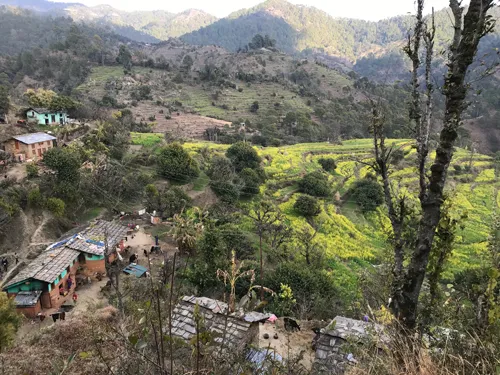
We conducted three phone interviews on April 15, 2021, with research participants in our field sites who confirmed similar experiences in Western Nepal. Three residents in the villages of Selinge in the district of Dadeldhura (Ajayameru Municipality) (Figure 1.1), and Tiltali, in the district of Doti (Shikhar municipality), stated that, in their villages, most keep physical distance and stayed at home as advised on the radio and national TV news. They hoped that returning migrants would follow quarantine rules so that the virus would not spread. Limited access to markets severely affected the whole cropping season as they could not purchase agricultural inputs or sell their produce. The supply of soaps, vegetables, or cell-phone recharge cards from the market was limited, as residents were advised not to leave their village, which was perceived as being considerably safe. Instead, a private truck regularly delivered food to them, although limited to those who could afford to buy food. This was problematic for those with limited financial resources if regular remittances no longer arrived.
Figure 1.1 Mustard on rice terraces in the village Selinge, Dadeldhura, Nepal, in February 2020 shortly before the lockdown (Stephanie Leder).
When we carried out fieldwork again in February 2021 across different villages in the same district, we conducted interviews both with farmers and local government stakeholders. The farmers recounted their stories of agricultural loss during the three months of lockdown. A female commercial vegetable farmer in the village Puilekh in Dadeldhura mentioned “last year the chilies that sold for 120 rupees [NPR, equals to about 1 USD], during lockdown they sold for only 20 rupees [NPR, equals to about 0.17 USD].” Farmers sold their chili for less than one-fifth of the normal market price during COVID-19. Further research is needed to systematically collect data on other vegetable prices across diverse districts.
Similarly, a couple of prominent farmers from the same village shared how COVID-19 mobility restrictions forced them to sell their vegetables and livestock at lower prices in their own village instead of at the local marketplace in Dadeldhura. “What remained after household consumption, we distributed to the neighbors,” the wife said. Furthermore, they suffered a loss of approximately 80,000 NPR (equal to about 700 USD) for selling their poultry at lower prices.
We suspect that the short-term food security effects of the lockdown measures were cushioned through the subsistence farming widely prevalent among Nepal’s poorest small-scale farmers, and the sharing of surplus produce with neighbors. Further investigations are needed to determine the different effects of the lockdown on households with diverse degrees of involvement in agriculture and different landholding sizes. Of particular importance is the need to assess whether landless laborers’ households were supported through local social networks, as they must have faced food shortages while being dependent on daily wages not available during the lockdown. In an earlier study on women’s empowerment in water security programs in the same sites in Western Nepal, Leder et al. (2017) found that differences between women, such as age, marital status, caste, remittance flow, and land ownership, led to some benefiting more than others from water and food security programs. Hence, we assume that the poorest and most disadvantaged women are also those most affected by the lockdown, due to their differential access to resources. The study also identified the importance of inter-household relations within communities, as well as intra-household relations: these social relationships strongly shaped women’s agency in their ability to secure water and food. We further assume that collective action is an underrecognized factor contributing to household food security in times of restricted mobility and market lockdown, as farmer collectives are able to improve smallholder’s food security through the pooling of labor, land, produce, and capital (Leder et al., 2019; Sugden et al., 2020).
Government of Nepal’s response for relief and recovery
Shortly after the Government of Nepal imposed a national lockdown, the Council of Ministers, through a decision made on 29 March, directed local governments to arrange vehicles to transport local produce to nearby markets and to the Kathmandu valley. In the same decision, local governments were directed to provide mobility passes for the vehicles of local entrepreneurs transporting local produce to markets.
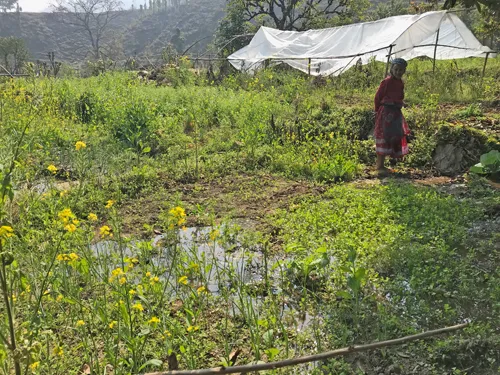
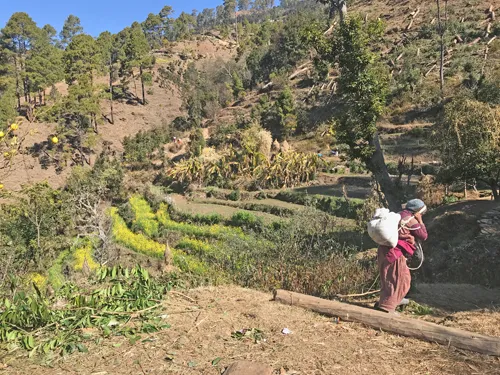
In May 2020, the Government of Nepal introduced emergency relief packages for farmers. However, voices from the field share the exclusionary consequences of such packages. Certain criteria must be fulfilled in order to be eligible for benefit from the relief, such as land entitlement and land size. The central government has announced a relief package of 750 Nepali rupees (6.20 USD) per kattha (338m2) of land. In Province 2, the government has announced a relief package for farmers who own 10 kattha (3380m2) of land, and cultivate it themselves, to receive 10,000 NPR cash in their accounts. This de facto excludes smallholders, tenant farmers, sharecroppers, and daily agricultural wage laborers, of which the majority are women (Figures 1.2 and 1.3).
This has huge implications on women’s well-being and family food security. While men equally suffer psychological stress due to the loss of income in emergencies, women are the ones to sell their assets first, causing increased incidences of poverty among women and women-headed households. Gender scholars repeatedly highlight the imperatives of gender and social inclusion measures in long-term agricultural and food security planning in Nepal. As a study on gendered practices in the water sector in Nepal shows, gender equality and social inclusion attempts only focus on gender quotas of 33 percent of women in water-user associations, without strategies to pursue more inclusive decision-making to overcome unequal and gendered power relations (Shrestha & Clement, 2019).
Figure 1.2 A woman farmer in front of her self-built polyhouse in the village Tiltali, Doti, Nepal, in February 2020 shortly before the corona lockdown. Self-built polyhouses as affordable support from local government (Stephanie Leder).
Figure 1.3 A female wage laborer carrying sand to build a new irrigation pond in the village Syauke, Dadeldhura, Nepal, in February 2020 shortly before the corona lockdown (Stephanie Leder).
Finally, the Government of Nepal and the World Bank signed an 80 million USD agreement to strengthen rural market linkages and promote agricultural entrepreneurship to facilitate post-COVID-19 recovery. The Rural Enterprise and Economic Development (REED) project will be implemented in five economic corridors spanning the seven provinces. The project will use a “cash for work” approach (GoN and WB, 2020). Cash for work is a labor-intensive approach and hence it is important to consider how it can be made gender-responsive, given that women are already overburdened with work due to high care responsibilities and often out-migrated husbands. Furthermore, as the project focuses on market and entrepreneurship, the degree to which it will benefit smallholder subsistence farming groups in order to lessen the risk of food insecurity seems unclear. As our research has demonstrated, local social networks, subsistence farming, and neighborhood sharing were particularly important to ensure food security.
The government of our field study (Province 7, Sudurpaschim) encouraged youth migrant returnees toward agriculture through facilitation and prize-distribution programs targeted toward people who have contributed in the local production through their entrepreneurship. They launched an agriculture subsidy program targeting returnee migrant workers in a bid to control remigration of young men during the pandemic to India or elsewhere. The 150 million NPR program (about 1.3 million USD) was targeted to provide 100,000 to 500,000 NPR (about 860–4300 USD) to more than 5000 workers; however, the number of applicants for the fund exceeded 80,000 (Shah, 2020). In Ajayameru municipality, 500 people applied for the agriculture subsidy and half of them received it. It is hoped that these loans will be used as intended, to support migrants in vegetable farming as well as livestock entrepreneurship such as buffalo and poultry farming, and pig and goat keeping at home. Notably, there will be gendered implications of these loans, as return migrants are predominantly men.
Women’s organizations and inclusive digital platforms to spread awareness
Local women leaders and farmer-managed organizations such as water-user associations are important backbones to handle the COVID-19 crisis, as they can reach out to rural farming populations. However, they do not have sufficient resources and influence on decision-making. A webinar organized by the IRDR Centre for Gender and Disaster co-hosted by Pallavi Payal, an independent researcher from Nepal, aimed to explore the lived experiences of women political leaders in Nepal in the time of COVID-19 (Yadav & Payal, 2020). In the webinar, Female Deputy Mayors from Nepa...
Table of contents
Cover
Half-Title
Series
Title
Copyright
Contents
List of figures
Contributor biographies
Acknowledgments
Introduction
PART 1 Food insecurity
PART 2 Care work in families, households, and communities
PART 3 Intersectional inequalities in the food system
PART 4 Beyond COVID: moving forward with policy and research
Conclusion
Index
Trusted by 375,005 students
Access to over 1.5 million titles for a fair monthly price.
Study more efficiently using our study tools.
Frequently asked questions
Yes, you can cancel anytime from the Subscription tab in your account settings on the Perlego website. Your subscription will stay active until the end of your current billing period. Learn how to cancel your subscription
No, books cannot be downloaded as external files, such as PDFs, for use outside of Perlego. However, you can download books within the Perlego app for offline reading on mobile or tablet. Learn how to download books offline
Perlego offers two plans: Essential and Complete
Essential is ideal for learners and professionals who enjoy exploring a wide range of subjects. Access the Essential Library with 800,000+ trusted titles and best-sellers across business, personal growth, and the humanities. Includes unlimited reading time and Standard Read Aloud voice.
Complete: Perfect for advanced learners and researchers needing full, unrestricted access. Unlock 1.5M+ books across hundreds of subjects, including academic and specialized titles. The Complete Plan also includes advanced features like Premium Read Aloud and Research Assistant.
Both plans are available with monthly, semester, or annual billing cycles.
We are an online textbook subscription service, where you can get access to an entire online library for less than the price of a single book per month. With over 1.5 million books across 990+ topics, we’ve got you covered! Learn about our mission
Look out for the read-aloud symbol on your next book to see if you can listen to it. The read-aloud tool reads text aloud for you, highlighting the text as it is being read. You can pause it, speed it up and slow it down. Learn more about Read Aloud
Yes! You can use the Perlego app on both iOS and Android devices to read anytime, anywhere — even offline. Perfect for commutes or when you’re on the go. Please note we cannot support devices running on iOS 13 and Android 7 or earlier. Learn more about using the app
Yes, you can access Gender, Food and COVID-19 by Paige Castellanos, Carolyn E. Sachs, Ann R. Tickamyer, Paige Castellanos,Carolyn E. Sachs,Ann R. Tickamyer in PDF and/or ePUB format, as well as other popular books in Negocios y empresa & Agronegocios. We have over 1.5 million books available in our catalogue for you to explore.