For decades scholars have pored over Hitler's autobiographical journey/political treatise, debating if Mein Kampf has genocidal overtones and arguably led to the Holocaust. For the first time, Hitler's Mein Kampf and the Holocaust sees celebrated international scholars analyse the book from various angles to demonstrate how it laid the groundwork for the Shoah through Hitler's venomous attack on the Jews in his text.
Split into three main sections which focus on 'contexts', 'eugenics' and 'religion', the book reflects carefully on the point at which the Fuhrer's actions and policies turn genocidal during the Third Reich and whether Mein Kampf presaged Nazi Germany's descent into genocide. There are contributions from leading academics from across the United States and Germany, including Magnus Brechtken, Susannah Heschel and Nathan Stoltzfus, along with totally new insights into the source material in light of the 2016 German critical edition of Mein Kampf. Hitler's views on Marxism, violence, and leadership, as well as his anti-Semitic rhetoric are examined in detail as you are taken down the disturbing path from a hateful book to the Holocaust.
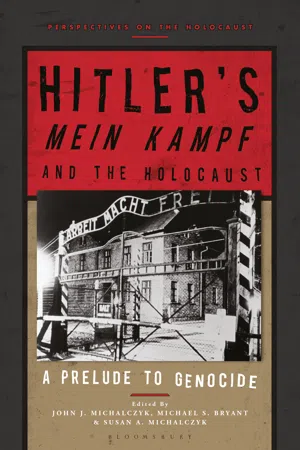
eBook - ePub
Hitler’s ‘Mein Kampf’ and the Holocaust
A Prelude to Genocide
- 368 pages
- English
- ePUB (mobile friendly)
- Available on iOS & Android
eBook - ePub
Hitler’s ‘Mein Kampf’ and the Holocaust
A Prelude to Genocide
About this book
Information
PART I
The Mise-en-Scène of Mein Kampf, 1924–2016
In a 1946 letter to Karl Jaspers, Hannah Arendt complained that the crimes of the Nazis were so unprecedented, so far beyond the ordinary human categories of sin, guilt, and accountability, that they “explode the limits of the law; this guilt, in contrast to all criminal guilt, oversteps and shatters any and all legal systems.” Jaspers would have none of it, chiding Arendt that such an attitude invested Nazi crimes with “satanic greatness.” Jaspers’s view that Nazi villainy was not truly original applies equally to many, and perhaps all, of the half-baked ideas presented in Mein Kampf, which Hitler adopted from the hard central European right of the fin de siècle and the fetid intellectual sewer of the postwar years in Germany.
At one time, Hitler’s party was just one of a hundred folk-national groups in the country against whom the Nazis competed for support. In Munich alone, between 1925 and 1928, Hitler had to contend for mastery with seventy extreme right-wing groups. In aggregate, they formed a taproot of imperialist, anti-Semitic, and anti-Republican notions that Hitler drew on when writing Mein Kampf. Some of them, like the belief that the Jews were dirty and malodorous, were centuries-old stereotypes dating back to the Middle Ages. Others were the excrescences of nineteenth-century German Romanticism, such as the idea that war strengthened and renewed a population. The concept of the Führer, a charismatic “strong man” mentioned in connection with Hitler’s leadership for the first time in December 1921, likewise had its origins in Romanticism as a backlash against mass democratic politics and, during the Wilhelmine period, disappointment with Wilhelm II’s Weltpolitik. By the 1920s, the Führer conceit had come to underlie a prevalent convention of the German far-right, the dichotomy between democracy/the mass and the “personality.” From Romanticism, the German folk-nationalists also borrowed the notion of the state as a “living organism,” reinterpreted by Hitler and other right-wing leaders as a body devoted exclusively to preserving the German race.
Nearly every anti-Semitic cliché in Mein Kampf is derived from other sources. The myth that the Jews had “Judaized” German culture, the equation of Jews with disease and leftist political groups, the claim that the Jew was an inveterate liar, the charge that the Jews dominated the press, the stereotype that the Jews were materialistic and incapable of higher spiritual values, the assertion that race, not language, is the determinant of German nationality, the belief that the Jews had enslaved the German government—these and dozens of other themes expressed in Mein Kampf were well-worn coins in the anti-Semite’s purse long before Hitler.
Hitler’s theory of race in Mein Kampf, too, was derivative. The foundation appears to be Joseph Arthur de Gobineau (1816–82), a French aristocrat who argued in his Essay on the Inequality of the Human Races (1853, translated into German as Versuch ueber die Ungleichheit der Menschenracen, 1898–1902) that humanity consisted of three races—the yellow, black, and white—and that of these three, only the white race, due to its “Aryan” elements, possessed the ability to achieve high culture. The decline and fall of every civilization in history were due to racial interbreeding between these three groups, wherein the culture-producing vitality of the Aryan was eroded. The German translation of Gobineau’s book gained traction in the Bayreuth Circle around Richard Wagner, whence his ideas sifted into Houston Stewart Chamberlain’s treatise Die Grundlagen des neunzehnten Jahrhunderts (The Foundations of the Nineteenth Century, 1899). Wagner and Chamberlain, then, transmitted these ideas to Hitler and the German folk-national right. Hitler’s additive was to see in the Jews not only a threat of cultural decay but an actual conspiracy to destroy the higher culture of the Aryan.
In the end, none of Hitler’s ideas was particularly new. What was new, however, was Hitler’s willingness to implement them once he stood astride Europe as the supreme warlord, pursuing them with a dogged fanaticism unto the gas chambers of the death camps.
1
Focus Landsberg
A Bavarian Town and Its Historical Ties to Hitler
Karla Schönebeck
The ties and connections between Landsberg and Adolf Hitler are the story of a relationship that is characterized by sober calculation, as well as highest expectations and unrequited love. It is a story with far-reaching consequences up to the present day.
At the time of his writing Mein Kampf in the Landsberg prison, Hitler was as relatively unknown as the provincial town itself, little known in Upper Bavaria as elsewhere in Germany. Still, on the evening of November 11, 1923, the consignment to the Landsberg prison of a man who had tried to put himself in power represented legal justice.
Was Hitler only a small revolutionary, perhaps a lunatic, who, once sent to the Landsberg prison, simply described himself as a pompous and meaningless writer?1 Or perhaps the future protector of salvation, promising the Landsbergers, the Bavarians, and even the Germans freedom from economic, social, and political burdens, escape from all the traumas they had suffered every day as a result of the loss of the Great War and the humiliation of the Treaty of Versailles?
The end of the Great War heralded an epoch of unprecedented trials for the German people. With the slaughter at the battles of Ypres, before Verdun, or at the Somme, the history of industrial killing had begun.2 All those who returned, defeated from battle, found a completely changed world. This became quite clear in the small towns with few inhabitants, such as Landsberg, that felt the casualties and deaths in the extreme. Landsberg, at that time, had only about 7,000 inhabitants.
The small town on the river Lech was known for its natural beauty, a humble hamlet-like idyll characterized by schools, Catholicism, public administrations, handicrafts, as well as its economic achievements, with a number of small and medium-sized industrial enterprises. Above all, Landsberg was familiar to everyone as a garrison town and had since 1908 one of the most modern prison buildings in Bavaria, a visible symbol of law and order.
Social and political conflicts accompanied the economic and thus existential hardship caused by the war, exacerbated by a Bavarian phenomenon. The Bavarian municipal constitution, dating back to the prewar period of 1908, linked municipal voting rights to civil rights. Since most of Landsberg’s workers were not part of the long-established population, only a few of them were recognized as having the right to vote.3 With a privileged minority dominating municipal politics, eventually an unbridgeable gap opened up between the traditional upper and lower classes, and it was against this backdrop that the revolutionary events of 1918–19 took place.
Only 50 kilometers away, in Munich, Kurt Eisner of the Independent Social Democratic Party of Germany (USPD) had proclaimed the Bavarian Republic as a “Free State” after the unspectacular fall of the last Bavarian king Ludwig III on November 8, 1918. Eisner was elected prime minister by the Assembly of Workers’ and Soldiers’ Councils, and only one day later, on November 9, 1918, a workers’ and soldiers’ council was formed in Landsberg, similar to those in Augsburg and Ingolstadt. Compared to the civil war–like conditions in Munich, the Landsberg revolution seemed moderate and non-threatening. Although thousands of supportive citizens gathered on the main square, when the acting mayor, Dr. Hermann Straßer, took the floor, and not the chairman of the Workers’ and Soldiers’ Council, it was seen as a sign of constructive cooperation.4
The fact that Munich mutated into the epicenter of the Central European Counterrevolution for a short period of time did not leave Landsberg unaffected; however, apart from a few harsh fisticuffs, there was no bloody confrontation between white and red. Red cells, Spartacists or communists, on the other hand, were found by chance at the neighboring Ammersee (Riederau/Dießen), where, among others, a son of Karl Liebknecht, Helmi Liebknecht, had fled after the murder of his father at the beginning of 1919.
Even though the fear of left-wing radical revolutionaries outside Munich was unfounded, fears of an overthrow of the social order, as elsewhere in Landsberg, encouraged the formation of Freikorps associations and local defenses. It was in this context that the name of Felix Danner,5 a native of Franconia, appeared for the first time. While at the Landsberg railway station, he had succeeded in carrying 2 box cars destined for the Red Army in Munich, including 56 machine guns, 500,000 rounds of ammunition and hand grenades. The weapons remained hidden and were never used.
One month later, on February 21, 1919, Bavarian prime minister Kurt Eisner was murdered on his way to the Bavarian Parliament where he was planning to abdicate. The assassin, Arco Graf von Valley,6 sympathized with the anti-Semitic Thule Society and was sentenced to life imprisonment in a fortress, which was seen as an honor, and transferred to Landsberg.
After Eisner’s assassination, the disputes between the supporters of a parliamentary democracy and those of a socialist Soviet republic in Bavaria intensified. The revolutionary counterforces were never used in Landsberg itself; however, they were put to good use outside the city. The Liftl Group operated in Munich, as did the Freikorps Landsberg, in association with the Bavarian corps of shooters, Schützenkorps, under the leadership of Colonel Franz Ritter von Epp. The Freikorps Landsberg, consisting of approximately 1,000 men, had been originally founded by former officers of the 9th Field Artillery Regiment stationed in Landsberg and eventually dissolved after the First World War, following the terms of the Treaty of Versailles. These troops, the Freikorps Landsberg, had hidden their weapons in the Benedictine abbey of St. Ottilien, forever known in history for their participation in “Operation Munich” and the associated violent suppression of the dictatorship of the councils.
With the municipal and district elections of June 15, 1919, the Bavarian council movement (Räterepublik) was defeated and politically destroyed. In Bavaria, as in the entire Reich, the civil defense forces were combined to form a statewide self-defense association, the so-called Einwohnerwehren. From then on, they presented themselves not only as a security instrument but also as a means of enriching social life with concert evenings in Landsberg.7
And Adolf Hitler? He had experienced the revolution more or less as a spectator, facing political uncertainty, and yet he learned much from these events. He identified with and understood the small soldiers returning home as defeated and damaged losers. In prison, Hitler knew that others saw him as a nobody without a graduation certificate, humiliated once again at the Beer Hall Putsch Trial, painfully similar to his humiliation in Vienna, where he had twice been rejected by the Academy of Fine Arts. The catastrophes of the postwar period, the fall of the monarchy, the civil war, and the provisions of the Treaty of Versailles had obviously affected his mental health, pushing him toward a crisis.
Hitler directed his intense experiences of loss outward, turning his frustration and anger into intense delusional hatred of the Jews that would become the driving force for his future plans. Munich, a city of countless emigrants from the former tsarist empire, fleeing the Russian Revolution, was the ideal place and breeding ground, providing a toxic connection to the losers of the First World War. The myth of Jewish Bolshevism combined with anti-Semitism naturally and smoothly linked thoughts of both émigrés and local folk. This ominous mélange spread as quickly and destructively as an epidemic.
In the spring of 1920, Felix Danner from Landsberg met Adolf Hitler in Munich’s Sterneckerbräu, the pub and founding location of the National Socialist German Workers Party (NSDAP), under whose guidance Danner founded the Landsberg local group (the NSDAP) shortly afterwards. The Bavarian People’s Party (BVP), which had emerged from the Catholic Centre Party, was strongly represented. In the state elections between 1919 and 1933, the BVP, also susceptible to nationalist and anti-Semitic tendencies, received between 31 and 39 percent of the vote. The Landsberg BVP participated almost vehemently in the propaganda against Weimar foreign policy, while all other bourgeois parties played only subordinate roles. The radical right, on the other hand, had already firmly established itself in Landsberg, chanting the slogan, “November criminals, the Jews, the Communists and all the other enemies of the people.” In addition, SA stormtrooper units had quickly formed in Landsberg and the surrounding area.
Their zeal was tempered when an SA unit from Dießen at Lake Ammersee after Hitler’s committal on November 11, 1923, hoping to participate in his liberation following the failed Beer Hall Putsch, was recalled from Munich.8 In contrast, ...
Table of contents
- Cover
- Half-Title
- Series
- Dedication
- Title
- Contents
- List of Figures
- Foreword
- Acknowledgments
- Introduction
- Part I The Mise-en-Scène of Mein Kampf, 1924–2016
- Part II Establishing Power
- Part III Eugenics and Aesthetics in Mein Kampf
- Part IV Mein Kampf and the Crusade against Germany’s “Enemies”
- Part V Religious Overtones in Mein Kampf
- Part VI Epilogue
- Appendix
- Notes
- Bibliography
- List of Contributors
- Index
- Copyright
Trusted by 375,005 students
Access to over 1.5 million titles for a fair monthly price.
Study more efficiently using our study tools.
Frequently asked questions
Yes, you can cancel anytime from the Subscription tab in your account settings on the Perlego website. Your subscription will stay active until the end of your current billing period. Learn how to cancel your subscription
No, books cannot be downloaded as external files, such as PDFs, for use outside of Perlego. However, you can download books within the Perlego app for offline reading on mobile or tablet. Learn how to download books offline
Perlego offers two plans: Essential and Complete
- Essential is ideal for learners and professionals who enjoy exploring a wide range of subjects. Access the Essential Library with 800,000+ trusted titles and best-sellers across business, personal growth, and the humanities. Includes unlimited reading time and Standard Read Aloud voice.
- Complete: Perfect for advanced learners and researchers needing full, unrestricted access. Unlock 1.5M+ books across hundreds of subjects, including academic and specialized titles. The Complete Plan also includes advanced features like Premium Read Aloud and Research Assistant.
We are an online textbook subscription service, where you can get access to an entire online library for less than the price of a single book per month. With over 1.5 million books across 990+ topics, we’ve got you covered! Learn about our mission
Look out for the read-aloud symbol on your next book to see if you can listen to it. The read-aloud tool reads text aloud for you, highlighting the text as it is being read. You can pause it, speed it up and slow it down. Learn more about Read Aloud
Yes! You can use the Perlego app on both iOS and Android devices to read anytime, anywhere — even offline. Perfect for commutes or when you’re on the go.
Please note we cannot support devices running on iOS 13 and Android 7 or earlier. Learn more about using the app
Please note we cannot support devices running on iOS 13 and Android 7 or earlier. Learn more about using the app
Yes, you can access Hitler’s ‘Mein Kampf’ and the Holocaust by John J. Michalczyk, Michael S. Bryant, Susan A. Michalczyk, John J. Michalczyk,Michael S. Bryant,Susan A. Michalczyk in PDF and/or ePUB format, as well as other popular books in History & 20th Century History. We have over 1.5 million books available in our catalogue for you to explore.