This book will inspire, challenge and engage you—and transform your teaching and learning. Each chapter in this book is written by a different educator or team about their experiences with project-based learning, both in and out of the classroom. They reflect not only on the how of project-based learning, but more importantly, on the what and the why. They offer insight into how connecting with learners, honouring their experiences, and promoting deep and rich questioning can be the path to powerful projects and learning. Their writing and thinking is saturated with empathy, expertise, a desire to improve their practice, and an acknowledgment of the need to collaborate.
eBook - ePub
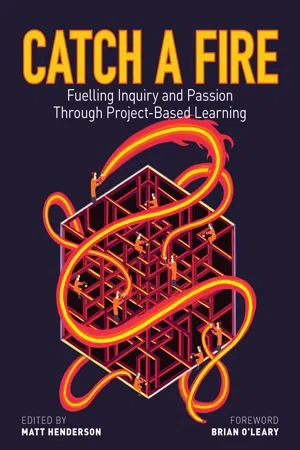
Catch a Fire
Fuelling Inquiry and Passion Through Project-Based Learning
- 200 pages
- English
- ePUB (mobile friendly)
- Available on iOS & Android
eBook - ePub
Catch a Fire
Fuelling Inquiry and Passion Through Project-Based Learning
About this book
Information
Topic
EducationSubtopic
Inclusive EducationCHAPTER 1
What Is a Project?
Matt Henderson, Assistant Superintendent, Seven Oaks School Division, and former principal, Maples Met School
Winnipeg, Manitoba, Canada
For this chapter, I asked learners of all ages to tell me what they think a project is. These learners, both young and old, all do amazing projects. They push the idea of what it means to be human on a daily basis. They are offbeat, yes, but they ask deep questions about the universe; they question their role within it; their curiosity is unquenchable.
Joel Jae Serrano, High School Learner
I would consider my childhood unconventional. Living in Dubai did not help either. The costs of living meant that my family barely made any allowance; therefore, I never had many toys. So I created my own. That was probably my magical moment – my very first project.
I think a project is something that has a purpose, triggered by an idea or a question that we have stumbled upon during our day-to-day lives. A broad question like, “How can we reform capitalism?”, or something as simple as, “Why are there labels on our store-bought fruits?” I like to think of it with a stoic’s perspective, instead of asking nonessential questions and thinking they matter in the real world. A project requires a set of tasks to accomplish, challenging our limitations. Creativity arises from working within these limitations, and constraints placed on these projects is also key.
A proverb from Joi Ito, director of the MIT Media Lab, goes as follows: “Education is what people do to you. Learning is what you do to yourself.” When I heard this, I realized that I was no longer a student but my own teacher. The point was not to receive a greater education, but to create my own learning and shape it for the unique challenges that await in this complex, unpredictable world, which is more connected than ever before.
Dr. Jay Roberts, PhD, Professor of Education, Earlham College
When we speak about project-based learning, we often have mental models in our heads about what such a pedagogy entails. But it is important to speak a bit about what we mean by a project in order to fully realize its educative potential. After all, a project poorly conceptualized with substandard planning is doomed from the start – regardless of the quality of the teacher and students.
For me, an educative project must contain five central elements:
1.Open-ended framing. (If the project is about gardens, do my learners know what a garden is?)
2.Authentic context. (Are my learners going to be engaged in gardening?)
3.Rich content. (Are my learners going to be learning about cell division, photosynthesis, nitrogen cycles, etc., from experts in the field?)
4.Intentional scaffolding. (Are there critical moments when we connect with the learners to ensure that they are learning?)
5.Student ownership. (Do the learners own what they are learning? Is the project their own?)
Projects should be open-ended in the sense that the design and conceptualization of the project are not predetermined in advance by the teacher. This takes an artful balance between laying the groundwork and framing the project without over-determining the design to the point that students perceive the project as “handed down” rather than co-constructed.
Projects should incorporate authentic contexts. The project should matter to someone besides the teacher and the students. This can be done through a presentation of learning to a community partner or through careful framing and facilitation that enables students to see the connections between the project and their lived experiences.
The content associated with the project should be rich and intentionally scaffolded (or integrated) through direct instruction, activities, and assessments. We must guard against the false dichotomies of lecture vs. active learning. That is, it is okay for our learners to engage in lectures. They are not bad, nor are other ways of connecting with content. We are after content that offers a rich, meaningful learning experience, and this can be achieved through a variety of instructional methodologies – including direct instruction.
Finally, projects should put the student at the centre of the learning endeavour. Students should be actively involved in all aspects of the project, including design, implementation, and assessment.
Alyric Balcita, High School Learner
A project can really be almost anything. If there’s a question you really want to know the answer to, and it involves a process, you can turn that into a project. If there is something you really want to do or prove, that can also be a project!
A project comes with passion and drive. Without those two things, wouldn’t the project seem pointless? Of course, every project has a purpose, but without passion or drive, there would be no positive motivation. That is what pushes you to complete it. Sometimes we’re given projects that we don’t enjoy. When it comes to that, we have to find something in the project that will help us complete it. For instance, the longer you take to get it done, the longer you have to dread it! With project-based learning, everything is project-based (obviously). When almost everything you do is in project form, you get better at finding ways to get motivated.
I think that the best projects are based on something you enjoy. If a final product is something that can be made from or presented about something you’re passionate about, then you’ve found that drive. When it’s something you enjoy, you put in more effort without thinking too hard about it. That is what a project is to me.
Kal Barteski, Artist
For me, a project is a meaningful, creation-based task or series of tasks, like a painting or a collection of paintings. There is a goal, but the goal can be loosely defined. It is a thing that gains momentum, meaning, and focus – maybe magic, too.
Sometimes the start and end of such works are clearly marked. Sometimes there are parameters and requirements. The “projects” I gravitate toward and dream about are organic processes that change shape and scope as the work progresses and interacts with the world. One example that speaks to this is the SeaWalls Churchill project I was part of in Churchill, Manitoba <www.seawallschurchill.ca>. This project brought together artists from all over the world to a community in need. I love this description of the SeaWalls project:
SeaWalls Churchill was created with the intention to educate and inspire a community to protect the oceans, but what transpired was more powerful than that. It was the story of a devastated small town on the edge of the Arctic being reminded of their own value and worthiness in this world.
Kevin Nikkel, Filmmaker
Speaking as an independent filmmaker, a project for me is a documentary. I understand each project as a process. When an idea triggers my curiosity, I’m compelled towards understanding something. I formulate my discovery into a summation of my learning, which is a finished film. To do this, I dive deep into what others have discovered previously. That involves lots of reading and hours spent in the archives, searching for clues. I’ll travel to a location, try and uncover a source, and find people with answers to my questions.
Film projects are about collaboration. I seek out those with wisdom and a connection to the story I want to tell – with luck they’ll be willing to appear on camera. Equally important are the friends I return to, film after film, who help me bring the story into focus. A camera operator, a composer, or friends who patiently watch a draft of a latest project – they know my body of work, they know where I’ve been, and they know when I’m starting to lose objectivity. I know that, as much as a project demands hours of introverted work, these projects are at their best when developed in the context of community.
Our consumer-driven culture usually sees projects as commodities needing to be measured and assessed. Did it get into enough big film festivals? Did it play on TV? How many “likes”? How many views online? This is a poor measure of a good project. I’d rather ask: Did I enjoy the collaborative process of learning, the process that is reflected in the end credits of the film? Did my film help others see something in a way they hadn’t been able to see it before?
Dennis Littky, Co-founder, Big Picture Learning
A project can be good? A project can be bad?
The Big Picture philosophy goes beyond projects. First, it’s all about the project being one the student is interested in and passionate about. Projects are better than lectures, but if they do not belong to the student, they have not gone far enough.
The goal is to engage students so that they want to study, want to go deeper, and find the flow in the work. Once students find out their interest and what they want to investigate or do, then it is important for a staff member to be a coach who helps students go deeper and helps them stay engaged with their idea.
I know there are many protocols to help students develop projects. But these are only helpful when the student cares. If the student doesn’t care, then it’s fake learning.
Yes, my schools in the past have done great projects based on the curriculum. But for 22 years, the emphasis, the key to a project is that students make it their own. One student was studying the Vietnam War because his father fought in it and wouldn’t speak about it. This fact kept the student engaged and motivated him to take college classes, to have war veterans as his mentors, and even to visit Vietnam.
One boy’s uncle was shot and killed in a bar. The killer was never caught, and the boy fought to have the legislators make sure all bars had video cameras at their doors. So you see, many projects can come about based on personal needs.
Projects are good. We can improve on how we help students develop them. But if they are not student-driven projects, then they are not good enough.
About the Authors
Tom Lake and Bonnie Powers are passionate experiential educators with experience in traditional (primary through higher) education, and outdoor, corporate, and environmental education programming. This husband and wife team travels to study and engage with different forms of education around the world. Their interests include learning, being outside, and thinking outside the box.
Who Should Read This Chapter?
Anyone interested in broadening their scope of practice to include socio-emotional development as well as academic progress.
The Theme of This Chapter in Three Words
Learners are people.
As an Educator, What Are You Passionate About?
The process of learning, engaging and empowering individuals, and valuing each learner as a unique person.
CHAPTER 2
How Does Project-Based Learning Allow for the Development of the Whole Student?
Tom Lake, Northwest Passage High School, and Bonnie Powers, Minnesota State University, Mankato, St. Paul, Minnesota, USA
Education is one of the great uniting, and potentially divisive, factors in life. Whatever our backgrounds are, people around the world have experience-based opinions about what education is and what it should be. The industrial era model of learning, characterized by timed lessons, rigid structures, and straight rows of desks, served its early 20th-century purpose by creating a relatively uniform workforce, but we now find ourselves in a new era where information is available at the touch of a fingertip, where young adults can expect to work a multitude of jobs rather than...
Table of contents
- Cover
- Title
- Copyright
- Dedication
- Contents
- Foreword
- Preface
- Introduction
- 1. What Is a Project?
- 2. How Does Project-Based Learning Allow for the Development of the Whole Student?
- 3. How Can Teachers Engage Students with Specific Learning Outcomes (SLOs) While Still Remaining True to the Spirit of Inquiry?
- 4. What Can We Learn When We Live the Math?
- 5. Insights from a Central American Agro-Conservation International Development Project
- 6. How Can Projects Work for Our Most Vulnerable Learners?
- 7. How Can Project-Based Learning Work with Learners on the Autism Spectrum?
- 8. Getting People on Board the Project-Based Learning Bus
- 9. Experiencing Project-Based Learning: Beginning in Teacher Education
- 10. Ecological Literacy and Project-Based Learning
- 11. One House Many Nations: Indigenous Project-Based Collaboration
- 12. Home-School Projects: Are They Learning the Right Stuff?
- Conclusion: Assessment for Continuity
Trusted by 375,005 students
Access to over 1.5 million titles for a fair monthly price.
Study more efficiently using our study tools.
Frequently asked questions
Yes, you can cancel anytime from the Subscription tab in your account settings on the Perlego website. Your subscription will stay active until the end of your current billing period. Learn how to cancel your subscription
No, books cannot be downloaded as external files, such as PDFs, for use outside of Perlego. However, you can download books within the Perlego app for offline reading on mobile or tablet. Learn how to download books offline
Perlego offers two plans: Essential and Complete
- Essential is ideal for learners and professionals who enjoy exploring a wide range of subjects. Access the Essential Library with 800,000+ trusted titles and best-sellers across business, personal growth, and the humanities. Includes unlimited reading time and Standard Read Aloud voice.
- Complete: Perfect for advanced learners and researchers needing full, unrestricted access. Unlock 1.5M+ books across hundreds of subjects, including academic and specialized titles. The Complete Plan also includes advanced features like Premium Read Aloud and Research Assistant.
We are an online textbook subscription service, where you can get access to an entire online library for less than the price of a single book per month. With over 1.5 million books across 990+ topics, we’ve got you covered! Learn about our mission
Look out for the read-aloud symbol on your next book to see if you can listen to it. The read-aloud tool reads text aloud for you, highlighting the text as it is being read. You can pause it, speed it up and slow it down. Learn more about Read Aloud
Yes! You can use the Perlego app on both iOS and Android devices to read anytime, anywhere — even offline. Perfect for commutes or when you’re on the go.
Please note we cannot support devices running on iOS 13 and Android 7 or earlier. Learn more about using the app
Please note we cannot support devices running on iOS 13 and Android 7 or earlier. Learn more about using the app
Yes, you can access Catch a Fire by Theresa Armstrong,Dr. Eva Brown,Will Burton,Jonathan Dueck,Bonnie Ferguson-Baird,Keith Fulford,Tom Lake,Dave Law,Glenys MacLeod,Jacob Mans,Bonnie Powers,Laura Sims,Sid Williamson,Alex Wilson, Matt Henderson in PDF and/or ePUB format, as well as other popular books in Education & Inclusive Education. We have over 1.5 million books available in our catalogue for you to explore.