- 152 pages
- English
- ePUB (mobile friendly)
- Available on iOS & Android
eBook - ePub
About this book
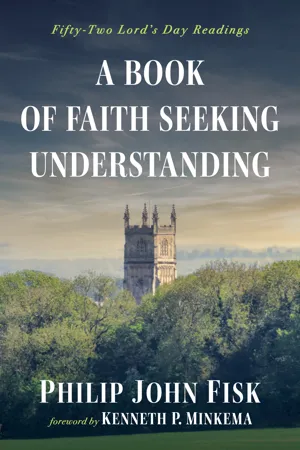
Far too often, the God of the philosophers, those who for the most part had no appointment at a university, are the primary sources relied upon by many authors nowadays in their approach to the problem of evil. These fifty-two Lord's day or Sabbath day readings draw the reader into a dialogue with university professors of the late medieval era and sixteenth and early seventeenth centuries. The theme of these literary renditions of yesteryear's debates and disputations is the perennial quest by theologians to exonerate God from the charge that he is the author of evil. The sophistication and complexity of their scholastic method and solutions to the problem of evil may surprise, but hopefully will persuade, modern day readers to rethink their own conclusion about the problem, and to take up and read university theologians who were formerly unknown, all in the spirit of Anselm's faith seeking understanding.
Information
Topic
PhilosophySubtopic
Philosopher BiographiesTable of contents
- Title Page
- Foreword
- Preface
- Chapter 1: Archetypal theology
- Chapter 2: Ectypal theology
- Chapter 3: The Logos, Life, and Light
- Chapter 4: God’s Knowledge of Approbation
- Chapter 5: God’s Knowledge of Simple Understanding
- Chapter 6: God’s Knowledge of Vision
- Chapter 7: God’s Negative Indifference
- Chapter 8: God’s Double Glory
- Chapter 9: God’s Double Plot Line
- Chapter 10: God’s Double Gift
- Chapter 11: God’s Physical Influx
- Chapter 12: God’s Passions and Immutability-1
- Chapter 13: God’s Passions and Immutability-2
- Chapter 14: Christ Our Surety
- Chapter 15: God’s Foreknowledge and Human Freedom
- Chapter 16: The Will: Producible versus Produced
- Chapter 17: The Priority of Nature versus Time
- Chapter 18: The Noble Cause.
- Chapter 19: The Soul’s Power of the Will
- Chapter 20: Shipwrecked and God’s Physical Predetermination -1
- Chapter 21: Shipwrecked and God’s Physical Predetermination-2
- Chapter 22: Prayer For Such a Time As This
- Chapter 23: Christian Fate
- Chapter 24: Sifting Providence Down to the Pure Bran-1
- Chapter 25: Sifting Providence Down to the Pure Bran-2
- Chapter 26: Sifting Providence Down to the Pure Bran-3
- Chapter 27: Summum Perfectus and Summum Bonum
- Chapter 28: Nunc Aeternitatis
- Chapter 29: The Neutral Proposition
- Chapter 30: Instantia Rationis
- Chapter 31: The Residue of the Spirit
- Chapter 32: A Double Conversion
- Chapter 33: Can The Justified Be Condemned?
- Chapter 34: The Virgin Mystery
- Chapter 35: Can The Past Be Contingent?
- Chapter 36: The Euthyphro Mystery
- Chapter 37: God’s Double Will-1
- Chapter 38: God’s Double Will-2
- Chapter 39: The Mystery of God’s Permissive Will
- Chapter 40: The Mystery of the Messiah’s Impeccability
- Chapter 41: The Mystery of Evil
- Chapter 42: God’s Best Of All Possible Worlds
- Chapter 43: The Mystery of God’s Supposed Middle Knowledge
- Chapter 44: The Mystery of Creabilis, Creandus, and Creatus
- Chapter 45: The Law Of Truth
- Chapter 46: The Law Of Justice
- Chapter 47: The Law Of Wisdom
- Chapter 48: The Square Of Opposition
- Chapter 49: The Square Of Opposition Revisited
- Chapter 50: The Essence of Free Choice
- Chapter 51: The Self-Determining Power of the Will
- Chapter 52: God Is No Minister Of Fate
- Bibliography
Trusted by 375,005 students
Access to over 1.5 million titles for a fair monthly price.
Study more efficiently using our study tools.
Frequently asked questions
Yes, you can cancel anytime from the Subscription tab in your account settings on the Perlego website. Your subscription will stay active until the end of your current billing period. Learn how to cancel your subscription
No, books cannot be downloaded as external files, such as PDFs, for use outside of Perlego. However, you can download books within the Perlego app for offline reading on mobile or tablet. Learn how to download books offline
Perlego offers two plans: Essential and Complete
- Essential is ideal for learners and professionals who enjoy exploring a wide range of subjects. Access the Essential Library with 800,000+ trusted titles and best-sellers across business, personal growth, and the humanities. Includes unlimited reading time and Standard Read Aloud voice.
- Complete: Perfect for advanced learners and researchers needing full, unrestricted access. Unlock 1.5M+ books across hundreds of subjects, including academic and specialized titles. The Complete Plan also includes advanced features like Premium Read Aloud and Research Assistant.
We are an online textbook subscription service, where you can get access to an entire online library for less than the price of a single book per month. With over 1.5 million books across 990+ topics, we’ve got you covered! Learn about our mission
Look out for the read-aloud symbol on your next book to see if you can listen to it. The read-aloud tool reads text aloud for you, highlighting the text as it is being read. You can pause it, speed it up and slow it down. Learn more about Read Aloud
Yes! You can use the Perlego app on both iOS and Android devices to read anytime, anywhere — even offline. Perfect for commutes or when you’re on the go.
Please note we cannot support devices running on iOS 13 and Android 7 or earlier. Learn more about using the app
Please note we cannot support devices running on iOS 13 and Android 7 or earlier. Learn more about using the app
Yes, you can access A Book of Faith Seeking Understanding by Philip John Fisk in PDF and/or ePUB format, as well as other popular books in Philosophy & Philosopher Biographies. We have over 1.5 million books available in our catalogue for you to explore.