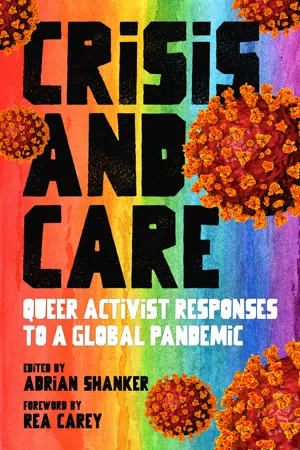
Crisis and Care reveals what is possible when activists mobilize for the radical changes our society needs. In a time of great uncertainty, fear, and isolation, Queer activists organized for health equity, prison abolition, racial justice, and more. Nobody who lived through the COVID-19 pandemic will soon forget the challenges, sacrifices, and incredible loss felt during such an uncertain time in history. Crisis and Care anthologizes not what happened during COVID-19, or why it happened, but rather how Queer activists responded in real time. It considers the necessity to memorialize resiliency as well as loss, hope as well as pain, to remember the strides forward as well as the steps back. Activist contributors Zephyr Williams, Mark Travis Rivera, Jamie Gliksburg, Denise Spivak, Emmett Patterson, Omar Gonzales-Pagan, Kenyon Farrow, and more provide a radical lens through which future activists can consider effective strategies to make change, even or perhaps especially, during periods of crisis.
- 128 pages
- English
- ePUB (mobile friendly)
- Available on iOS & Android
eBook - ePub
About this book
Information
Topic
Ciencias socialesSubtopic
Estudios LGBTBUILDING OUR QUEER AND QUARANTINED SEXUAL WORLDS
Emmett Patterson
I thought thenOf holding youAs a political act. IMay as well haveHeld myself.—Jericho Brown, excerpt from “Stand”
How would we organize and move our communities if we shifted to focus on what we long for and love, rather than what we are negatively reacting to?—adrienne maree brown, Pleasure Activism
Three months passed without grabbing my faithful bottle of poppers and trotting off to my hookup’s house a few blocks away. Had I known it would be my last sexual foray into the outside world, maybe I would have taken more advantage of the moment. When discussing writing this chapter, my partner Rodrigo and I shared similar sentiments with each other. Our open relationship to unabashedly flirt, connect with, and fuck other people is an expression of our queerness. In a moment where we are both choosing to protect each other by forgoing sex outside of our household, I found myself mourning life where I felt at my most sexually liberated.
In the past few years, sexual liberation has become a framework through which I can view how the kind of sex I want and have intertwines with my whiteness, my trans identity and queerness, my disabilities, my body size, and so many more parts of me. A continuous process of growing and reflecting, I have realized that sexual liberation is a road unpaved, one that sharply turns as the potholes of shame and trauma litter the path. Early on in understanding my transness, I maintained social distancing before it was cool. Even though I had just turned eighteen and headed off to a university in one of the gayest cities in the US, I completely avoided gay sexual spaces, fearing rejection and violence from cis men. I found myself assessing risks and choosing celibacy to reduce potential harm.
Now, after finding myself strategically choosing celibacy again, I am reassessing what safer sex and connection in lockdown might look like. As a sexual health activist, I feel that we all have a stake in supporting each other and our desires during a time of unprecedented uncertainty. For me, that means: examining how queer people and our wisdom show up in public health efforts during past and current pandemics; understanding how abstinence-only messages miss the mark, while pleasure-centered prevention could help; and pondering what opportunities we might have to mobilize our people during the quarantine and after it is lifted.
Building a new reality in our quarantined roles leverages our queer power garnered from past pandemics. Our queerness is birthed from the vibrant lives of our queer ancestors, who survived by connecting with each other through sex, radical organizing, and collective care. This is not our first pandemic. We queers have the tools, wisdom, and strength to envision these new realities; meaning, we must remember how to curtail an epidemic that thrives on our physical connection to each other without sacrificing our real needs and desires for that connection.
Who Is the “Public” in Public Health?
Before I go straight into it (as if I can go straight into anything), what do I mean by “public health,” and how does sexual liberation play a role? When stripping back public health to its essential components, we can see that it differs from a Western understanding of health care in two core ways: a focus on populations, rather than individuals, and prevention, instead of treatment. What I have all too quickly figured out while working in partnership with global activists is that public health frameworks alone are inadequate in describing and strategizing toward building a healthier world for queer people, often because we aren’t seen as an integral part of the public itself.
Alexander McClelland, the cofounder of the Policing the Pandemic project, describes the way in which queer people and other marginalized people have been historically removed from public health:
When we talk about public health, we have to think about who is the “public” in public health and whose health is being protected. And when we play that question out, we find that people living with HIV or queers are never the public in public health. They’re always the subjects who the public is to be protected from. So we’re framed as objects of risk that the public is to be protected from.1
To be marginalized is to be excluded from the very definition of public health and, thereby, its efforts. Black and Brown people, Indigenous peoples, queer people, trans people, disabled people, people living with HIV…, aren’t we part of the public who needs protecting, too?
Recently, I have been questioning my place in the frame of “the public.” If I were to map my identities, I would start with being a young, white, queer trans man. At the very beginning of the pandemic surge in the US, I was diagnosed with multiple autoimmune diseases and began biologic therapy to suppress my amped-up immune system. My disabled identity quickly became central in that map, because I instantaneously became both at-risk as an immunocompromised person but invisible in the pandemic as a young person. Every message coming from the US Centers for Disease Control and Prevention (CDC), the World Health Organization, and even Instagram was that young people need not worry; only older people and people with health conditions should be concerned. Even though official federal guidance did not mention people with chronic health conditions or disabilities, I felt the sting of ableism as I watched my peers flaunt their haircuts, crowds flock to the beach, and officials reopen their states despite COVID-19 infection and fatality rates continuing to grow.2
In thinking of public health, it’s obvious that we cannot remove social conditions from our efforts. Public health leaders must not allow themselves to be comforted by “universalizing” approaches that don’t take systemic violence into account. Even when it comes to intimacy and sex, the vast, specific needs that arise in historically marginalized communities remain central. In 2019, I co-led a group of trans and nonbinary community activists on a research project to outline steps toward sexual health and liberation for our communities. A Blueprint for Trans and Non-Binary Sexual Health and Liberation demonstrated that sexual health involves much more than STI testing and treatment; for trans and nonbinary participants, sexual health was “inextricable from overall mental and physical health,” including commonly cited social determinants of health in public health discourse.3 Racism, criminalization, ableism, xenophobia, economic and housing insecurity: these are significant aspects of our sexual health that often get essentialized out of public health. Public health leaders must not ignore the ways in which marginalization and sexual health interact over the course of this pandemic and how liberatory frameworks can describe and alter almost predetermined forces in our lives.
Throughout history, societies have focused on these social conditions by blaming the spread or origin of disease on marginalized people without acknowledging how systems of power remove access to lifesaving information to control one’s health. For people impacted by the HIV and AIDS pandemic in the US, the 4H club named “homosexuals, Haitians, heroin users, and hemophiliacs” or rather “queer and trans people, Black people (and other people of color), people who use drugs, and people with disabilities” as both the most impacted in terms of infection and those responsible for the spread of HIV;4 thus, these groups threatened the health of the privileged “public.”
Societies continue to place marginalized people at odds with public health efforts in the name of protecting the “public.” For example, in Seoul, South Korea, there was a threat to dox and out gay men and the LGB...
Table of contents
- Cover
- Title Page
- Copyright
- Dedication
- Epigraph
- Contents
- Foreword
- Introduction
- Eliminating Health Care Discrimination during a Public Health Crisis
- From Gloryholes to Vaccine Advocacy: The Journey of Queer Health Activism during COVID-19
- Building Our Queer and Quarantined Sexual Worlds
- How LGBTQ+ Centers Kept Communities Connected
- Coronavirus Is a Drag: LGBTQ+ Resilience and Leadership through Drag Arts
- Breathing in Solidarity
- Protest Amid the Pandemic
- Queers, COVID-19, and Medicare for All
- Spiraling into Self-Love: The Wilderness, the Journey, and COVID-19
- Four Things We Must Do to Fight Medical Mistrust After the COVID-19 Pandemic Ends
- Macho, Macho Man: What We Learned About Masculinity from COVID-19
- Reopening the Past or Reimagining the Future?
- Conclusion
- Acknowledgments
- About the Authors
- About PM Press
- Friends of PM Press
Trusted by 375,005 students
Access to over 1.5 million titles for a fair monthly price.
Study more efficiently using our study tools.
Frequently asked questions
Yes, you can cancel anytime from the Subscription tab in your account settings on the Perlego website. Your subscription will stay active until the end of your current billing period. Learn how to cancel your subscription
No, books cannot be downloaded as external files, such as PDFs, for use outside of Perlego. However, you can download books within the Perlego app for offline reading on mobile or tablet. Learn how to download books offline
Perlego offers two plans: Essential and Complete
- Essential is ideal for learners and professionals who enjoy exploring a wide range of subjects. Access the Essential Library with 800,000+ trusted titles and best-sellers across business, personal growth, and the humanities. Includes unlimited reading time and Standard Read Aloud voice.
- Complete: Perfect for advanced learners and researchers needing full, unrestricted access. Unlock 1.5M+ books across hundreds of subjects, including academic and specialized titles. The Complete Plan also includes advanced features like Premium Read Aloud and Research Assistant.
We are an online textbook subscription service, where you can get access to an entire online library for less than the price of a single book per month. With over 1.5 million books across 990+ topics, we’ve got you covered! Learn about our mission
Look out for the read-aloud symbol on your next book to see if you can listen to it. The read-aloud tool reads text aloud for you, highlighting the text as it is being read. You can pause it, speed it up and slow it down. Learn more about Read Aloud
Yes! You can use the Perlego app on both iOS and Android devices to read anytime, anywhere — even offline. Perfect for commutes or when you’re on the go.
Please note we cannot support devices running on iOS 13 and Android 7 or earlier. Learn more about using the app
Please note we cannot support devices running on iOS 13 and Android 7 or earlier. Learn more about using the app
Yes, you can access Crisis and Care by Adrian Shanker in PDF and/or ePUB format, as well as other popular books in Ciencias sociales & Estudios LGBT. We have over 1.5 million books available in our catalogue for you to explore.