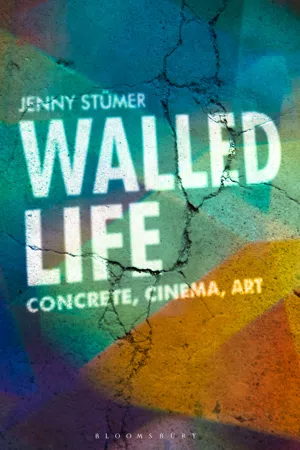
Going beyond a discussion of political architecture, Walled Life investigates the mediation of material and imagined border walls through cinema and art practices. The book reads political walls as more than physical obstruction, instead treating the wall as an affective screen, capable of negotiating the messy feelings, personal conflicts, and haunting legacies that make up "walled life" as an evolving signpost in the current global border regime. By exploring the wall as an emotional and visceral presence, the book shows that if we read political walls as forms of affective media, they become legible not simply as shields, impositions, or monuments, but as projective surfaces that negotiate the interaction of psychological barriers with political structures through cinema, art, and, of course, the wall itself.
Drawing on the Berlin Wall, the West Bank Separation barrier, and the U.S.-Mexico border, Walled Life discovers each wall through the films and artworks it has inspired, examining a wide array of graffiti, murals, art installations, movies, photography, and paintings. Remediating the silent barriers, we erect between, and often within ourselves, these interventions tell us about the political fantasies and traumatic histories that undergird the politics of walls as they rework the affective settings of political boundaries.
- 272 pages
- English
- ePUB (mobile friendly)
- Available on iOS & Android
eBook - ePub
About this book
Information
1
Introduction
We create borders, build walls, and fences, divide, classify and make hierarchies. We try to exclude—from humanity itself—those who have been degraded, those who we look down on or who do not look like us, those with whom we imagine never being able to get along.
But there is only one world. We are all part of it, and we all have a right to it.
ACHILLE MBEMBE
Those who build walls are their own prisoners
URSULA K. LE GUIN
Is that it?
DEREK LANDY
What can a wall tell us about the world, a nation, or a person? How do fences, barriers, and walls affect those who build them and those who live in their shadows? In Walled Life I take the wall as a starting point in order to think about the cultural imaginaries, affective histories, and collective fantasies that shape political division. I understand the wall not simply as a soulless obstruction or a dead pile of bricks, but as something that creates atmospheres and worlds—a structure that generates feelings and impressions, cultivating the imagination and disrupting intimacies, unsettling relations, and also bringing them into zones of contact. I think of the wall as a canvas or a screen, capable of telling stories or foreclosing them, creating meaning and desolation, all at the same time. By focusing on the ways in which political walls are tied to emotions, stories, and fantasies about invading others that find expression in film, photography, graffiti, performances, and other media, I highlight the critical role of cinema and art in contesting exclusionary politics. In this book, I am interested in the narratives and images that supplement political walls and articulate ongoing legacies of domination, fantasies of protection, routines of boredom, visceral responses, silent crises, and other messy attachments. I also explore how filmmakers, artists, and activists utilize the wall to challenge divisive culture. In short, I am thinking about the ways in which political walls are thoroughly mediated and work as media in their own right, chronicling affective encounters that reveal something about the state of the world.
Growing up in Berlin, my starting point for unpacking these questions and concerns has always been the city’s infamous wall. Of course, today, the Berlin Wall is old and tired. The once massive structure dividing a continent, a country, and a city is now a mere shadow of its former self, carefully refurbished and retired, complete with authentic cracks and holes, scars and lines. An icon of the past, the Berlin Wall seems almost absurd in the space of the present: it has become a symbol of hyperbolic freedom, a tacky tourist attraction, and a gallery for art. Tamed and preserved, it lingers as a colorful history lesson—painted over, decorated, taxidermized. And yet, the wall still tells us stories that resonate with the present: These stories speak of separated families, violent persecution, and ruthless apathy. They reflect on fantasies of security and intimate prisons, human aspiration, and, of course, despair. Ultimately, these stories document the wall’s own vulnerability and the fallibility of its creators, but they also rejoice in the resilience of those who endured division (or continue to live with barriers today). Paying witness to its inevitable demise, the stories the wall can tell us are themselves occupied by those who challenge barriers, artistically or practically, together and alone. In other words, the wall I want to tell you about reaches far beyond Berlin. The wall I am concerned with is haunting the world. It has solidified countless times throughout history, shifting, rebuilding, falling, and reappearing again. It resurfaces as a slogan, materializes where camps are built and refugees must be kept out. It lingers where stones meet tanks. It endures in hearts and minds. The wall that inspired this book has always been more than a political barrier: It is a concept, a feeling, a memory, a promise, a prison, a ghost, a shield, a screen, a medium.
Foundations
Despite the rhetoric of a unified world, we increasingly face the violence of separation: our world espouses itself as being walled in the physical, metaphorical, and political sense. Alain Badiou suggests post-1989 that there is in fact such a thing as “the world’s wall,”1 which serves as a reference point for ever newer modes of division, effacement, and conflict. He explains that “the overwhelming majority of the population have at best restricted access to this world. They are locked out, often literally so.”2 Acutely, such modes of division are reflected in global anxieties surrounding the figure of the migrant; they are palpable in images of caged children in the United States or those that show them swept up on the shores of Europe. They resonate with refugee tents in Idomeni, checkpoints in Gaza, and fences across Sinai; but they also contour the divisive lines of our post-Brexit, pandemic-stricken, fake news world, in which synagogues and mosques are viciously attacked, women still demand the right to be heard, indigenous peoples are once more arrested for protecting their lands, and Black people still have to assert that their lives matter. I suggest these divides can be understood as the manifestation of a persistent circle of violence, within which walls, fences, and barriers present themselves as effects of historical forces that create modes of toxic protection and privilege at the cost of physical and psychological impediment.
Indeed, political walls (in their material manifestation) have made a stunning re-appearance on the face of the world. Élisabeth Vallet, who has tracked the emergence of border walls since the end of the Second World War, counts no less than eighty-one such barriers in 2021.3 From Donald Trump’s campaign to build a wall at the US-Mexican border to Israel’s progressing separation barrier in the West Bank and Europe’s re-erection of walls and fences in the face of its refugee “crisis,” political walls are a symptom of our time and a testimony to the divisive and polarized politics of the twenty-first century. It seems that the more we imagine ourselves as part of an increasingly open, free, and transnational community, the more we are confronted with the occupying, partitioning, barricading, and walling-off of cities, territories, and nations. After the fall of the Berlin Wall, such barriers have continuously reminded the world, from Palestine to Europe to Mexico, that political division is a recurring motif in the writing and rewriting of global maps and identities.
Thinkers like Alain Badiou and Étienne Balibar have long analyzed these developments in the wake of the Berlin Wall’s demise.4 Both have suggested that the “end of history,” as the end of grand narratives, has neatly survived its own epitaph, with the myth of global unity subverted by increased fortification. More recently, Wendy Brown revived this discussion, investigating the resurgence of walls as a reaction to the waning sovereignty of nation-states in the twenty-first century.5 Her analysis exposes the emergent walls in Israel-Palestine and at the US-Mexican border as having similarities with the crumbled Berlin Wall—in fact all three seek to fix an equally vulnerable ideological narrative. Linking emerging border walls to the fears that energized the global War on Terror, Reece Jones has further shown that twenty-first-century walls expand and consolidate sovereign power by homogenizing populations in opposition to an uncivilized elsewhere.6 Intimating the ways in which historical walls likewise condition contemporary political structures with reference to colonial legacies, Achille Mbembe has additionally explained that the organization of political life has always been invested in “procedures of differentiation, classification and hierarchization aimed at exclusion”7 and that these “fierce colonial desires”8 are now translated into the will to “impose a regime of separation”9—one which is based on the necropolitical premise that selected segments of population are literally considered disposable10 (in resonance with Judith Butler “ungrievable”11) or what Mbembe identifies as a “superfluous humanity”12 locked out behind walls.
Collectively, these lines of thought attest to an imaginary substantiation of the global politics of walls. The walls of the world exclude the other as they create the other by exclusion. At first glance, political walls function to omit “the other,” whose status as “intruder” does not so much threaten, but actually maintains, the rigid political imaginary of a nation in fear. The Israeli West Bank barrier exemplifies this “separation as a philosophy”13 meant to protect a community from an impending threat while creating a boundary to support collective identification. Complemented by the increasing fortification of its counterpart in Mexico and the new walls appearing all around Europe, the barrier envisions the emergence of the modern walled state, where collectives are stabilized and protected against the backdrop of an imaginary other, which is equally feared and disdained. In this way, the new walls resonate with the memory of the demolished Berlin Wall, as they reintroduce means of exclusion and control into contemporary political landscapes. Political walls demarcate a highly controlled space at the same time as they produce (and foreclose) confined modes of community.
Highlighting the affective tissues that bind and separate groups of people, Lauren Berlant and Sara Ahmed have expanded discussions of political investments by drawing attention to the role of emotion and fantasy. Both authors provide insight into the psycho-affective formations that mobilize attentive relations to a world in crisis. As Ahmed puts it “emotions are a form of cultural politics,”14 producing attachments to “affect worlds,” as Berlant would add.15 Seen from this perspective, walls are (also) a site of affective staging that register and potentially energize collective experience as a form of worldmaking. Circulating political feeling, such “affective economies,” to use Ahmed’s indispensable term, do not locate emotions in either subject or object, but reproduce them as the effect of encounter.16 In other words, emotions produce and undo the boundaries that sustain walled states and minds, creating the affective parameters of inside and outside. “The nation’s borders and defenses are like skin,”17 in Ahmed’s words, as such, they mediate relations between external and internal, us and them, here and there, through sensory experiences of pain, fear, disgust, boredom, anger, hate, or love. Political walls hence need to be viewed in the full context of the visceral intimacies they provoke and disable.
What I want to draw attention to in this book, then, is the way in which the walled space is saturated by cultural narratives, emotional investments, and psychological undercurrents that reproduce the political boundary on an imaginary and affective level and thereby assist in the construction of a walled identity. This way of being in the shadows of political walls—or what I call “walled life”—delimits the unconscious settings, silent barriers, and emotional legacies that are internalized and reproduced within and between individuals as part of a walled existence. Walled life unfolds in resonance with the way that Sigmund Freud, Cathy Caruth, Kaja Silverman, and Jacqueline Rose have analyzed the workings of trauma,18 Renata Salecl examines the politics of fantasy19 and Lauren Berlant unfolds the crisis of the ordinary “in stories about navigating what’s overwhelming.”20 Drawing on these discussions, I explore the way in which psychic division and emotional barricades are informed by political formations (and vice versa). Hence, what is interesting about the visual statement of a concrete wall made of solid, impenetrable surfaces is how these façades, as symptoms of cultural alienation, make visible the psychological and emotional foundation of political space. Political walls carry with them (and on them) collective fantasies and historical narratives, re-enacting, but also potentially subverting, the power divisions they are meant to support. Put simply, political walls are media.
Drawing on the example of the former Berlin Wall as the wall of the past, Israel’s separation barrier as the wall of the present, and the impending wall at the US-Mexican border as the wall of the future, the book examines the psychological and affective settings of political division as materialized in political boundaries. I consider the reinforcement and subversion of border fortifications primarily through film and art practices that turn walls into screens in order to think through different expressions of the “walled life” that is experienced in these political landscapes. I maintain that if we read political walls as forms of media, they become legible not simply as shields, impositions, or monuments, but as a projection surface (in the technological and psychological sense) by which the psycho-politics of walls intimate “a historical present that becomes apprehensible as an affective urgency”21 as Berlant might put it. My analysis hence goes beyond the discussion of political architecture and expands insights into political mediation. While I draw on the political setting of the walled state,22 I am primarily interested in the ways in which psychological and affective barriers interact with political structures as mediated by cinema, art, and, of course, the wall itself.
I work from the premise that the wall is the concretization of a sensory trace, informing and performing human divisions (and revision) as linked to past, present, and future. As a screen the wall thereby exposes the affective makeup of political space, because it is the point where political conflicts and shared atmospheres are either blocked from consciousness or made available for a process of encounter. In this regard, as a construct, the wall does not simply evoke, but is central to the very logic of trauma. Barriers are formed to protect the psyche, and isolated segments of feelings, like isolated people, become alienated, split off, and ultimately imprisoned.23 Invariably, these segments act “like a foreign body”24 or something other within the most intimate territory of the self, despite and because of these protective measures. Taking the resonance between trauma and wall as a way into understanding the affective trajectories of a walled life, I demonstrate how the wall acts as a psycho-political structure that, if viewed as a medium, opens up new forms and fantasy constructions through which alternative political discourses can be formed.
My argument is situated at the intersections between the political and the psychological. I work from the spatial organization of what Hannah Arendt, Carl Schmitt, Giorgio Agamben, and Robert Cover have aptly described as the nomos25 to theorize the spatial, legal, and normative realization of a specific political formation in order to move this discussion to the emotional barricading of the mind in the Freudian unconscious, the collective attachments invoked by Lauren Berlant and Sara Ahmed, and the fantasies of the political as discussed by Renata Sale...
Table of contents
- Cover
- Halftitle Page
- Title Page
- Dedication Page
- Contents
- Acknowledgments
- Note on Text Translations
- 1 Introduction
- 2 Berlin: No Wall in Sight
- 3 Looking to the Other Side: The Walls between Us
- 4 Palestine: Dreams of Walls and Undead Lives
- 5 Mirror, Mirror, on the Wall: Ambiguous Projections
- 6 Mexico: Colonial Ghosts, Walled Minds
- 7 To Trump Them All: The Most Beautiful Wall
- 8 Leap into Freedom: Concluding Remarks
- Notes
- Bibliography
- Index
- Imprint
Trusted by 375,005 students
Access to over 1.5 million titles for a fair monthly price.
Study more efficiently using our study tools.
Frequently asked questions
Yes, you can cancel anytime from the Subscription tab in your account settings on the Perlego website. Your subscription will stay active until the end of your current billing period. Learn how to cancel your subscription
No, books cannot be downloaded as external files, such as PDFs, for use outside of Perlego. However, you can download books within the Perlego app for offline reading on mobile or tablet. Learn how to download books offline
Perlego offers two plans: Essential and Complete
- Essential is ideal for learners and professionals who enjoy exploring a wide range of subjects. Access the Essential Library with 800,000+ trusted titles and best-sellers across business, personal growth, and the humanities. Includes unlimited reading time and Standard Read Aloud voice.
- Complete: Perfect for advanced learners and researchers needing full, unrestricted access. Unlock 1.5M+ books across hundreds of subjects, including academic and specialized titles. The Complete Plan also includes advanced features like Premium Read Aloud and Research Assistant.
We are an online textbook subscription service, where you can get access to an entire online library for less than the price of a single book per month. With over 1.5 million books across 990+ topics, we’ve got you covered! Learn about our mission
Look out for the read-aloud symbol on your next book to see if you can listen to it. The read-aloud tool reads text aloud for you, highlighting the text as it is being read. You can pause it, speed it up and slow it down. Learn more about Read Aloud
Yes! You can use the Perlego app on both iOS and Android devices to read anytime, anywhere — even offline. Perfect for commutes or when you’re on the go.
Please note we cannot support devices running on iOS 13 and Android 7 or earlier. Learn more about using the app
Please note we cannot support devices running on iOS 13 and Android 7 or earlier. Learn more about using the app
Yes, you can access Walled Life by Jenny Stümer in PDF and/or ePUB format, as well as other popular books in Media & Performing Arts & Film & Video. We have over 1.5 million books available in our catalogue for you to explore.