An overview on one of the most successful infantry formations used by Alexander the Great and his successors to dominate the ancient world.
The Macedonian pike phalanx dominated the battlefields of Greece and the Near and Middle East for over two centuries. It was one of the most successful infantry formations of the ancient world, only rivaled by the manipular formation of the Roman legions. The phalanx was a key factor in the battlefield success of Alexander the Great and after his death dominated the armies of his Successors (the Diadochoi), who ruled from Greece and Egypt to the borders of India. Richard Taylor gives an overview of the phalanx's development, organization, equipment and training. He analyses the reasons for its success, with an emphasis on case studies of the many battles in which it was used, from Philip II's reign to the Mithridatic Wars. He discusses whether the famous defeats by the Romans necessarily mean it was inherently inferior to the manipular legion tactics, and considers what other factors were in play. The clear, accessible and well-researched text is supported by diagrams and battle maps, making this an outstanding study of this mighty formation.
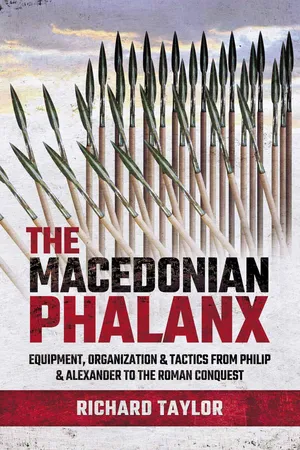
eBook - ePub
The Macedonian Phalanx
Equipment, Organization & Tactics from Philip and Alexander to the Roman Conquest
- 482 pages
- English
- ePUB (mobile friendly)
- Available on iOS & Android
eBook - ePub
The Macedonian Phalanx
Equipment, Organization & Tactics from Philip and Alexander to the Roman Conquest
About this book
Chapter 1
Origins
The story of how Philip II established the small kingdom of Macedon as the dominant power in Greece, and of how his even more famous son Alexander III (‘the Great’) conquered the whole of the Achaemenid Persian Empire and beyond, is well known. Alexander’s conquests ushered in a period of three centuries (the Hellenistic Age) in which Greco-Macedonian kingdoms were established throughout the Near and Middle East, from the Mediterranean to the borders of India, initiating a unique flourishing of Greek culture (albeit sometimes viewed as inferior to the earlier glories of the Classical period that preceded it) that lasted until overwhelmed by the rising power of Rome. Central to Philip’s rise to power, to Alexander’s spectacular conquests and to the dominance of vast areas by the kings who followed them was the Macedonian army (or in the case of the new kingdoms, armies created following the Macedonian model); and central to the success of the Macedonian army was the Macedonian phalanx, that is to say, the heavy infantry of the Macedonian and Hellenistic kingdoms. Before the Roman legions rose to prominence as the dominant heavy infantry force of the ancient world, the Macedonian phalanx occupied a comparable place of honour, and it was the defeat of the phalanx at the hands of the legions that brought about the final decline and subjugation of the Greek-speaking world – and with it the end of the political and cultural dominance of Greece.
This book is an attempt to provide a comprehensive, if at times necessarily high-level, analysis of the rise, dominance and decline of the Macedonian phalanx, to describe what the phalanx was and how it functioned, examine why it was so spectacularly successful and discover why in the end it fell before the might of Rome.
Definition of terms
Before considering the origins of the Macedonian phalanx, we should be clear about terminology, starting with the phrase ‘Macedonian phalanx’ itself. What exactly is meant by this?
Firstly, ‘Macedonian’. This means, simply enough, from Macedon or Macedonia. The ancient Greek name was Macedonia (Mακεδονία) – in English, the forms Macedon and Macedonia are both used, largely interchangeably, though sometimes Macedon is used for the kingdom and Macedonia for the geographical area. In this book I will use the form Macedon, to make clear that it is the ancient kingdom being referred to, not the modern country (the former Yugoslav republic, as of the time of writing called ‘North Macedonia’, which lies somewhat to the north of ancient Macedon), nor the region of northern Greece, which more closely matches the boundaries of the ancient kingdom. This being a work of ancient history, it is to be understood that the name Macedon in this book refers always to the ancient kingdom, and I do not have anything to say about the controversies surrounding the modern uses of the name.1
Macedon lay on the coastal plains between Thessaly to the south (with Mount Olympus on the border) and Thrace to the east, and extended (to a greater or lesser extent, depending on the current political strength of the kingdom) into the mountainous inland regions running north and west from the coast. The Macedonians had much in common ethnically and culturally with their neighbours to the south in the rest of Greece. Exactly how much they had in common was a matter of some dispute at the time; it seems that Macedonians generally considered themselves to be part of the wider Greek world, though lower-class Macedonians (the serfs and peasants who made up the bulk of the population) may have been more different culturally. There was perhaps a distinct Macedonian language, or maybe a very strong dialect of Greek, at any rate different enough to be largely incomprehensible to southern Greek speakers.2
At this period, of course, the notion of ‘Greekness’ was rather different from what we are used to today in the era of nation states. The Greek world was divided into numerous small, competing political units – in southern Greece particularly, the familiar city-states (such as Athens and Sparta), with larger leagues or confederacies often centred around a powerful city (such as the Boeotian League, headed by Thebes). A Greek citizen’s first loyalty was to his home state (usually his city) rather than to any wider Greek ‘nation’. Greeks did see themselves as different from (and largely superior to) non-Greek-speaking outsiders (‘barbarians’ – a term indicating foreign-sounding language rather than savagery), and faced with an outside threat – such as the Persian invasions of the early fifth century – Greeks could unite and form common cause against the enemy, though there were probably nearly as many Greek speakers (including the Macedonians) who joined the Persians as fought against them. But the notion of any unified Greek nation was wholly alien at the time, and the cities, leagues and kingdoms were as much defined by their differences as by their shared ‘Greekness’. In the course of the fourth century, a greater sense of pan-Hellenism was starting to develop, but this was in continued opposition to the outside enemy (Persia) rather than due to any great desire for political unity.3
In the context of this divided Greek world, the Macedonians were on one level just another Greek state; though, somewhat unusually, a monarchy spread over a relatively wide geographical area rather than a democratic or oligarchic city state. But the southern Greeks had traditionally seen the Macedonians as being rather backward and uncultured – not least in retaining their monarchical traditions – and being to a greater or lesser extent outsiders. This was a view that some upper-class Macedonians, and in particular many of the kings, fought to correct by enthusiastically embracing and promoting southern Greek culture, though it is doubtful just how far down the social ladder this penetrated. Even among the aristocracy there was a great attachment to a traditional way of life, centred around fighting, hunting, heavy drinking and sexual licence (at least as described by censorious southern Greeks), partly inspired (ironically enough) by identification with the heroic values to be found in the great Greek epic and origin myth, Homer’s Iliad. The Macedonians’ relationship to the Greeks of the south is perhaps analogous to the historical relationship between Scotland and England. On the one hand, the two are ethnically and culturally closely related, with a common language and culture, and, to a varying degree, joined by a shared sense of Britishness (at least since the union of the two kingdoms). On the other, English and Scots remain distinct, proud of their different heritage, and retain a sense of political and cultural difference. In Scotland as in Macedon, there was also a distinction between the upper social levels (and Lowlanders), who more fully adopted English/British culture, and the lower classes (and Highlanders), who retained a greater cultural difference and their own distinct language, and were sometimes viewed as being somewhat backward by English and Lowland Scots alike. Macedon too had its Highlanders – who may have formed the core of its phalanx as we shall see – possibly with their own language, and Macedon retained its own traditions, even as it adopted Greek literature and philosophy and led a pan-Hellenic campaign against the ‘barbarian’ enemy. In the course of this book I will sometimes use ‘Macedonian’ in opposition to ‘Greek’, to distinguish between the Macedonians and the Greeks of the southern mainland and islands. This should not be taken to imply that the Macedonians were not themselves also Greek, but reflects genuine differences in traditions, self-image and status which were clearly important at the time.
Next, the phalanx. ‘Phalanx’ was a Greek word of uncertain etymology (it may originally have meant ‘log’ or ‘roller’), which had for some centuries been used to describe a close-order formation of heavy infantry (that is, infantry with shields and armour who fight hand-to-hand rather than with missiles), formed up several (typically eight) ranks deep and in a solid more-or-less continuous block, hundreds of men wide. The origins of the phalanx – the formation and the word – are uncertain and the subject of much debate. Homer, the first great writer of Greek literature, author of the Iliad and Odyssey (I am assuming for the sake of simplicity that there was a single author, rather than a more dispersed oral tradition), who held a place in Greek literature similar to that occupied by the Bible and Shakespeare in English, used the word ‘phalanx’ (in the singular) in his accounts of combat before the walls of Troy only once, though he did use the plural, phalanges, a number of times to refer to bodies of men. Indeed, combat in his day (or in the day to which his writings referred back) seems to have involved looser, more open-order formations of infantry (although as we will see, the later Greeks did not see it this way). At some point between the eighth century BC (when Homer may have been writing) and the fifth century (the time of the Persian Wars), social, political and (to some extent) technological changes in Greece caused the decline of the chariot-borne warrior backed up by more or less disorganized bands of warriors on foot, as described by Homer, and the rise of the phalanx, a unified body of close-order heavy infantry, who formed up together, stood together and fought together, the embodied, armed citizenry of their home state. There are disagreements among scholars about the date at which these changes happened and their causes, but whatever the details, the overall picture is clearly established that by the end of the fifth century – when the two victors in the war against Persia, Athens and Sparta, fought a costly and disastrous war against each other – Greek infantry of the major (city-) states were heavily armed infantry – hoplitai in Greek, known in English as ‘hoplites’. They had large shields (typically a metre across), lesser or greater amounts of bronze armour (at the least, a bronze helmet, though body armour and greaves/leg guards were also often worn) and wielded a spear, around two metres long, in one hand. Infantry armed this way were too ponderous to move rapidly or to cross rough terrain with ease, and could be vulnerable to missile-armed opponents able to shoot from a distance and retire, or to take cover in rough ground. But formed up shoulder to shoulder (or shield to shield), in large formations many ranks deep, such infantry could defeat any opponent, Greek or non-Greek, in pitched battle on the open field. Experience in the Persian Wars, when at the start of the fifth century the Persian kings Darius I and Xerxes attempted to subjugate the Greek mainland, had shown that Greek hoplites formed up in a phalanx were masters of the battlefield. With success came demand; Persian kings did not repeat their attempt to conquer Greece, but hired large numbers of Greek mercenary hoplites for their civil wars and, in due course, to oppose the pan-Hellenic invasion under Alexander the Great, while hoplite phalanx armies contested all the major battles of the fifth and fourth centuries in which the Greek city-states fought, ultimately fruitlessly, for domination.4
It is important to keep in mind, though, that ‘phalanx’ was not (just) a technical term for this particular formation. Ancient Greek tended to be more free and easy with technical terminology than we might like, and to use the same word for different (if similar) things, rather than devising new words for new phenomena. Thus ‘phalanx’ could be used for any infantry formation, not just one made up of hoplites or equivalent close-order heavy infantry, and could be used to mean just ‘line of battle’ (sometimes as opposed to cavalry or light skirmisher forces outside of the main line). The Macedonian phalanx was a special variant of the earlier hoplite formation, but it could also mean just the Macedonian line of battle, and not every time the word is found in our sources does it carry a particular technical meaning. For the purposes of this book, unless stated otherwise, ‘phalanx’ means specifically the close-order heavy infantry formation.5
So a phalanx is a heavy infantry formation of multiple ranks, and the Macedonian phalanx is the type of phalanx particularly associated with and used by the Macedonians. As we will see in the following chapters, there are a number of special features of the Macedonian phalanx (not all of which, in my view, are actually real). While discussion of the details of each of these features will be the subject of the rest of this book, it is worth setting out here what may be taken as the orthodox modern view of the nature of the Macedonian phalanx, and what made it different from the Greek phalanx (or phalanxes) that preceded it. So, the Macedonian phalanx is distinctive for:
•being particularly close order and/or ‘heavy’ (the meaning of this word in this context will be considered later); the Greek phalanx presumably used a more open order in comparison, and/or was less ‘heavy’.
•using a longer spear than the Greek hoplite, long enough that it needed to be held in both hands rather than wielded one-handed. The length of this spear varied (and is subject to some uncertainty and much debate), and was called by the Macedonians a sarisa or sarissa (the single ‘s’ is the more usual Greek spelling, but in English it is usually written with two, and as this is an Anglicized version of the word, I will use the plural sarissas).
•using a smaller shield than the Greek hoplite’s shield, necessitated by the two-handed grip of the spear (and perhaps by the close-order formation). This shield was (it is usually argued) called a pelte (or pelta, there being two dialect variants of the word), a term which in Greek was applied to any small or light shield, as opposed to aspis, which is the normal Greek word for the large shields carried by classical hoplites.
•possessing a particularly high standard of drill, necessitated by and enabling the close order and use of the cumbersome long sarissa. Greek hoplites, in contrast, were (with some exceptions, notably the Spartans) generally undrilled citizen militias called up only for short campaigns, and neither professional nor highly trained.
•being rendered, by virtue of the close-order of the formation and long spear, particularly ponderous on the battlefield, unable to manoeuvre effectively and liable to fall into disorder on difficult terrain. Greek phalanxes also performed badly on rough ground, but this feature is thought to be taken to an extreme by the Macedonian phalanx.
I will be examining – and in some cases questioning – this view of the Macedonian phalanx in the following chapters. But this overall picture of a unique Macedonian phalanx, distinct from the hoplite phalanx that preceded it, seems clear enough. This phalanx was sometimes called by ancient historians ‘the Macedonian phalanx’ or, more frequently, the phrase ‘armed in the Macedonian fashion’ was used – it being understood in both cases that this implied a particular formation, tactic and method of arming that was consistent across the whole of the period under consideration, from the invention of the Macedonian phalanx in the fourth century until its demise during the second and first centuries (the extent to which it is true that the nature of the phalanx was consistent across this period will be one of the issues examined in this chapter and the next). The men making up the Macedonian phalanx tend, in modern parlance, to be called ‘phalangites’, and this term does have a basis in ancient Greek, as they are sometimes called phalangitai. Among modern authors, ‘phalangite’ is often used in distinction to ‘hoplite’, the earlier large shield and short spear-wielding infantry of the Greek city states. This distinction of terms is not found in ancient authors, as the members of the Macedonian phalanx were often also called hoplitai (the word being simply the general Greek term for heavy infantry, literally ‘armed men’ or ‘men-at-arms’), as well as a selection of other terms including ‘peltasts’, that is ‘small-shield-carriers’ (peltastai) and ‘sarissa-carriers’ (sarisophoroi). In this book I will generally use ‘phalangites’ to refer to the members of the Macedonian phalanx, those armed in the Macedonian fashion, and ‘hoplites’ to refer to Greek infantry armed in the traditional manner, but it should be borne in mind that these terms do not necessarily accurately reflect their ancient Greek usage.
Historical background
The history of the Macedonian phalanx is in many ways also the history of Macedonian imperialism and of the Hellenistic world which Macedonian expansion created. This book looks at the phalanx thematically, so it will be useful to have in mind an overview of the history of the period to understand how the story of the phalanx fits into the history of the age. Those who are already familiar with the historical background may wish to skip this section.
The Macedonian phalanx was created in the kingdom of Macedon, by the Macedonian king Philip II. Philip came to the throne of Macedon in 359, at a time when the Greek city-states were still vying for supremacy and none, despite the defeat of Athens by Sparta in the Peloponnesian War at the end of the fifth century, was predominant. The Persian Empire, which had invaded Greece at the start of the fifth century, made no attempt to invade again, but maintained an interest in Greek affairs, frequently intervening financially and diplomatically to further its own interests. Macedon, meanwhile, was, as usual in its history up to this point, struggling against its inherent weaknesses – an underdeveloped economy, rural society, hostile and aggressive neighbours, a powerful and unruly aristocracy and a royal fam...
Table of contents
- Cover
- Title
- Copyright
- Contents
- Note on sources
- Chapter 1 Origins
- Chapter 2 Arms and armour
- Chapter 3 Organization and drill
- Chapter 4 The men in the phalanx
- Chapter 5 Manpower and recruitment
- Chapter 6 Command and control
- Chapter 7 Battles and tactics
- Chapter 8 Fighting in the phalanx
- Chapter 9 Legion and phalanx
- Epilogue
- List of battles
- List of rulers and generals
- Glossary
- Notes
- Bibliography and abbreviations
Trusted by 375,005 students
Access to over 1.5 million titles for a fair monthly price.
Study more efficiently using our study tools.
Information
Publisher
Pen & Sword MilitaryYear
2020Topic
StoriaPrint ISBN
9781526748157
Subtopic
Storia europeaeBook ISBN
9781526748164
Frequently asked questions
Yes, you can cancel anytime from the Subscription tab in your account settings on the Perlego website. Your subscription will stay active until the end of your current billing period. Learn how to cancel your subscription
No, books cannot be downloaded as external files, such as PDFs, for use outside of Perlego. However, you can download books within the Perlego app for offline reading on mobile or tablet. Learn how to download books offline
Perlego offers two plans: Essential and Complete
- Essential is ideal for learners and professionals who enjoy exploring a wide range of subjects. Access the Essential Library with 800,000+ trusted titles and best-sellers across business, personal growth, and the humanities. Includes unlimited reading time and Standard Read Aloud voice.
- Complete: Perfect for advanced learners and researchers needing full, unrestricted access. Unlock 1.5M+ books across hundreds of subjects, including academic and specialized titles. The Complete Plan also includes advanced features like Premium Read Aloud and Research Assistant.
We are an online textbook subscription service, where you can get access to an entire online library for less than the price of a single book per month. With over 1.5 million books across 990+ topics, we’ve got you covered! Learn about our mission
Look out for the read-aloud symbol on your next book to see if you can listen to it. The read-aloud tool reads text aloud for you, highlighting the text as it is being read. You can pause it, speed it up and slow it down. Learn more about Read Aloud
Yes! You can use the Perlego app on both iOS and Android devices to read anytime, anywhere — even offline. Perfect for commutes or when you’re on the go.
Please note we cannot support devices running on iOS 13 and Android 7 or earlier. Learn more about using the app
Please note we cannot support devices running on iOS 13 and Android 7 or earlier. Learn more about using the app
Yes, you can access The Macedonian Phalanx by Richard Taylor in PDF and/or ePUB format, as well as other popular books in Storia & Storia europea. We have over 1.5 million books available in our catalogue for you to explore.