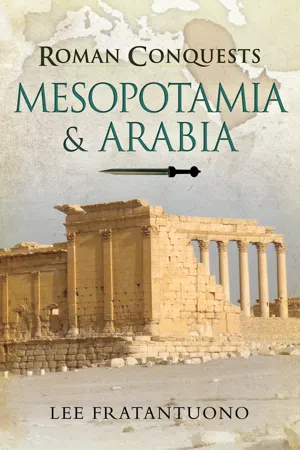
This volume explores the Roman invasions and military operations in two distinct yet related areas: Mesopotamia and Arabia. In these far-flung regions of the ancient known world, Rome achieved the greatest point of expansion in the history of her Empire. Under the reign of the Emperor Trajan, the Roman Empire reached the point of maximum expansion made famous by maps of the world circa AD 120. Under the Severans, significant efforts were expended on a Roman dream of linking the two regions into one mighty provincial bulwark against Eastern enemies. Individual chapters detail the history of the conquest of these easternmost territories of the Empire, analyzing the opposing armies involved (Roman, Parthian, Sassanian, Arab) and the reasons for success and failure. The story of how Rome won and lost her Far East offers a paradigm for the rise and fall of the greatest military empire of the ancient world.
- 192 pages
- English
- ePUB (mobile friendly)
- Available on iOS & Android
eBook - ePub
Mesopotamia & Arabia
About this book
Information
Subtopic
Middle Eastern HistoryIndex
HistoryChapter 1
Introduction to Roman Arabia
The Expedition of Aelius Gallus against Arabia Felix, 26–25/25–24 BC; the Putative Arabian Expedition of Gaius Caesar, AD 1
The history of the Roman conquest of Arabia – if indeed it can be said that Rome ever did such a thing – is a subject of intrinsic interest, not least for the ongoing importance of that region of the world in contemporary military and political affairs. It is a topic that also poses significant problems for the would-be student or researcher, whether professional or amateur. Our sources are relatively limited, and even the reigns of such great and well-known Roman emperors as Trajan and Septimius Severus – to name but two who are of great significance in the history of Rome’s involvement in Arabia – are not particularly well documented. Some of our ancient sources survive only in later abridgment; sometimes, what sources we have are quite likely wrong in their statements. And perhaps fundamentally, one is challenged by the fact that ‘Arabia’ never seems to mean quite the same thing to our individual ancient authors and sources. What one author might label ‘Arabia’ could refer to anything from territory bordering on contemporary Iran in the east down to the Sinai Peninsula of modern Egypt, through Iraq, Syria, Jordan – and of course the Arabian Peninsula. The history of Roman Arabia is inextricably linked to that of its neighbouring Roman provinces and territories, to Roman Syria, Mesopotamia, Egypt and Judaea.
Today, that vast Arabian Peninsula is home to a number of nation states, of which the largest by far is the Kingdom of Saudi Arabia. Saudi Arabia and the United Arab Emirates are the only contemporary nation states on the Arabian Peninsula whose names reference this storied ancient land of Arabia; the other countries as of this writing are the State of Kuwait, the Kingdom of Bahrain, the Sultanate of Oman, the Republic of Yemen and Qatar. In antiquity, the peninsula was home to a variety of peoples, with nomadic populations and scattered kingdoms marking its immense territory.
In the records of classical antiquity, we have no evidence that there was ever a unified control of this huge swathe of largely desert land. Greek and Roman historians and other writers not only regularly refer to ‘Arabia’ without always providing a reference as to the specific area or people they are describing, but also sometimes seem to mislabel even particular regions of Arabia. ‘Arabia’ was a name applied potentially to the entire region, just as today the label ‘Arab world’ is often employed to refer to areas as disparate as Morocco and Kuwait, and likewise ‘Arab’ is commonly employed as a sometimes quite imprecise ethnic label.
Consideration of ‘Roman Arabia’ as a discrete territory of the ancient Roman world is thus difficult for a variety of reasons, not least the fact that ‘Arabia’ was never precisely defined geographically by either the Greeks or the Romans. When historians speak of ‘Roman Arabia’, they often mean the province of Arabia Petraea, established in AD 106 by the great emperor Trajan. This province did extend into territory now held by the Kingdom of Saudi Arabia, but it also included extensive portions, for example, of modern Jordan and Syria. Indeed, its very name ‘Petraea’ refers to the great settlement of Petra that was located in modern Jordan.
When we speak of ‘Roman Arabia’, we are referring to one of the more remote regions of the Roman Empire as it existed at its greatest extent early in the second century AD, during the reign of Trajan. The Romans never succeeded in subjugating the entire peninsula – indeed, they never sought (at least in practice if not in imperial propaganda) to capture the entire region, the majority of which is inhospitable desert. It is difficult if not impossible to identify with precision the borders of what constituted ‘Arabia’ for the Romans; we are left ultimately (and as ever) with the need to rely on ancient Greek and Roman sources that reference the region, as well as the archaeological record. The very remoteness of the region contributed to the problems that plague our sources. ‘Arabia’ – whatever part of it one meant – was simply not as well known to our Roman imperial sources as was Gaul, Spain or even Britain.
‘Arabia is a vague word,’ Glen Bowersock notes on the first page of his seminal work on Roman involvement in this region, Roman Arabia (Harvard University Press, 1983). Few scholars have done as much for the study of Roman Arabia as Bowersock, and the inaugural sentiment of his influential book on Roman involvement in the region properly highlights this core problem that confronts us as we begin our desert trek with the ancients.
Depending on the source, historical references to Arabia could include territory beyond the confines of the peninsular Asian subcontinent of Arabia. For the purposes of our story in this second part of our work, we shall focus particular attention where possible on the peninsula – though of necessity that part will include overlap with neighbouring areas.
One ancient source that does attempt to define ‘Arabia’ is the great work of Diodorus Siculus (c. 80–20 BC), a Greek writer from Sicily who wrote a vast compendium of world history in forty books. Diodorus is a sometimes underappreciated treasure trove of information about the ancient world. He is not nearly as famous as such ancient historians as Herodotus, Thucydides, Livy or Tacitus, and few would consider ranking him with those luminaries of ancient history. But he does do what relatively few others attempted: he offers a ‘complete’ history of the ancient world, an omnibus view from the perspective of a late first-century BC scholar, and we would be much the poorer in our knowledge of antiquity minus his surviving work.
At Book 2.48–49 of his history, Diodorus offers a general overview of ancient ‘Arabia’. For him, it was a region between Syria and Egypt, with the eastern part inhabited by the Nabataeans. Diodorus’ Nabataeans live a life of thievery and plunder that is based on their extensive knowledge of where to find water in the inhospitable desert of their realm. Fiercely independent, the Nabataeans were exceedingly difficult to surpass in war, in large part because they knew the territory so well and the territory they mastered posed extreme conditions for any would-be conqueror. Besides this unforgiving region of vast eastern desert, there was a comparatively more fertile and fruitful southern zone, the ‘Arabia Eudaimon’ of Greek lore (‘Arabia Felix’ for Latin speakers). This was the storied land of spices, of myrrh and cinnamon. At 19.94–100, Diodorus records invaluable information about the Nabataean Arabs as part of his account of the efforts of Alexander the Great’s one-time general Antigonus’ attempted campaign against them. The Nabataeans live the ultimate nomadic life; indeed, for these Arabs, to plant grain or fruit-bearing trees, to cultivate wine or to construct a house is a capital offence. These Arabs, Diodorus notes, believe that to engage in such acts of domestic civilization would render them subject to the domination of others. Instead, they focus on the desert pasturage of camels and sheep. Though only some 10,000 in number, the population is by far the wealthiest in Arabia because of access to the spice trade. Diodorus thus presents what we shall find to be recurring themes in the history of Arabia: wealth and commerce, trade and riches from spices and incense, all of which contribute to an eventual surrender to luxury and decadence – a common theme of the moralizing historians.
At some point in their history, the Nabataeans – or at least some of them – abandoned a primarily nomadic life and became more settled. There was soon the apparatus of a monarchy, with a king and an attendant luxurious life in such settlements as the famed Petra in modern Jordan. Scholars have speculated that one reason for the marked change in Nabataean life was the inevitable result of economic prosperity for a kingdom at the very crossroads of important commercial exchange between Rome, India, Mesopotamia, Egypt and Syria. ‘Arabia’ soon became a realm of conspicuous wealth, with a power that was rooted more in economic strength than military might. Places like Petra and Bostra (in modern Syria) were opulent by ancient standards, and they were on the very border of Roman Syria. By the time of Trajan, the Nabataean Arabs did not constitute any real military threat to Rome, but they did pose an inviting target for Roman expansion at a cheap price. Petra was given the special status by Trajan as metropolis Arabica – the Arabian metropolis or Arabian ‘mother city’. Petra was of undeniable importance to the region, even if Bostra became the base of the eventual single Roman legion in Arabia. The city of Philadelphia was transferred from Roman Syria to Roman Arabia under Trajan; it was located on the site of the modern capital of Jordan, the city of Amman. Arabia became ‘urbanized’, we might say, even if such ‘urbanization’ was on a scale far less grand than that seen in other quarters of the empire.
Alexander the Great himself had intended a conquest of Arabia before death cut short the continuation of his ambitious plans for Macedonian expansion and ever-increasing empire. Indeed, quite literally at the time of his death, his main workload consisted of reviewing plans for the proposed operations. The Romans would succeed in winning appreciable victories in the region, and would eventually see the setting up of a province under the emperor Trajan. But Arabia was always a hinterland for Rome, yet one of romantic allure from Alexander to Augustus and beyond, and a region of economic significance even in times long before the advent of oil, as well as ever-increasing strategic importance in the defence of the eastern empire and the eastern Mediterranean coast in particular. Arabia thus held a dual fascination for the Romans: it was on the one hand a romantic realm of imperial association with conquest of the ‘ends of the world’ and the dreams of the great Alexander, but it also represented a significant military and economic strategic region of interest, especially as Rome faced increasing and indeed sometimes perennial challenges from its eastern neighbours Parthia and Persia. Arabia was a region that demanded attention for very good economic and strategic reasons. It was also a relative backwater of empire, a place all too easy to ignore without a crisis.
A major element of the propaganda for Rome’s first emperor, the celebrated Augustus (63 BC – AD 14), was that he had brought peace to the world by his defeat of Cleopatra of Egypt and her lover Mark Antony at the naval Battle of Actium in 31 BC; that victory was cast as a triumph of West over East, of the forces of the sober Roman world against the drunken madness of barbarians. Augustus had helped to spread Roman peace and order from west to east – including to Arabia. Such grandiose considerations of empire and glory played very well in the arena of political propaganda and poetic reflections on the splendid restored Golden Age of Augustus – whatever the historical reality behind the epic veneer. Augustus came as the last figure in a long history of Roman civil wars, and a major element of his approach to winning power in Rome was his casting of his conflict with Antony as a foreign one. Rome was fighting not so much a great Roman commander like Antony, but his Eastern paramour and her Eastern allies. It was a fight between the sober, traditional forces of the Italian West and the decadent, indeed drunken excesses of Cleopatra’s East (an argument that was only aided by Antony’s notorious bibulousness). It was a clash of civilizations, a recurring theme in history of interactions between West and East, Europe and Asia, Rome and its distant neighbours. And Arabia was part of that equation.
Augustus would come to present himself as having done what Alexander the Great had not lived long enough to accomplish: the capture of Arabia. It was a bold claim, ridiculous on its face in so many regards. But it made for excellent press coverage, as it were, of what the new Roman princeps had achieved in his settlement of the East. And it was not entirely the stuff of fantasy.
The historical justification for this ambitious claim of global conquest with respect to the Arabs was an expedition that resulted in several military engagements in 26–25 or 25–24 BC (there is some uncertainty as to the precise dates). Luca Grillo offers the following summary of the episode in his entry on ‘Arabia and Arabi’ in the vast Virgil Encyclopedia of Richard Thomas and Jan Ziolkowski: ‘Aelius Gallus (not to be confused with his predecessor as prefect of Egypt, Cornelius Gallus), on behalf of Augustus, conducted an uneasy expedition in Yemen (25–24 BC), which Augustus could not quite call a victory (Augustus, Res Gestae 26.5; compare Cassius Dio 53.29.3–8). By Virgil’s time, then, Arabs were identified with worrisome people living in the Arabian peninsula.’ Arabia was one of the hotspots of early Augustan imperial military strife.
The years after Actium were not years of uninterrupted peace for Rome. Admittedly, Augustus’ achievements had put an end – at least for the time being – to the grim spectre of civil war that had for so long haunted the Roman political and military scene. There is good reason for the celebrated reference in the evangelist Luke’s gospel to the peace that prevailed in the world under Caesar Augustus at the time of the birth of Christ.
But foreign wars and engagements continued apace, even during the years of his intended Pax Augusta, or ‘Augustan Peace’. And Arabia was a theatre for such engagements, albeit not nearly as famous or celebrated an arena as Spain or Germany would be. Arabia was one of the classic ‘Eastern’ territories that played such a key part in the unfolding development of Augustan propaganda. India was as well, though the Romans never made it anywhere near even the borders of where Alexander’s Macedonian army of conquest was able to venture. Arabia was the most exotic and indeed fantastic of the areas referenced in Augustan propaganda that actually saw the presence of Roman military units. The dusty sands of Arabia constituted a legitimate arena for Roman adventurism and attempted conquest. The drama that would unfold would not, however, serve to provide a particularly glorious page in the annals of Roman conquest. Propaganda would often trump reality for the Romans and Arabia.
No complicated, highly original thesis is needed to explain the impetus for the Aelius Gallus campaign. Wealth and the dreams of Arabian treasure would be enough to motivate Augustus to authorize the expedition. Awareness that Alexander had planned a conquest of Arabia centuries before would only have served to provide even more encouragement in the increasingly irresistible mix of motivators. The fact that Augustus’ notorious foes Cleopatra and Mark Antony had extensive dealings in the East, and had used the East as a base of operations aimed against Italy, would also have been a consideration. This was an expedition designed to explore and to establish friendly economic and military ties; to conquer recalcitrant foes only if need be.
We may begin our consideration of Roman involvement in Arabia and Rome’s conquest of Arabia with a note from Augustus’ Res Gestae. Augustus therein provides a reference to a military expedition that was conducted during his reign in the far south of the peninsula. It was not the first Roman operation in ‘Arabia’, though it was apparently the first in the southern part of the vast peninsula (we shall later reference some of the earlier Roman military engagements, in particular the operations of Pompey the Great against the Nabataean Arabs in the north-west, though the account of Roman Republican military operations under Pompey in this region are covered by Richard Evans’ companion volume in this series, Roman Conquests: Asia Minor, Syria and Armenia). The Romans had had dealings with Arab peoples in the process of the conquest of Asia Minor and Syria; there had never been an actual expedition to the southern part of the peninsula until Augustus, and there was never any (at least successful) attempt under either Augustus or his predecessors to set up a lasting Roman presence.
The Res Gestae is an account of the deeds of the emperor Augustus that was intended to be inscribed on his mausoleum in Rome. Because of its preservation (mainly from the so-called Monumentum Ancyranum from modern Ankara in Turkey), we are fortunate to have the text of the inscription in its original Latin, which deserves to be quoted here (with my translation appended). Arabia is mentioned once, in a passage that has occasioned significant critical commentary:
‘Meo iussu et auspicio ducti sunt duo exercitus eodem fere tempore in Aethiopiam et in Arabiam quae appellatur Eudaemon, magnaeque hostium gentis utriusque copiae caesae sunt in acie et complura oppida capta. In Aethiopiam usque ad oppidum Nabata perventum est, cui proxima est Meroe; in Arabiam usque in fines Sabaeorum processit exercitus ad oppidum Mariba.’ (Res Gestae 1.26.5)
‘At my order and under my auspices two armies were conducted almost at the same time into Ethiopia and into the Arabia that is called Felix [i.e., Fertile], and great forces of the enemy of both races were slain in battle, and very many towns were captured. In Ethiopia there was progress to the town of Nabata, which is the closest to Meroe; in Arabia the advance proceeded up to the territory of the Sabaeans, to the town [of] Mariba.’
Augustus thus provides a tantalizingly (and characteristically, for the work) brief account of his purported achievements. Mariba, the modern Mar’ib in Yemen, was the capital of the Sabaean kingdom. The Sabaeans are perhaps best known in the popular imagination for lingering cultural references to Solomon’s encounter with the Queen of Sheba (which may be identical with ‘Saba’), and to the references to the gifts and incense of the Sabaeans in the Christian liturgy for the Feast of the Epiphany/Theophany. The very names are redolent with the mystique of the East: Arabia, the Sabaeans. The propaganda value of mentioning these distant lands as fodder for Augustan conquest was immense.
For the Romans of the Augustan Age, then, Mariba was one of the most distant landmarks of Roman expansion and domination. Mariba was a fabled city of the Far East, as it were, a fabulous locale to which relatively few Romans had ever ventured. What Augustus does not reveal is just how successful the venture was. ‘Arabia’ and the ‘Arabs’ are referenced in the great epic of Augustan Rome, the Aeneid of Virgil; certainly Arabia figured in the propaganda of the Augustan regime. But the actual extent of Roman rule over any territory in the modern Yemen or Saudi Arabia was a different story altogether from the poetic dreams of conquest and subjugation. The Augustan Age involvement in Arabia was not so much a story of glory as of almost desultory disappointment and failure.
Indeed, Augustus’ laconic note about Arabia Felix references what some might reasonably think was a fiasco: an expedition launched from Roman Egypt all the way to modern Yemen. It was an expedition that was not destined to add territory to the burgeoning Roman Empire; it was not even to secure a lasting economic benefit t...
Table of contents
- Cover
- Title
- Copyright
- Contents
- Preface and Acknowledgments
- Chapter 1: Introduction to Roman Arabia
- Chapter 2: Roman Naval and other Military Operations in the Red Sea under the Early Principate
- Chapter 3: Trajan and Arabia Petraea
- Chapter 4: Roman Arabia during the High Empire
- Chapter 5: Roman Mesopotamia
- Chapter 6: Roman Mesopotamia from Hadrian to Septimius Severus
- Chapter 7: Septimius Severus
- Chapter 8: Caracalla
- Chapter 9: Elagabalus, Alexander Severus and the Rise of Persia
- Chapter 10: Persia and the Crisis of the Third Century from Maximinus Thrax to Philip the Arab
- Chapter 11: From Philip the Arab to Renewed War with Sapor
- Chapter 12: Palmyra and Roman Resurgence in the East
- Chapter 13: Zenobia and Aurelian
- Chapter 14: From Probus to Diocletian
- Chapter 15: Roman Mesopotamia and Arabia in the Fourth Century
- Plate section
Trusted by 375,005 students
Access to over 1.5 million titles for a fair monthly price.
Study more efficiently using our study tools.
Frequently asked questions
Yes, you can cancel anytime from the Subscription tab in your account settings on the Perlego website. Your subscription will stay active until the end of your current billing period. Learn how to cancel your subscription
No, books cannot be downloaded as external files, such as PDFs, for use outside of Perlego. However, you can download books within the Perlego app for offline reading on mobile or tablet. Learn how to download books offline
Perlego offers two plans: Essential and Complete
- Essential is ideal for learners and professionals who enjoy exploring a wide range of subjects. Access the Essential Library with 800,000+ trusted titles and best-sellers across business, personal growth, and the humanities. Includes unlimited reading time and Standard Read Aloud voice.
- Complete: Perfect for advanced learners and researchers needing full, unrestricted access. Unlock 1.5M+ books across hundreds of subjects, including academic and specialized titles. The Complete Plan also includes advanced features like Premium Read Aloud and Research Assistant.
We are an online textbook subscription service, where you can get access to an entire online library for less than the price of a single book per month. With over 1.5 million books across 990+ topics, we’ve got you covered! Learn about our mission
Look out for the read-aloud symbol on your next book to see if you can listen to it. The read-aloud tool reads text aloud for you, highlighting the text as it is being read. You can pause it, speed it up and slow it down. Learn more about Read Aloud
Yes! You can use the Perlego app on both iOS and Android devices to read anytime, anywhere — even offline. Perfect for commutes or when you’re on the go.
Please note we cannot support devices running on iOS 13 and Android 7 or earlier. Learn more about using the app
Please note we cannot support devices running on iOS 13 and Android 7 or earlier. Learn more about using the app
Yes, you can access Mesopotamia & Arabia by Lee Fratantuono in PDF and/or ePUB format, as well as other popular books in History & Middle Eastern History. We have over 1.5 million books available in our catalogue for you to explore.