Balanced and in-depth military coverage (all theaters, North and South) in a non-partisan format with detailed notes, offering meaty, in-depth articles, original maps, photos, columns, book reviews, and indexes. 35th Battalion VA Cavalry – Reed and Bigelow's Battery –1st WV Cavalry – Twice lost 8th LA battle flag – Major Nevin and the 93rd PA Infantry – Reunion in 1887 of Philadelphia Brigade and Pickett's Division
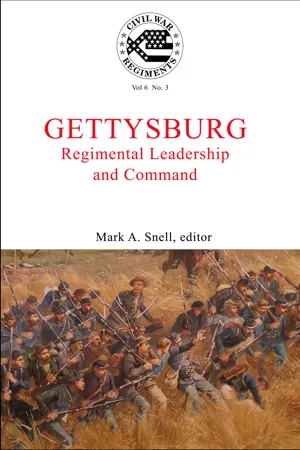
eBook - ePub
A Journal of the American Civil War: V6-3
Gettysburg: Regimental Leadership and Command
- English
- ePUB (mobile friendly)
- Available on iOS & Android
eBook - ePub
A Journal of the American Civil War: V6-3
Gettysburg: Regimental Leadership and Command
About this book
Information
Subtopic
American Civil War HistoryIndex
History“…the scene presented war in one of its most diabolical aspects.”
THE Ground TREMBLED AS THEY CAME
The 1st West Virginia Cavalry in the Gettysburg Campaign

Steven A. Cunningham and Beth A. White
As the third summer of the Civil War began, the 1st Virginia Volunteer Cavalry (U. S.) was headquartered at Fairfax Court House, Virginia as part of Maj. Gen. Julius Stand’s cavalry division. Spirits were high in the Union regiment that had been raised in western Virginia by loyalists in the summer and autumn of 1861. A few weeks earlier, a regimental detachment had thwarted a surprise attack by Maj. John Mosby’s Rangers near Warrenton Junction. The men had been resting when Mosby and his Invincibles charged. Although fighting on foot at a disadvantage, the Union Virginians repulsed the charge and captured several of Mosby’s men.1
“Our men are in the enjoyment of good health, with plenty to eat, and not more duty to do than we are abundantly able for,” wrote First Sergeant William Porter Wilkin of Company F in a June 2, 1863 letter to his friend Dr. J. G. Blair. Wilkin added,
We are looking, however, for lively times and hot work in this department soon. The two great armies of Hooker and Lee, I think from present indications, are not likely to lay much longer and quietly eye each other…certainly something will be done soon.2
Wilkin was correct. General Robert E. Lee, who had defeated Maj. Gen. Joseph Hooker at Chancellorsville in early May, decided to launch his second raid north of the Potomac River. His plan called for the Army of Northern Virginia to move north through the Shenandoah and Cumberland valleys and into Maryland and Pennsylvania, using Confederate cavalry to screen his movements. On June 9, two divisions of Federal cavalry under Gen. Alfred Pleasonton clashed with Gen. J. E. B. Stuart’s cavalry at Brandy Station near Culpepper. The following morning, Lee moved his army westward and into the valleys to begin its march north.3
Federal reconnaissance discovered Lee’s movement, and Hooker’s army left its position on the Rappahannock River to follow the Confederates north-ward, staying between Lee and Washington. Pleasonton’s cavalry was involved in several skirmishes in the pursuit, including Thoroughfare Gap, Upperville, Middleburg, and Aldie.4 On June 19, Hooker ordered Stahel to concentrate his cavalry division for movement to join the Army of the Potomac.5
As the campaign unfolded, the regiment would no longer be known as the 1st Virginia Cavalry, because it was representing a new state. The loyal government of Virginia, which had been established in June 1861 in Wheeling, successfully petitioned Congress and President Lincoln for statehood. After some debate about the constitutionality of such an action, Lincoln signed the proclamation on April 20, 1863. Two months later on June 20, West Virginia became the thirty-fifth state. The regiment thus began its service in the Gettysburg Campaign as the 1st West Virginia Cavalry.6 (To prevent confusion, the title of “West Virginia” will be used throughout this essay, even if the reference is before June 20, 1863.)
The 1st West Virginia Cavalry was organized in Wheeling, Clarksburg, and Morgantown from July 10 through November 11, 1861.7 At that time, the Federal government was not yet recruiting volunteer cavalry regiments.8 Henry Anisansel, a 32-year-old immigrant from Geneva, Switzerland, was commissioned colonel of the regiment on September 7 in Wheeling.9 His lieutenant colonel was Nathaniel P. Richmond, a native of Indiana, who had served as a second lieutenant in the 13th Indiana Volunteer Infantry.10 On September 10, Dr. Henry Capehart was named regimental surgeon. Capehart was originally from Cambria County, Pennsylvania, but had practiced medicine in Bridgeport, Ohio since 1849.11 By the war’s end all three men, as well as Henry’s brother Charles, would command the regiment.
Loyalists in West Virginia were met with enthusiastic support from their neighbors in western Pennsylvania and eastern Ohio, who now had a buffer between them and the Confederate border. The region’s fidelity to the union “did much to attract the sympathy and help of those States to the support of the brave loyalists,” wrote one West Virginia officer.12 The companies of the 1st West Virginia Cavalry were comprised of men from all three states. First Company A was made up of men from Monongalia County, West Virginia and New Creek, which is in Hampshire County, West Virginia. The company was mustered in on July 18, 1861 and became known as “Kelly’s Lancers.”13 Second Company A was recruited throughout West Virginia and included several enlistments from Martinsburg and Charlestown, a region of many more Confederate sympathizers than loyalists.14 Company B was organized in Washington County, Pennsylvania. Men from Clarksburg and surrounding Harrison County, West Virginia were recruited from late August until the end of October for Company C. That company also contained two groups of private cavalry which had been organized in Wood County, West Virginia by Isaiah S. Hill to escort supply wagons for his employer, William P. Rathbone. When the cavalry disbanded, Hill recruited for the 1st West Virginia Cavalry as well as the 10th West Virginia Infantry. Hill was mustered-in as captain of the company.15

Major Charles Capehart
Library of Congress
Company D was organized at both Camp Carlile in Wheeling and East Richland, Ohio, while Company E was organized in Wood County and additional men for the company were recruited in Buckhannon, West Virginia. Men from Taylor County, West Virginia, as well as several Ohio counties along the Ohio River comprised Company F. Company G was organized in Cabell County, West Virginia, but nearly all of its recruits were from southeastern Ohio. Company H was mustered-in at Grafton, West Virginia and included soldiers from Cambria and Washington counties in Pennsylvania. Company L was organized at both Wheeling, West Virginia and Steubenville, Ohio, and Company M was organized in Mason City, Ohio. Company N, which was later designated as Company I, was organized in several towns in West Virginia and Ohio including Clarksburg, West Virginia and Athens, New Lexington and Ashland, Ohio.16
When the regiment entered service, it “was composed of superior material,” wrote one officer, “mostly young men from the farms, experienced horsemen and marksmen, who could break and tame the wildest colt, or pierce the head of a squirrel in the top of the tallest hickory with a rifle bullet.”17 The regiment also included Professor Carl Colby’s silver cornet band, whose members were mounted on white horses.18 The band accompanied the regiment and Colonel Anisansel from Camp Carlile through the streets of Wheeling on September 30 when the ladies of the town presented a flag to Capt. Weston Rowand and the Norton Cavalry of Company K.19
The unit began its service attached to the Cheat Mountain military district in West Virginia. Company A was the first to see action and took part in an engagement at Romney on October 26, 1861. Detachments spent the autumn and early winter of 1861 scouting, supporting infantry in West Virginia and Kentucky, and guarding the Baltimore & Ohio Railroad. Colonel Anisansel even had a brief encounter with Mary Jane Green, a notorious Confederate guerilla, after she was arrested near Sutton for spying on Union troops.20
From January until March 1862, the regiment was attached to Gen. Frederick Lander’s division of the Army of the Potomac.21 Lander was ordered into West Virginia and Maryland to protect the vital Baltimore & Ohio Railroad and the Chesapeake & Ohio Canal following Gen. Thomas J. Jackson’s successes in that region during the winter. Lander’s division was camped near Paw Paw in Morgan County, West Virginia. O...
Table of contents
- Cover
- Title
- Copyright
- Founders
- Contributors
- Contents
- Introduction: Coral Rearzdon
- Comanches on the Warpath: The 35th Battalion Virginia Cavalry in the Gettysburg Campaign: John M. Chapman
- “The Severest Fought Battle of the War”: Charles Wellington Reed and 9th Massachusetts Battery: Edited by Eric A. Campbell
- “The Ground Trembled as They Came”: The 1st West Virginia Cavalry in the Gettysburg Campaign: Steve A. Cunningham and Beth A. White
- Twice Lost: The 8th Louisiana Volunteers’ Battle Flag at Gettysburg: Jerry L. Jones
- “On the March Again at Daybreak”: Major John I. Nevin and the 93rd Pennsylvania Infantry: Edited by Dana B. Shoaf
- “The, Most Notable Event at Gettysburg Since the War”: The Reunion of the Philadelphia Brigade and Pickett’s Division, July 1887: D. Scott Hartwig
- The Continuing Battle of Gettysburg: Near “These Honored Dead”—More Development Lies Ahead: Wlater L. Powell
- Book Reviews
Trusted by 375,005 students
Access to over 1.5 million titles for a fair monthly price.
Study more efficiently using our study tools.
Frequently asked questions
Yes, you can cancel anytime from the Subscription tab in your account settings on the Perlego website. Your subscription will stay active until the end of your current billing period. Learn how to cancel your subscription
No, books cannot be downloaded as external files, such as PDFs, for use outside of Perlego. However, you can download books within the Perlego app for offline reading on mobile or tablet. Learn how to download books offline
We are an online textbook subscription service, where you can get access to an entire online library for less than the price of a single book per month. With over 1.5 million books across 990+ topics, we’ve got you covered! Learn about our mission
Look out for the read-aloud symbol on your next book to see if you can listen to it. The read-aloud tool reads text aloud for you, highlighting the text as it is being read. You can pause it, speed it up and slow it down. Learn more about Read Aloud
Yes! You can use the Perlego app on both iOS and Android devices to read anytime, anywhere — even offline. Perfect for commutes or when you’re on the go.
Please note we cannot support devices running on iOS 13 and Android 7 or earlier. Learn more about using the app
Please note we cannot support devices running on iOS 13 and Android 7 or earlier. Learn more about using the app
Yes, you can access A Journal of the American Civil War: V6-3 by Mark A. Snell, Theodore P. Savas in PDF and/or ePUB format, as well as other popular books in History & American Civil War History. We have over 1.5 million books available in our catalogue for you to explore.