- 448 pages
- English
- ePUB (mobile friendly)
- Available on iOS & Android
eBook - ePub
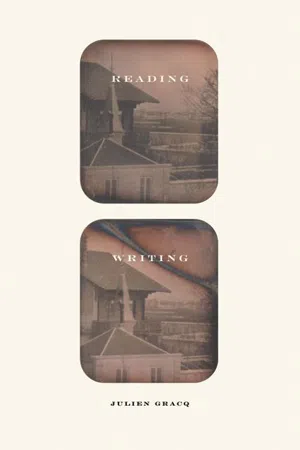
Reading Writing
About this book
This first English-language edition of En lisant en écrivant marked a turning point in the public reception of Julien Gracq. Here he emerged as the ideal critic, a reader who accompanied himself in his reading like a "polite third party."
Every reader is a potential writer and every writer is a reader in actuality. Reading Writing is a subjective history of fiction and poetry and a personal meditation on the links between literature and two visual arts: painting and cinema. Gracq's poetics is founded upon the basic acts of reading and writing and on the relationship between the writer and his language.
Information
Subtopic
Literary CriticismIndex
LiteratureSTENDHAL—BALZAC—FLAUBERT—ZOLA
For every period of art, there is an intimate rhythm, as natural and instinctive for it as the rhythm of breathing can be, and that, much more profoundly than its picturesque exterior, more profoundly even than the key images that obsess it, connects it to being and really causes it to exist: only in this rhythm does the world begin to dance in time for it, only at this pace can it pick up and translate life, the way the needle of a gramophone can only read a record at a certain established and regulated speed. Mozart’s tempo is fundamentally foreign to Wagner’s but maintains a close, vital relationship with Dangerous Liaisons and Manon Lescaut or The Ingenu: The Marriage of Figaro marks the natural conjugation of its specific speed with the literature of its time; similarly, in another era, Wagner’s lento maestoso was paired with Baudelaire and Poe, and all Symbolist literature. An equally essential change in rhythm, a similar slowing down of tempo, probably more important than the modification of material in a novel or the composition of a character—and which perhaps ultimately presides there and commands it—separates, in the history of the novel, Cousin Bette or The Charterhouse of Parma on the one hand, and Madame Bovary on the other. A novelistic superpressure—where pages jostle one another and content swirls like water in a reservoir emptying from the bottom, as if the world were suddenly trying, in literary terms, to evacuate itself entirely through an overly narrow conduit—congests La Comédie Humaine from beginning to end, and confers on Balzac’s works the suffocating density of an agitated world reaching its maximum internal tension. And the airier allegro of The Charterhouse is quicker still: it is a traveler without baggage, unencumbered by voluminous Balzacian carriages. Flaubert’s tempo, in Madame Bovary and also in Education,8 is entirely that of a retrospective journey, of a man looking over his shoulder—therefore, already much closer to Proust than to Balzac, it belongs not so much to the season of unhappy bourgeois consciousness, perhaps, as to one in which the novel slides gradually into nostalgic rumination, its kinetic energy depleted from prospecting what it was as a whole. We should try to reread the great nineteenth-century novels as if they were the hero’s final glimpse over his life, this illuminating encapsulation attributed to the dying in their final seconds: such a fiction is rejected from the start by The Red and the Black and by Old Goriot,9 which rail against it on every page, but constitutes light itself, the only plausible light, in Madame Bovary, with its sluggish, stupefied pauses, where all its scenes, one by one, come to sink into the mire: a life recalled in its entirety, with no real departure, no problematics, without the faintest palpitation of the future. A dreamy, listless tempo with a vaguely dreamlike coloration, that is not solely concerned with a personal constant or a subject’s demands, far from it, but that is the muffled and rhythmic bass of every era, and that, one might say, as their creative poles coincide, makes Sentimental Education an almost totally unrecognizable replica of Lost Illusions.
*
Stendhal sings his own praises in On Love, Memoirs of an Egotist, Henry Brulard, not in The Charterhouse: the novel mercilessly ferrets out the secret and well-protected images from the heart of hearts, because it will draw pitilessly on the author’s last reserves. Even poetry is better at disguise than this. The exceptionally high vital expenditure demanded by the novel is partially responsible (a caricaturist of the end of the last century who left elegant parties at the break of day said it was not until four in the morning that fashionable women’s faces finally relaxed—or gave in). And, above all, no color lasts—on the literary genre most battered by all kinds of bad weather—but the colorfast colors, colors carved from the block. Everything iridescent—even if it is charming, even if it is delightful—pitiless years will scour from the novel, with the friction of a scrubbing brush. A superficial emotion may bring color and life to “fleeting” poetry for a long time (Verlaine’s collections are full of these poems that seem to shimmer like a butterfly wing, and that nevertheless are protected by an invisible fixative). But it cannot animate a novel. The period between the two world wars, and particularly Anglo-Saxon literature (Rosamond Lehmann, Margaret Kennedy, etc.), was rich in novels vibrating, like aeolian harps, with a lively feminine sensibility, but that did not innervate a single central, internal organizing image: in spite of their qualities, their immediate charm, they went the way of yesterday’s snow (and yet Weather in the Streets and The Constant Nymph, which no one seems to remember today, were not minor novels).10 It is not sufficient for a novel to be carried by the heat of a sincere emotion; this emotion has to be able to reanimate the chosen images, stored and dormant, the whole secret, private iconography—and not the documents or “true little facts” collected externally—that alone represent the real archives with which a novelist fills his books. The bad novelist—by which I mean the skilled and indifferent novelist—is the one who tries to bring to life, to animate from the outside and on the whole faithfully, the local color that strikes him as specific to a subject he has judged ingenious or picturesque—the true novelist is the one who cheats, who asks the subject, above all, through oblique and unexpected paths, to give him access once again to his personal palette, knowing full well that in terms of local color, the only kind that can make an impression is his own.
Thus, Flaubert, half the time, is mistaken about the choice of subjects he deals with, because he believes their autonomy must be respected. What self-denial in the act of writing Salammbô! But, in truth, in the eyes of the authentic novelist, it is the subject that must make room for him and not he who should lend life and heat to the development of a foreign body according to its own law.
*
It certainly seems that of the four greats of the French novel—Stendhal, Balzac, Flaubert, and Proust—Balzac seems left behind by criticism today: the quantity of studies on him is no doubt far behind those devoted to each of the three others. The “competition of his works with the registry office,” and the disparity in relation to the traditional novel—a fatally minimal disparity for him, since everyone tacitly sought this sort of novel chiefly in his books—everything that built his glory solidly, undoes him in 1978 among the subtlest literary scholars: the model of the French novel, just as Hugo is the model of poetry, we tend to accord him the same essential function as reference and the same sort of disinterest per se that we accord a yardstick.
And I admit when I have the desire to reopen him, it is primarily for those of his works that could be considered more or less deviant in relation to the type: not Lost Illusions, Cousin Bette, or Eugénie Grandet, but Les Chouans, Lily of the Valley, Béatrix. Rereading the standard Balzac no longer gives me but a moderate pleasure. I am surprised moreover—having just reread An Old Maid—at the differences in quality of this supplier’s product (differences to which Alain, out of piety, once directed us to close our eyes).11 The missteps and chatter of An Old Maid, its buffet-table pleasantries, the outrage and at times parodic inconsistency of the characters (Athanase Granson!) surprised me, on this rereading, so much so that I couldn’t believe my eyes at times, and, furious with myself, almost agreed with Sainte-Beuve’s judgment.
If, as soon as he was published, Balzac had been abundantly and faithfully illustrated, as, for example, Jules Verne was by his publisher Hetzel, if our reading habits did not separate his text from such images any more than Five Weeks in a Balloon or North Against South, it seems at times we would be better able to sense, or more clearly see, the essential Balzacian singularity, which is a hemming in and almost a burying of each character in the hyperbolic network of the material relationships in which he is not simply engaged, as with other realist novelists, but truly swaddled, to the point of being almost inseparable in the end from these encasings, as concentric and tight as an onion skin, encasings that outline, mold, and almost definitively make him exist for us. Encasings that, most intimately, are called clothes, furniture, and home, and, most externally, kinship, relations, trades, business, fortune. People go into ecstasies, and justly so, over the human swarm of Balzacian characters making up the various repertories, but do they imagine (for example) what dreamlike Galeries Barbès, what hyperbolic Manufrance catalog, what accumulation of issues of Intermédiaire des chercheurs et des curieux, what quantity of universal secondhand fur niture could rival the gigantic thrift shop, the colossal flea market, catalogued and described in the thirty or forty volumes of La Comédie Humaine?) There is more than one novel by Balzac—and, above all, we should recognize, more than one second-rate effort—where the essence of the book seems to be not man’s relationship with the world, or man’s relationship with his fellow-man or society, but rather man’s relationship with the moneyed and material intermediary of these great, intimidating entities: Furniture and Real Estate.
*
The light and playful tone with which Stendhal speaks of the conflict of the social classes (l’abbé Pirard at the Marquis de la Mole’s) belongs entirely to the eighteenth century, a century that for Balzac remains as if it never existed. Between them there is not only a mutual exclusion of the space of the novel, but a time lag in the historic moment of the gaze, and, because of this lag, there is a sort of distantness in Stendhal in relation to his narrative that marks his books more intimately perhaps than any other feature. The Red and the Black is certainly Stendhal at his most brilliant, but, at times, it is also as if Laclos or Diderot had been asked, against the grain of chronology, to recount the Restoration. This does not have to do only with tone, the omnipresence of a will for demystification, or generalized skepticism. The opacity and inevitability of the social structure, whose physical weight we feel on each page of Balzac, have in Stendhal no other reality but a semi-fanciful one. We can leave aside The Charterhouse, where money plays no role and where social relations between rich and poor are treated somewhat like those of kings and shepherds in the pastoral novel. But if we take The Red and the Black, for example, we must observe that in spite of the apparent realism of the whole, the two true Balzacian realities, money and social promotion, are treated purely as fairy tales there. In spite of all the calculations of his ambition, money comes to Julien Sorel only in the anonymous form of a mysterious bill of exchange—promotion, by the magical stroke of a no less mysterious summons to see the Marquis de la Mole. Moreover, at no moment in the “arriviste” Sorel’s career is there the slightest relationship between will and results. This is because Balzac, when he is optimistic, is the novelist of planned success, and Stendhal, the novelist of happiness, always more or less the product of a miracle (here, prison). The only social moral to be extracted from his books is that goals serve no purpose, except to communicate the motions through which happiness might present itself obliquely to a life; it is the moral of a class that has “arrived,” that of the witty, cynical, pleasure-seeking court nobles of eighteenth-century salons, with the Marquis de la Mole and Count Mosca their old-fashioned brothers, the two true mentors on the life paths of Julien and Fabrice, respectively.
*
Politics in The Red and the Black. I like the fact that no made-up name is clearly translatable for the historian here (though, more than once, on the topic of conspiracy, one name comes to the tip of the tongue). My principle has been confirmed: in fiction, everything should be fictional: Stendhal even managed to avoid the name of the reigning monarch. A character in a novel, however lifelike he may be, instantly loses his suppleness and freedom if we encounter him in a scene with an actual historical figure, because suddenly he has been linked to an isolated fixed point: for a moment, he is nothing more than a coat hung on a peg. Thus—in Men of Good Will, a novel quite unworthy of The Red—this happens to Gurau or Mionnet, as soon as they make contact with Poincaré or Jaurès.12
An objection, by the way, that has nothing against the historical novel, where authentic characters, by the mere fact of becoming members of the majority party, find themselves automatically fictionalized, in The Three Musketeers as in War and Peace. This spontaneous mutation of substance is made obvious by a novel like Dumas’s Queen Margot, where there are almost no invented characters: the few remaining fictional figures, in the midst of their fully conquered novelistic freedom, suddenly make things awkward for Catherine de Médicis or the Duke d’Alençon.
*
The loges of La Scala, San Carlo in Naples, the Argentina Theater in Rome—rented for the year or granted for life, carpeted, draped, furnished, and canopied in the taste of their tenants—were Stendhal’s true second homes in Italy; but, contrary to our customs, people left the glacial and unfurnished grand palaces of that era at a fixed hour to find the promiscuity of shared transports and the warmth of proximity to others.
*
In his processes of magnification, Balzac never dismisses the preoccupations of the caricaturist: faithfulness to the real, swiftness, divination, isolation of the decisive feature, but also, distortion and systematic accentuation for effect. His (scarcely inferior) counterpart in the category of the plastic arts is indeed Daumier, a great painter, but halfway between Rembrandt the engraver and the Charivari.13 In reality, just as a writer like Colette in our time had privileged and at times distorted relationships with a certain right-bank café society all her life (guided by Willy),14 whose sense of elegance, art, innovation, and success had very little in common with the preoccupations of the circles that, say, Gide or Claudel moved in, in order to grasp the nature of Balzac’s ambitions, we would have to surround him with a whole milieu deeply marked by the very emphatic, broad strokes of journalism (which fascinated him), and by the distorting pencil of Daumier, Guys, or Gavarni.15 A world for whom the sign of success is not the work of art painstakingly and slowly elaborated in private, but the punch that instantly makes the Parisian echo chamber resonate—not the exquisite and shadowy marginality of Stendhal, but the flashy career of George Sand, or the dazzling ascent of Thiers carried by the rocket of the National.16
*
In the end, it doesn’t matter whether you prefer Stendhal to Balzac or to Flaubert, or to anyone else, or whether you find his novel production meager, and, moreover, colonized, garlanded everywhere like a forest by its creeping vines, by arabesques without beginning or end, the inexhaustible flourish of his ego; his singularity is that he delivers to his readers an era and country completely in the margins of both chronology and geography, an Icaria whose consonances alone are Italian, floating somewhere in the displaced time between Garibaldi and Césare Borgia, flourishing not by trade, industry and commerce, but sole...
Table of contents
- Cover
- Title Page
- Copyright
- Contents
- Literature and Painting
- Stendhal—Balzac—Flaubert—Zola
- Landscape and the Novel
- Proust Considered as an End Point
- The Novel
- Writing
- Reading
- Readings
- Literature and History
- Germany
- Literature and Cinema
- Surrealism
- Language
- Work and Memory
- Dwellings of Poets
- Literary Centuries
- Notes
Trusted by 375,005 students
Access to over 1.5 million titles for a fair monthly price.
Study more efficiently using our study tools.
Frequently asked questions
Yes, you can cancel anytime from the Subscription tab in your account settings on the Perlego website. Your subscription will stay active until the end of your current billing period. Learn how to cancel your subscription
No, books cannot be downloaded as external files, such as PDFs, for use outside of Perlego. However, you can download books within the Perlego app for offline reading on mobile or tablet. Learn how to download books offline
Perlego offers two plans: Essential and Complete
- Essential is ideal for learners and professionals who enjoy exploring a wide range of subjects. Access the Essential Library with 800,000+ trusted titles and best-sellers across business, personal growth, and the humanities. Includes unlimited reading time and Standard Read Aloud voice.
- Complete: Perfect for advanced learners and researchers needing full, unrestricted access. Unlock 1.5M+ books across hundreds of subjects, including academic and specialized titles. The Complete Plan also includes advanced features like Premium Read Aloud and Research Assistant.
We are an online textbook subscription service, where you can get access to an entire online library for less than the price of a single book per month. With over 1.5 million books across 990+ topics, we’ve got you covered! Learn about our mission
Look out for the read-aloud symbol on your next book to see if you can listen to it. The read-aloud tool reads text aloud for you, highlighting the text as it is being read. You can pause it, speed it up and slow it down. Learn more about Read Aloud
Yes! You can use the Perlego app on both iOS and Android devices to read anytime, anywhere — even offline. Perfect for commutes or when you’re on the go.
Please note we cannot support devices running on iOS 13 and Android 7 or earlier. Learn more about using the app
Please note we cannot support devices running on iOS 13 and Android 7 or earlier. Learn more about using the app
Yes, you can access Reading Writing by Julien Gracq in PDF and/or ePUB format, as well as other popular books in Literature & Literary Criticism. We have over 1.5 million books available in our catalogue for you to explore.