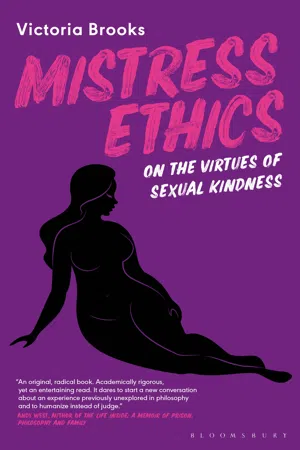
The figure of the mistress is undoubtedly controversial. She provokes intense reactions, ranging from fear, to disgust and revulsion, to excitement and titillation, to sadness and perhaps to some, love. The mistress is conventionally depicted as a threat to moral living and someone whose sexuality is considered defective and toxic. Of course, she is a woman that you would not have as your friend, and certainly not your wife, since her ethical sense, if she even has one, is dubious at best. This book subverts these traditional judgements and offers an unflinching look at the lived experience of the mistress. Here she is recast as a potentially loving, free, intimate 'other' woman.
Drawing upon feminist philosophy, contemporary sexual ethics and the current cultural moment of #MeToo, Mistress Ethics moves beyond a narrative of infidelity, conventional judgment, the safeguarding of monogamy and conventional heterosex that permeates our society. It asks what happens when we let go of our insecurities, judgments and moralistic relationship philosophies and opt, instead, for an ethics of kindness. This kindness – underpinned by engaging with those deemed 'other' and learning from mistresses, both straight and queer – will teach us new ways of thinking about ethics and sex, and reveal how we have better sex, and how we can be better to each other.
- 200 pages
- English
- ePUB (mobile friendly)
- Available on iOS & Android
eBook - ePub
About this book
Information
1
What is sexual kindness?
From Grand Central Station to new worlds
Elizabeth Smart is a superhero. Her prose poetry book By Grand Central Station I Sat Down and Wept is a semi-fictional account of Smart’s eighteen-year affair with the married poet George Barker, with whom she had four children (although in the novel these pregnancies are distilled as one). My copy is on my desk, looking at me accusingly, as I begin to write. It is a rare piece of writing, remarkable for its time, in that Barker is barely described and we hear a story entirely from a Mistress. My copy has been inscribed with a poem from a married lover, from whom this book was a gift at the start of a toxic and abusive affair. The book is radical and free, but this was an unkind gift, since it was prophetic. Save for the four children and the length of the affair, this lover of mine was, in all but name, George Barker, and I, Smart. And I too, sat at many a station and wept. Not at stations as grand as Grand Central, but still. As I will soon make clear in this book, Smart is an archetypal Mistress. This is because she gives and gives, and for that, she is punished by the guardians of law and society (both actual and self-appointed): ‘They eye me. They bore a hole in my wedding finger because it is bare.’1 She is also punished by her lover who leaves her pregnant, and remains with his wife. So, through all this, what is it that keeps her surviving, fighting and writing?
Smart shows us that as a Mistress, one does not receive kindness from the world. The kindness that she needed was from both her lover and from those she encountered. She needed them to see her in the fullness of her humanity and sexuality, outside of the structures that would give her virtue. She needed them to see her not as a ‘non-wife,’ not as a friend, but in her glory as a powerful outsider, with traumas often thought of as deserved, and joys that are not. As a Mistress, she must not be acknowledged as deserving such humanity, nor indeed as giving it, since then the world might be required to revise some deeply treasured beliefs about men, monogamy, marriage and power. Perhaps even more fearfully, the world might see what it does to Mistresses, while also seeing the beauty and potential of their desire and sexual kindness. That could be an unbearable combination. The Mistress is a Witch whose spell is sexual kindness, and as we know from Smart, such Witches are punished, ‘just for wearing the lineaments of gratified desire’.2 A Mistress can overturn, initiate and even conjure new worlds and new lives; sexually, structurally and morally. This is a superpower for which women tend to be burnt, figuratively and literally, at the stake.3
In The Parable of the Sower, a dystopian novel written by science-fiction pioneer Octavia Butler, the protagonist, Lauren, has a superpower similar to that of the Mistress, that of ‘hyper empathy’. This power allows Lauren to not only viscerally share emotions and sensations with others but also generate intergalactic visions of not just life, but of philosophy and morality.4 This conception of kindness is world-changing and also burgeons throughout Smart’s writing about Barker’s wife, whom she describes as her ‘gentle usurper’ and usurped, as killer and killed. Smart also gives this kindness to the world, by relentlessly turning inward and telling her revolutionary story. Her kindness is not reciprocated, yet it has many dimensions, all of them troubling and constantly offering ways to be kind to someone who has been forever an outsider. Smart is exhausted from it, which can be felt through every word of the short text. In the concluding chapter, as the final devastation hits that George has deserted her while she is pregnant with his child, Smart writes: ‘By Grand Central Station I sat down and wept: I will not be placated by the mechanical motions of existence, nor find consolation in the solicitude of waiters who notice my devastated face.’5 Smart is raging. While being pulled by the world and its matters and rituals, she is also forced to hide her pain. It is a world that is the wrong shape to receive her story, a world that would prefer she kept quiet, and carried on: ‘Well, it’s too late to complain, my honey-dove. Yes, it’s all over. No regrets. No postmortems.’6 Let’s give Smart the postmortem. Now she, now the Mistress, has our attention; let’s look deeper into this sexual kindness that surrounds Mistresses like her. What we will find is a rare superpower that combines sex with kindness, sex with ethics, and the erotic with the revolutionary.
Sex and kindness: rare bedfellows?
We have seen from Smart’s story that kindness of any kind is rarely bestowed upon the Mistress. The Mistress might even doubt that she is entitled to kindness, given how she can be treated. In Signs for Lost Children, a novel about abusive intimate bonds between mothers and daughters, Sarah Moss reminds us of the sad perception, and often lived truth, particularly for women, that kindness rarely ‘finds sexual expression’.7 Although the Mistress might often testify to this as truth since she is rarely the recipient of kindness – far from it, she is often the victim of abuse and cruelty; she can point incisively to its occurrence, necessity and sexual power. She is often an expert at deploying it. She can show where it is required, and what systems are currently in place to prevent it. But what is it? Let me first be clear about the type of kindness that sexual kindness is not.
Sexual kindness is not niceness
As Kate Manne reminds us in Down Girl, ‘kindness is not kindness, if it doesn’t come from having the beneficiary’s best interests at heart, as one of its motivating factors’.8 Yet, this must not be in service of a power serving ‘good’ such as loyalty. In other words, sexual kindness is not manipulation for the benefit of the person pretending to give it. Niceness could also be considered to be the bare minimum, if niceness means treating a person whom you want to have sex with as a human being. But actually, niceness is not kind. It is faux-kindness. Kindness is not lavishing roses, gifts and compliments; it is not manipulation of feeling, and it is not being kind despite thinking someone is not worthy of your attention. Sexual kindness is also not requiring a person to have sex with someone because that person says or indicates that they are entitled to it, or acts as though they are entitled to it. Sexual kindness is also not consent. Consent is a legal concept that says both parties must agree to sex. Sexual kindness is much more than basic agreement, which ought to be the bare minimum.
Sexual kindness does not excuse racism. Sexual kindness is not an excuse for homophobia, transphobia, biphobia or ableism. Sexual kindness is not using/abusing someone but being polite about it and occasionally chucking in an ‘I love you’ to make yourself seem kind. Sexual kindness is not seeking out (consciously or not) the vulnerability within a person and using fucking as a simulacrum for giving care. It is not judgement of sexual practices based on your own moral sense of superiority. These acts or ways of using ‘kindness’ are not sexual kindness at all, but the very opposite: they are sexual cruelty. Sexual kindness bursts right through any of these forms of weaponized niceness. Sexual kindness bursts through shackles of propriety and the founding tenets of Western philosophy, morality, society and law, and sees and cares for the whole of the body, how it has suffered and how it can be pleasured.
Sexual kindness is not legal
Joseph Story, one of America’s most famous jurists, described the law as a ‘jealous mistress’. He went on to say that such a Mistress requires constant courtship and ‘is not to be won by trifling favours, but by lavish homage’.9 Story is both right and wrong. The law is indeed jealous, possessive and requires not only lawyers but everyone to surrender their constant vigilance and respect. But the law is not a Mistress. The law is the opposite of a Mistress, since the law is never kind. Law is the foundation of that very institution that the Mistress threatens, that is so dear to Western morality: marriage. Law is the text that tells the story that adultery is unlawful; that is, in the heteronormative sense that for a man or woman who is married to have penis in vagina sex with another man or woman is a ground for divorce.10 And so it has been for centuries. The law is not only inside our bodies but between our sheets. Both invited and uninvited presence, the law tells us what we can have and what we cannot, under the guise of protection, in the full knowledge that as humans, we cannot resist forbidden fruit. As French philosopher Michel Foucault argued, by virtue of telling us what desires are ‘right’, the law pushes us to transgress, or to desire what we cannot, or should not have.11 Simultaneously, we are taught to renounce temptation and treat it as that which makes us impure along the path to evil.12 It is not hard to see why revilement of the Mistress as temptress is so engrained within us. She symbolizes both our sexuality and the path towards the punishment that we believe we deserve – and boy, are we angry about it? The law is much more like a jealous husband.
The law, in Smart’s story, conceals a multitude of sins. The affair is consensual. And thus, concludes the law’s concern for Smart. Remember, consent is underpinned by the idea of agreement, and it is impossible to argue that Smart did not agree to her relationship with Barker. But this does not mean that she is unharmed, nor does it mean that her case does not need investigating.
Yet we see the consistent and persistent devaluation of her sexual being during her affair, and along with it, we are led to witness the law’s disdain for the Mistress. Mistresses can be treated very badly. Further, though, Mistresses can be Mistresses against their will. As we know, for the law, Mistresses, like wives, are property. The horror of this idea is shown to spectacular effect in Margaret Atwood’s speculative dystopian The Handmaid’s Tale. Offred is an ‘official’ (non-consensual) Mistress, whose function, with the (coerced) complicity of the infertile wife, is to have sex with the husband and to produce children, and ultimately to be generally and sexually abused.13 Atwood’s tale might be futuristic and dystopian, but it is also a commentary on the present. The chill can also be felt in the similarity between Atwood’s tale and Smart’s. Both situations are different, both in time and in space, as well as context, but in both novels we find painful accounts by women controlled (and so inside the law) yet outside of the law’s protection. By virtue of her existence, the Mistress undercuts the law, and shows its insider/outsider distinctions to be false.
Enslaved Mistresses
Women have historically been enslaved into being Mistresses, and it is the law that has allowed this to happen. This is the law at its cruellest, most oppressive, and also its most revealing. Mistresses have been made into the property of enslavers and husbands alike. As we know, the law has always allowed husbands to own their wives. For example, English law only abolished the marital rape exception (the law stating that a man cannot rape his wife since she is his property and provides irrevocable consent by virtue of marriage) in 1991.14 Yet maintaining the idea of women as property is not only to do with sexual access to women’s bodies. When women are property, they are also ‘under control.’ This is not happening in the shadows of a dystopian world but in plain sight. Angela Y. Davis, one of many Black women who taught us how to be radical in reclaiming our bodies, wrote, ‘as long as women are viewed as the sexual property of their present or future husbands, their ability to bring about the institutional transformations that will lessen the burden of sexist oppression will be severely limited’.15
To understand how the law allows men to own Mistresses as well as wives, it is necessary to draw attention to an important person in American history, Sarah (Sally) Hemings, who is widely acknowledged to have been the enslaved Mistress of Thomas Jefferson.16 Since racist Jefferson (who believed Black people to be inferior) and his descendants have long denied this relationship, there are little in the way of accounts, particularly from Sally herself. In fact, there are little in the way of stories told by any enslaved Mistresses; rather, available reports focus on the white oppressor and their efforts to silence these stories. Stories generally of Black women’s sexuality, independent of colonial narratives, are only starting to become visible in the mainstream. The telling of these stories is fraught with danger for the authors, who face colonial legacies of censorship (by white feminism too) in the form of stereotyping, hyper-sexualization and misogynoir.17 The incredulity faced by Mistresses is bad enough, but the incredulity towards a woman who is both Black and a Mistress? Here we find the hearts of white feminism aflame. The fire is fuelled by colonial entitlement, proprietorship over victimhood and the enforcement of the colonial violence of the gender binary.18 Colonial power has possessed Mistresses in far more violent ways than it has possessed wives, and the fear of hearing this truth runs deep.
Enslaved Mistresses have had their status as dehumanized and desexualized enshrined by law, which is no surprise since the idea of people as property, the gender binary19 and ‘who could wed and who could bed’ are concepts foundational to colonialism.20 The law determines who can be property, who can be controlled and who can be punished. Enslaved Mistresses, as property, would not have been able to give or refuse consent to sex, since to do so is an attribute of someone who has legal personhood, and not a person who is property, and certainly not a person who is illegitimate property. The protections of being property in the form of being a wife are a respectable (white) woman’s privilege, which ensures the domination and subordination of Black women.21
Keeping Mistresses
Throughout the enslavement of people, a Black woman would not have been able to consent, since she was denied personhood at law. Post-abolition and into the time of writing, a husband’s Mistress would have been able to technically refuse to consent, though given the bigoted and sexist attitudes of judges and juries, it is unlikely that any case of sexual assault or rape brought by her would be sympathetically received. Her personhood would be more insidiously denied, through rape myths, and a belief that a Mistress is always free to do what she wants, and therefore to consent. The husband might ‘take’ a wife from her personhood, but he might also ‘keep’ a Mistress from her personhood.22
The idea of a Mistress as an illegitimate form of property is also present in eighteenth-century literature. Novels such as the eighteenth-century epistolary Pamela; or Virtue Rewarded by Samuel Richardson...
Table of contents
- Cover
- Halftitle Page
- Title Page
- Dedication Page
- Contents
- Acknowledgements
- Prologue
- 1 What is sexual kindness?
- 2 Whore! Wife! Pervert! Mother! Who is a Mistress and who has a Mistress?
- 3 Fearing the queering: Bisexual, queer and kinky Mistresses
- 4 Grimy hotels and dungeons to satin pillows: What’s the sex like?
- 5 Three’s a crowd and more than ‘each other’: Why is the Mistress wrong?
- 6 The Mistress Manifesto
- Notes
- References
- Index
- Imprint
Trusted by 375,005 students
Access to over 1.5 million titles for a fair monthly price.
Study more efficiently using our study tools.
Frequently asked questions
Yes, you can cancel anytime from the Subscription tab in your account settings on the Perlego website. Your subscription will stay active until the end of your current billing period. Learn how to cancel your subscription
No, books cannot be downloaded as external files, such as PDFs, for use outside of Perlego. However, you can download books within the Perlego app for offline reading on mobile or tablet. Learn how to download books offline
Perlego offers two plans: Essential and Complete
- Essential is ideal for learners and professionals who enjoy exploring a wide range of subjects. Access the Essential Library with 800,000+ trusted titles and best-sellers across business, personal growth, and the humanities. Includes unlimited reading time and Standard Read Aloud voice.
- Complete: Perfect for advanced learners and researchers needing full, unrestricted access. Unlock 1.5M+ books across hundreds of subjects, including academic and specialized titles. The Complete Plan also includes advanced features like Premium Read Aloud and Research Assistant.
We are an online textbook subscription service, where you can get access to an entire online library for less than the price of a single book per month. With over 1.5 million books across 990+ topics, we’ve got you covered! Learn about our mission
Look out for the read-aloud symbol on your next book to see if you can listen to it. The read-aloud tool reads text aloud for you, highlighting the text as it is being read. You can pause it, speed it up and slow it down. Learn more about Read Aloud
Yes! You can use the Perlego app on both iOS and Android devices to read anytime, anywhere — even offline. Perfect for commutes or when you’re on the go.
Please note we cannot support devices running on iOS 13 and Android 7 or earlier. Learn more about using the app
Please note we cannot support devices running on iOS 13 and Android 7 or earlier. Learn more about using the app
Yes, you can access Mistress Ethics by Victoria Brooks in PDF and/or ePUB format, as well as other popular books in Philosophy & Gender & The Law. We have over 1.5 million books available in our catalogue for you to explore.